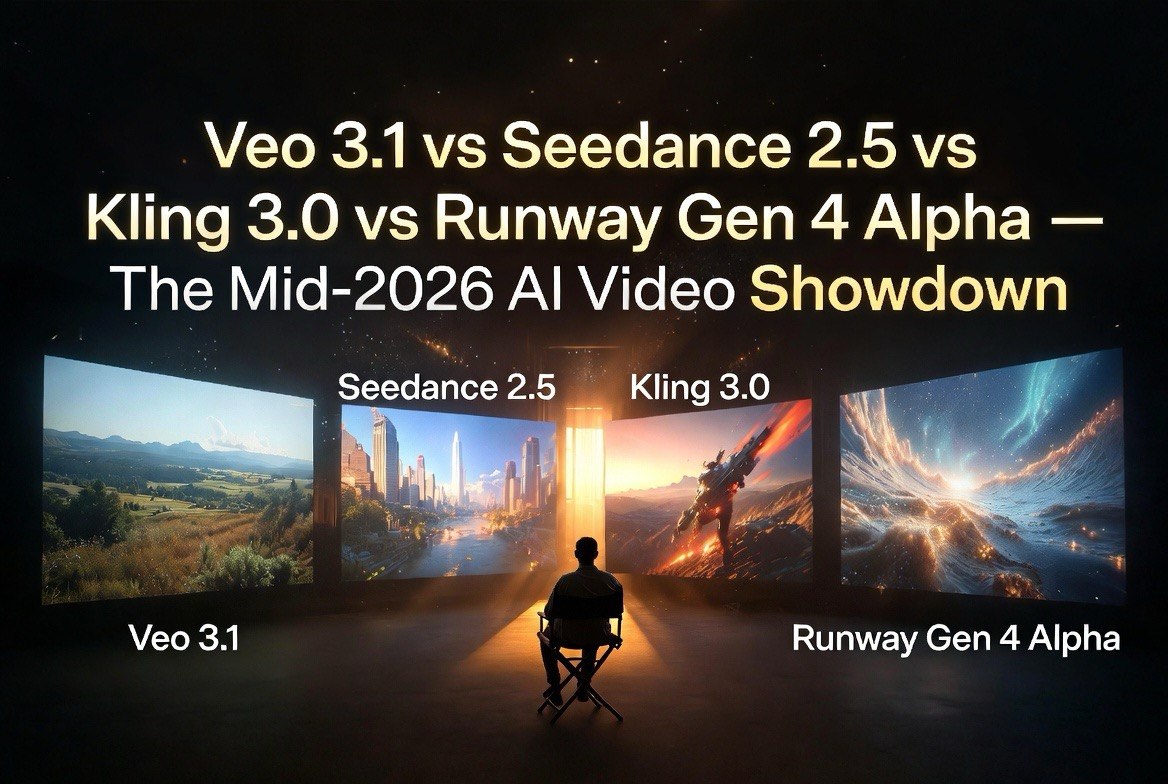
Veo 3.1 vs Seedance 2.5 vs Kling 3.0 vs Runway Gen-4 Alpha — The Mid-2026 AI Video Showdown
Get The Faceless YouTube Blueprint — Free
The exact AI tool stack and workflow used to build a faceless YouTube channel from zero.
Veo 3.1 vs Seedance 2.5 vs Kling 3.0 vs Runway Gen-4 Alpha — The Mid-2026 AI Video Showdown
⚡ Expert Summary: The AI video generation landscape has shifted dramatically in mid-2026. Google DeepMind’s Veo 3.1 leads on photorealism and prompt adherence. Seedance 2.5 dominates in creative stylization. Kling 3.0 is the speed champion. And Runway Gen-4 Alpha has the most mature creative toolset. Here is the head-to-head comparison every video creator needs to make the right choice right now.
If you are a video creator in mid-2026, you have four legitimate options for AI video generation. That is four more than you had two years ago. But having choices does not make the decision easier.
Each of the four major platforms — Google DeepMind Veo 3.1, Seedance 2.5, Kling 3.0 by Kuaishou, and Runway Gen-4 Alpha — has taken a different approach to the same problem. Understanding those differences is the difference between spending hours fighting a tool and spending those hours creating.
Here is the head-to-head comparison based on real creator testing, technical benchmarks, and practical workflows. If you are trying to decide where to spend your time and budget in mid-2026, this breakdown will help you make the right call for the type of content you actually produce.
DeepMind Veo 3.1 — The Photorealism King
Veo 3.1, released by Google DeepMind in April 2026, has become the default choice for creators who need their AI footage to look indistinguishable from real video. Its strength is in physics simulation — water flows naturally, fabric drapes correctly, shadows follow light sources accurately.
What it does best:
Cinematic landscape shots, product demonstrations, architectural visualization, and any scene where realism matters above all else. Veo 3.1 handles reflections, translucency, and complex lighting better than any competitor. Its understanding of how objects interact — a glass shattering on concrete, rain hitting pavement, smoke dispersing in wind — is visibly superior.
Resolution and output: Up to 4K output at 24 or 30 fps. Generation times are the slowest of the four — expect 5 to 8 minutes for a 30-second 1080p clip. The raw quality is worth the wait for professional work.
The catch: Veo 3.1 has the weakest creative stylization. It tries to make everything look real. If you want something painterly, stylized, or animated, Veo 3.1 will fight you. DeepMind’s $75 million partnership with A24 studio signals they are aware of this gap and working on it, but for now, Veo is for realism.
Seedance 2.5 — The Creative Edge
Seedance 2.5 takes the opposite approach. Where Veo chases reality, Seedance chases aesthetic. Its stylization engine allows creators to define a visual mood — film grain levels, color grading, brush texture — and have the AI maintain that style consistently across multiple shots.
What it does best:
Music videos, brand content, social media ads, and any project where visual style matters more than realism. Seedance 2.5 excels at maintaining a consistent aesthetic across different scenes, which is critical for branded content series and multi-shot narratives.
Resolution and output: Up to 1080p at 30 fps. Seedance has not yet cracked 4K, which limits it for cinematic work. Generation speed is moderate — 3 to 5 minutes for a 30-second clip.
The catch: Photorealism is not Seedance’s game. If you need a scene that looks like it was shot on an Arri Alexa, choose Veo. Seedance scenes look good, but they look artificially good — optimized for visual appeal rather than natural accuracy. For short-form social content, that is often an advantage. For premium advertising, it can be a limitation.
Kling 3.0 — The Speed Champion
Kuaishou’s Kling 3.0 has carved out the speed niche. While Veo and Seedance take minutes per clip, Kling 3.0 generates usable video in 30 to 90 seconds. That speed makes it the go-to tool for real-time content workflows — live events, breaking news, rapid iteration.
What it does best:
Rapid prototyping, bulk content generation, social media at scale, and any workflow where iteration speed matters more than pixel-perfect quality. Kling 3.0 is also the most affordable option on a per-generation basis, making it viable for high-volume creation.
Resolution and output: Up to 1080p at 24 fps. Quality is noticeably below Veo and Seedance — fine for social media thumbnails and short clips, but not suitable for premium production. Motion coherence is the weakest of the four, particularly with fast-moving subjects.
The catch: Speed comes at a quality cost. Kling 3.0 exhibits more artifacts, less coherent motion, and weaker physics than its competitors. For creators who need polished footage, it is a prototyping tool, not a final-output tool.
Runway Gen-4 Alpha — The Creative Suite
Runway Gen-4 Alpha is not just a video generator — it is a full creative suite with video editing, compositing, and inpainting built in. While its raw generation quality sits between Kling and Seedance, its toolset makes it the most versatile option for creators who want to do everything in one platform.
What it does best:
End-to-end video production. You can generate a clip, extend it, edit specific frames, add effects, and composite multiple generations — all without leaving Runway’s interface. Gen-4 Alpha also has the most mature text-to-video controls, with precise shot-by-shot prompts and scene transition management.
Resolution and output: Up to 1080p at 30 fps. Generation quality has improved significantly from Gen-3 but still lags behind Veo 3.1 for realism and Seedance 2.5 for stylization. Generation time is 2 to 4 minutes per clip.
The catch: The output quality ceiling is lower than the specialists. For a creator who needs polished, high-end footage and does not need the editing tools, Veo or Seedance is a better choice. Gen-4 Alpha wins on workflow, not on raw quality.
How They Compare Side by Side
Here is the practical breakdown for creators deciding between them in mid-2026:
Choose Veo 3.1 if your priority is photorealism and you are producing premium content — commercials, cinematic sequences, product showcases. Accept slower generation in exchange for output that can stand next to traditionally filmed footage.
Choose Seedance 2.5 if your priority is visual style and you are creating branded content where aesthetic consistency matters more than realistic physics. Seedance is the best tool for maintaining a signature look across a campaign.
Choose Kling 3.0 if your priority is speed and volume — rapid prototyping, bulk social content, real-time needs. Understand that you will sacrifice quality and may need to refine outputs.
Choose Runway Gen-4 Alpha if your priority is workflow — you want one platform for generation, editing, and compositing, and you value control and iteration over peak output quality.
What the Benchmark Tests Actually Show
Independent benchmark testing from AI video analysis sites in May and June 2026 provides concrete data beyond subjective quality impressions. The numbers confirm the platform positioning.
These numbers matter because they translate directly to time spent. Lower adherence means more re-generations, more prompt refinement, and more post-production work to fix mismatches.
Prompt adherence: Veo 3.1 scores highest at approximately 87% adherence — meaning the generated video matches the prompt description 87% of the time. Seedance 2.5 follows at 82%, Runway Gen-4 Alpha at 78%, and Kling 3.0 at 71%. Veo’s lead here reflects DeepMind’s investment in training on high-quality captioned video data rather than web-scraped content.
Motion coherence: This measures whether objects move naturally from frame to frame without morphing or flickering. Veo 3.1 leads again, particularly in scenes with complex motion — running water, moving vehicles, crowd scenes. Seedance 2.5 matches Veo for slow, stylized motion but falls behind on fast action. Runway Gen-4 Alpha excels at scene-to-scene transitions. Kling 3.0 struggles with fast motion coherence, which limits its use for action content.
Generation cost per clip: Kling 3.0 is the cheapest by a wide margin at roughly $0.03 per generation for 720p output. Seedance 2.5 runs $0.08 to $0.12 per generation. Runway Gen-4 Alpha costs $0.15 to $0.25. Veo 3.1 is the most expensive at $0.30 to $0.50 per generation through Google’s Vertex AI platform. The price difference narrows significantly when factoring in re-generations — a platform with lower prompt adherence requires more iterations to get a usable output.
For a creator producing 100 video clips per month, total monthly AI generation costs range from $3 (Kling-only) to $50 (Veo-only). The hybrid workflow approach typically costs $15 to $30 per month across platforms.
The Practical Workflow
The most efficient creators in mid-2026 are not choosing one platform. They are combining them. A typical professional workflow looks like this:
- Prototype concepts in Kling 3.0 — fast and cheap iteration
- Refine selected shots in Seedance or Veo — higher quality for final output
- Edit and composite in Runway Gen-4 Alpha — leverage the toolset, generate missing elements
- Bring everything into traditional editing software for final assembly
This stack covers every scenario. The upfront cost of learning four tools is offset by dramatically better output in every category. The creators doing this well are producing AI-generated video that non-experts cannot distinguish from traditionally filmed content.
Where the Market Is Headed Next
The AI video generation market in mid-2026 is still early enough that the leaderboard changes every few months. Veo 3.1 launched in April and immediately reset expectations for realism. Seedance 2.5 answered with better stylization tools. The cycle is accelerating.
Several trends visible in mid-2026 will reshape this comparison by the end of the year. Veo’s $75 million partnership with A24 indicates DeepMind is investing in cinematic creative tools that could close the stylization gap with Seedance. Runway’s steady release cadence suggests Gen-4 Final will arrive within months with improved quality. Kling’s parent company Kuaishou is rumored to be developing a premium tier that sacrifices speed for higher output resolution.
The convergence point is visible but not yet reached. Each platform currently has clear strengths and trade-offs. The creator who chooses one tool over another is making a real sacrifice in some dimension. The platforms that first deliver on all three axes — quality, speed, and toolset — will consolidate the market. Until then, using multiple platforms is not a luxury. It is the only rational strategy.
The Bottom Line
AI video generation has passed the “is it usable?” threshold and is now in the “which tool for which job?” phase. The answer matters more than it did six months ago. Choosing the wrong platform for a project means wasted time, frustrated iterations, and compromised quality.
Veo 3.1 is the realism leader. Seedance 2.5 is the stylization leader. Kling 3.0 is the speed leader. Runway Gen-4 Alpha is the workflow leader. Matching the tool to the job is the skill that separates professional creators from hobbyists in the mid-2026 AI video landscape.
Frequently Asked Questions
Which AI video generator is best for realism in 2026?
Google DeepMind’s Veo 3.1 leads on photorealism with the best physics simulation, lighting accuracy, and 4K output. It excels at cinematic landscapes, product demos, and any scene where footage needs to look indistinguishable from real video.
What is the fastest AI video generator?
Kuaishou’s Kling 3.0 is the speed champion, generating usable clips in 30 to 90 seconds. It is ideal for rapid prototyping and bulk content but has the lowest output quality of the four leading platforms.
Should I use multiple AI video generators together?
Professional creators are combining platforms — prototyping in Kling 3.0, refining in Veo 3.1 or Seedance 2.5, and editing in Runway Gen-4 Alpha. This stack approach produces dramatically better output than relying on any single tool.
How does Seedance 2.5 compare to Veo 3.1?
Seedance 2.5 prioritizes creative stylization and aesthetic consistency over realism, making it the best choice for branded content, music videos, and social media ads. Veo 3.1 is the superior choice when photorealism matters. Seedance currently maxes out at 1080p while Veo outputs 4K.

About Barak Schurr
Barak Schurr is a serial entrepreneur who built and exited a major ticketing platform before turning his attention to AI and content. He runs three AI-focused research sites and writes about the tools, workflows, and strategies that let solo creators build real channels — without a crew, a studio, or a Hollywood budget.
Email: [email protected]
More from the Barak Schurr Network