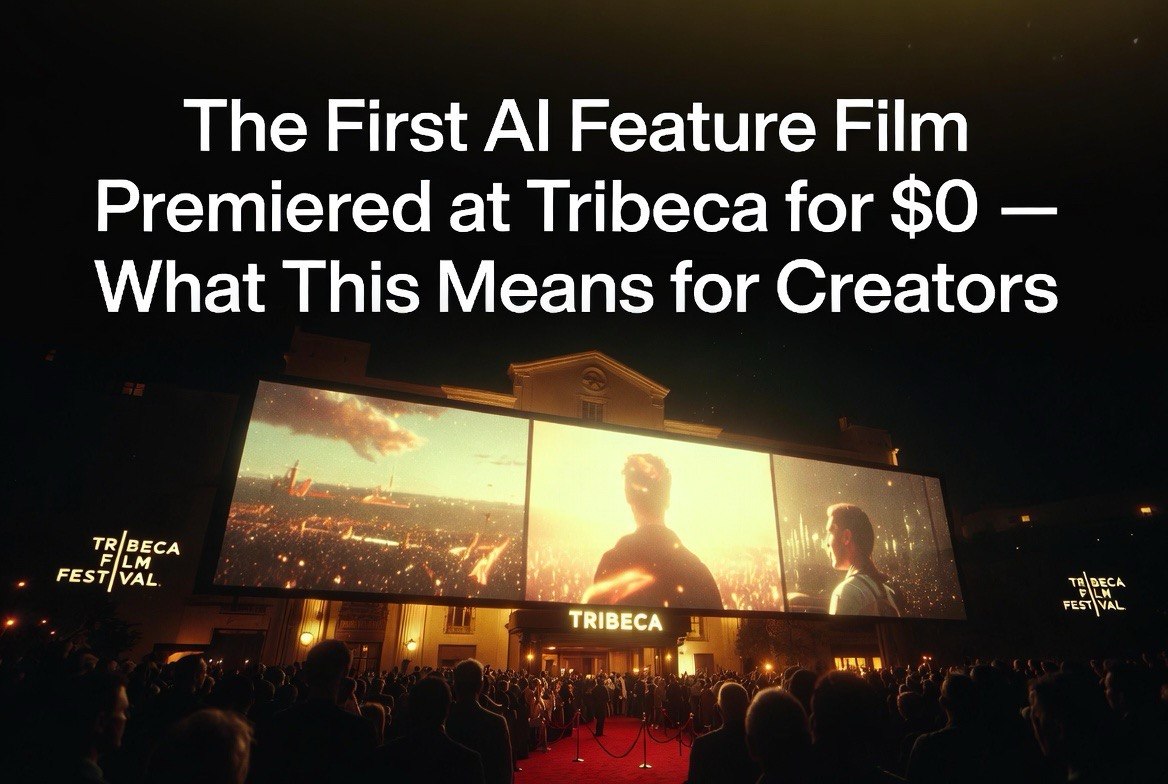
The First AI Feature Film Premiered at Tribeca for $2,000 — What This Means for Creators
Get The Faceless YouTube Blueprint — Free
The exact AI tool stack and workflow used to build a faceless YouTube channel from zero.
The First AI Feature Film Premiered at Tribeca for $2,000 — What This Means for Creators
⚡ Expert Summary: The feature-length live-action AI film “Dreams of Violet” premiered at the Tribeca Film Festival in June 2026 — the first AI-generated feature to screen at a major festival. Made for approximately $2,000 using a combination of Kling 3.0, Seedance 2.0, Pika, and ElevenLabs, the film proves that the barrier to feature-length production has dropped to consumer-level budgets. For independent video creators, this changes the calculus of what is possible.
A film made for $2,000 just premiered at Tribeca. Not a short. Not an experimental art piece. A 94-minute feature-length narrative film, created almost entirely with AI video generation tools, screening at one of the most prestigious film festivals in the United States.
Dreams of Violet, directed by filmmaker Marcus Andrews, debuted at the 2026 Tribeca Film Festival and represents a watershed moment for AI video creation. PetaPixel reported that the film was produced with a budget of approximately $2,000 — roughly 0.01% of the average independent feature film budget — using a multi-model AI pipeline that any creator with a laptop and a subscription could replicate today.
The Tech Stack Behind Dreams of Violet
Andrews documented the production pipeline, and it reads like a checklist of 2026’s best AI video tools:
- Kling 3.0: Primary text-to-video model for establishing shots, action sequences, and scenes requiring complex motion
- Seedance 2.0: Character consistency across scenes — used for close-ups and dialogue sequences where visual continuity mattered most
- Pika: Style transfer and atmospheric effects — dream sequences and transitions
- ElevenLabs: Voice generation for all dialogue, including multiple character voices
- Descript: Editing and assembly — the film was assembled in Descript’s timeline with AI-assisted scene transitions
- Topaz Video AI: Upscaling selected sequences from 1080p to 4K for festival projection
The multi-model approach is noteworthy. Andrews did not rely on a single AI tool. He routed different types of shots to different models based on what each does best — Kling for motion, Seedance for faces, Pika for style — and assembled the output in a standard editing timeline. This is the workflow that professional AI video creators will recognize as the emerging standard in 2026: not one model to rule them all, but a routing strategy across multiple tools.
What $2,000 Actually Buys in AI Film Production
To put the $2,000 budget in perspective:
- Average independent feature film budget in the US: $1-3 million
- Average micro-budget indie film: $50,000-250,000
- Paranormal Activity (2007): $15,000 — famously one of the cheapest releases
- Dreams of Violet (2026): $2,000
The budget breakdown Andrews shared: approximately $800 in AI generation credits across Kling, Seedance, and Pika; $200 for ElevenLabs voice generation; $150 for Descript; $50 for Topaz upscaling; and the remainder covering storage, rendering time, and festival submission fees. The director’s primary expense was time — he reported approximately 300 hours of generation, curation, editing, and iteration over four months.
Why This Is Different From Previous AI Experiments
AI-generated short films have been circulating since 2023. What makes Dreams of Violet different is not the technology — it is the reception. The Tribeca selection committee did not program it as a “tech experiment” or a novelty screening. It was selected as a narrative feature, competing alongside traditionally produced films.
Reviews from the festival noted that the film’s limitations — occasional visual artifacts, inconsistent character rendering across wide shots — were offset by a coherent narrative and emotional performances delivered entirely by AI-generated voices. The conversation shifted from “look what AI can do” to “this is an actual film.”
That distinction matters for US content creators. When a festival like Tribeca accepts an AI-generated feature as a legitimate film, it signals that the gatekeeping function of traditional production budgets is eroding. The barrier to entry for long-form video content is no longer financial. It is creative.
The Legal and Rights Questions Creators Need to Ask
Dreams of Violet opens legal questions that every creator working with AI video tools needs to understand before launching a feature-length project. The film uses multiple AI models under different terms of service, and the rights landscape for AI-generated content in the United States is still being defined by courts and copyright offices.
Copyright eligibility: The US Copyright Office’s current position is that AI-generated content is eligible for copyright protection only to the extent that a human contributed significant creative input. The Copyright Office has granted registration for works where AI was used as a tool within a human-directed creative process — exactly the model that Andrews used. The key precedent is the Copyright Office’s 2025 decision on the graphic novel Zarya of the Dawn, which granted copyright for the human-written text and the selection, arrangement, and coordination of AI-generated images, but not the individual AI outputs themselves. For Dreams of Violet, the copyright would likely cover the script, the edit decisions, and the overall film as a curated work — but not the individual generated clips.
Model terms of service: Each tool in Andrews’ pipeline has different rules about commercial use and content ownership. Kling 3.0 grants full commercial rights to generated output. Seedance 2.0 also grants commercial rights but prohibits using output to train competing models. Pika’s terms are similar. ElevenLabs specifically prohibits using generated voices to impersonate real people without consent — a constraint that Andrews navigated by using entirely synthetic character voices. Creators launching similar projects should audit the terms of every tool in their pipeline before production begins.
Distribution platform policies: Tribeca accepted the film, which sets a festival precedent. But streaming platforms have their own rules. Netflix, Amazon Prime, and Apple TV+ each have evolving policies on AI-generated content that creators need to verify before committing to a distribution strategy. As of mid-2026, none of the major platforms prohibit AI-generated content outright, but several require disclosure that AI was used in production — a requirement that does not affect distribution but does affect audience perception.
The legal landscape is evolving faster than the technology. Creators who document their production process carefully — keeping records of prompts, edits, regeneration decisions, and human creative input — will have a stronger position in any future copyright dispute. The documentary approach that Andrews took to his production diary serves a dual purpose: it is marketing material for the film and legal evidence of human creative contribution.
What Independent Creators Can Learn
Dreams of Violet is not a template for every creator to make a feature film. But it does demonstrate three principles that apply to any video project in 2026:
1. Multi-model routing beats single-tool loyalty. Andrews used four different generation models and two editing tools. The best AI video production in 2026 does not come from mastering one tool. It comes from knowing which tool to use for which shot and having a workflow that moves assets between them efficiently.
2. Post-production is still the bottleneck. Andrews spent 300 hours generating and curating footage for a 94-minute film. That ratio — roughly 3 hours of generation and selection per minute of finished footage — is the current reality of AI video production. The generation is fast. The curation, refinement, and assembly are not.
3. Storytelling compounds the value of AI tools. The films that stand out in 2026 will not be the ones with the most technically impressive AI output. They will be the ones that use AI to tell a story that could not have been told at a $2,000 budget any other way. The technology is accessible to everyone. The story is the differentiator.
For creators who have been waiting for permission to use AI video tools professionally, Dreams of Violet at Tribeca is that permission. The tools are ready. The distribution channels are open. The only missing piece is the project.
Frequently Asked Questions About AI Feature Films
Frequently Asked Questions About AI Feature Films
Can you really make a feature film with AI for $2,000?
Dreams of Violet was produced for approximately $2,000 using Kling 3.0, Seedance 2.0, Pika, and ElevenLabs — all consumer-accessible tools. The majority of the cost was AI generation credits. The director’s primary investment was 300 hours of curation and editing time, not money.
What AI tools were used to make Dreams of Violet?
The film used Kling 3.0 and Seedance 2.0 for video generation, Pika for style transfer, ElevenLabs for voice generation, Descript for editing and assembly, and Topaz Video AI for upscaling.
Is an AI-generated film eligible for film festivals?
Dreams of Violet premiered at the 2026 Tribeca Film Festival as a narrative feature, proving that AI-generated films are eligible for major festivals. Individual festival policies vary, but Tribeca’s selection sets a precedent for AI features in the festival circuit.

About Barak Schurr
Barak Schurr is a serial entrepreneur who built and exited a major ticketing platform before turning his attention to AI and content. He runs three AI-focused research sites and writes about the tools, workflows, and strategies that let solo creators build real channels — without a crew, a studio, or a Hollywood budget.
Email: [email protected]
More AI Resources for Your Business