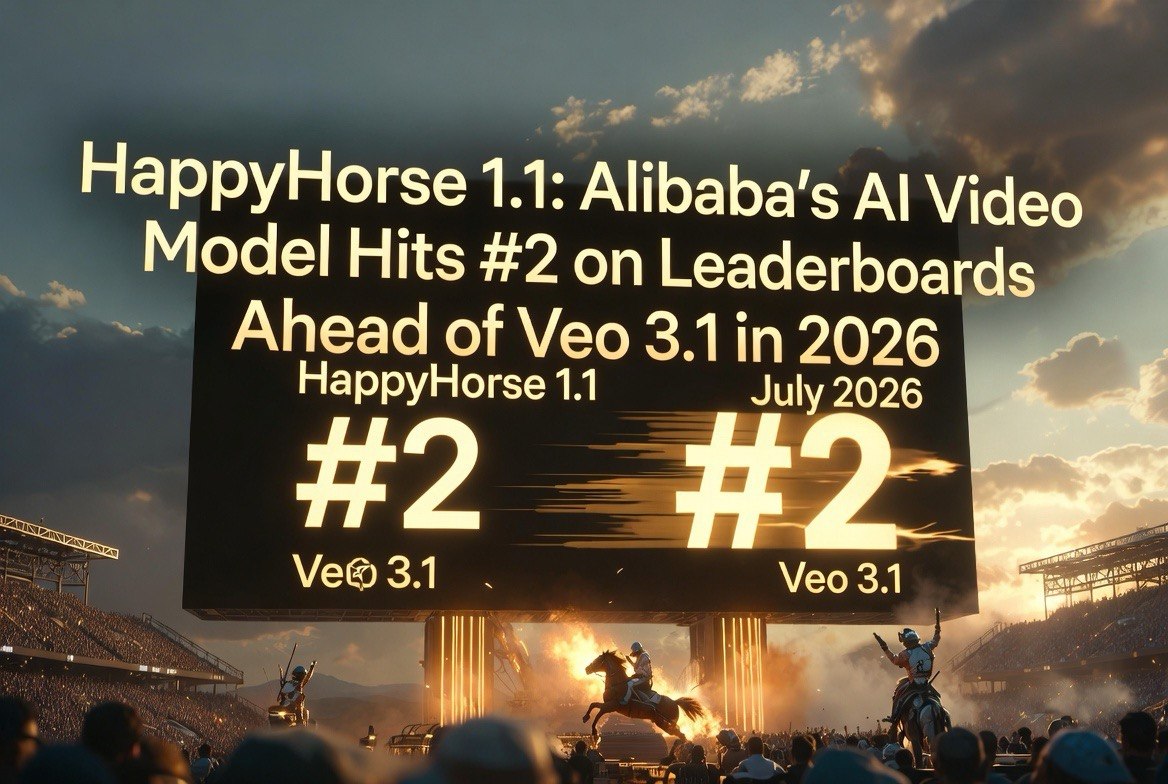
HappyHorse 1.1: Alibaba’s AI Video Model Hits #2 on Leaderboards Ahead of Veo 3.1 in 2026
Get The Faceless YouTube Blueprint — Free
The exact AI tool stack and workflow used to build a faceless YouTube channel from zero.
HappyHorse 1.1: Alibaba’s AI Video Model Hits #2 on Leaderboards Ahead of Veo 3.1 in 2026
⚡ Expert Summary: Alibaba Cloud launched HappyHorse 1.1, a major upgrade to its AI video generation model that now ranks #2 on arena.ai leaderboards ahead of Google Veo 3.1 and xAI Grok-Imagine-Video. The model supports text-to-video, image-to-video, and reference-to-video with native synchronized audio, multilingual lip-sync, and 720p/1080p output. API access is available through Alibaba Cloud Model Studio for enterprise and creator use.
HappyHorse 1.0 landed at #1 on video leaderboards when it launched. Then came Veo 3.1, Seedance 2.0, and Kling 3.0, and HappyHorse slipped in the rankings like every model eventually does.
HappyHorse 1.1 just climbed back.
Alibaba Cloud launched HappyHorse 1.1 in mid-June 2026, and the upgrade is significant enough to push the model to #2 on arena.ai leaderboards, ahead of Google Veo 3.1 and xAI Grok-Imagine-Video in several key categories. For the first time, a Chinese AI model is outperforming Google’s flagship in publicly ranked benchmarks.
For AI video creators in the United States and globally, this matters because it validates the multi-model strategy. The gap between Western and Chinese AI video models has effectively closed. The question is no longer which country produces better models. It is which model serves your specific use case.
What HappyHorse 1.1 Delivers
Three Generation Modes
HappyHorse 1.1 supports three input modes that cover the standard AI video workflow. Text-to-video generates clips from a text description. Image-to-video animates a static image with motion. Reference-to-video uses up to 9 reference images to maintain character and scene consistency across generated clips.
The reference-to-video mode is the most relevant for professional creators. Nine reference images allow for detailed character sheets, environment reference, and style guides that the model respects across outputs. This is one more reference than Kling 3.0 supports and competitive with Seedance 2.0’s reference input capabilities.
Native Synchronized Audio
A notable differentiator: HappyHorse 1.1 generates native synchronized audio, including ambient sound, background music, and multilingual lip-sync for character speech. Most AI video models require a separate audio generation step and manual synchronization. HappyHorse 1.1 produces video and audio in a single pass, with lip movements that match the spoken content in multiple languages.
For creators producing content for multilingual US audiences, or for businesses generating product videos in English and Spanish, this eliminates a significant post-production step.
Leaderboard Performance
HappyHorse 1.1 ranks #2 on arena.ai’s video generation leaderboard, ahead of Google Veo 3.1 and xAI Grok-Imagine-Video. The model scores particularly well on motion quality, prompt adherence, and overall visual appeal. It trails ByteDance’s Seedance 2.0 in character consistency and Kling 3.0 Turbo in generation speed, but it beats both on audio synchronization and multilingual accuracy.
The leaderboard position is notable because it is competitive across multiple evaluation categories rather than dominant in one and weak in others. HappyHorse 1.1 is a balanced model that performs well on most axes, making it a strong general-purpose choice.
Why HappyHorse 1.1 Matters for Creators
HappyHorse 1.1’s leaderboard position is interesting for benchmarks, but the practical importance for creators is about diversification of the AI video tool stack.
Relying on a single AI video model creates a dependence risk. When a model updates its API, changes pricing, or discontinues a feature, existing workflows break. OpenAI discontinued Sora in early 2026, leaving creators who had built pipelines around it scrambling for alternatives. The same thing has happened with Runway, Pika, and others as their business models shifted.
A multi-model strategy — routing different types of video generation requests to different models based on their strengths — is the professional standard that HappyHorse 1.1 makes more viable. Creators can use Kling 3.0 Turbo for fast short clips, Seedance 2.5 for longer narrative content, and HappyHorse 1.1 for projects requiring synchronized audio and multilingual output.
HappyHorse 1.1’s API availability through Alibaba Cloud Model Studio also means it integrates into existing automation and pipeline workflows without requiring manual upload to a web interface. For agencies and production houses producing video at scale, API access is a requirement, not a nice-to-have.
How It Compares to the Competition
HappyHorse 1.1 sits in a specific competitive position that no other model currently fills. Seedance 2.0 and 2.5 are stronger on clip length and character consistency. Kling 3.0 Turbo is faster and offers native 4K. Google Veo 3.1 has stronger benchmark scores on specific quality metrics. But none of these offer native synchronized audio at HappyHorse 1.1’s quality, combined with the multilingual lip-sync capability.
For a creator producing a product video in English with a Spanish version for a dual-language US market, HappyHorse 1.1 can generate both versions with proper lip-sync in a single pass. Any competitor would require separate audio generation and post-production synchronization for each language.
The model also benefits from Alibaba Cloud’s infrastructure pricing. API access through Alibaba Cloud Model Studio is competitively priced compared to Western cloud providers, which matters for creators operating on tight margins or agencies producing high volumes of content.
Who Should Use HappyHorse 1.1
HappyHorse 1.1 is not the best choice for every use case, and understanding where it fits saves creators time and money.
Best for: Creators producing content that requires synchronized audio and multilingual output. Product video creators serving bilingual markets. Agencies that need API-accessible video generation for pipeline integration. Projects where audio quality is as important as visual quality.
Good for: General-purpose short-form content generation where the model’s balanced performance across categories provides reliable results without switching between multiple tools. The 9-reference image input makes it viable for character-consistent series content.
Weak for: Projects requiring native 4K output, where Kling 3.0 Turbo or Seedance 2.5 are better choices. Long-form narrative content requiring clips longer than 15 seconds. Creators who prefer a web-based interface over API access, since HappyHorse 1.1 is primarily an API product.
What the Leaderboard Ranking Actually Means
Leaderboard rankings in AI video are useful signals but are not the same as real-world performance. Arena.ai evaluates models on controlled benchmark prompts that may not reflect the chaotic, specific, and domain-constrained prompts that professional creators actually use.
HappyHorse 1.1’s #2 ranking is significant because it represents consistent scoring across multiple evaluation axes rather than exploiting a single benchmark weakness. The model performed well on motion quality, prompt adherence, visual appeal, and audio synchronization. That breadth suggests the model will generalize well to diverse creator use cases rather than excelling only in narrow test scenarios.
However, creators should test HappyHorse 1.1 on their specific content types before committing to a workflow. A model that scores well on leaderboard prompts may not score well on a restaurant chain’s food photography turned into a video, or a brand’s product catalog with specific color requirements. The 9-reference image input is specifically designed to address this gap by allowing creators to provide representative inputs that reflect their actual production content.
For US creators evaluating their multi-model AI video strategy, HappyHorse 1.1 should be treated as a complementary tool rather than a primary replacement for Seedance or Kling. Its unique strength — synchronized audio with multilingual lip-sync — fills a gap that no other model currently serves at comparable quality. For projects that do not require that capability, other models remain stronger choices.
Pricing and Access
HappyHorse 1.1 is available through Alibaba Cloud Model Studio with full API access for enterprises and creators. Pricing follows Alibaba Cloud’s consumption-based model, with per-second pricing for video generation and per-request pricing for audio synchronization. Exact pricing varies by region and volume tier.
For US creators, the practical implication is that Alibaba Cloud accepts international accounts, and the API is accessible from the United States with standard latency. Alibaba Cloud has data center presence in Silicon Valley, making API response times competitive with US-based providers.
There is no consumer-facing web interface equivalent to Seedance’s free tier. HappyHorse 1.1 is primarily an API-first product, which means it requires technical setup or integration through a partner platform. Creators without API development capability should expect to access HappyHorse 1.1 through third-party tools that integrate the model rather than directly.
Practical Use Case: Multilingual Product Launch
To show how HappyHorse 1.1 changes a real workflow, consider a US ecommerce brand launching a product in both English and Spanish markets. The brand needs a 15-second product video with voiceover, ambient music, and product shots for both language versions.
With conventional tools, the workflow looks like this: generate the English video in Seedance or Kling (15-30 minutes per pass), generate the Spanish video in a separate pass (15-30 minutes), generate English voiceover audio in ElevenLabs (5 minutes), generate Spanish audio separately (5 minutes), synch audio to video in a video editor (30-60 minutes per language), export both versions (10 minutes each). Total time: approximately 2-3 hours per product.
With HappyHorse 1.1, the workflow is: provide product images and a prompt describing the video in English (5 minutes), specify that the audio should be in English and Spanish (one parameter), generate the English version with native synchronized audio (2-5 minutes depending on queue). Generate the Spanish version with the same prompt but language parameter changed (2-5 minutes). Total time: approximately 15-20 minutes.
The difference is not marginal. It is the difference between being able to produce multilingual video content at scale and being limited to a single language by production capacity. For US businesses with bilingual customer bases, or brands targeting both domestic and international audiences, this capability alone justifies evaluating HappyHorse 1.1 regardless of its leaderboard position.
Alibaba Cloud’s announcement of HappyHorse 1.1 API availability specifically called out enterprise content production as a primary use case, which suggests the model is optimized for commercial-grade output rather than experimental generation. The infrastructure pricing model, combined with API-first access, positions HappyHorse 1.1 as a production tool for agencies and content teams rather than a toy for individual creators.
The 9-reference image input is available on all tiers, though higher-volume tiers may be necessary for consistent character generation across multiple clips.
Frequently Asked Questions
Is HappyHorse 1.1 free to use?
HappyHorse 1.1 is primarily an API-access model through Alibaba Cloud Model Studio. Pricing is consumption-based with per-second and per-request rates. There is no free tier for direct API access, though some partner platforms may offer free trial credits.
Does HappyHorse 1.1 work from the United States?
Yes. Alibaba Cloud has US data center presence, and the API is accessible from the United States. Latency is competitive with US-based AI video APIs.
What languages does the lip-sync support?
HappyHorse 1.1 supports English, Mandarin Chinese, and select additional languages for lip-sync. Alibaba Cloud has not published the full list of supported languages, but English and Chinese are confirmed as primary languages for the multimodal audio system.
Can I use HappyHorse 1.1 with the same prompt as Seedance or Kling?
Model behavior varies between platforms. Prompts optimized for Seedance or Kling may not produce the same results on HappyHorse 1.1 due to differences in training data and model architecture. HappyHorse 1.1 performs best with descriptive prompts that include scene setting, motion direction, and mood indicators.
Does HappyHorse 1.1 generate 4K video?
No. HappyHorse 1.1 outputs at 720p and 1080p. For creators requiring 4K output, Seedance 2.5 or Kling 3.0 Turbo are the appropriate choices. HappyHorse 1.1 is best used for projects where audio quality and multilingual capability are higher priorities than maximum resolution.
How does HappyHorse 1.1 handle character consistency?
The model supports up to 9 reference images for character and scene consistency. For multi-clip projects, providing consistent reference images across all generation requests maintains character appearance. Within a single clip, character consistency is competitive with other top-tier models.

About Barak Schurr
Barak Schurr is a serial entrepreneur who built and exited a major ticketing platform before turning his attention to AI and content. He runs three AI-focused research sites and writes about the tools, workflows, and strategies that let solo creators build real channels — without a crew, a studio, or a Hollywood budget.
Email: [email protected]