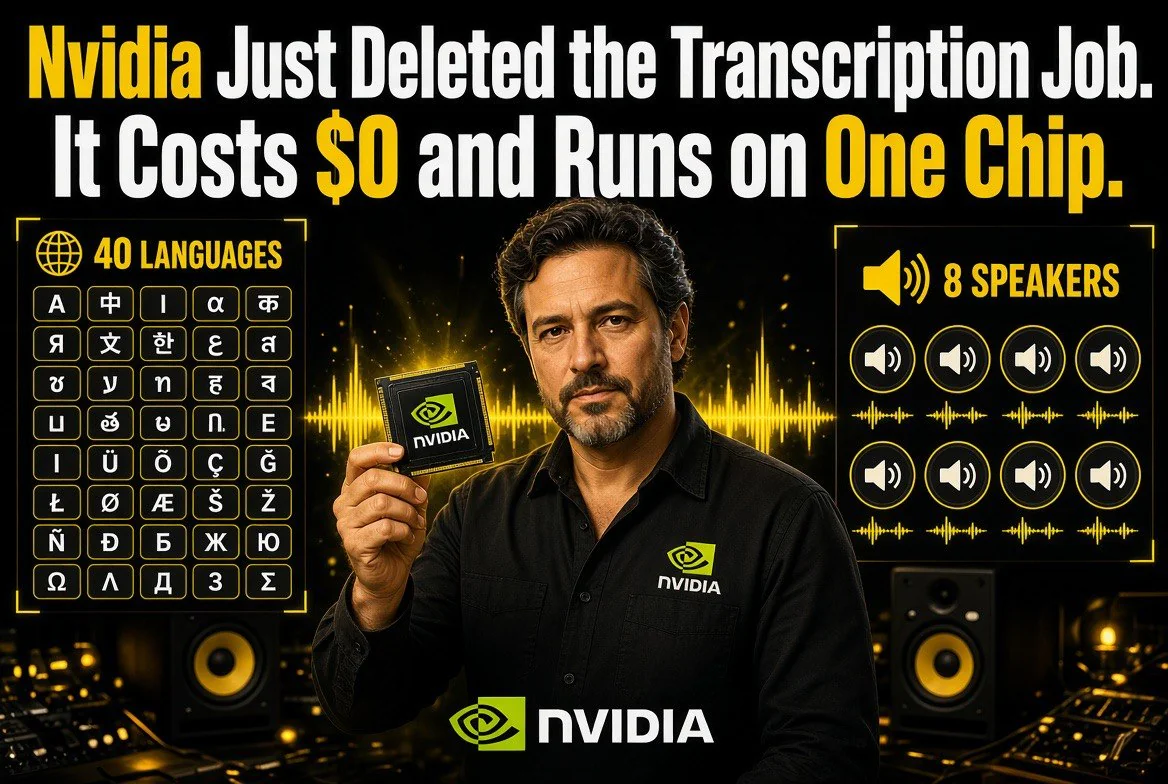
Nvidia Just Deleted the Transcription Job. It Costs $0 and Runs on One Chip.
Nvidia Just Deleted the Transcription Job. It Costs $0 and Runs on One Chip.
⚡ Expert Summary: On Wednesday Nvidia released Nemotron 3.5 Transcribe — a free, open-weight speech-to-text model at 30 billion parameters that handles up to 40 languages, translates 31 of them to and from English, transcribes recordings up to an hour long, and separates up to eight speakers. It runs on a single chip, from a Jetson AGX Thor robotics controller to a Blackwell datacenter GPU. Nvidia also shipped version 2 of Granary, its open speech dataset. The one thing it does not do is live audio — and that gap is the entire business model the transcription industry was quietly standing on. If your income comes from turning recorded speech into text, hours, or captions, the price of your labour just went to zero and the moat that remains is not one you own.
Don’t read this as a model release. Read it as a price.
Twenty-four months ago, transcribing one hour of multi-speaker recorded audio was a billable service. Freelancers charged by the audio minute. Agencies sold “captioning packages” with a delivery window measured in days. A SaaS platform could raise a seed round on the promise of accurate speaker separation and 30 language support, because doing it properly required humans or licences to something expensive.
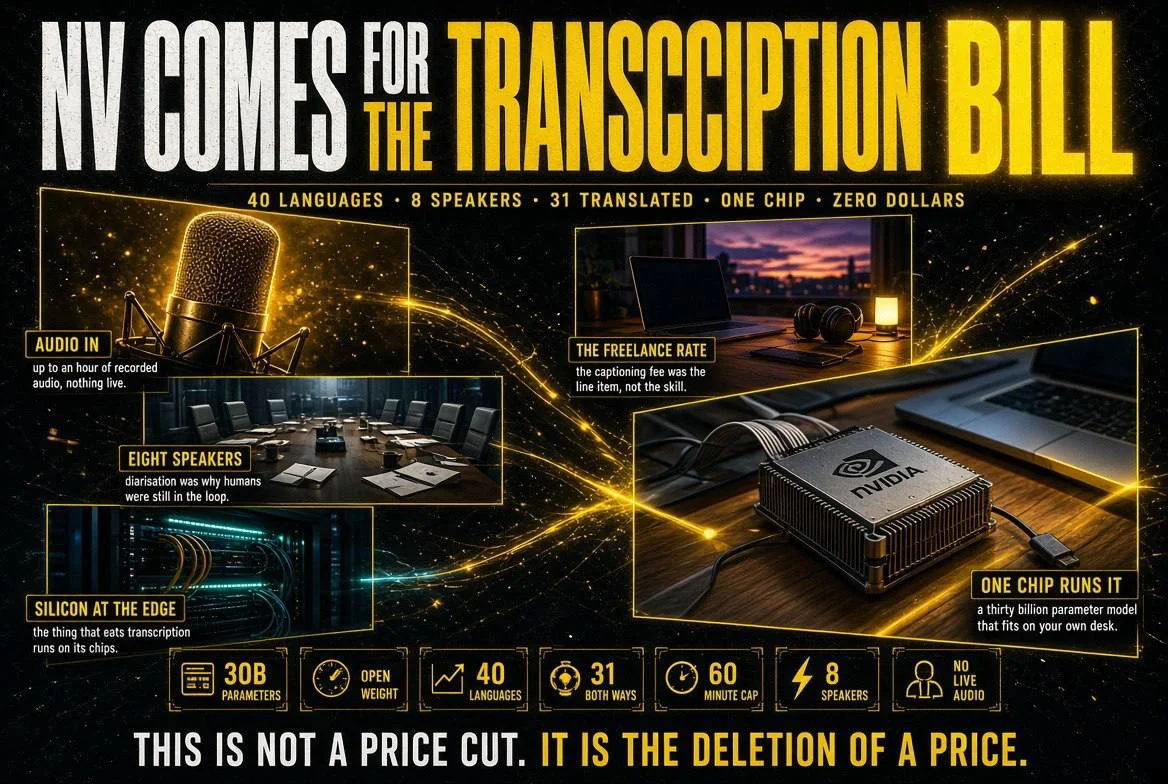
Today the answer to that same job is a 30-billion-parameter model you download for nothing, run on hardware you may already own, and use without asking permission — commercially or otherwise, because it is open-weight. Up to an hour of audio, eight speakers, 40 languages, 31 of them translating both directions to English.
That is not a price cut. That is the deletion of a price.
And the industry that just got deleted was not the one at the top. Every studio that sells transcription as a line item, every freelancer whose rate baked in “I’ll do the captions,” every small SaaS built on wrapper access to somebody else’s ASR — all of them just got a competitor whose marginal cost is electricity.
What Nvidia Actually Shipped, Without the Marketing
The specs that matter, and why each one is a business fact rather than a spec sheet entry.
30 billion parameters, open-weight. Open-weight means you can run it, modify it, and ship it inside your own product. It means the capability is not rentable, so it cannot be repriced on you later. That is the single most important word in this release and it is the one the coverage skips.
Up to 40 languages, 31 translating both directions to English. A creator publishing in Japan can now get an English transcription of their own recording, and an English creator can go the other way, on their own machine. Subtitling for international distribution stops being a paid tier and becomes a preprocessing step.
Recordings up to an hour long. That is a full podcast episode, a two-hour seminar split once, a full day of interviews in chunks. It is aimed squarely at the tool category that charges by the minute.
Up to eight speakers separated. Diarisation — knowing who said what — was the hardest part of transcription and the reason humans were still in the loop. Eight speakers covers almost every panel, roundtable and client meeting that ever needed a transcript.
Runs on a single chip. Jetson AGX Thor robotics controllers, DGX Spark laptops, Blackwell datacenter chips. This is Nvidia saying, explicitly, that transcription is an edge capability now. Your laptop can be the transcription service.
Nemotron 3.5 Transcribe joins Parakeet, Nvidia’s 1.1 billion parameter voice model, in a growing open-weight voice family. Nvidia is not trying to sell you a transcription product. It is trying to make sure the thing that eats the transcription market runs on its silicon.
| What you need to do | Nemotron 3.5 Transcribe | Freelance transcript service | SaaS wrapper platform |
|---|---|---|---|
| Cost per hour of audio | Electricity and hardware you own | Billable rate, by the minute | Monthly subscription plus minutes |
| Languages covered | Up to 40, 31 translating to and from English | Whichever the human speaks | Varies by tier, often the paid one |
| Speaker separation | Up to eight | As many as they can track | Usually two to four on cheap plans |
| Where it runs | Your own single chip, offline | Their laptop | Their servers, your audio uploaded |
| Live audio | No — recordings only | Possible, at a premium | Some offer real-time, sold as premium |
| Can you resell it | Yes, it is open-weight | No | Depends entirely on their contract |
Look at the resale row. A three-person studio can now take the same open model, wrap it in its own glossary and workflow, tune it on the client’s industry jargon, and sell the outcome at a margin no subscription competitor can match. The tool stopped being the product. The tuning and the trust became the product.
The One Thing It Cannot Do Is the Whole Industry’s Alibi
Nemotron 3.5 Transcribe works on recorded audio. It does not handle livestreams.
That limitation is real, and it is worth respecting rather than dismissing. Real-time speech is genuinely harder — you cannot look ahead, you cannot re-hear a word, and latency becomes part of the product. TechCrunch is right to note that this leaves real-time to rivals like ElevenLabs, which shipped Realtime for instant speech inside voice agents.
But understand what the gap actually protects. It protects the slice of the market that needs a transcript while the audio is happening: live captions in a call, an agent hearing a customer, a transcriptionist working a courtroom or a clinic in real time.
It does not protect the enormous, boring, profitable middle of the business — the recorded interview, the podcast episode, the client call recap, the deposition, the lecture, the video file sitting on a creator’s drive waiting to be captioned before upload. That work is now free at the point of use, and nobody is coming to buy it at a per-minute rate again.
This is the pattern creators keep refusing to internalise. Every time an AI release comes with a tidy limitation, the industry reads the limitation as protection. It never is. The limitation is a temporary boundary, and the part of your work that sits on the free side of it is already gone — you just have not been told yet.
Who Actually Gets Hurt, in Order
First, the wrapper SaaS. If your product is a pleasant interface over an ASR API and a minutes counter, you just lost your input cost advantage to a competitor running a model they downloaded. Open-weight means the floor of this market is now engineering time, not licensing.
Second, the per-minute freelancer. Not the good ones — the ones whose differentiation was availability and speed rather than accuracy on hard audio. The moment a client finds out they can get 90% of the benefit on their own laptop, your quote looks like a tax.
Third, and least obviously, the creator who thought captions were labour. Captions were never the deliverable. They were the tax you paid to be legible to an algorithm. Once that tax is zero, being legible is not a competitive advantage — it is the entry fee, and the differentiation moves back to whether the video is worth captioning at all.
Who wins? Anyone who owns a workflow with a client relationship around it. A studio that promises “we will make your archive searchable” now has a cost structure that makes that promise profitable. A creator with 400 hours of unsearchable footage can turn it into an indexed asset for the price of laptop time. Anyone whose moat was access is dead. Anyone whose moat was judgment just got a bigger margin.

Open Weight Is the Real Story, and Nvidia Is Not Being Generous
Ask why Nvidia gives this away. The answer is not charity, and it is not confusion about its own business model. Nvidia sells chips. A world where transcription is free and runs on a single accelerator is a world where every meeting-room device, every clinic workstation, every creator’s laptop and every robotics controller is a candidate for one more Nvidia chip.
Nvidia does not need to win the transcription market. It needs transcription to happen locally on hardware. Then the model being free is not a loss leader — it is the cheapest possible way to expand demand for silicon.
That changes what the release means for you. You are not being handed a gift by a friendly company. You are being handed the demand-side subsidy of a hardware strategy, and the subsidy happens to be genuinely, permanently useful to you. Both things are true.
The strategic read: capability that runs locally and freely is capability that cannot be repriced, revoked, or rate-limited. That is worth more than a feature advantage, and it is the criterion you should use the next time a vendor pitches you a subscription on top of something open.
| Recent voice release | Who made it | What it is for | What it costs you |
|---|---|---|---|
| Nemotron 3.5 Transcribe | Nvidia | Recorded audio to text, 40 languages, 8 speakers | Nothing, open-weight |
| Parakeet | Nvidia | Small footprint voice model, 1.1B parameters | Nothing, open-weight |
| Voxtral 3 | Mistral | Speech understanding and transcription | Varies by licence and access |
| Realtime | ElevenLabs | Live speech inside voice agents | Subscription, per usage |
| Launa-Omni | Salesforce | Voice model for enterprise workflows | Platform terms |
What a Creator or Studio Should Do With This, This Week
Four things, in order of payoff. None of them require you to change your whole stack.
Stop paying per minute for recorded audio. If any part of your workflow bills or pays by transcription minute on files that already exist, that line item is now optional. This is the simplest money on the table.
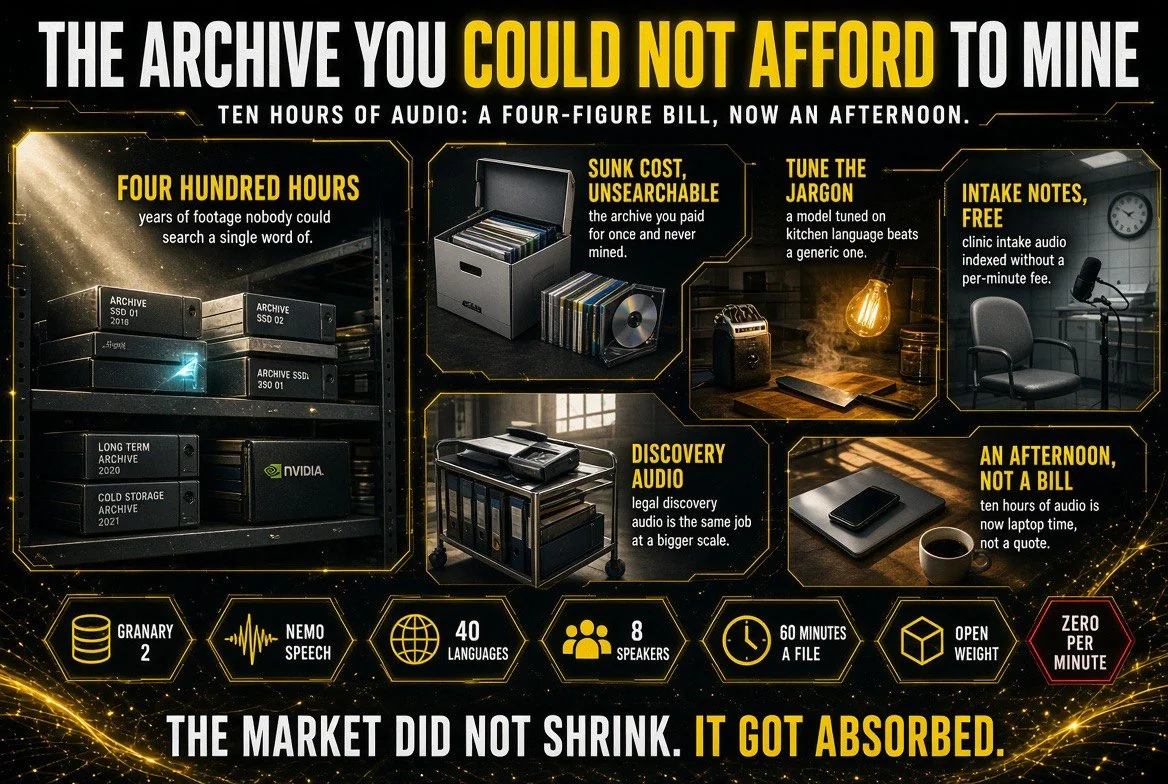
Make your archive searchable. This is the underrated play. If you have years of footage with no transcript, Nemotron 3.5 plus Granary 2 lets you build a text index of everything you have ever shot — searchable, quotable, reusable. The archive you could not afford to mine is now a library. Creates a genuinely new asset out of sunk cost.
Customise on jargon, not on volume. Nvidia’s own pitch is that developers can tune the model with NeMo Speech and the Granary dataset so it recognises industry language in each language. That is your differentiator now: a transcription tuned for restaurant kitchens, or clinical intake, or legal discovery, beats a generic one no matter whose servers it sits on.
Do not build a business on live-only. Real-time is the last paid fortress, but it is also the first place the next open model lands. The studios that survive are selling tuned outcomes and client trust, not minutes of audio converted to text.
The Uncomfortable Arithmetic
Let me put the number where the argument is. If a freelance transcriptionist charged, say, $60 per hour of recorded audio with speaker separation, and a studio resold that work at a markup, then a ten-hour archive project was a four-figure bill. The same project, run through an open-weight model on a laptop, is now a coffee and an afternoon.
That is not a 20% efficiency gain. That is a category of work returning to its inputs. When a price goes to zero, the work does not vanish — it moves to whoever was already holding the audio and the client relationship. That is the whole shift in one sentence: the transcription market did not shrink, it got absorbed.
And the uncomfortable part for creators is that absorption works both ways. If your clients can now caption and transcribe their own material for free, the question they will ask is not “who transcribes this.” It is “why am I paying you at all.” Answer that question with judgment, taste and a workflow they cannot replicate — because the part of your work that used to answer it for you is free now.
Frequently Asked Questions
What is Nemotron 3.5 Transcribe?
A free, open-weight speech-to-text model Nvidia released on 28 October 2026. It transcribes recorded audio in up to 40 languages, translates 31 languages to and from English, handles recordings up to an hour long, and separates up to eight speakers.
Is it really free?
Yes. It is an open-weight model, which means you can download and run it yourself, including inside your own product. Your real cost is the hardware and the electricity, not a licence.
Can it do live transcription?
No. Nemotron 3.5 Transcribe works with recorded audio, not livestreams. Nvidia’s release leaves real-time speech to rivals such as ElevenLabs’ Realtime.
What hardware does it need?
Nvidia says the 30-billion-parameter model can run on a single chip, including Jetson AGX Thor robotics controllers, DGX Spark laptops, and Blackwell datacenter GPUs.
What is Granary 2?
It is the second version of Nvidia’s open source speech dataset, released alongside the model. Combined with NeMo Speech, it lets developers tune the model to recognise industry-specific jargon in each supported language.
Does this replace paid transcription services?
For recorded audio, largely yes — the per-minute economics no longer hold when an open-weight model does the same job locally. Live and real-time transcription is the remaining paid niche.
Why would Nvidia give away a model this capable?
Because Nvidia sells chips. Free, capable, local speech models increase demand for accelerators that run them. The subsidy is real and useful, but it is a hardware strategy, not a gift.
Related Reading on AI Video Advisor
If this argument lands, go deeper on the audio side. Fish Audio made voice cloning free for 2 million people is the same pattern on the synthetic side of speech. Nvidia’s 22-millisecond synthetic video detector shows what the same company does on the defence side. And the AI Video Advisor archive tracks which of these releases actually changes a creator’s workflow.
About Barak Schurr
Barak Schurr is a serial entrepreneur who built and exited a major ticketing platform before turning his attention to AI and content. He runs three AI-focused research sites and writes about the tools, workflows, and strategies that let solo creators build real channels — without a crew, a studio, or a Hollywood budget.
Email: [email protected]
More AI Video Resources