NVIDIA’s New AI Detects Synthetic Video in 22 Milliseconds — What This Means for Content Creators
Get The Faceless YouTube Blueprint — Free
The exact AI tool stack and workflow used to build a faceless YouTube channel from zero.
NVIDIA’s New AI Detects Synthetic Video in 22 Milliseconds — What This Means for Content Creators
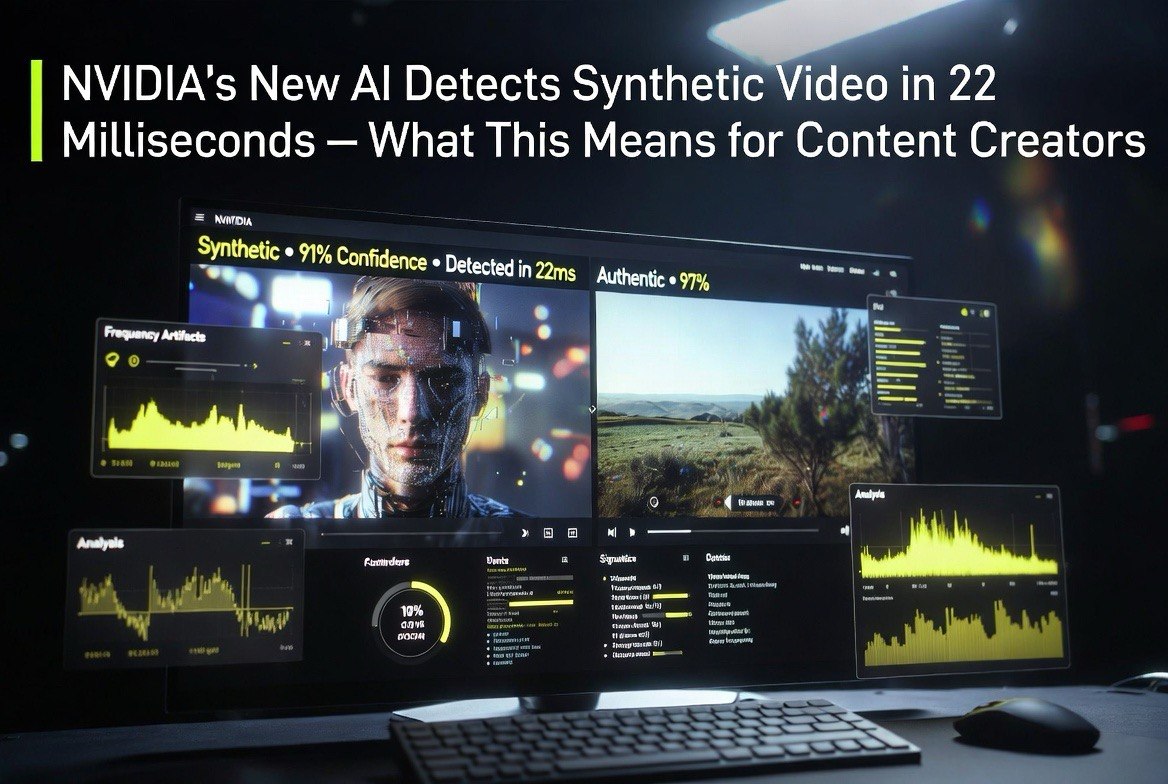
⚡ Expert Summary: NVIDIA launched its Synthetic Video Detector NIM microservice at SIGGRAPH 2026 in July. The tool analyzes video frame-by-frame and returns a classifier score indicating whether the content is AI-generated. It achieves up to 92% accuracy on uncompressed video, maintains 82% accuracy through 50% compression, and processes 1080p footage in roughly 22 milliseconds on RTX hardware. For video creators, this means every AI-generated clip you publish can now be verified by newsrooms, platforms, and clients using a free public API.
The same week Neill Blomkamp released his entirely AI-generated short film Nightborne, NVIDIA shipped a tool that can detect that the video was AI-generated in the time it takes to blink.
The timing is not accidental.
AI video generation is advancing faster than anyone expected in 2025. ByteDance’s Seedance 2.0, OpenAI’s Sora Turbo, Kling 3.0 — these tools now produce output that most viewers cannot distinguish from camera footage. That creates a problem for newsrooms, platforms, and businesses that need to know whether a video is real or synthetic.
NVIDIA’s Synthetic Video Detector NIM, launched at SIGGRAPH 2026, is the first serious attempt at a production-ready answer.
How the Detector Works
The Synthetic Video Detector is a downloadable NIM microservice that analyzes video content and outputs a probability score. It examines each frame for statistical signatures that differ between camera-captured and AI-generated footage. These signatures exist because AI video models produce outputs with subtle artifacts — not in pixel content visible to the human eye, but in the mathematical distribution of the frame’s underlying data.
The tool processes video in a single pass and returns a classifier score between 0 and 1. A score above the configurable threshold (default ~0.3) flags the content as likely synthetic. The user can adjust the threshold based on their tolerance for false positives versus false negatives.
Key performance metrics from NVIDIA’s testing:
- 92% accuracy on uncompressed video
- 87% accuracy at 15% compression
- 82% accuracy at 50% compression
- 22ms processing time for 1080p video on RTX GPUs
- ~30ms on L40 data center GPUs
- AUC of 0.9614 on NVIDIA’s internal benchmark set
The system remains effective after common real-world processing like cropping, resizing, re-encoding, and transcoding. This matters because AI-generated video rarely stays in its original format — it gets compressed for social media, resized for embedding, and re-encoded for distribution.
What the Accuracy Numbers Actually Mean
The 92% figure on uncompressed video is the headline number, but the compression tolerance is the real story. Most AI-generated video that reaches an audience has been compressed at least once — through YouTube’s encoder, a social media upload pipeline, or a video editing tool’s export settings.
At 50% compression — roughly the quality level of a standard social media upload — the detector still achieves 82% accuracy. That is not perfect, but it is operationally useful. If a newsroom runs 100 flagged videos through the detector and gets 82 correct classifications, that changes how they triage content.
The 22ms processing speed also deserves attention. That is fast enough to run detection on every frame of a video stream in real time. Platforms like YouTube, TikTok, and Instagram could integrate this into their upload pipelines without introducing noticeable latency. A video is analyzed before the upload progress bar finishes.
How It Compares to Other Detection Methods
NVIDIA’s frequency-domain approach differs from the two other common detection strategies:
Spatial domain analysis looks at pixel-level details — oddities in lighting, inconsistent shadows, unnatural skin textures. It is effective against lower-quality AI generation but struggles with models like Seedance 2.0 and Sora Turbo that produce photorealistic output.
Motion analysis tracks unnatural movement patterns across frames — objects that move too smoothly, characters with inconsistent limb positioning, backgrounds that warp around moving subjects. It detects artifacts specific to generative video models but can be fooled by slow-paced, static content.
Frequency domain analysis (NVIDIA’s method) examines the underlying signal characteristics that are invisible to the human eye but mathematically distinct between real and synthetic footage. AI video models produce frames with statistical distributions that differ from camera-captured video, even when the pixel content appears identical.
The AUC of 0.9614 on NVIDIA’s benchmark set means the detector is highly effective across a range of confidence thresholds. For context, an AUC of 0.5 is random guessing, 0.8 is good, and 0.96+ is exceptional.
What This Means for AI Video Creators
If you are creating AI-generated video content professionally — whether for marketing, filmmaking, or social media — this tool changes the verification landscape.
Every major content platform is evaluating detection tools. When a news organization or brand client downloads your AI-generated B-roll and runs it through NVIDIA’s detector, they will get a clear signal. That is good news if you are transparent about your workflow. It is bad news if you were hoping the synthetic origin would go unnoticed.
The practical implication: always disclose AI-generated content. The detection technology exists. It works. And it will only get better. NVIDIA’s current 92% accuracy on uncompressed video will improve with each model revision, just as AI video generation improves with each release.
For creators who use AI as part of a hybrid pipeline — real footage with AI-enhanced backgrounds, camera footage upscaled with AI, real audio with AI-generated B-roll — the situation is more nuanced. The detector flags the synthetic frames, not the whole video. A creator can show provenance for the real portions while acknowledging the AI-generated elements.
The Detection Gap Under Compression
The accuracy drop from 92% to 82% at 50% compression is worth understanding. When video is heavily compressed for social media distribution, some of the AI artifacts that the detector relies on are destroyed — but so are some of the natural signatures from real footage. The tool is still effective, but the confidence margin narrows.
For content creators working with heavily compressed output (TikTok, Instagram Reels, YouTube Shorts), the detection accuracy is lower but still significant. A creator who runs their output through aggressive compression before publishing should expect the detector to flag it less reliably, but not to miss it entirely.
This compression gap is also where adversarial techniques could emerge. A motivated actor could intentionally over-compress AI-generated video to push it below the detector’s confidence threshold. This is the same arms race dynamic that plays out in every detection technology, from spam filters to antivirus software.
Accessing the Tool
NVIDIA offers the Synthetic Video Detector as a free public demo and API at build.nvidia.com. The full NIM microservice is available for on-premises, edge, hybrid, or air-gapped deployment. This means newsrooms and platforms can run it locally without sending video to an external API.
For individual creators, the public demo is sufficient for checking individual clips. For agencies and production studios processing high volumes of content, the downloadable NIM integrates directly into existing media pipelines. NVIDIA has also indicated that the NIM can be containerized and deployed on any infrastructure with an NVIDIA GPU.
Platforms and Regulators Are Already Circling
The European Union’s AI Act already requires labeling of AI-generated content. The United States has no federal mandate yet, but the White House AI executive order from 2025 called for watermarking and provenance standards. California’s proposed AI transparency bill (AB 3211, reintroduced for 2026) would require platforms to label AI-generated content.
NVIDIA’s detector gives platforms a tool to meet these requirements without building their own. YouTube announced in early 2026 that it would require creators to disclose AI-generated content. TikTok already labels AI-generated uploads. A detection tool that processes video in 22ms per frame means these platforms can verify disclosures rather than relying on creator honesty.
The detector also creates liability questions. If a platform runs NVIDIA’s tool on uploaded content and the tool reports 92% confidence of AI generation, does the platform have an obligation to flag it? If they choose not to run detection, are they liable for AI-generated misinformation on their platform? These questions are not answered yet, but the existence of a production-ready detection tool changes the legal calculus.
Where Detection Is Headed
NVIDIA’s release is the first salvo in what will become a detection arms race. AI video models improve their output quality, reducing the artifacts that detection tools rely on. Detection tools improve their sensitivity to find new signatures. The cycle continues.
Future developments likely include:
- Ensemble detectors that combine frequency analysis, spatial analysis, and motion analysis into a single pipeline. Multiple detection methods working together will be harder to evade than any single approach.
- Platform-level integration where detection is baked into the upload pipeline rather than run as a separate check. YouTube and TikTok already test AI labeling systems. NVIDIA’s speed makes real-time detection feasible at platform scale.
- Provenance standards like the C2PA (Coalition for Content Provenance and Authenticity) that attach cryptographic signatures to camera-captured content. Detection and provenance are complementary — detection catches what wasn’t signed, provenance verifies what was.
The more significant development is standardization. As detection tools become integrated into media platforms — content management systems, newsroom editing tools, social media upload pipelines — the question shifts from “can I detect this?” to “what happens when a platform flags my content as AI-generated?”
For professional video creators, the answer is straightforward: label your work, maintain provenance records, and build trust. Detection is not a threat to transparent AI use. It is a threat to undisclosed AI use.
The Detection Arms Race Is Already Underway
As detection tools improve, AI video generators are also improving their output quality, reducing the statistical artifacts that detection methods rely on. This creates a loop: better detectors push video generators to produce cleaner output, which forces detectors to find new signatures, which pushes generators again. The cycle benefits neither side exclusively — it raises the baseline quality of both detection and generation.
NVIDIA’s advantage is hardware integration. A detection model running on the same GPU architecture used for inference can operate at line speed — 22ms per frame — without additional hardware. This means platforms deploying NVIDIA GPUs for other workloads can run detection as a zero-marginal-cost background task. For competing detection tools running on general-purpose CPUs, the economics look different: detection requires dedicated compute that adds real cost at platform scale.
For video creators, the practical implication is that detection is not going away. It will become invisible infrastructure — baked into upload pipelines, content management systems, and streaming platforms — just as spam detection is invisible infrastructure for email. The decision to disclose AI use is not about evading detection. It is about building a workflow where detection confirms your disclosure rather than contradicting it.
The economics favor transparency. A creator whose work can be verified across tools, platforms, and workflows gains a trust advantage over competitors who rely on opacity. When clients and platforms can check with near-instant results, the cost of being caught in undisclosed AI use — lost contracts, platform penalties, reputation damage — far exceeds the effort required to simply state what is real and what is synthetic.
Frequently Asked Questions
How accurate is NVIDIA’s synthetic video detector?
NVIDIA reports up to 92% accuracy on uncompressed video, 87% at 15% compression, and 82% at 50% compression. Internal benchmarks show an AUC of 0.9614 on their test dataset.
How fast does the detector process video?
Approximately 22 milliseconds for 1080p video on RTX GPUs. Roughly 30 milliseconds on L40 data center GPUs. Fast enough for real-time frame-by-frame analysis.
Can I try NVIDIA’s video detector for free?
Yes. A free public demo is available at build.nvidia.com. The full NIM microservice is available for enterprise deployment with support for on-premises, edge, and air-gapped environments.
Does compression affect detection accuracy?
Yes. Accuracy decreases as compression increases, from 92% on uncompressed video to 82% at 50% compression. The tool remains effective across consumer-grade compression levels.
Is the detector available for newsrooms and platforms?
Yes. The NIM microservice supports on-premises, edge, hybrid, and air-gapped deployment. Integration directly into media editing pipelines is the primary enterprise use case.

About Barak Schurr
Barak Schurr is a serial entrepreneur who built and exited a major ticketing platform before turning his attention to AI and content. He runs three AI-focused research sites and writes about the tools, workflows, and strategies that let solo creators build real channels — without a crew, a studio, or a Hollywood budget.
Email: [email protected]
More AI Resources for Your Business