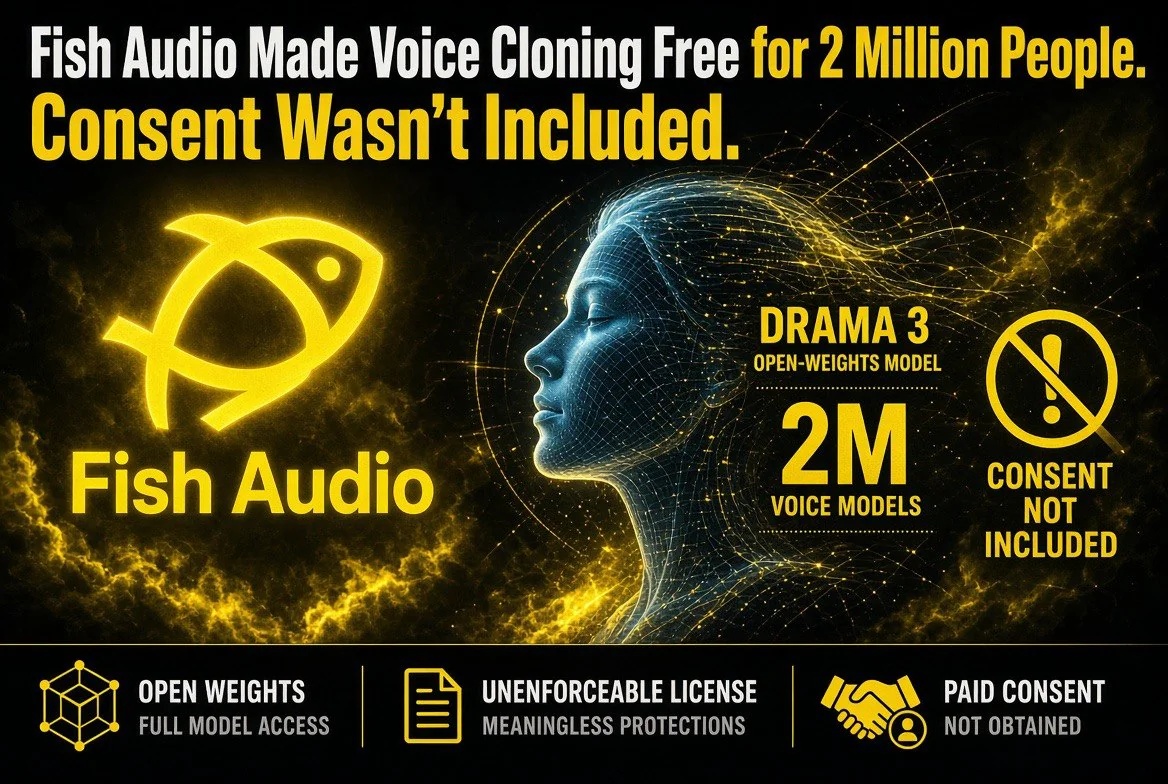
Fish Audio Made Voice Cloning Free for 2 Million People. Consent Wasn’t Included.
Fish Audio Made Voice Cloning Free for 2 Million People. Consent Wasn’t Included.
⚡ Expert Summary: Fish Audio released Drama 3 on October 13, 2026 as open weights under the Community License v1.0 — free for commercial use to anyone earning under US$500,000 a year. The license bans cloning a real person’s voice without consent. That sentence is the problem: it sits in a file on Hugging Face, and no one can audit a local install. The same company runs a verification system that actually works — Professional Voice Clone refuses to finish until the voice owner passes a live ownership check. That system is included with paid plans. The consent mechanism exists, and it is sold separately from the model that makes it necessary. The bottom line: 2 million voice models already sit in the community library. Drama 3 sharpened pronunciation by 5.1 points and made the whole stack downloadable. If consent is a feature and not a precondition, then for anyone below the revenue threshold, consent was never the product.
On October 13, 2026, Fish Audio published a model called Drama 3. Their chief scientist, their CEO and their CTO signed the announcement together. It is the best-performing text-to-speech model they have ever built, it reads 93.2% of hard words correctly, and it is available as open weights on Hugging Face.
It is also free to use commercially for anyone earning less than half a million dollars a year.
Those three facts are not the story. The story is the fourth one, buried in the licensing paragraph: the license also bans cloning a real person’s voice without their consent.
Read that again. The model is downloadable. The weights are on the internet. The consent rule is a sentence in a text file that nobody outside Fish Audio has the ability to check. You cannot enforce a license clause against a copy of a model sitting on someone’s laptop in a country you have no jurisdiction in.
So the honest description of what shipped on October 13 is this: Fish Audio made voice cloning free for 2 million people and asked them politely to obtain consent. Not because the company is cynical — because that is the structural consequence of open weights, and every lab that takes this path inherits it.
The Number That Should Worry Voice Actors
Two million. That is how many voice models Fish Audio says sit in its community library, per the company’s own first-anniversary post in July 2026.
Those models were built over the platform’s first year, largely under instant cloning — the tier that needs as little as ten seconds of audio and produces a voice that “sounds roughly like you.” Ten seconds. A voicemail, a TikTok, a line in a podcast. That is the input requirement for a speed bump, not a safeguard.
Fish Audio is unusually candid about why that is a problem. In their own June 2026 post introducing Professional Voice Clone, they write that voice actors “have watched their recordings get cloned without permission, payment, or any say in where the result ends up,” and that handing your voice to an AI platform can feel “less like an opportunity and more like a risk.”
That is a company describing the exact harm its own free tier enables, in the opening paragraph of the product it sells to fix it. I have read a lot of vendor copy this year. Very little of it is that direct about the damage.
Which is why the interesting question is not whether Fish Audio is honest. It is. The interesting question is what honesty is worth when the enforcement mechanism is optional.
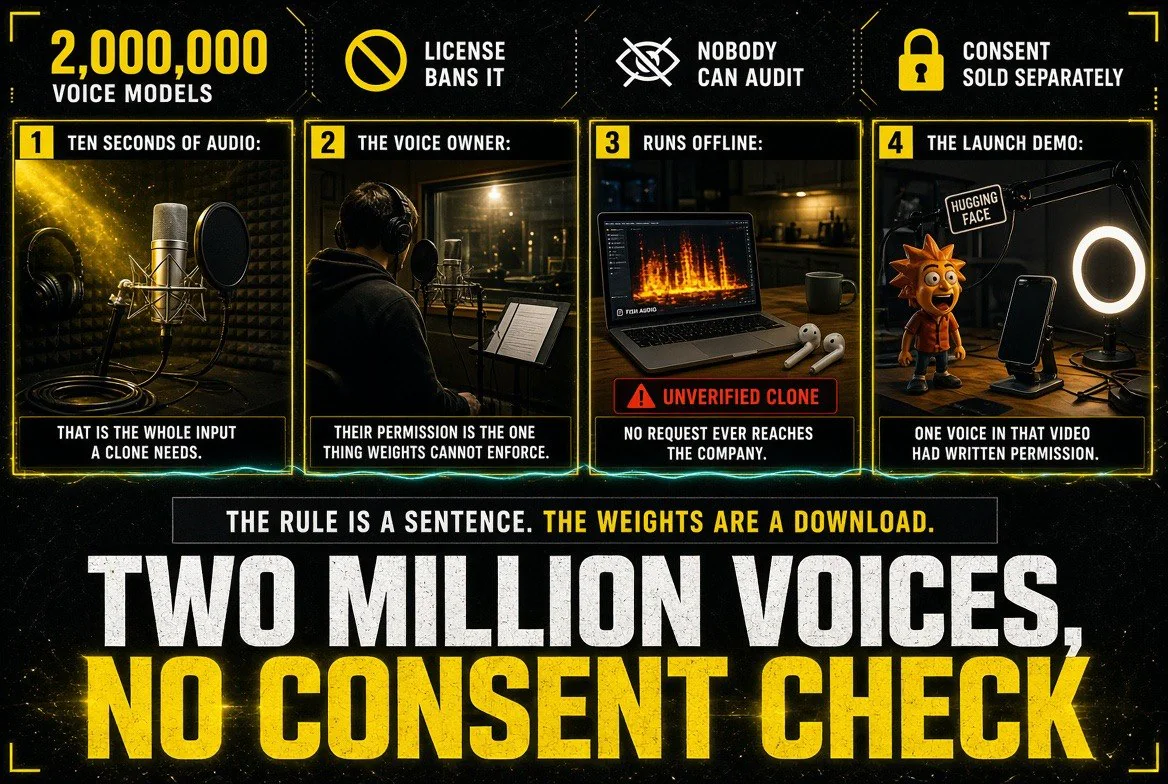
Ten seconds of audio is enough input for a clone, the weights run offline where no request reaches the company, and the one voice in the launch video had written permission. That is the whole asymmetry.
What Actually Works, and What It Costs
Professional Voice Clone works. It trains on 10 to 180 minutes of clean audio and — critically — it will not complete until the voice’s owner personally verifies, by live recording, that the voice is theirs. That is a real consent gate. It is the strongest one I have seen shipped by a TTS platform this year, because it happens at the moment of creation rather than in a terms document nobody reads.
It is also included with Plus, Pro and Max plans. Paid plans.
I want to be careful here, because the easy version of this argument is an accusation I cannot support. Fish Audio is not charging voice actors for the right to consent — the PVC slots come at no extra credit cost to the person buying the plan. And their pricing is not unusual; every serious platform gates its highest-fidelity tier.
But the architecture still says something. Verification lives in the paid product. The model that makes verification necessary is free and downloadable. Nobody at Fish Audio can stop you from running Drama 3 locally and cloning whoever you like, and their license says you must not. Those two statements are compatible, and that is precisely the problem.
| Layer | What It Does | Who Can Check It |
|---|---|---|
| Model weights | Drama 3 downloadable from Hugging Face | Nobody — runs offline, no telemetry required |
| License text | Bans cloning a real voice without consent | A court, if the cloner is reachable and worth suing |
| Instant clone tier | 10 seconds of audio produces a usable voice | Platform-side only, on hosted accounts |
| Professional Voice Clone | Owner verifies by live recording before clone completes | Fish Audio, at creation — genuinely enforceable |
| The gap | Free weights + unenforceable consent clause | Falls to the person being cloned |
The Comparison Nobody Is Making
Here is what makes this a genuine strategic choice rather than an accident of open-source culture. Fish Audio could have shipped Drama 3 as a hosted API only. Plenty of competitors do exactly that, and they get criticized for it — closed models are the standard villain in this space, and the argument against them is always that creators deserve ownership of the stack.
Fish Audio took the popular position. Open weights, community license, free below a revenue line. And in doing so they moved the one control that actually protects a person — the ability to refuse a clone — out of the system and into a document.
That trade is the whole post. Closed models can enforce consent because they can refuse to process your request. Open models cannot, because the request never reaches them. You cannot have both full local control and a working consent gate, and the industry has spent two years pretending otherwise.
| Approach | Consent Enforcement | Creator Control | Who Bears the Risk |
|---|---|---|---|
| Closed API model | Strong — request can be refused | Low — vendor can change terms | The platform |
| Open weights, no verification tier | None — unenforceable | High | The person cloned |
| Open weights + paid verification tier (Fish Audio) | Partial — works on-platform, not off it | High | Split, and undocumented |
| Verification required to clone at all | Strong, and local | Medium | Shared by design |
That last row is the option nobody has shipped yet, and it is not technically absurd. A model can require a signed permission token at inference time for any voice derived from a real person. It costs latency and it costs convenience, which is exactly why it has not happened.
What Drama 3 Actually Got Right
None of this is an argument that the model is bad. It is a very good model, and the improvement is measurable in a way that matters to anyone who has ever built a video on generated voice.
Artificial Analysis runs an independent Pronunciation Robustness benchmark — hard words, numbers, codes and brand names dropped into English sentences, checked by human listeners. Drama 3 scored 93.2% overall, the top of the leaderboard, against 88.1% for Fish Audio’s previous S2.1 Pro.
The breakdown is where the gain lives. Brand names, places and technical terms went from 87.3% to 95.9%. Words whose pronunciation depends on context went from 86.1% to 95.3%. Exact sequences — file paths, codes, email addresses — went from 79.4% to 86.3%. Shorthand like numbers and units barely moved, 92.7% to 93.6%, because that was already solved.
If you have ever had a voiceover read “RTX 5090” as “R-T-X five thousand and ninety,” you understand why that first row is the one that converts a demo into a workflow. Pronunciation is the property that decides whether generated audio ships or gets re-rendered eleven times.
The other real advance is direction that survives mid-sentence. You write acting notes in square brackets the way you would say them to a performer — [barely holding it together, forcing a smile] — and the read changes where you put it. Fish Audio’s own demo line shifts from forced calm to a cracked voice to a whisper inside twelve words. There is a paired emphasis tag for the same reason, so a single phrase can be pushed without re-rendering the paragraph.
That is a directing interface, not a text box with a voice selector, and it is the correct direction for the category. Emotion sliders were always a lie. Direction in language is how you actually talk to a performer.
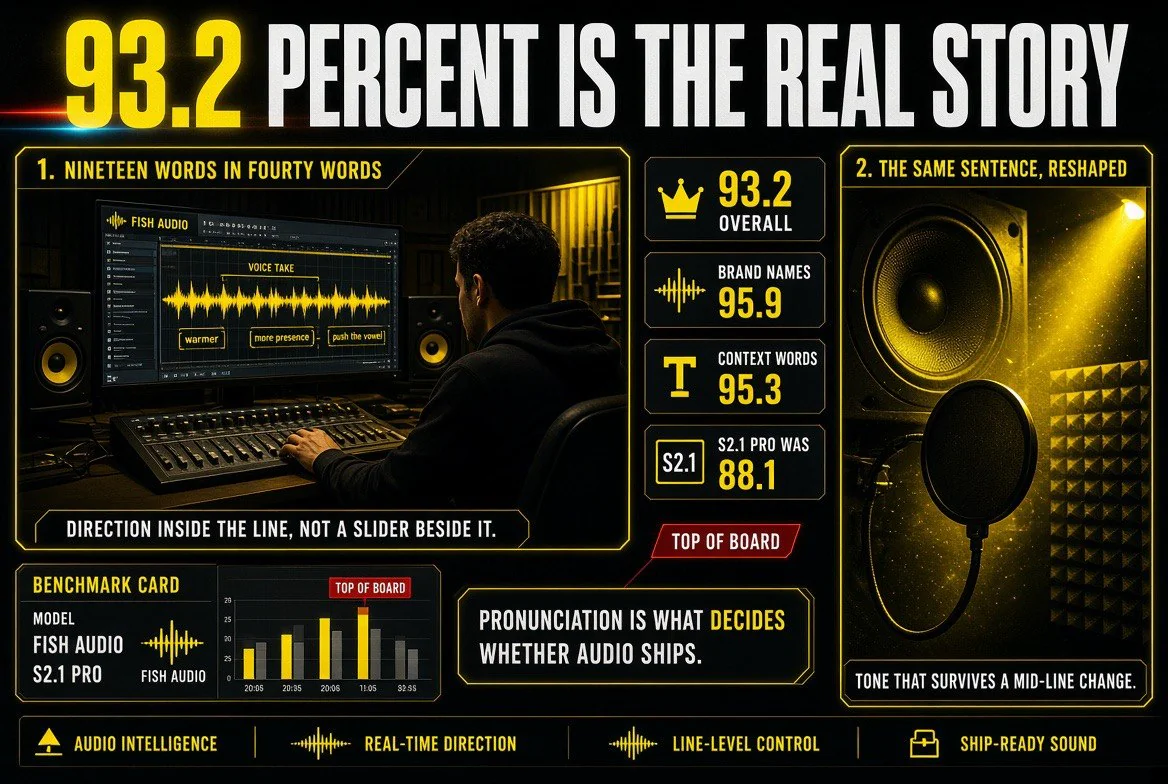
The measurable gain is in the words that used to break a take: brand names, places and context-dependent terms. That is the difference between a demo and a workflow.
The Celebrity in the Launch Video
Fish Audio’s launch video stars Uncle Roger — the comedian Nigel Ng’s character — directing an AI clone of his own voice. The company’s post notes pointedly that the clone was “made and used with his permission.”
I do not think that is cynical. I think it is the most revealing sentence in the entire announcement, because it is doing two jobs at once. It demonstrates the product with a voice people recognize, and it reassures the reader that the recognizable voice consented. A launch built entirely on permission, in front of a model that does not require it.
And then the post turns the demo into an invitation: “Uncle Roger’s voice is on Fish Audio, so you can direct him yourself.”
There is nothing wrong with that — Nigel Ng consented, and a licensed celebrity voice is a legitimate product. But it is worth sitting with what the frictionless version of this looks like at scale. The distinguishing factor between the launch demo and the problematic case is one man’s permission, obtained in advance, celebrated in a blog post. Two million community voices did not all arrive that way, and the platform’s own copy says so.
The Revenue Clause Is Doing More Work Than You Think
The $500,000 threshold deserves more scrutiny than it got in the launch coverage, because it decides who the consent rule applies to in practice.
Under the Community License v1.0, commercial use of Drama 3 is free if you and your affiliates earn less than US$500,000 a year. Above that, or if you want to offer Drama 3 to others as a text-to-speech, voice-cloning or inference service, you need a license from Fish Audio. Offering it as a service requires a license regardless of your revenue.
Fish Audio is upfront that the free grant is generous: monetised videos, audiobooks, client work, all permitted below the line. That is a real grant and it is more useful than most commercial TTS terms, which typically tie your rights to a seat count or a character budget.
The consequence is that the no-consent ban and the revenue ceiling are in the same document, which means the people most exposed to unverified cloning are also the people least likely to have a lawyer reading the clause. A solo creator under the threshold has a license, an obligation, and no institutional pressure to comply. A studio above it has a contract with Fish Audio and an actual business to lose.
Enforcement, in other words, is inversely proportional to the size of the party. That is not a Fish Audio innovation — it is how all open licenses work — but voice is the first medium where the input is a person’s identity rather than their code.
What to Actually Do About It
If you are a creator using Drama 3, the practical position is straightforward and mostly unglamorous.
Clone only yourself, or someone with written permission. Not verbal, not implied by an existing working relationship. Written, dated, and specific about where the output can appear. The license requires this and it is also just clean practice when the deliverable is going on a client’s channel.
If a client hands you audio of a third party, get the permission upstream. The most common failure mode in agency work is a brand supplying a voice clip of a spokesperson or a founder and assuming that settles it. It does not. You are the one running the clone.
If you are the person being cloned, assume the license is not protecting you. Ask the platform for the verification tier specifically, not a general assurance about consent policy. The difference between a policy and a gate is whether the clone can complete at all. Fish Audio’s PVC is a gate. Most platforms have a policy.
If you are building a product on Drama 3, read the service clause before you write code. The free commercial grant does not cover offering the model to others as a TTS or cloning service at any revenue level. That line separates “I use this in my videos” from “my startup is a voice API,” and it is the trap that catches teams who prototype under the free grant and then launch.
And one thing worth doing regardless: go read the license file itself on Hugging Face. It is short. The consent sentence is in there, plainly written, with no ambiguity about the obligation and no mechanism to check it. If you are going to rely on a rule, it is worth knowing exactly what you are relying on.
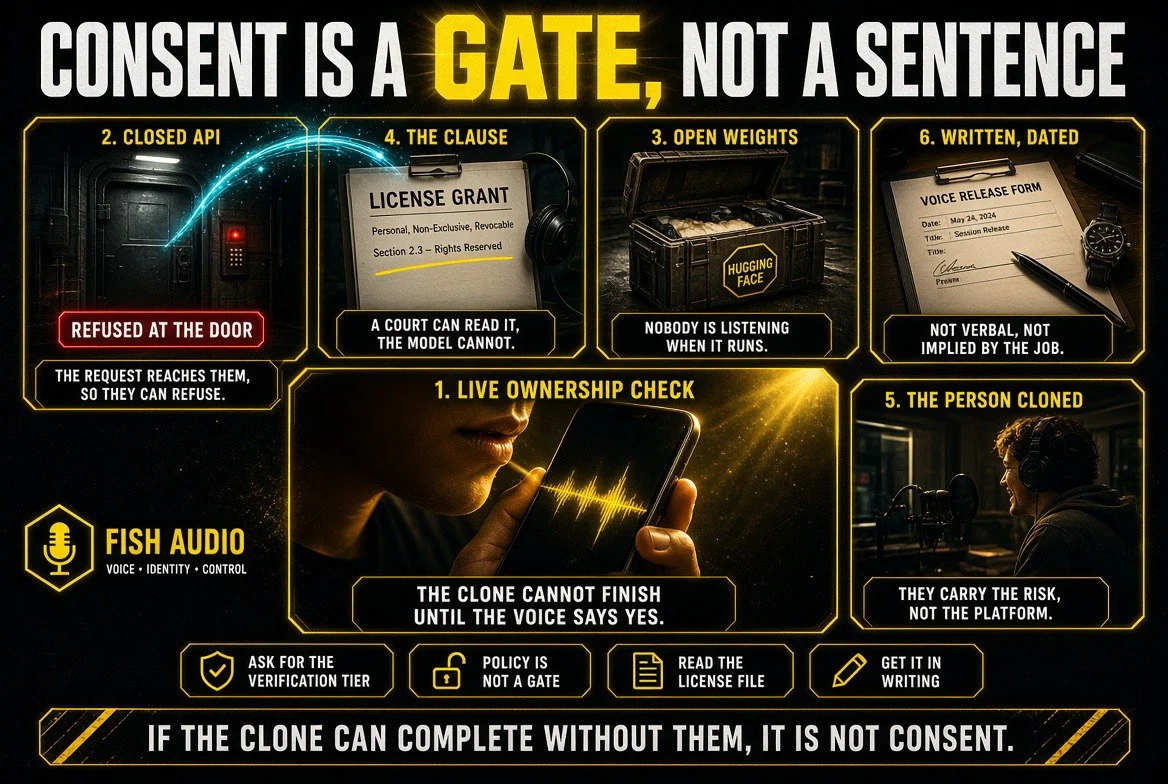
Six ways to tell a gate from a sentence. The test is not what the policy promises but whether the clone can finish at all without the voice owner saying yes.
Why This Matters Beyond Voice
Drama 3 is the clearest example yet of a pattern that is going to repeat across every generative medium, and it is worth naming before the next launch makes it feel normal.
Open weights are sold to creators as an ownership argument: you control the model, you are not renting access, the vendor cannot pull the rug. All of that is true, and it is genuinely valuable. What the argument leaves out is that a proprietary system enforces its safety rules through a chokepoint. Your request reaches their servers, they can refuse it, and the refusal is instantaneous and total.
Remove the chokepoint and you remove the enforcement. What remains is a license obligation on the honest and a technical capability in everyone’s hands. For code, that trade has been broadly worth it. For a model where the raw material is a human being’s voice, face or handwriting, the party who absorbs the cost of that trade is not the developer and not the platform. It is the person whose identity was the training data.
Fish Audio deserves credit for saying so out loud, for building the verification tier, and for refusing to pretend that a license clause is a safeguard. Their own words: voice actors have watched their recordings get cloned without permission, payment, or any say in where the result ends up. That sentence is in the vendor’s marketing copy, written by the vendor, about the category the vendor sells into.
The next time a model ships with a consent clause and downloadable weights, ask the question this launch makes unavoidable: is consent a gate, or is it a sentence? If it is a sentence, it protects the company that wrote it far more than the person it names.
Frequently Asked Questions
Is Fish Audio Drama 3 free to use commercially?
Yes, if you and your affiliates earn less than US$500,000 in annual revenue. Above that threshold, or if you want to offer Drama 3 to others as a text-to-speech, voice-cloning or inference service at any revenue level, you need a commercial license from Fish Audio.
Does the Drama 3 license ban cloning a real person without consent?
It does. The Fish Audio Community License v1.0 explicitly bans cloning a real person’s voice without their consent. The limitation is enforcement: because the weights run locally, Fish Audio has no technical way to verify compliance on an offline install.
How accurate is Drama 3 compared to S2.1 Pro?
Drama 3 scored 93.2% overall on Artificial Analysis’ Pronunciation Robustness benchmark versus 88.1% for S2.1 Pro. The largest gains were on brand names and technical terms (95.9% vs 87.3%) and context-dependent words (95.3% vs 86.1%).
What is the difference between Instant Voice Clone and Professional Voice Clone?
Instant cloning works from as little as ten seconds of audio and produces a rough likeness quickly. Professional Voice Clone trains on 10 to 180 minutes of clean audio and will not complete until the voice’s owner verifies by live recording that the voice is theirs. Only the professional tier includes a real consent gate.
Can I use Drama 3 to build my own voice API?
Not under the free grant. The Community License excludes offering Drama 3 to others as a text-to-speech, voice-cloning or inference service regardless of your revenue. Building a hosted voice product on Drama 3 requires a separate license from Fish Audio.
How many voice models are already on Fish Audio?
Fish Audio reported more than 2 million voice models in its community library as of July 2026, alongside 8 million creators, developers and enterprises on the platform and $21 million in annual recurring revenue.
About Barak Schurr
Barak Schurr is a serial entrepreneur who built and exited a major ticketing platform before turning his attention to AI and content. He runs three AI-focused research sites and writes about the tools, workflows, and strategies that let solo creators build real channels — without a crew, a studio, or a Hollywood budget.
Email: [email protected]
More AI Video Resources