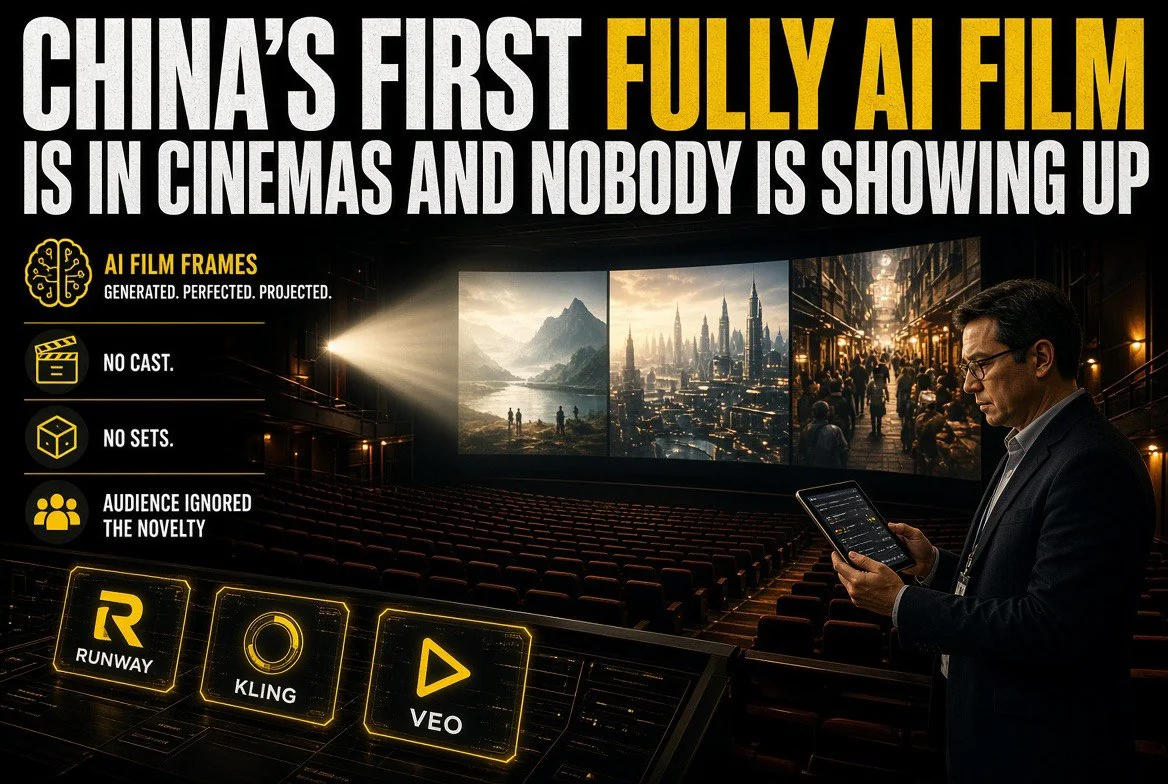
China’s First Fully AI Film Is in Cinemas and Nobody Is Showing Up
China’s First Fully AI Film Is in Cinemas and Nobody Is Showing Up
⚡ Expert Summary: China has released the first fully AI-generated feature film into cinemas, and the box office has been described, politely, as underwhelming. The industry read is that AI filmmaking isn’t ready. The correct read is that the film was sold on the wrong promise — the novelty of a machine making a movie — instead of the only thing that has ever sold a ticket, which is a story someone wanted to see. Creator takeaway: the technology has been sufficient for about eighteen months. The bottleneck was never rendering. It is the same bottleneck it has always been: a script worth 90 minutes of a stranger’s attention.
A fully AI-generated feature film has opened in Chinese cinemas. Every frame, as the marketing tells it, came out of a model. No cast, no sets, no location shoot, no crew of two hundred eating catering. It is the milestone the AI video industry has been promising since the first coherent generated shot landed, and it is now in theatres where real people can pay real money to watch it.
They are not.
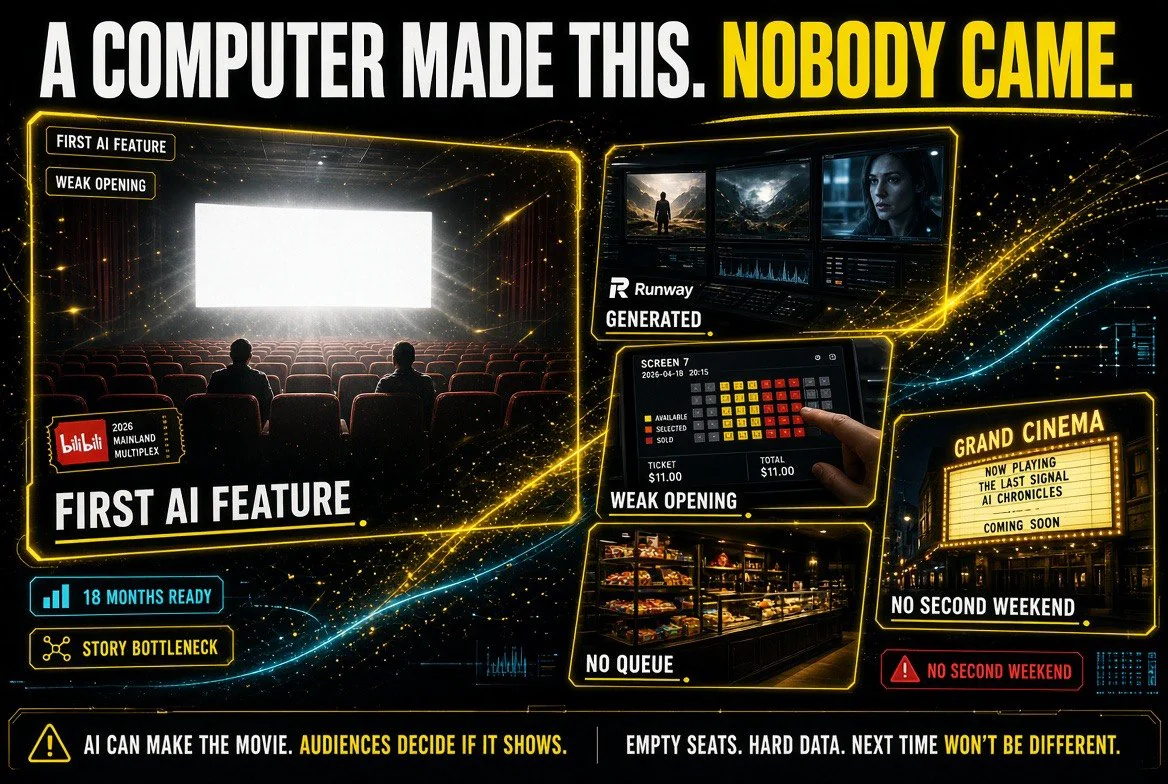
Coverage across NBC, the Taipei Times, and the Kuwait Times in the same week describes a release that has largely landed with a shrug — thin crowds, muted word of mouth, and the general sense that the milestone was more interesting to the people who built it than to the people who were supposed to buy tickets. That is the story everyone is filing.
But writing it up as “AI films flop” is lazy, and it lets everyone off the hook. The film didn’t fail because the technology isn’t good enough. It failed because it was launched as a technology demo and then asked to compete in a market that has never once rewarded a technology demo.
What Actually Happened in Those Cinemas
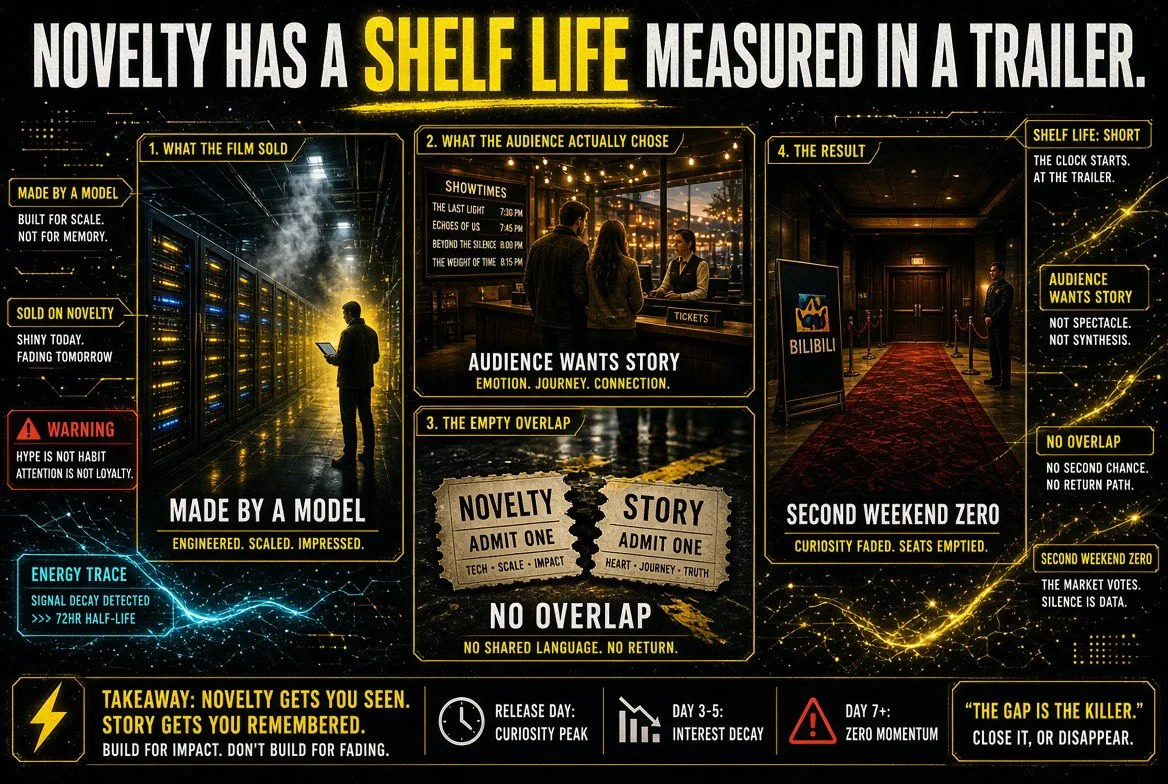
Consider what a Chinese cinema ticket actually buys in 2026. A weekend audience with a choice between a mid-budget drama with a known lead, an action picture with an established franchise, and a film whose entire marketing hook is “a computer made this.” The third option is not competing on story. It is competing on novelty, and novelty has a shelf life measured in a trailer.
The people most excited about a fully AI-generated feature are, almost without exception, the people who make AI video. That is a tiny audience. The audience in the cinema is not them. The audience in the cinema does not care how the frames were produced any more than they care what camera the last film was shot on. They care whether the two hours are worth the babysitter.
This is the gap that the entire AI film conversation keeps walking into. The industry treats production method as the value proposition. The audience treats it as invisible infrastructure — which, if the film is good, is exactly what it should be.
| What the AI film sold itself on | What the cinema audience actually buys on | Overlap |
|---|---|---|
| Every frame generated by a model | A story they were told about and wanted | None |
| No cast, no crew, no location shoot | Faces they want to spend time with | Negative — the absence is a cost, not a benefit |
| Low production cost | Production value they can feel on screen | Usually inverted |
| A technical first | A reason to leave the house tonight | One weekend, at most |
| Pitch to the industry | Pitch to the audience | Two different products |
That third row is the one that hurts. Cheap production is a business advantage for the studio and a red flag for the viewer. Audiences have spent a century learning that a certain density of image means a certain budget, and they read sparse or strange as “something went wrong.” Winning that back requires craft, not compute.
The Renders Are Not the Problem Anymore
Let’s be honest about where the tooling actually is, because the “AI film isn’t ready” take is roughly twelve months out of date.
A solo creator today can open Runway, Veo, or Kling and generate a shot with coherent motion, consistent lighting, and character continuity across a scene cut. Nine out of ten shots will be usable with enough attempts. That was simply not true in early 2025. The consistency problem — the thing that made AI film look like a slideshow of unrelated images — has largely been solved at the shot level, and is being solved at the scene level right now.
What has not been solved, and will not be solved by a model update, is the thing that decides whether anyone watches: the script.
Seventy percent of a film’s success is decided before a single frame is generated. Structure. Character want. The turn at minute forty. Whether the premise can survive being described out loud to someone who has not seen the trailer. AI video tools do not help with any of that. They help you execute a decision you have already made — and if the decision was “let’s make a film entirely with AI because that would be a first,” you have made a marketing decision, not a story decision.
What the Flop Actually Proves for Creators
For anyone reading this who makes AI video for a living, the Chinese release is genuinely useful — as a negative case study, not a setback.
Novelty does not scale. The “made entirely with AI” hook gets you press coverage, which gets you a curious opening weekend, which gets you an empty second weekend. Every AI-first project will run this arc. Budget accordingly.
The tool is invisible to the audience, and that is the goal. The creators making money with AI video right now are not selling the AI. They are selling a channel, a brand, a series, a face, an angle. The AI shows up only when they talk to other creators about how it was made.
Short-form is where the economics already work. A 90-minute feature is the hardest possible format to prove this technology in — longest runtime, highest audience patience requirement, most expensive marketing to fill a room. Meanwhile creators are shipping serialized short-form that holds attention for eight minutes at a time, costs nothing to distribute, and iterates weekly against real audience feedback.
Distribution beats production. A film that nobody knows exists fails identically whether a human or a model made it. The Chinese release had a novelty angle and no audience relationship. A creator with 200,000 subscribers and a mediocre AI film will out-earn an unknown studio with a technically flawless one, every time.
The Counter-Argument: Maybe the Film Was Just Bad
There is a version of this story where the technology is fine and the film is simply not good — and it’s worth taking seriously, because it’s probably partly true and it doesn’t change the conclusion.
First features are usually bad. That is not an AI problem, it is a filmmaking problem, and the base rate for first-time directors is brutal regardless of toolset. If a model-generated debut lands flat, the most parsimonious explanation involves the script, the pacing, and the absence of a star — none of which require the word “AI” to explain.
The trouble with that framing is that it removes the industry’s excuse. If the film failed for ordinary filmmaking reasons, then the AI part worked — it produced a real film that could be distributed and judged on normal terms. Which means the barrier to making a feature is now low enough that the barrier to making a watchable feature is the only barrier left, and that barrier is talent, not compute.
That is a much more interesting problem. And it is a problem that favors creators who have been building an audience and learning story, not creators who have been collecting model releases.
What To Actually Do With This
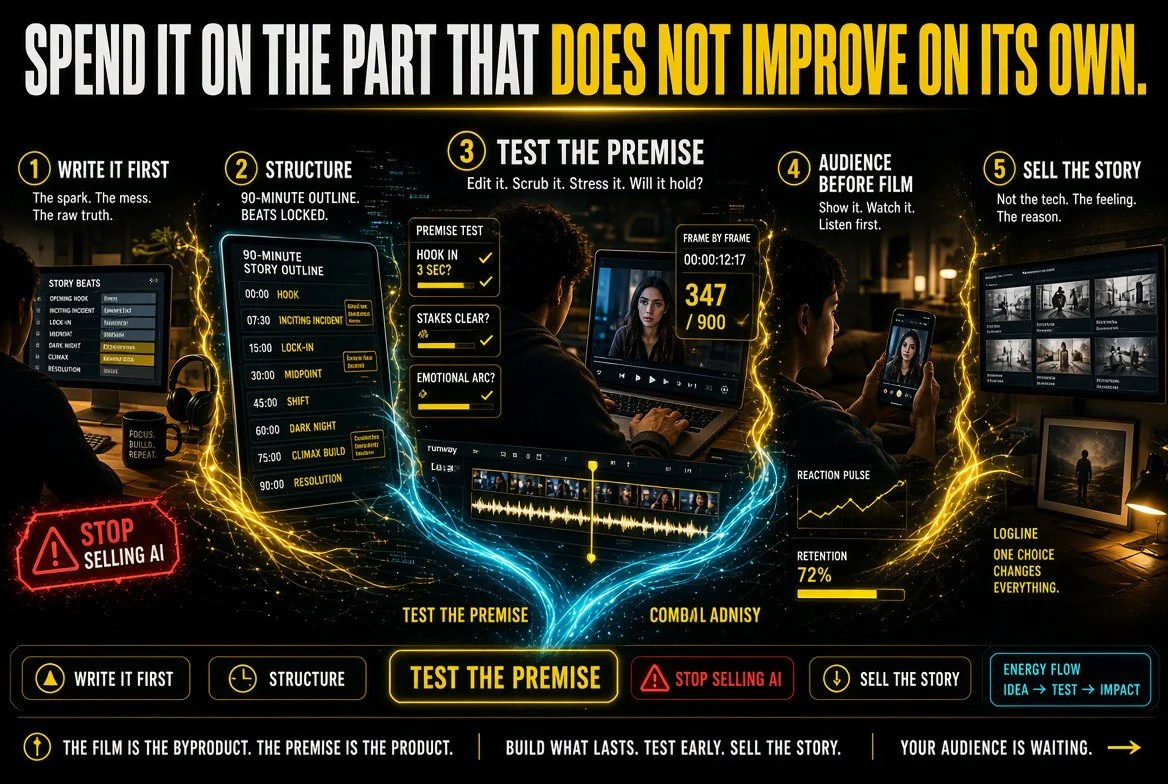
If you are a solo creator with an AI video pipeline and ambitions beyond short-form, the lesson is not “wait for better models.” The models improved eleven times while this film was in production. The lesson is to spend your next project on the part that does not improve on its own.
Write the thing first, in prose, with no visuals attached. If the 90-minute outline does not hold up as a written document, no amount of generated imagery will save it. Read it to someone who does not care about AI and see if they ask what happens next.
Build the audience before the film, not after. A feature is a monetization event for an existing relationship, not a way to create one. Creators who launch a feature into an audience of zero are asking distribution to happen by luck.
Test the premise in the cheapest format you have. If the core idea can’t hold a three-minute short that people finish, it will not hold ninety minutes. Short-form is free market research — use it before you spend a year of render time.
Stop treating “fully AI” as a selling point. Say what the film is about. If the only interesting thing about it is how it was made, the audience will correctly conclude there is nothing else interesting about it.
The first fully AI feature film is now a historical fact, and it will be remembered as a footnote rather than a landmark. Not because the technology failed — because the film was sold on the technology. The next one that works will be sold on a story, and most people watching it will never know how it was made. That is what winning looks like.
Frequently Asked Questions
What is China’s first fully AI-generated feature film?
It is a feature-length film marketed as having every frame generated by AI models, released into Chinese cinemas in October 2026. Coverage from NBC, the Taipei Times, and the Kuwait Times described weak audience turnout despite the technical milestone.
Why did the fully AI film fail at the box office?
It was marketed on production method rather than story. Cinemagoers buy tickets based on premise, cast, and word of mouth, not on how the frames were generated, so the novelty hook had no second weekend behind it.
Is AI video generation good enough to make a feature film?
Technically, largely yes. Current tools including Runway, Veo, and Kling produce shot-level consistency good enough for continuous narrative. The remaining bottleneck is script, structure, and audience relationship — not rendering quality.
Should creators make a full AI feature film now?
Only with an existing audience and a script that works as written prose first. A feature is a monetization event for a relationship you already have, not a way to create one. Short-form series test the same premises far more cheaply.
What does the flop mean for the AI film industry?
It moves the bar from technology to craft. The novelty of machine-generated cinema has been spent, and future AI films will be judged on the same terms as any other film — story, pacing, and whether anyone wants to watch them.

About Barak Schurr
Barak Schurr is a serial entrepreneur who built and exited a major ticketing platform before turning his attention to AI and content. He runs three AI-focused research sites and writes about the tools, workflows, and strategies that let solo creators build real channels — without a crew, a studio, or a Hollywood budget.
Email: [email protected]
More AI Video Resources