YouTube Wrote the Study That Says You Love AI
YouTube Wrote the Study That Says You Love AI
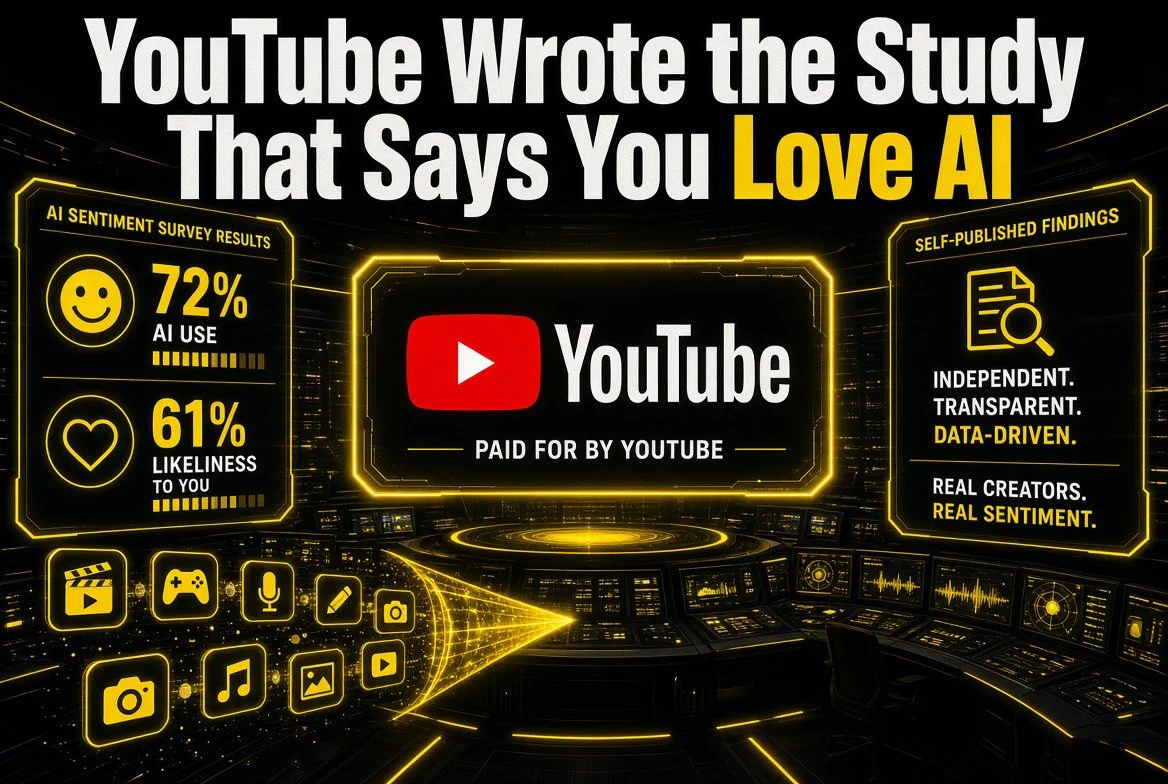
⚡ Expert Summary: YouTube’s Culture and Trends team partnered with NRG to survey 694 people who uploaded video in the past 12 months. The finding everyone is quoting: most respondents feel positive about AI, 72% already use it on video and images, and 61% want to insert their own likeness into their content. The problem is not the data. It is who paid for it, who framed the questions, and who published the conclusion three days before the answer became useful to YouTube’s own policy. This is a company grading its own homework and handing out the marks.
YouTube commissioned a study about whether creators like generative AI. YouTube ran it through its Culture and Trends team. YouTube published the results. YouTube is now pointing at the results as evidence that creators are fine with the AI rollout YouTube is doing to them.
Read that sequence out loud and it sounds like a joke about corporate research. Except it is how a slice of platform policy now gets made.
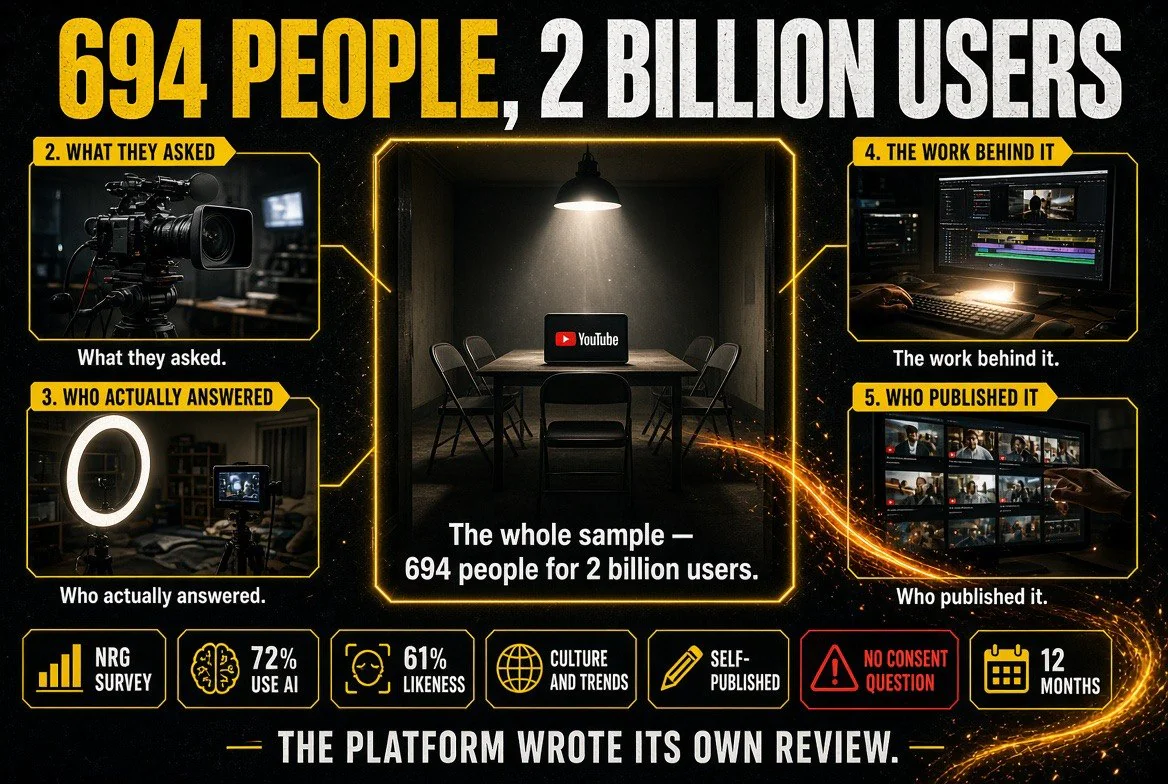
The survey itself is real and the numbers are specific. NRG polled 694 U.S.-based “video posters” — people who had uploaded video content in the past 12 months. Within that sample, 72% said they use AI on video and images. 61% said they are interested in using AI to insert depictions of their likeness into their content.
Now the part YouTube’s press framing left out: the same period in which those 694 people answered questions about how much they like AI is the same period in which creators were publicly accusing the platform of scraping their videos without consent, quietly upscaling their work, and flooding the recommendation system with generated slop.
The Sentence That Gives the Game Away
Tubefilter, which reported the survey, wrote the fair version of the caveat: “YouTube has ulterior motives behind its decision to champion generative AI. The Culture and Trends team should be expected to boost the products YouTube is rolling out, even if some creators might have dissenting ideas.”
That is the entire argument, and it took two sentences.
The Culture and Trends team is not an independent research body. It is a marketing and insight function inside the company whose products the research is evaluating. Its output is designed to be quotable in exactly the way this output is being quoted — as proof that the platform’s direction is wanted by the people it affects.
No one should be surprised by this. What should concern creators is how readily an in-house survey of 694 people becomes the sentence “creators like AI.”
| Question You’d Want Answered | What the Survey Actually Asked | Why the Gap Matters |
|---|---|---|
| Do you consent to your videos training models? | Do you use AI on video and images? (72% yes) | Using a tool is not consenting to be the raw material |
| Has AI hurt your reach or income? | Do you feel positive about AI? | Attitude is not impact |
| Do you want AI labels on synthetic video? | Interested in inserting your likeness? (61% yes) | Opting into a feature is not endorsing the policy |
| Is the AI slop problem affecting you? | Not disclosed in the published summary | The complaint most creators raise is absent |
694 People Is a Sample, Not a Movement
Seven hundred respondents, minus the ones who dropped out or were screened, is a workable consumer survey. It is not a mandate for a platform with more than two billion logged-in monthly users.
It is also a sample of “video posters” — people who uploaded something in the last year. That definition sweeps in everyone from a creator with a weekly show and 400,000 subscribers to someone who posted one clip from a holiday. Both count equally in a 72% figure. One of them has a career riding on the platform’s AI decisions. The other has an account.
YouTube’s own reporting does not break the numbers down by channel size, revenue dependence, or whether the respondent’s content had already been affected by AI tools. Those are the cuts that would tell you whether the people with the most to lose feel the same way as the people with the least.
They were not published. The headline percentage was.
Remember What Creators Were Saying in the Same Twelve Months
The survey window — the last twelve months of uploads — is not a quiet period in YouTube’s relationship with its creators.
Tubefilter’s own framing of the criticism: “Creators have cried foul as LLMs have scraped videos without consent, surreptitiously upscaled existing content, and flooded YouTube with a deluge of slop.”
That is not a small gripe list. Consent, alteration, and saturation are the three things a creator’s business model actually rests on. If your work can be ingested without permission, re-rendered without disclosure, and buried under infinite generated competitors, you do not have a distribution platform. You have a landlord who also rents your floor space to a machine that copies you.
And in September 2024, a Tubefilter headline read: “70% of creators say AI is a threat to their careers.”
Two years apart, two surveys, two opposite headlines. The 2024 number came from a different sample and a different question. But the contrast is the story: the sentiment metric moved exactly as far as the survey’s sponsor needed it to.
| Finding | Who Ran It | What It’s Used For |
|---|---|---|
| 72% use AI on video and images | YouTube Culture and Trends + NRG, 694 respondents | Justifying AI feature expansion |
| 61% want AI depictions of their likeness | Same survey | Marketing likeness tools as creator demand |
| 70% of creators say AI threatens their careers | Independent survey, September 2024 | Not quoted by the platform |
The Likeness Feature Is the Tell
Of everything in the report, the 61% likeness number is the most revealing, and not in the way YouTube intends.
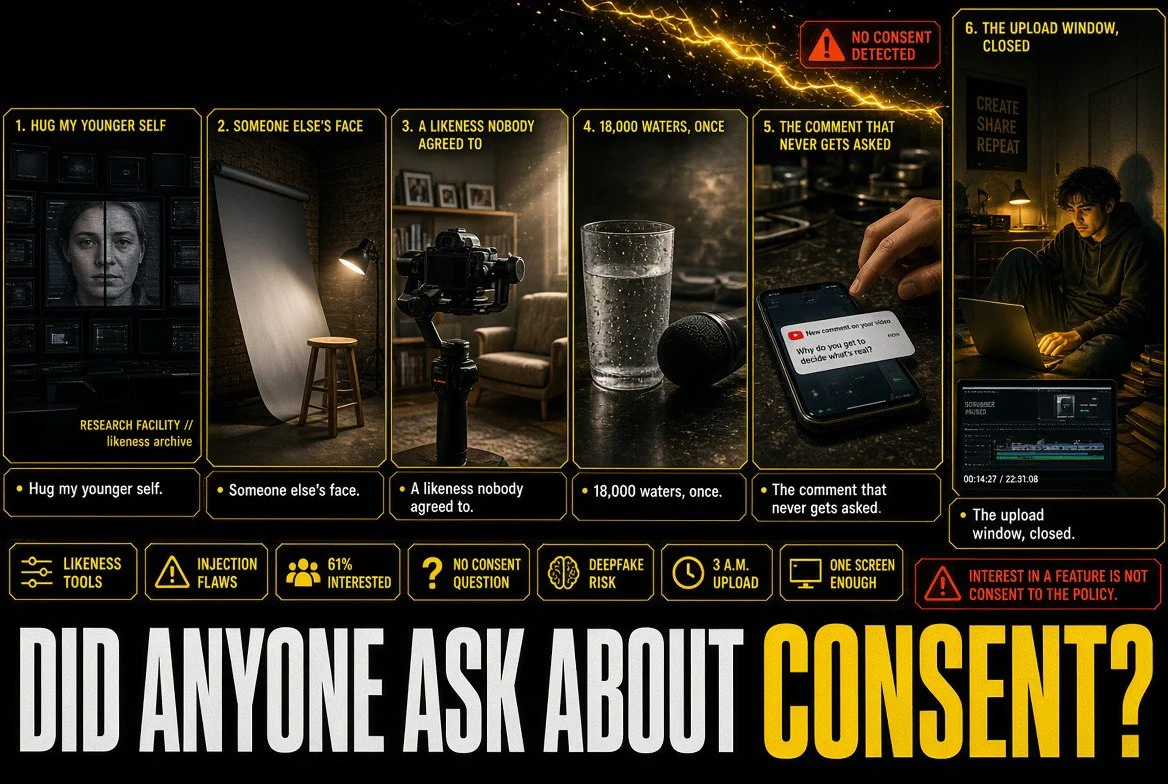
The report frames self-likeness generation warmly: creators generating past versions of themselves, “hug my younger self,” playing with identity and alternate selves. “For some AI experimenters, the technology is a way to play with the different aspects of their self-identity and imagine alternate selves,” it reads. “By using it to visualize their complex emotions, people turn knotty feelings into cathartic imagery that others can empathize with.”
That is a genuinely lovely use case. It is also, technically, the same capability that lets a stranger put your face into content you never agreed to appear in. The engine does not know whether the person typing the prompt is you.
A platform that is simultaneously publishing research celebrating likeness generation and tightening rules about synthetic content has to reconcile those two things in public. A survey asking whether creators are
interested
in a feature is not that reconciliation.
What This Means for Creators — and for Anyone Using AI Video
If you make video, the real takeaway is not “YouTube says you like AI.” It is that the research function of your distribution platform now produces evidence used to justify the platform’s own product decisions. Plan accordingly.
Assume your catalogue is training data until told otherwise in writing.
The consent complaints in the record did not produce a clear, permanent, per-video opt-out summary in this reporting. If a client asks whether their footage can be used to train a model, the honest answer is that it depends on platform terms most people have never read.
Disclose your AI use before someone discloses it for you.
Platforms are moving toward labeling. Being early, deliberate, and consistent about what is generated in your work protects you when the detection is imperfect and the accusations are not.
Read the sponsor before the finding.
Any study about creator sentiment toward AI should be read with a single question first: who paid for it, and what decision does the finding support? The 694-person survey tells you what YouTube wants to be true. It does not tell you what the median creator with a mortgage and 40,000 subscribers actually thinks.
Keep your own numbers.
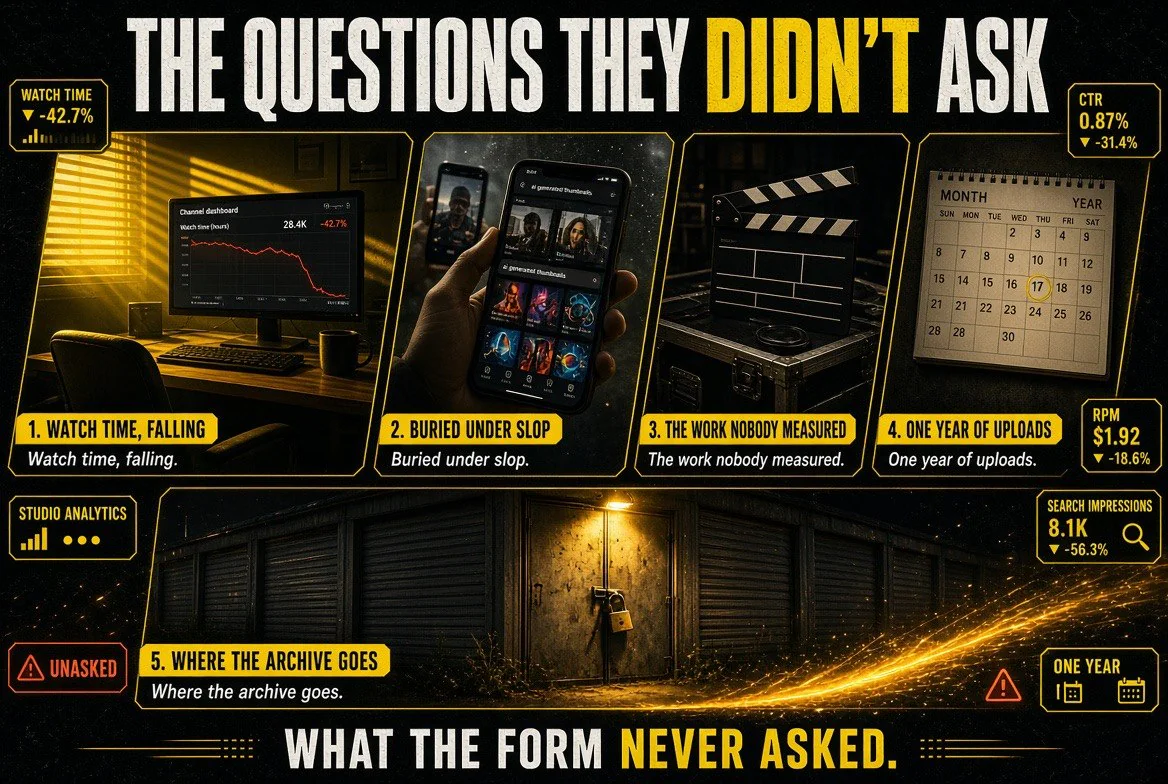
Watch time, CTR, revenue per mille, and search impressions from tools you run through YouTube Studio and third-party analytics are the only data about your channel that no one else’s survey can overwrite.
The Counter-Argument, Stated Fairly
The strongest defence of the survey is that the findings may simply be accurate, and the caveat was published alongside them. Tubefilter noted that “criticisms of AI get lots of attention, but YouTube is showing that there are still people with positive attitudes hiding among the skeptics.” A team that only ever published flattering numbers would not have let that framing through — and a great many creators genuinely do use these tools daily, happily, without any crisis of conscience.
That is fair, and it should be said plainly. But it does not answer the policy question. Whether individual creators enjoy using generative tools is not the same as whether the platform’s AI ingestion and labeling rules are just. Those are two different questions, and one of them is much harder to survey than the other — which is precisely why the easy one got asked.
The Question Nobody Put on the Form
Here is the survey YouTube did not run: “Has a video of yours been upscaled, re-rendered, or re-uploaded by an AI tool without your permission in the last twelve months?”
Or: “Has a generative video channel competed with yours in the recommendations for content you spent a week making?”
Or, most simply: “Do you feel more or less secure about your income on this platform than you did a year ago?”
Those answers would not have made a press-friendly number. That is not evidence that they were avoided on purpose — but it is evidence that a company running its own research gets to choose which questions get asked, and 694 people answering the chosen questions is not the same thing as a creator base giving consent.
The defendant wrote the report. The report says everyone is fine.
Frequently Asked Questions
What did YouTube’s study actually find?
YouTube’s Culture and Trends team partnered with NRG to survey 694 U.S. video posters. 72% said they use AI on video and images, and 61% said they are interested in inserting depictions of their likeness into their content. Most respondents held positive attitudes about AI.
Who conducted the survey?
YouTube’s internal Culture and Trends team worked with research firm NRG. The platform both commissioned and published the findings.
How many people were surveyed?
694 respondents, all described as U.S.-based “video posters” who had uploaded video content in the previous 12 months.
Why is the survey controversial?
Because the company whose AI products the research evaluates commissioned, framed and published it, then used it as evidence that creators welcome those products. Critics note the sample size is small and the questions do not address consent, reach, or income impact.
Have creators complained about AI on YouTube?
Yes. Creators have raised concerns about models scraping their videos without consent, AI tools upscaling existing content, and generated content flooding the platform and competing in recommendations.
What about previous surveys on creator attitudes to AI?
A September 2024 survey reported that 70% of creators described AI as a threat to their careers — a very different headline from the current findings, from a different sample and question set.
What is the “hug my younger self” example?
It is a use case highlighted in YouTube’s report where creators use generative tools to depict and interact with younger versions of themselves, framed as a way of exploring identity and emotion.
Are AI likeness tools safe for creators to use?
The same capability that lets you generate your own likeness can be used to generate someone else’s. Check a tool’s consent requirements and output watermarking before uploading your face or a client’s.
Does this mean YouTube’s AI features are bad?
No. It means the case for them is being made with evidence the company produced about itself. Whether the features are good is a separate question from whether that evidence should settle the argument.
What should creators do about it?
Track your own channel metrics, disclose AI use clearly, assume your catalogue may be treated as training data unless terms say otherwise, and read who sponsored any survey before accepting its conclusion.

About Barak Schurr
Barak Schurr is a serial entrepreneur who built and exited a major ticketing platform before turning his attention to AI and content. He runs three AI-focused research sites and writes about the tools, workflows, and strategies that let solo creators build real channels — without a crew, a studio, or a Hollywood budget.
Email: [email protected]
More AI Resources for Your Business