
AI in Film Is Coming and It Can’t Be Stopped! What the Top Festivals Are Doing About It
AI in Film Is Coming and It Can’t Be Stopped! What the Top Festivals Are Doing About It
⚡ Expert Summary: Three Oscar-qualifying animation festivals now hold three incompatible positions on the same film. Manchester Animation Festival bans any final moving image “generated or transformed” by a generative model and keeps your $70 to $125 entry fee, Annecy asks you to justify the tooling in writing, and Ottawa wants to see an artist’s hand in the pixels. The Academy says only that it will ask. There is no standard, nobody is writing one, and the person paying for that is the filmmaker holding a non-refundable receipt.
On the afternoon of Friday 13 November 2026, Manchester Animation Festival handed out its awards, announced almost 12,000 admissions across five days, and then quietly published the most consequential document in independent animation this year.
It is five pages long. It is called a Generative A.I Policy for Filmmakers. And in the plainest sentence anyone in this industry has written, it says this: “If any part of the final moving image has been generated or transformed by a generative audio, image or video model, it will be deemed ineligible for the festival.”
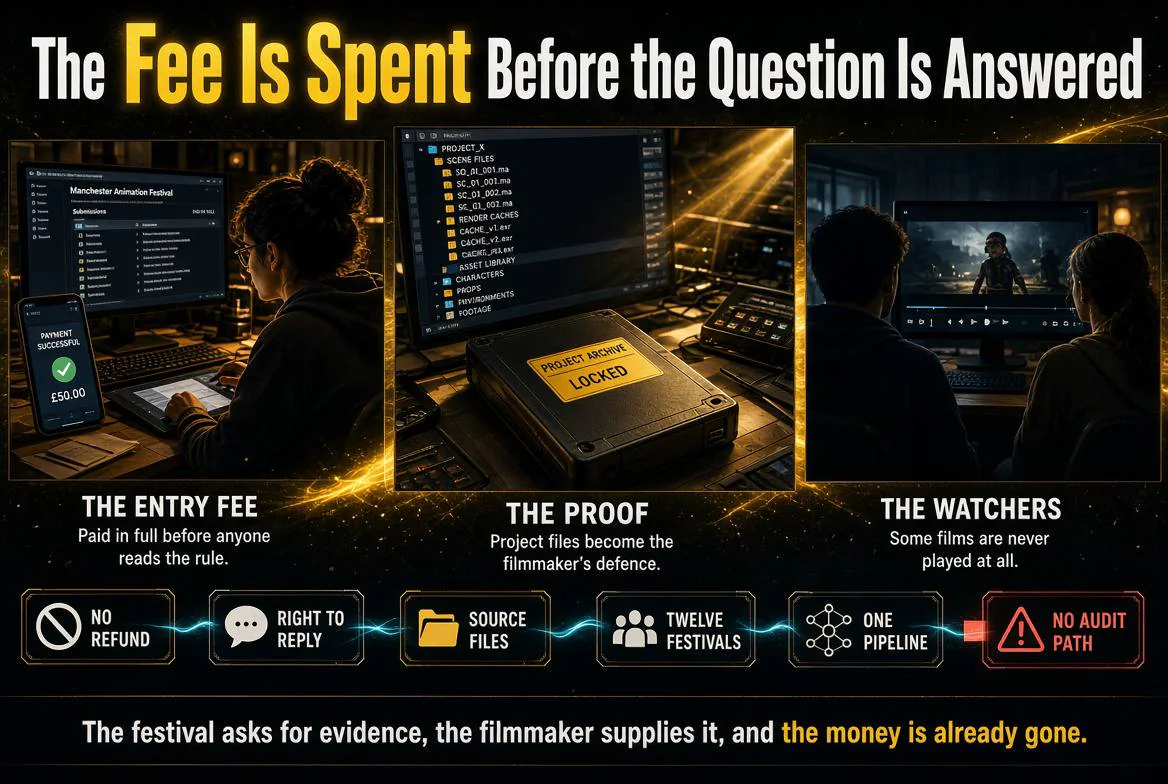
Read the next line, because this is where the argument lives. “If you submit work to the festival that is Gen A.I we will not be obliged to watch it. You will not be entitled to a refund as per our terms.”
Manchester is the UK’s only Oscar and BAFTA-qualifying animation festival. It sits on a circuit where a short film can turn a career from a favour into a job. And it has just told the world that a filmmaker can spend a year and a few hundred pounds on a submission, discover after the fact that their compositing pipeline crossed a line nobody drew in advance, and receive nothing back. Not a rejection letter with a reason. Not a screening. Not the fee.
Worse, Manchester is not the outlier it looks like. It is one of three answers to a question the international festival circuit has not agreed on: does a film made with generative AI count as film? Annecy says justify it. Ottawa says show me your hand. Manchester says don’t bother, and keep the receipt. The Academy of Motion Picture Arts and Sciences, the body that decides what an Oscar is, says it will ask.
That is not a policy landscape. That is four separate countries drawing four separate borders through the same territory, and charging admission to each.
Manchester Drew the Clearest Line in the Industry, And Then Kept Your Money
Start with the document itself, because almost every take on this story so far has been written off a press release and the press release leaves out the part that matters.
Manchester’s policy does not ban “AI”. It bans a specific relationship between an artist and a moving image. The policy divides filmmaking into three forms: animation, which it defines as “the creation of movement” by hand; live action, “capturing movement”; and generative AI, which it calls “a calculation of movement”. Everything downstream follows from that taxonomy, and the taxonomy is genuinely thought through in a way most festival rules are not.
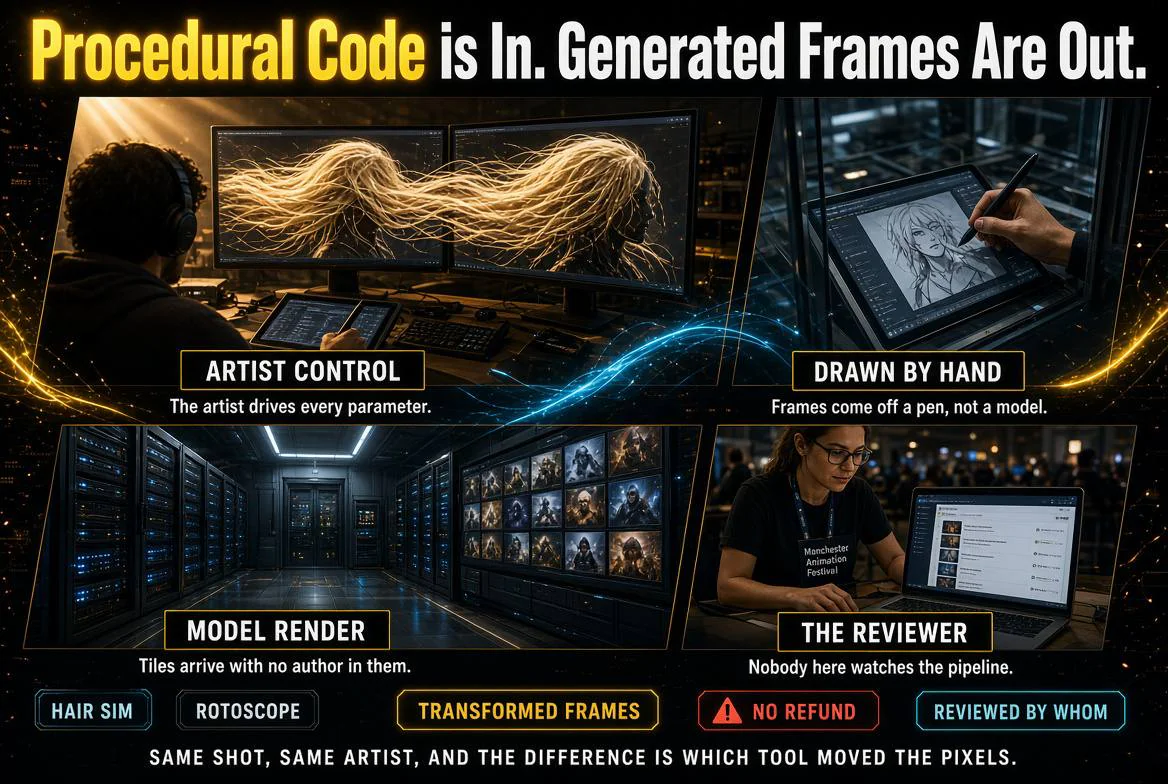
Procedural computer animation survives. Manchester explicitly protects “using coding to generate crowd scenes or hair simulation” and other automated processes, provided “the artist is in control of the input and the outcome”. Their reasoning is worth quoting verbatim because it is the sharpest sentence in the whole debate: with generated animation, “control of the motion is done at the hands of an artist with their decisions producing the final outcome”. A hair sim is a tool the artist drives. A generative model is a tool that drives itself and shows you an approximation afterwards.
Traditional rotoscoping survives too, and this is where the policy earns its keep as an editorial document rather than a compliance form. Manchester writes that it “would recognise a rotoscoped film as fully animated because the final work presented has been done using the artists hand, assisted by live action”. Then the trapdoor: “a film using Gen A.I to calculate motion using rotoscoping is fully generated, so the finished thing we see is fully generated and as such is ineligible.”
Same technique. Same reference footage. Same filmmaker at the same desk. One version is eligible for an Oscar-qualifying festival and one is disqualified before anyone watches it, and the difference is whether the in-between frames came out of a pencil or out of a model.
That is a real line. It is also, and this is the part Manchester’s own document will not resolve for you, a line drawn through the middle of modern production. Nobody in a 2026 short film pipeline is doing pure hand rotoscoping on a deadline. They are doing hybrid work.
The Hybrid Problem Nobody Has Audited
Here is the gap, stated plainly, because the policy documents do not state it at all.
Consider a filmmaker using a generative model for two narrow technical steps: matte extraction on a hair-heavy live-action plate, and lighting isolation so the compositor can relight a shot without reshooting it. Neither step is in the final image as a creative decision. Both are the modern equivalent of a rig removal. Under Manchester’s wording, both may be enough to poison the whole film: if any part of that final moving image was “transformed by a generative audio, image or video model”, the film is ineligible.
Now look for the audit procedure. There isn’t one. No festival in this chain publishes a method for examining a hybrid pipeline, no accepted list of “safe” generative operations, and no threshold for how much of a frame a model may touch before the frame stops counting as human work. What Manchester does have is a Right to Reply clause, and it is the clearest statement of where the burden has landed.
Read it: “If you wish to clarify, contest or defend a particular method of filmmaking you can contact the festival team to discuss. The MAF team will require evidence that your film does not violate this policy which will be reviewed by the festival team and/or third parties.”
Evidence. That means project logs and source files, handed over to a festival, reviewed by the festival and possibly by unnamed “third parties”, so that a filmmaker can prove a negative about their own process. The creator does the paperwork. The creator supplies the audit trail. The creator pays the fee first.
And detection, the thing that would make all of this enforceable without the paperwork, does not exist in any reliable form. Nobody watching a finished animation short can tell you whether the in-betweens were drawn or interpolated. Provenance standards, watermarking and C2PA-style content credentials all attach best to generated media and least well to the second half of a pipeline, where a human draws over a model’s output and the metadata quietly dies. A festival with this policy is not running a test. It is running a disclosure regime with a forfeiture clause, and forfeiture regimes only work on people who tell the truth.
Three Festivals, Three Verdicts on One Film
Manchester did not invent this problem alone. It answered it in isolation, months after everyone else answered it differently. Look at what the same film would face on the same circuit.
The other major animation festival, Annecy, sits at the opposite end of the spectrum. Its rules do not ban generative visuals. They require the filmmaker to explain them, and specifically require projects “featuring visuals generated by artificial intelligence” to “include and justify the creative process as well as the tools used”. Justify is a strange verb for a rulebook and an excellent one for a festival: Annecy has decided that authorship is an argument you make, not a property the festival can test for.
Ottawa International Animation Festival takes a third position in its own official rules, and it is the most human-sounding of the three. AI-assisted work is acceptable “as long as there is some sign of the artists’ hand”; fully generated work is out; and passing off another artist’s work as your own gets you banned, no exceptions.
Read those three sentences together against a single submission and you can see the absurdity. A film with a Midjourney concept board, a hand-drawn final line and generative matte extraction is a justification problem at Annecy, a judgement call about the “artist’s hand” at Ottawa, and very possibly a disqualification with no refund at Manchester. The film is identical. The verdicts are not.
| Factor | Manchester Animation Festival | Annecy | Ottawa (OIAF) |
|---|---|---|---|
| Position on generative AI | Ineligible if any part of the final moving image was generated or transformed | Permitted with a written justification of process and tools | AI-assisted allowed where there is some sign of the artist’s hand; fully generated is out |
| What the filmmaker must supply | Evidence on request via Right to Reply, including project logs and source files | An explanation of the creative process and the tools used | A film in which human work is visible in the final image |
| Procedural code (hair sim, crowd generation) | Protected, as long as the artist controls input and outcome | Covered by the justification route | Reads as assistive and artist-directed |
| Manual rotoscoping | Eligible, described as fully animated | Not a stated exclusion | Not a stated exclusion |
| AI used for rotoscoping or cleanup | Ineligible, described as fully generated | Requires disclosure and justification | Judged on whether the artist’s hand shows |
| Fee refund on an AI rejection | No refund, and no obligation to watch | Not addressed in the AI wording | Not addressed in the AI wording |
| Oscar-qualifying | Yes, Oscar and BAFTA qualifying | Yes | Yes |
This is what a missing standard looks like in practice. Three flagships of the same art form, in the same qualifying year, disagreeing not on a detail but on whether the work is art at all. And the disagreement is not a scandal anyone is fixing. Manchester’s policy carries its own review date, August 2027, which is as close as any of these documents comes to admitting that the line will move again.
What the Ban Actually Costs a Filmmaker
Now the money, because the money is the only part of this that is unambiguous.
Festival submission is not free, and animation is the most expensive end of short filmmaking. Entry fees on the animation circuit run from roughly $30 to $70 for regional and smaller shorts festivals and $70 to $125 per deadline tier for the major Oscar-qualifying flagships, with the price climbing at each tier as the deadline approaches and no refund for a rejection at any of them. A short with a real campaign behind it is submitted to a dozen or more festivals. That is a four-figure line item before travel, before a DCP, before the poster.
Under Manchester’s rule, the risk is not the standard submission rejection. Everyone in this industry eats those. The risk is that the fee is spent before the question is answered, and the question is answered by the festival alone, after the fact, with no obligation to watch the work and no obligation to return the money. The festival’s own language is explicit that a Gen A.I submission will not even be viewed. A filmmaker can pay to have a film refused sight unseen because a clause they read afterwards covers a step they never considered part of the artwork.
| Cost line | Typical range (USD) | What the ban changes |
|---|---|---|
| Single regional shorts entry | $30 to $70 | Non-refundable if a generative step is later judged disqualifying |
| Single major qualifying entry, per deadline tier | $70 to $125 | Same exposure, larger loss, and no viewing guaranteed |
| Full campaign across a dozen festivals | Four figures across tiers | Each festival applies a different rule, so the risk cannot be priced once |
| Proof of process for a Right to Reply | Unbudgeted time and archive work | Project logs and source files become a deliverable |
That last row is the one the industry will feel and no policy document accounts for. Source files for a finished animation are not a neat folder. They are layered scene files, links to assets that may have moved, version stacks, render caches and a folder of reference footage with a licensing question attached. Assembling a defensible audit trail after the fact is days of work, and that work is now a hidden production cost of submitting to a British festival.
Tribeca Already Programmed a Fully AI-Generated Film
Every strong argument has a fact that resists it, and this piece would be dishonest without the one that resists mine.
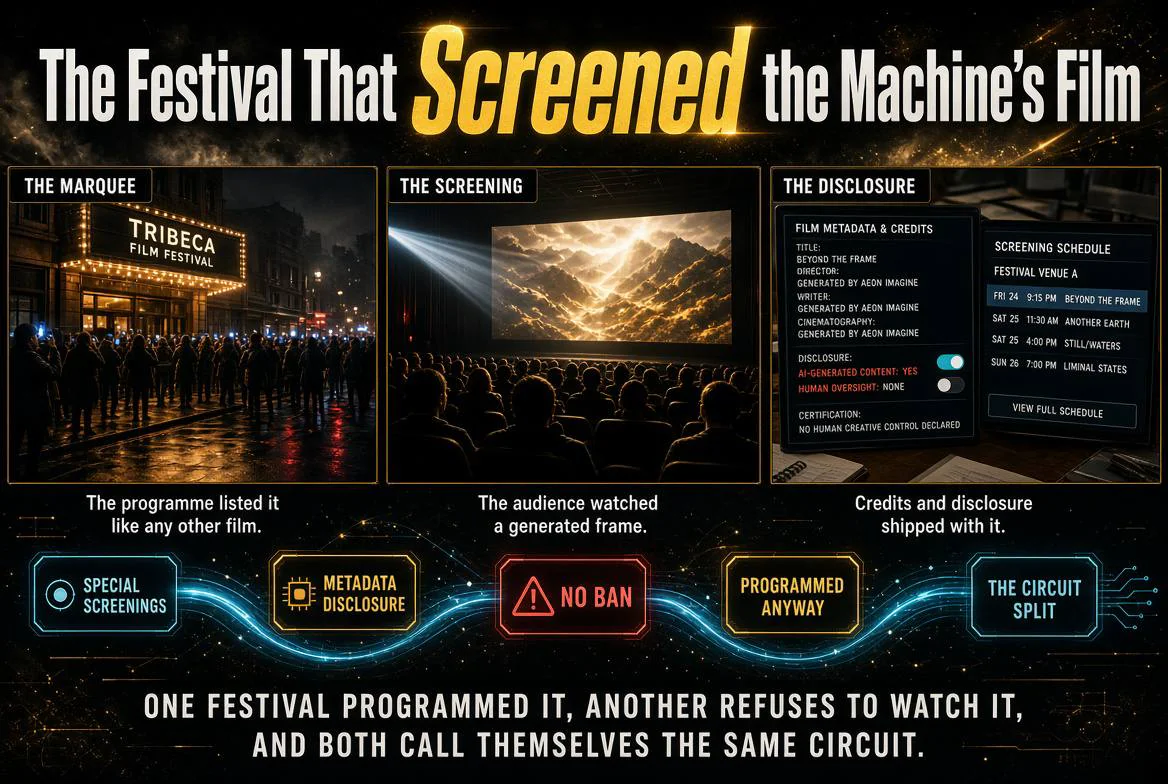
The gatekeepers have not all said no. Tribeca screened fully AI-generated work. Ash and Pooya Koosha’s Dreams of Violets was programmed into special screenings, presented with metadata and credit disclosure, which is to say: a major international festival looked at the most extreme version of this question and chose the screening slot over the ban. Not a workshop. Not a panel about the future. A film, in the programme.
So the tidy story, “the festivals have closed ranks against AI film”, is false, and any writer selling it is selling you a mood. What is actually happening is more interesting and less flattering. The circuit is not closing ranks. It is split, publicly and without embarrassment, and each festival is deciding on its own terms while its own marketing department tells a different story than its rules do.
That split is why a filmmaker cannot plan. A ban is at least knowable. What makes this landscape hostile is that the answer changes with the postcode of the submission portal, and the flagship that welcomes the film may sit two hours from the flagship that disqualifies its making.
The Academy Says It Will Ask, Which Is Not a Policy
The rule everyone quotes in arguments like this one is the Academy’s, approved 1 May 2026, which allows the Academy to “request more information about the nature of the use and human authorship”. That is it. That is the world’s most powerful film body, in the middle of the largest shift in image-making since sound, reserving the right to ask a follow-up question.
It is also, importantly, not a festival rule and not a gate. A ban at Manchester does not bar a film from Oscar eligibility. The Academy decides independently, on its own criteria, and no festival’s disqualification automatically travels into the Academy’s process. The two systems do not talk to each other. A film can be unwatched in Manchester and nominated by the Academy, and a film can win in Annecy because it justified its tools beautifully and still fail an Academy query about human authorship.
Meanwhile the Oscars keep the one thing nobody is arguing about: the animated feature and short categories are decided by a branch of professionals whose craft identity is bound up in exactly the question Manchester just answered. That branch has not been asked to define animation, and the moment it is, the disagreement that is currently three festivals wide becomes an awards-season problem with lawyers attached.
What No Festival Has Said, and Why It Matters
Strip the marketing out of these documents and the pattern is not a philosophical debate. It is an absence.
No festival on this circuit has published an enforcement method. None has published a list of permitted tools or permitted operations. None has said who conducts the “third party” review in Manchester’s Right to Reply clause, or what standard they apply. None has accepted any chain-of-custody evidence a filmmaker can prepare in advance and submit with the film. And crucially, the one thing that would make all of this fair, an upfront declaration route with a ruling before the fee is paid, does not exist anywhere in the chain.
The rules handle the easy cases and abandon the hard ones. Fully generated film? Manchester’s answer is clear and so is Ottawa’s. Hand-animated film with a spreadsheet and a coffee machine? Everyone agrees. It is the enormous middle, the hybrid productions that define professional animation in 2026, where the documents go quiet, and quiet is where a filmmaker loses money.
The clearest of the three policies is also the hardest on the person it governs, and that is not a coincidence. Clarity and risk have been traded off against each other. Manchester bought a sharp line by putting audit costs and forfeiture risk on the filmmaker. Annecy bought flexibility by making authorship a written argument. Ottawa bought intuition by asking programmers to look for a human hand. None of them bought enforcement, because enforcement is not for sale at any price the circuit is willing to pay.
And the honest gap, the one I will not paper over: there is no named filmmaker I can put in front of you whose short was publicly disqualified under a 2026 festival AI policy. The complaints exist, on forums, anonymous, about rejections that came without explanations. That absence is itself a finding. A rule with no public casualty, no appeal outcome and no disclosed audit is a rule that has never been tested in daylight, which is precisely why it is indistinguishable, from the outside, from a rule that could fall on anyone at any time.
What a Filmmaker Should Do Before Paying an Entry Fee
One practical section, and then the argument closes, because the argument is the point.
Ask for the AI clause in writing before you pay. Not the FAQ, not the newsletter, not the announcement post that summarises it. Manchester’s policy is a five-page PDF and the sentence that costs you money appears twice in it and nowhere in the press release. If a festival cannot produce its AI rules on request, treat that silence as a rule of its own.
Then map your own pipeline honestly against the strictest document you might face, and decide whether you can prove the gap. If your process includes generative matte work, generative cleanup or a model-driven render step, know that under Manchester’s wording those steps are not “minor assistive tasks”, they are the whole film’s disqualification, because the test is on the final moving image and the final moving image was touched.
Archive as you go. Project logs, asset licences, dated renders, the version history of every shot a model touched. Under a Right to Reply regime the archive is not housekeeping, it is your defence, and assembling it after a challenge is far more expensive than keeping it while you work. Then choose the festivals that match the film you actually made, not the film the circuit wishes you had made by hand.
And say the thing out loud in your submission statement, because the one position that is defensible everywhere is a filmmaker describing their own process accurately. Annecy has already decided that a justification is enough. Ottawa has already decided that a visible hand is enough. Manchester has decided that neither is enough, and will keep the fee either way. The circuit will only stop making this up alone when filmmakers force the question into the open, one honest pipeline disclosure at a time.
FAQ
Does Manchester Animation Festival ban all use of AI?
No. It bans generative AI, which it defines as “final pixel, on screen work” produced with generative audio, image or video models. Procedural computer animation such as coded crowd generation or hair simulation is explicitly protected as long as the artist controls the input and the outcome, and traditional hand rotoscoping remains eligible.
Will Manchester refund my entry fee if my film is rejected for using generative AI?
No. The policy states that if you submit generative AI work, the festival is not obliged to watch it and you are not entitled to a refund under its terms.
What is Manchester’s Right to Reply clause?
It lets a filmmaker contact the festival to clarify, contest or defend a method of filmmaking. The festival then requires evidence that the film does not violate the policy, reviewed by the festival team and possibly third parties, which in practice means project logs and source files.
How do Annecy and Ottawa differ from Manchester on AI?
Annecy permits generative visuals where the filmmaker includes and justifies the creative process and the tools used. Ottawa allows AI-assisted work as long as there is some sign of the artist’s hand, excludes fully generated work, and bans passing off another artist’s work.
Does a festival AI ban stop a film from being Oscar-eligible?
Not automatically. The Academy decides eligibility independently, and a rule approved 1 May 2026 allows it to request more information about the nature of the use and human authorship. Festival disqualification and Academy eligibility are separate processes.
Has any major festival programmed fully AI-generated film?
Yes. Tribeca screened Ash and Pooya Koosha’s Dreams of Violets in special screenings, presented with metadata and credit disclosure, which makes the claim that every gatekeeper has refused AI film factually wrong.
Is there any shared standard across the animation circuit?
No. There is no agreed definition of AI-generated, no shared audit method, no common disclosure format and no reciprocal rule. Each festival writes its own clause, including Manchester’s own review date of August 2027, and a filmmaker must read every one.
Can I prove my film is not generative AI?
Only partially. Detection of interpolated or model-assisted frames in a finished film is unreliable, and provenance metadata often does not survive a pipeline where a human draws over a model’s output. That is why festivals rely on disclosure and demand source files rather than testing the master.
About Barak Schurr
Barak Schurr is a serial entrepreneur who built and exited a major ticketing platform before turning his attention to AI and content. He runs three AI-focused research sites and writes about the tools, workflows, and strategies that let solo creators build real channels — without a crew, a studio, or a Hollywood budget.
Email: [email protected]
More AI Video Resources