28 AI Video Models for $4.90 Is a Second Job, Not a Studio
28 AI Video Models for $4.90 Is a Second Job, Not a Studio
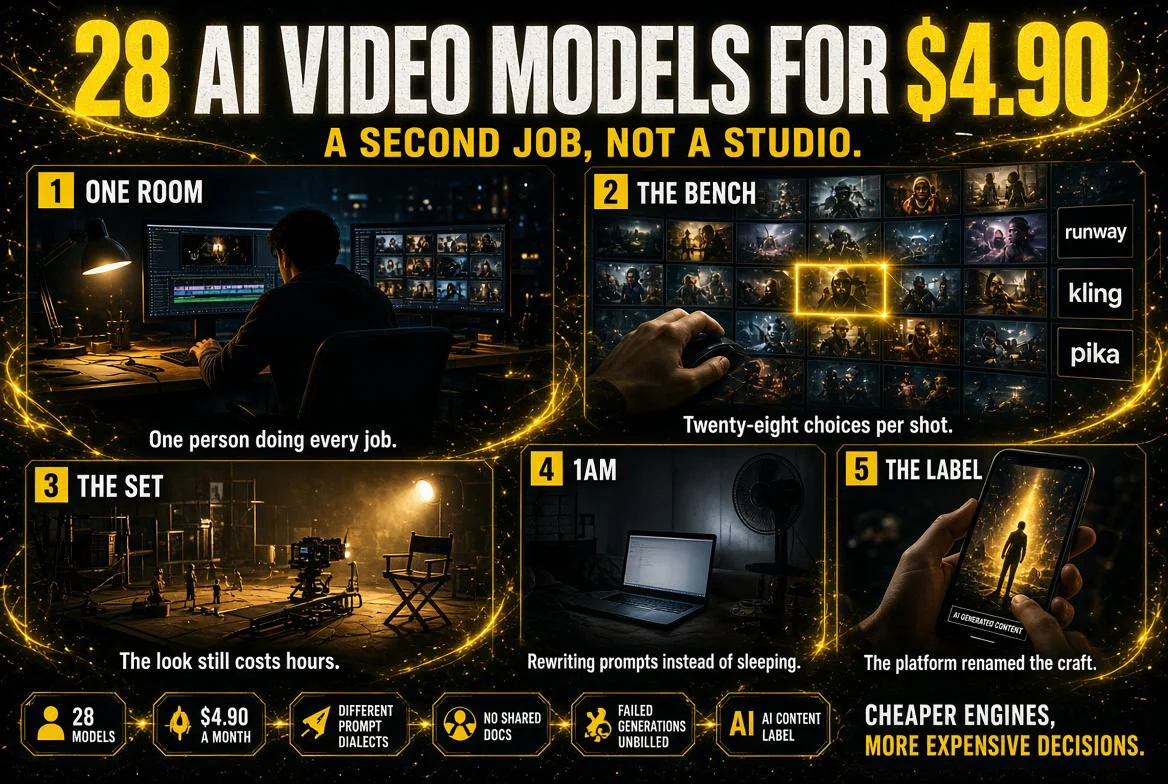
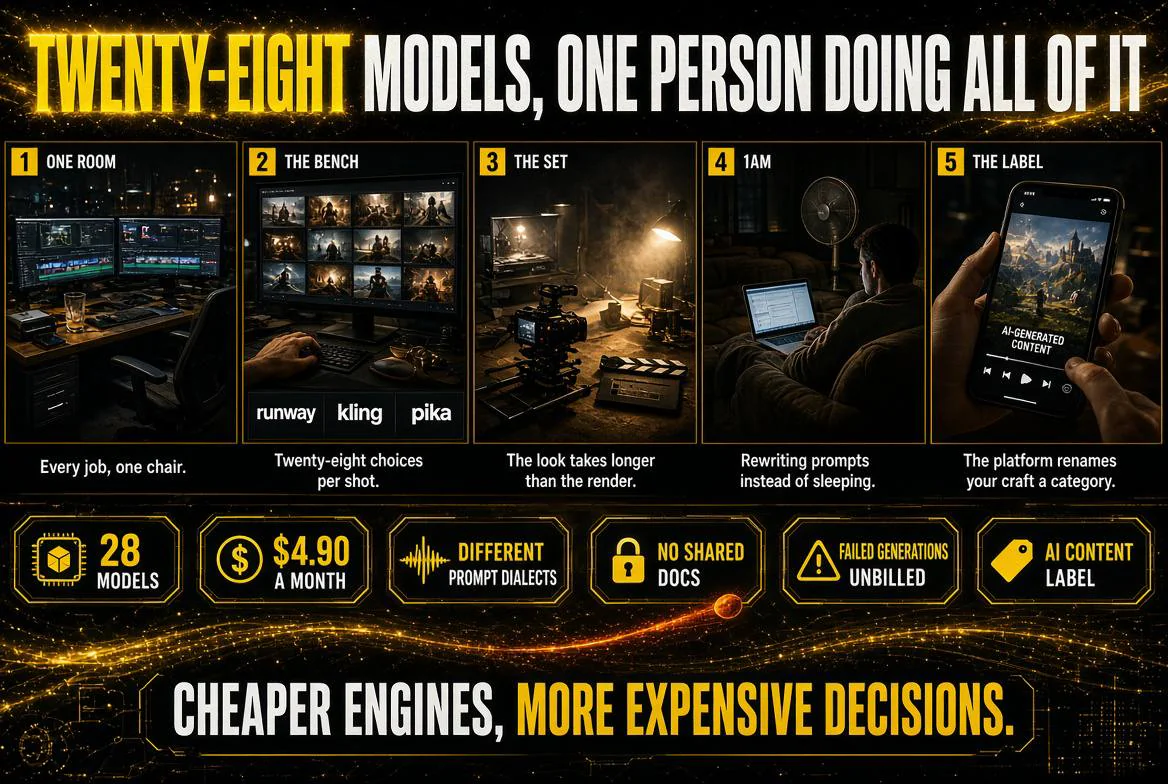
⚡ Expert Summary: One site now sells access to 28 video models for $4.90 a month, and the pitch is freedom. It is not freedom. It is a bench of 28 engines with different prompt dialects, different frame limits, different audio behaviour and no shared documentation, handed to one person who has to pick the right one before every shot. The models got cheap. The judgment did not get cheap, and it still lands on you at 1am.
Twenty-eight video models. Four dollars ninety a month.
That is a real offer on a real site, quoted in a piece that ran with the byline “in collaboration with” at the top — which is the polite way of saying the price was the point of the article.
And the number is genuinely extraordinary. Two years ago, four dollars and ninety cents bought you nothing in this category. Now it buys more rendering capability than a mid-size studio had in 2019.
So why does it feel like a demotion instead of a promotion?
What You Actually Bought
You did not buy a studio. You bought a bench.
A bench is a set of tools with different capabilities and no opinion about which one you should use. That is fine if you are a technician who has spent years learning each engine. It is not fine if you are a solo creator on a deadline who needs one shot that looks right.
Look at what is sitting on that bench right now. PixVerse V6 does fifteen seconds of 1080p with native audio in a single pass. Seedance 2.5 does four to thirty seconds. Those are not variations of one capability — they are different production formats with different prompt grammars, different failure modes and different output economics.
PixVerse wants to be described one way. Seedance wants to be described another way. The prompt that gives you a beautiful PixVerse shot will give you something unusable out of Seedance, and nothing in the interface teaches you the difference.
The Prompt Translation Tax
Here is the cost nobody puts in the comparison table.
Every model has its own dialect. Some want camera movement described first, some want the subject first, some respond to lens language and some ignore it entirely. Some handle a character reference and some quietly average your two actors into a third person. Some give you native audio and some hand you silence you have to fill elsewhere.
Learning one dialect takes weeks. Learning twenty-eight takes a career you do not have, because you are already doing every other job in the studio.
So what actually happens is worse than learning them. You pick two or three, get competent on those, and use them for everything — which means the other twenty-five on the subscription are decoration. You are paying four dollars ninety to feel like you have options, while quietly running a one-engine workflow.
| What the subscription promises | What you actually do in week one | Real cost to a solo operator |
|---|---|---|
| 28 models in one place | Test eight, abandon six, keep two | Two evenings gone, no video finished |
| Native audio on the best engines | Discover audio only works on some models | A rebuild of the shots you already cut |
| 15 seconds per clip from one, 4 to 30 from another | Re-plan every sequence around frame limits | Cut points decided by a vendor spec, not the edit |
| One low monthly fee | Re-prompt repeatedly to match a house look | Fifty failed generations is the real bill |
| Freedom from enterprise contracts | Now you are the integration layer | You became the workflow engineer, unpaid |
Read the right-hand column again. Every row is time, and time is the only thing a solo creator cannot buy more of. The subscription made the engines cheap and made your evenings expensive.
Why the Aggregator Exists
It is worth being fair to the platform, because the model underneath is sound.
Aggregating models makes sense. No single engine wins every shot. One is better at motion, one at faces, one at holding a product steady, one at producing audio that does not sound like a robot inside a jar. A single subscription that reaches all of them removes the enterprise sales call, the per-seat minimum and the currency conversion.
That is real value and it is why these platforms grew.
The problem is what aggregation does to responsibility. When a render fails, the aggregator points at the model, the model points at your prompt, and you are standing in the middle holding a deadline. Nobody in that chain is accountable for the output looking right. That job is now yours, and it always was — but the aggregator makes it look like someone else’s product.
The Platform Made Your Output Interchangeable
While you were learning which of the twenty-eight handles a close-up, something else happened that matters more.
YouTube started labelling photorealistic AI-generated content — below the player, and as an overlay on Shorts — after announcing it in late May 2026. Monetisation through the YouTube Partner Program still applies.
Read that combination carefully. The platform did not ban you. It did not demonetise you. It labelled you, and then it let you keep earning.
That is a more consequential decision than a ban, because a ban is an event and a label is a permanent condition. Once every photorealistic AI video carries the same small disclosure, the visual craft that used to separate one creator from another becomes a commodity with a badge on it. The label does not say yours is worse. It says the platform has decided that this is a category now, rather than a technique.
Which is fine, if what you were selling was the render.
What Still Is Not Commoditised
Here is the part that survives, and it is the whole argument.
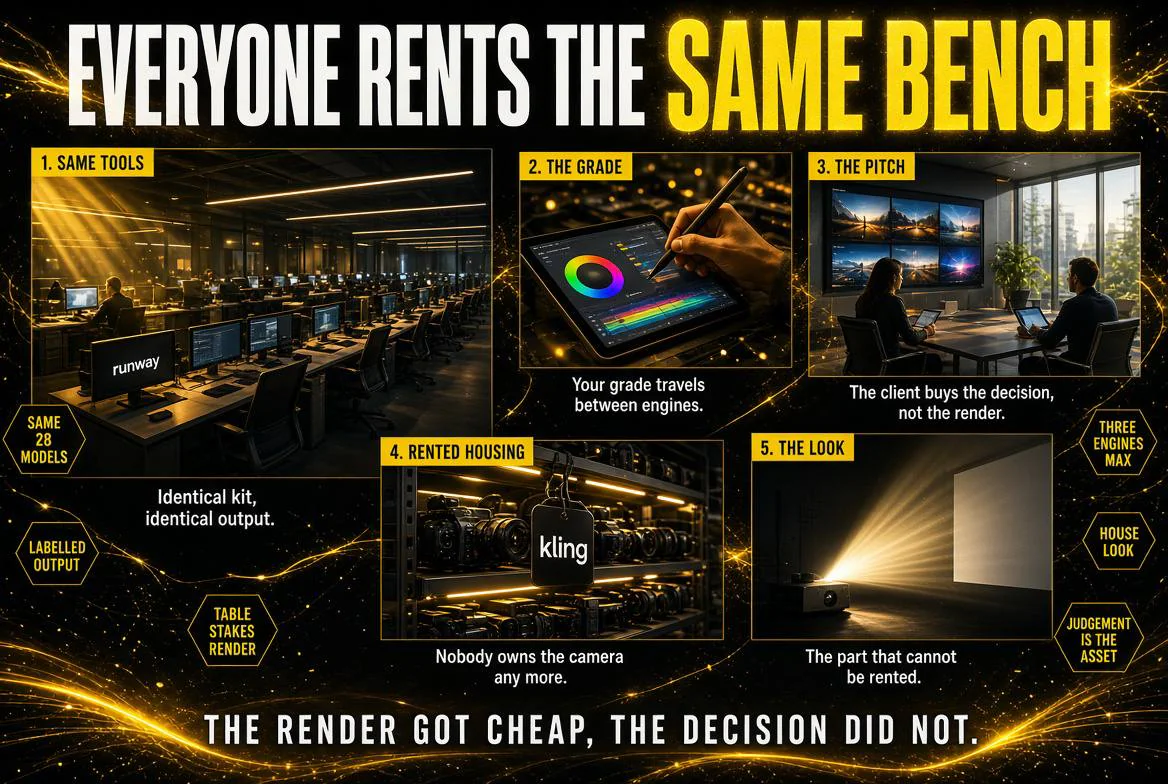
If the render is labelled and the models are identical and every rival can reach the same twenty-eight engines for the price of a coffee, then the only thing left to compete on is the decision about what to make and which engine to point at which shot.
That decision has a name in every other craft. In film it is the director. In music it is the producer. In this new stack it is the person who knows that this particular beat needs the engine with native audio because the lip sync will otherwise cost three hours in post, and that the next beat needs the one with the longer frame limit because the camera has to travel.
That knowledge is not in the subscription. It cannot be. It is accumulated failure, and the subscription has no memory of your failures.
| Asset | Was it commoditised in 2026? | What it is worth now |
|---|---|---|
| Access to a good video model | Yes — 28 of them for $4.90 | Almost nothing on its own |
| A clean photoreal render | Yes — and now labelled by the platform | Table stakes, not differentiation |
| Knowing which engine for which shot | No — earned through failed generations | Hours saved per project, every project |
| A repeatable look a client can name | No — it lives in your head and your prompts | The only thing a client renews for |
| Taste about what is worth making | No — and no roadmap for it | Everything |
The 1am Problem
There is a specific failure that anyone running a multi-model stack will recognise.
You are fifteen shots into a piece. Shot sixteen needs a slow push in on a face, and the engine you have been using all night keeps melting the eyes. You know, from a month ago, that a different engine on the same subscription handles faces better. You open it. The prompt does not transfer.
So you rewrite the prompt in a dialect you last used in March, with the wrong aspect ratio set, at 1am, having already delivered the first cut to the client’s inbox.
That is not a workflow. That is triage.
And it is the exact cost the $4.90 pitch leaves out. The pitch compares subscription prices, because that is easy to compare. It never compares the ten minutes you lose every time you switch engines, because that number does not appear on anyone’s pricing page.
A Stack You Can Actually Remember
Practical, and it costs nothing to change.
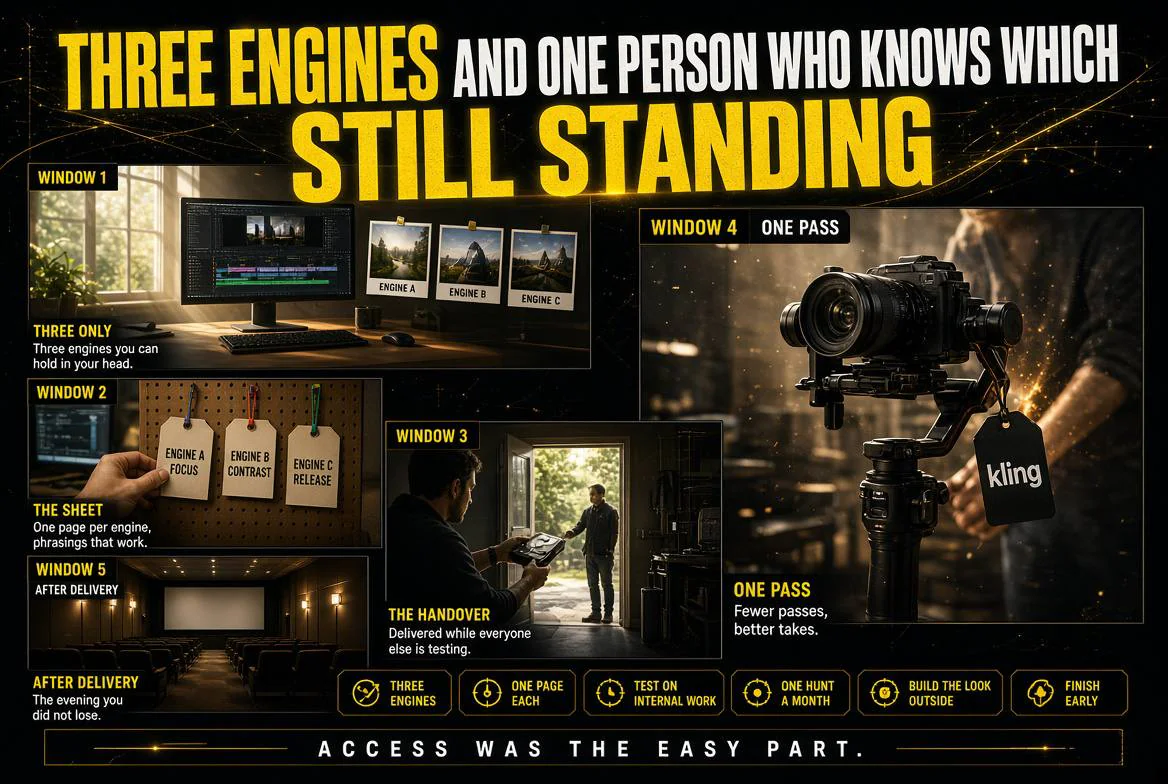
Pick three engines and write down what each is for. Not what they can do — what you will use them for. One line each: this one for faces, this one for movement, this one when you need audio in the pass. Three is the most any solo operator can hold in their head under deadline.
Keep a prompt sheet per engine. A single page each, with the phrasing that works and the phrasings that produced garbage. This is the asset the subscription will never give you and it is the thing that makes you faster than a creator with twice the subscription.
Test new models on paid work, never on client deadlines. A new engine gets a shot on something internal, not on the thing due tomorrow. The temptation to try the shiny one at the worst moment is how the 1am problem happens.
Cap your monthly model hunt. One afternoon a month to re-test what is on the bench. More than that and the bench is managing you.
Build the look outside the models. Your grade, your pacing, your title treatment, your sound design. Those travel between engines. A house look built on one model’s quirks dies the moment that model is deprecated, and they are all deprecated eventually.
What the Subscription Cannot Sell You
In fairness, and this is what the aggregators get right: the access is real, the price is genuinely absurd, and for a creator in a market where a single enterprise seat used to cost more than a camera, this is a democratisation that matters.
What they cannot sell is judgment, and the marketing quietly implies otherwise. Twenty-eight models sound like twenty-eight capabilities you now have. They are twenty-eight decisions you now have to make.
That is the trade. Cheaper inputs, more expensive choices.
The Part Worth Arguing With
The industry line will be that cheap models mean anyone can make video now, and that this is a good thing.
Anyone could always make video. A phone has been enough for a decade. What was never cheap was making something a stranger would finish watching, and nothing on that bench of twenty-eight changes that — not the native audio, not the fifteen-second clips, not the thirty-second Seedance runs.
The label under the YouTube player is the honest version of this story. The platform looked at a wave of photorealistic output and decided the craft had become a category. Categories do not get paid a premium. People inside categories do, when they are the ones everybody calls.
So the four dollars ninety is not the mistake. Believing it turned you into a studio is. It turned you into an operator of twenty-eight machines, and the operators who survive that are the ones who whittle it down to three and spend the saved evenings getting good at deciding.
Frequently Asked Questions
Is a 28-model aggregator worth $4.90 a month?
Yes as access, no as a workflow. It is the cheapest way to test engines, and it becomes a liability the moment you try to use every model on it for real work.
How many AI video models should I actually use?
Three. One for faces, one for movement, one when you need native audio in the pass. More than three and you spend more time re-learning prompts than rendering.
Do the models really have different prompt styles?
Yes. Frame limits, camera language, reference handling and audio behaviour all differ between engines, which is why a prompt that works on one produces unusable output on another.
Does YouTube’s AI label affect monetisation?
No. The disclosure applies to photorealistic AI-generated content and partnership earnings still apply, but the label marks your work as part of a category rather than a technique.
What is PixVerse V6 good for compared with Seedance 2.5?
PixVerse V6 produces fifteen-second 1080p clips with native audio in one pass. Seedance 2.5 covers four to thirty seconds, which suits sequences where a cut point needs a longer take.
Will cheap models make my work worthless?
Cheap models make renders cheap. They do not make knowing which engine to point at which shot cheap, and that is what clients end up paying for once everyone has the same bench.
What is the first thing I should do?
Write one line per engine saying what you will use it for, and delete the rest from your workflow. A shorter bench you understand beats a longer one you browse.

About Barak Schurr
Barak Schurr is a serial entrepreneur who built and exited a major ticketing platform before turning his attention to AI and content. He runs three AI-focused research sites and writes about the tools, workflows, and strategies that let solo creators build real channels — without a crew, a studio, or a Hollywood budget.
Email: [email protected]
More AI Video Resources