
SoundCloud Just Gave AI Music Its Own Front Door
SoundCloud Just Gave AI Music Its Own Front Door
⚡ Expert Summary: On November 5, 2026, SoundCloud became the first external platform to accept direct publishing from ElevenLabs’ ElevenMusic — generate a song, click “Save to SoundCloud,” done. SoundCloud also hands every Artist Pro subscriber three free months of ElevenMusic Pro and openly lists 13 generative-audio partners on its own AI page. The only disclosure it asks for is a voluntary tag it merely “encourages,” and only from creators inside the EU. The architecture is the policy, and the architecture says yes.
SoundCloud spent a decade as the place musicians went when they had nothing but a laptop and no permission. No label, no distributor, no gatekeeper. Upload it, and if it was good, somebody found it.
That is still the pitch. What changed on November 5, 2026, is who else gets to use the door — and how little the company wants to talk about it.
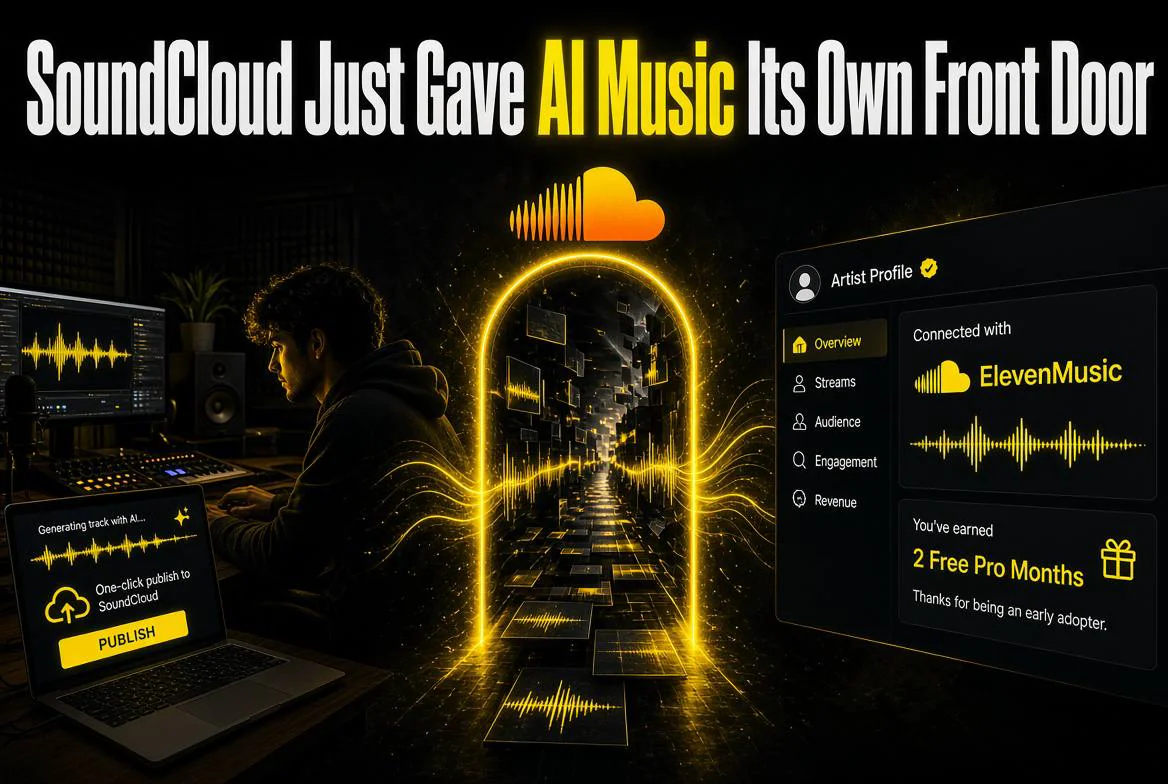
On that day SoundCloud announced a partnership with ElevenLabs, the voice-cloning company valued at more than $6 billion, to make its music generator ElevenMusic the first tool that can publish songs directly onto an outside platform. Not export a file. Not download an MP3 and upload it manually. Publish, from inside the generator, with the artist profile already connected.
The announcement called it a way to “empower artists by connecting creation and discovery,” and there is a genuine version of that story. It is also the moment a streaming platform stopped treating AI music as a moderation problem and started selling it as a subscription perk.
What Actually Shipped on November 5
The mechanism is almost aggressively simple, and that is the point.
Per ElevenLabs’ own walkthrough, published November 6 by Kendall White, a creator opens Profile Settings, goes to Linked Accounts, connects a SoundCloud account, opens an original ElevenMusic track, adds a description, genre and tags, and clicks Save to SoundCloud.
There is no review queue described in that flow. No rights clearance step. No field asking the creator to declare whether a human wrote it. The entire compliance burden sits in a description box the user can leave empty.
SoundCloud’s release is explicit that this is a first: “For the first time, ElevenMusic is enabling creators to publish their music directly beyond its own platform through a new integration with SoundCloud.” The dek adds that SoundCloud “becomes the first external platform for direct publishing from ElevenMusic.”
And the carrot: “new and existing SoundCloud Artist Pro subscribers can unlock three months of ElevenMusic Pro for free through SoundCloud’s Member Benefits program.” ElevenMusic Pro includes “up to 1,000 song creations, 500 stem splits, and five custom styles or vocals per month.” After the trial, per ElevenLabs, it is $9.99 a month unless cancelled.
Read that bundle carefully. SoundCloud is not merely tolerating a flood of machine-made tracks. It is paying part of the acquisition cost to create one, and attaching it to the subscription tier that its most committed artists already buy.
The Vendor Wall Nobody Is Talking About
If you want to understand SoundCloud’s actual position on AI music, do not read the press release. Read its AI Partnerships & Integrations page, which is a catalogue of everyone the company has decided to do business with.
Thirteen generative audio companies are listed there. ElevenMusic by ElevenLabs generates complete songs with vocals from a text prompt. Moises separates stems and rebuilds tracks. Google Flow Music lets users generate songs and remix their own beats section by section. Fadr makes mashups. Soundful generates royalty-free background music. Voice-Swap turns vocal stems into the style of licensed artist voices. Tuney remixes and generates. Hook and Tuttii run AI remix and mashup platforms. Two Shot builds custom samples. ACE Studio produces sung vocals from MIDI and lyrics. Lemonaide writes melodies and chord progressions.
Alongside them sit three rights-enforcement partners — Audible Magic, Pex and AI For Music — whose job is content recognition and anti-infringement. The architecture, in other words, is not a wall. It is a marketplace with a security guard at one gate.
The copy on that page is worth quoting exactly, because it is the clearest statement of strategy the company has published: “At SoundCloud, we’re making music creation more accessible through ethical, AI-powered tools that help creators and fans remix, explore, and connect – no studio required.” And, two lines later: “With trusted partners like ElevenLabs’ ElevenMusic, Audible Magic, Pex, and AI For Music, we’re protecting rights, credit, and creativity.”
The same page carries the sentence SoundCloud clearly wants quoted everywhere: “SoundCloud will not train generative AI models on user content without explicit consent. Period.” Followed by: “SoundCloud is artist-first. Always.”
Both statements are true and neither is the whole picture. SoundCloud not training models on your uploads is a promise about its own behaviour. It says nothing about what happens when a licensed partner’s model produces a track that sounds like the audience you spent three years building, and lands it in the same feed.
| What SoundCloud Says | What the Policy Actually Requires |
|---|---|
| “Artist-first. Always.” | Three free months of an AI song generator bundled into Artist Pro |
| “Protecting rights, credit, and creativity” | 13 generative partners listed; enforcement handled by third-party recognition tools |
| AI transparency for listeners | A source label arrives only on tracks published from ElevenMusic — nowhere else |
| EU AI Act transparency | Creators are “encouraged” to disclose, not required. Voluntary. |
| Terms of Use | No mandatory AI-labelling requirement anywhere in the document |
| Impersonation | Explicitly forbidden — the one hard line that is enforced |
The Word “Encouraged” Is Doing All the Work
Here is the single most important sentence in this story, and it comes from SoundCloud’s own help centre, in an article last updated October 30, 2026.
“Creators who are subject to the transparency requirements of the EU AI Act (‘the Act’) under Article 50(4), are encouraged to disclose that their covered content is ‘AI-generated or manipulated’ within their track description on SoundCloud.”
Not required. Not mandatory. Not enforced. Encouraged — and only for creators who fall inside EU jurisdiction, which excludes the overwhelming majority of the platform’s 40 million artists.
The same help article is firm about impersonation: AI content “must also not intentionally mislead listeners about its authenticity, origin, or the identity of the creator – impersonation and identity theft is strictly forbidden.” That is the line SoundCloud will actually act on, and it is a good line. It is also a narrow one. It protects a famous voice. It does nothing about the far larger category of music made by nobody in particular that sounds like everything on the platform already.
SoundCloud’s Terms of Use, which run to roughly 68,000 characters, reference AI only in anti-impersonation clauses. There is no mandatory AI-labelling requirement and no metadata standard anywhere in the document. The entire disclosure regime for the largest catalogue of independent music on earth rests on a voluntary description tag.
The Verge, in its November 5 coverage, put the contrast more bluntly than SoundCloud would like: the company has avoided “the loud-and-proud press releases detailing how many spammy AI songs it’s removed from its platform, or bragging about demonetizing them.” That is not a description of a platform fighting a flood. It is a description of one that has decided the flood is inventory.
There is a genuine defence here and it deserves airing. Every streaming platform faces the same problem and none of them has solved it. A mandatory label is trivially easy to lie on — the uploader just does not tick the box, and no detector is reliable enough to overrule them at scale. Deezer’s approach has been active detection and removal. SoundCloud’s approach is trusted partners, source labels where they are technically unavoidable, and voluntary disclosure everywhere else. That is a policy, not an accident.
But a policy that relies on the goodwill of the person uploading the track is not a policy. It is a hope with a URL.
Who This Actually Costs
The person who loses here is not SoundCloud, and it is not ElevenLabs.
ElevenLabs is a company that raised at a reported $6.6 billion valuation and has built a genuinely remarkable product. ElevenMusic generates complete songs, with vocals, in the genre you ask for. For a bedroom producer with no singer, no drummer and no budget, that is an extraordinary tool, and pretending otherwise would be dishonest.
The cost lands on the artist whose entire competitive advantage was being a specific person with a specific voice. On SoundCloud that advantage was never money or marketing — it was identity. The reason someone found your track in 50 million uploads was that it sounded like you and nobody else.
Now the same feed carries tracks that sound like a category. A prompt can generate forty songs that all fit a mood better than your one careful attempt, because they were trained to fit the mood by construction. The uploader can do it in an afternoon. Nobody needs to go looking for a voice, because a voice is a setting now.
This is the quiet tragedy of AI music and it does not require anyone to be evil. It only requires the platform to optimise for volume, the tool to make volume free, and the discovery algorithm to reward whatever gets listens. SoundCloud’s discovery engine has never been a meritocracy; it has always been a volume game. AI just changed who can play it.
The Comparison Everyone Should Be Making
SoundCloud’s October 21, 2026 integration with Moises is the tell, because it is a genuinely different deal and the company itself says so.
Moises lets a creator pull a SoundCloud track into its tools, separate the stems, remix it, and republish — and Moises states plainly that its models are “trained exclusively on licensed and authorized music, not on content that users upload or create within the platform.” That is a partner operating with an explicit training-data commitment.
ElevenMusic’s integration is not that. It is a publish button. The Verge noted the difference directly: the ElevenLabs integration “isn’t as deep as the Moises integration.”
| Integration | Moises (Oct 21, 2026) | ElevenMusic (Nov 5, 2026) |
|---|---|---|
| What the creator does | Pull an existing SoundCloud track, split it, remix it | Generate an original song and publish it |
| Starting material | Music a human already uploaded | A text prompt |
| Training data stated | Licensed and authorized music only | Not addressed in the partnership |
| Disclosure on output | Relies on the platform’s general rules | A source label identifying ElevenMusic |
| Free access offered | No bundled subscription perk | 3 months of Pro for Artist Pro members |
| Who owns the creative act | The original artist, still | The person with the prompt |
Both deals are on the same platform, announced two weeks apart, and they point in opposite directions. One treats the catalogue as raw material to be respected. The other treats the platform as a destination for material that never needed a catalogue at all.
The Label Is Real, and It Is Not Enough
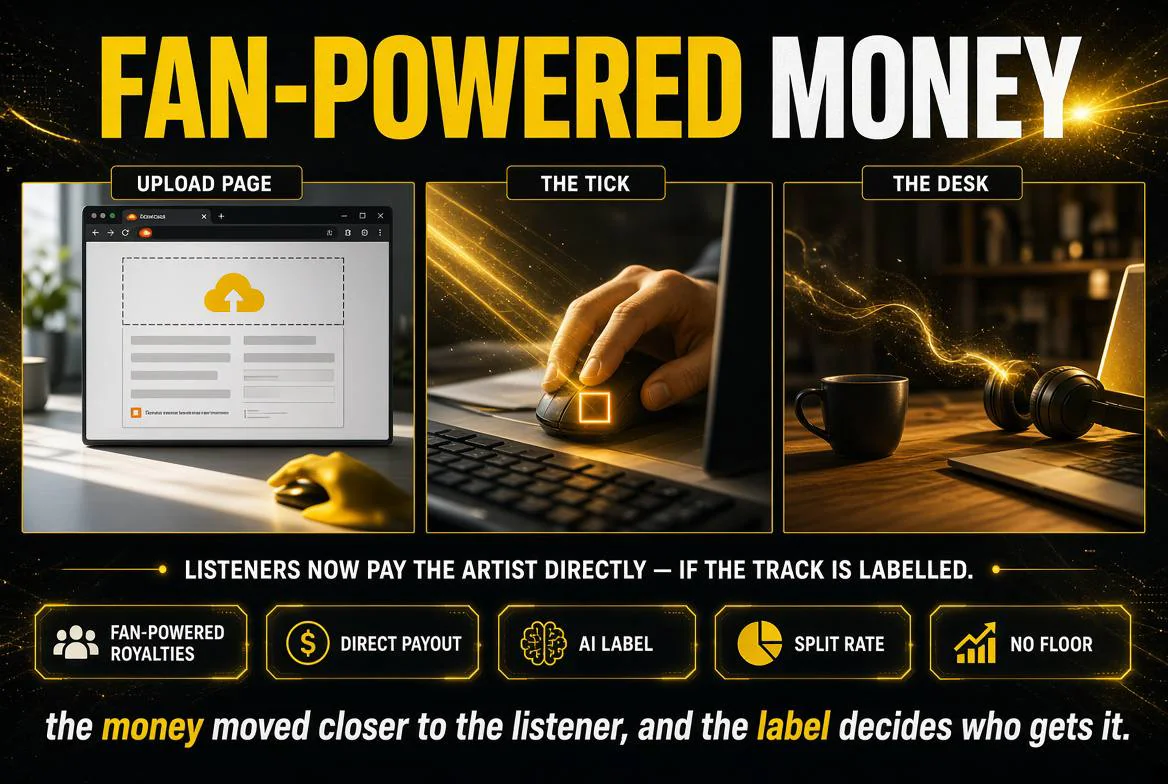
Credit where it is due: SoundCloud did build a disclosure. The release states that “tracks published directly from ElevenMusic will also carry platform-specific disclosures identifying ElevenMusic as their creation source, helping provide greater transparency for listeners.” That is more than most platforms have shipped and it is exactly the right idea.
Now count what it does not cover.
It does not cover a song generated in a rival tool and uploaded manually through the web form, which is the path every other creator uses. It does not cover a song generated in ElevenMusic, downloaded, and re-uploaded through a different account. It does not cover audio generated locally on a laptop with an open model. And it does not cover the case that matters most commercially — a track that started as an AI generation and was edited enough by a human that no automated source label would apply.
In other words, SoundCloud’s disclosure covers precisely the integration that SoundCloud built a button for. It is a property of one API call, not a property of the platform.
That distinction is why the label will not survive contact with anyone motivated to avoid it. ElevenMusic’s flow, as documented by ElevenLabs, asks only for a description, genre and tags. A creator who wants to be transparent can be. A creator who does not want to be transparent simply uses a different door — and there are twelve other partners on the page.
What a Working Policy Would Look Like Instead
This is the part where criticism has an obligation to be useful. Four things would actually change the picture, and none of them requires SoundCloud to ban anything.
First, make the tag mandatory rather than encouraged. A required checkbox with a required answer costs one click and produces a dataset. Voluntary disclosure produces a vibe.
Second, apply the source label to the upload, not the integration. If a file carries generator metadata — and most do — read it at ingest and display it. That catches the manual upload path, the second-account path and the re-encode path in one move.
Third, separate the discovery surfaces. Give listeners a filter and give artists a feed that excludes generated tracks by default. The audience most likely to leave SoundCloud over this is the audience that came for human music, and it is a filter away from staying.
Fourth, publish the numbers. How many tracks were removed, how many accounts were actioned, how many uploads were flagged by the recognition partners. SoundCloud’s competitors avoid these releases because they are embarrassing. The company that publishes them first gets to define what an acceptable rate looks like.
The Part SoundCloud Got Right
None of this makes the partnership indefensible, and it is worth saying plainly that the outrage economy has this one slightly wrong.
Eliah Seton, SoundCloud’s CEO, framed the deal with unusual care: “SoundCloud has always been a place where artists experiment, push boundaries, and turn creative ideas into something bigger… This is just the beginning of what we can accomplish together as we continue exploring how responsibly developed AI can expand creative possibilities while keeping artists at the center.”
Mati Staniszewski, ElevenLabs’ CEO and cofounder, said: “We built ElevenMusic to help more artists create, experiment and reach their fans… Music creation and discovery belong together and now, with SoundCloud, that music can reach even more audiences and communities.”
Both statements are honest about the intent. And the release carries a real commitment: “Music published through the integration will be subject to SoundCloud’s existing content policies, including applicable ownership and rights requirements.”
The problem is not hypocrisy. It is arithmetic. Existing content policies were written for uploads where a human made every decision, and the entire enforcement model — recognition partners, impersonation clauses, takedown flows — assumes there is an original to compare against. A generated track has no original. It is not a copy of anything. It is a new thing that happens to occupy the same space as a thousand other new things, and no recognition system on the market can tell you whether it should be there.
That is not a SoundCloud failure. It is a category error sitting underneath the entire recorded-music industry, and SoundCloud is simply the first platform to ship a button that makes the error visible at scale.
What This Means If You Upload Music
For independent artists actually using the platform, three things are now true that were not true last week.
Your competition in the algorithmic feed just got cheaper, faster and more consistent than you can be. That is not a reason to quit; it is a reason to stop competing on polish you can buy and start competing on the thing a prompt cannot produce — a specific story, a specific room, a specific mistake that turned out to be the best part of the song.
Your listener now has to make a judgment you cannot help with, because the platform will not always tell them what they are hearing. The artists who name their process openly will keep the trust that anonymous uploads will lose. Say how you made it. Say what is real. It costs nothing and it becomes your differentiator the moment the feed is full of things that cannot say anything at all.
And the free Pro subscription is not a gift to you. It is a customer acquisition cost aimed at your audience, bundled into the tier you already pay for. Take the three months if the tool is useful. Just do not mistake a marketing line for an alliance.
The Door Was the Point All Along
SoundCloud’s original promise was that the door was open to anyone with a laptop and something to say. That promise had a cost the company carried for years: no gatekeeping meant no curation, and no curation meant a platform that was impossible to search and easy to game. AI music is the final boss version of that problem — it is what happens when the door being open is the entire business model and the thing walking through it does not need to be alive.
The company chose, on November 5, to make the door wider and charge admission in subscription months. That is a rational decision for a platform that has spent years trying to prove it can be a business. It is also a decision that put the label question at the bottom of a description box and left it there.
Seton said the partnership reflects a belief that technology “should expand creative possibilities while respecting artists’ rights and choices.” He is entitled to that belief. What the architecture shows is that SoundCloud has decided to trust the person uploading — and the person uploading, on a platform with 40 million of them, is not a person the platform knows.
That is what a voluntary label is: trust extended to strangers. It will hold for most of them, and it will not hold for the ones who cost the artists anything. SoundCloud built a front door for AI music and handed everyone a key. The only question left is who bothers to knock.
Frequently Asked Questions
Can you publish AI music directly to SoundCloud?
Yes, since November 5, 2026. ElevenMusic, ElevenLabs’ music generator, is the first external tool that can publish tracks directly into a SoundCloud account through Linked Accounts, without downloading a file and re-uploading it.
Does SoundCloud label AI-generated music?
Partially. Tracks published directly from ElevenMusic carry a platform-specific disclosure identifying ElevenMusic as the creation source. Tracks generated elsewhere and uploaded manually are not labelled, and SoundCloud does not require creators to declare them.
Is AI disclosure mandatory on SoundCloud?
No. SoundCloud’s help centre states that creators subject to EU AI Act transparency requirements are “encouraged” to disclose that content is AI-generated or manipulated in the track description. There is no mandatory labelling requirement in SoundCloud’s Terms of Use.
Does SoundCloud train AI on user uploads?
SoundCloud states that it “will not train generative AI models on user content without explicit consent. Period.” That commitment covers SoundCloud’s own model training and does not govern how partner tools operate.
Does SoundCloud use AI detection to remove AI tracks?
SoundCloud lists Audible Magic, Pex and AI For Music as rights and content-recognition partners. It has not published figures on how many AI-generated uploads it removes or demonetises.
How much does ElevenMusic Pro cost after the free trial?
SoundCloud Artist Pro subscribers get three months of ElevenMusic Pro free through Member Benefits. After that, per ElevenLabs, the subscription is $9.99 per month unless cancelled. Terms run to October 31, 2027.
Is the SoundCloud and ElevenLabs integration live now?
Yes. It was announced November 5, 2026, with ElevenLabs publishing its own walkthrough on November 6, 2026. The publish flow is available to connected accounts.

About Barak Schurr
Barak Schurr built and sold a major ticketing platform, ran global nightlife operations at Eventbrite, and now spends his time a serial entrepreneur who built and exited a major ticketing platform before turning his attention to AI and content. He runs three AI-focused research sites and writes about the tools, workflows, and strategies that let solo creators build real channels — without a crew, a studio, or a Hollywood budget.
Email: [email protected]
More AI Resources for Your Business

