You Were Four Days From Being Liable for Every Meta AI Ad You Touched
You Were Four Days From Being Liable for Every Meta AI Ad You Touched
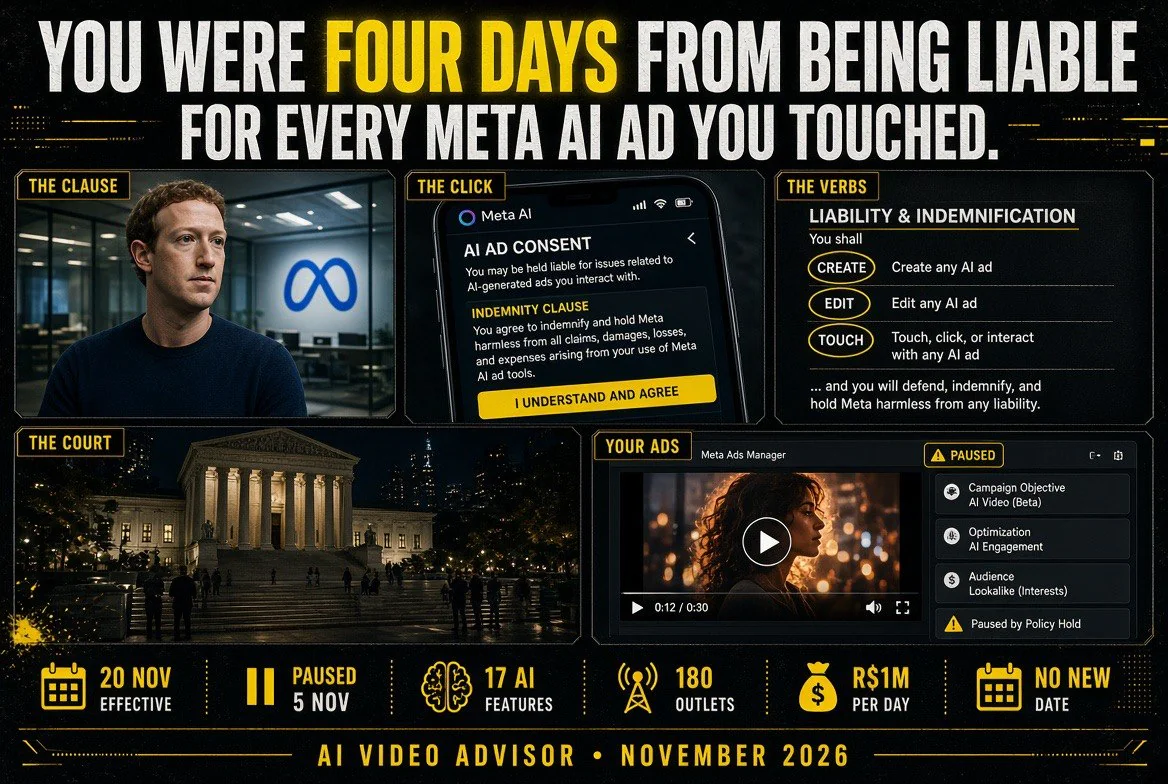
⚡ Expert Summary: Meta paused its revised ad-creative AI terms on 5 November 2026, four days before the 20 November effective date that would have made every business using its generative ad tools assume the legal risk for them. The paused clause was blunt: “You agree to assume any and all risks associated with your use of, or reliance on, any Generative AI Features… You agree to defend, indemnify, and hold harmless Meta.” The terms were first published in September 2026, pushed from 15 October to 30 October to 20 November, then rewritten on 16 October to delete the word train and narrow the scope to “advertising and business products.” Meta says paused, never withdrawn, and has given no new date. If you clicked accept on any earlier version, that acceptance does not bind you — the legacy terms still govern your account.
The most important thing about this story is the number four. Four days. That is how close every advertiser using Meta’s generative ad tools came to signing away their own legal defence, in a checkbox, on a terms update most of them would never have read.
And here is the part that should bother you more than the clause itself: it was not advertisers who stopped it. It was a Norwegian court, a UK competition regulator, and a Brazilian judge. Three jurisdictions moved faster than the market did.
If you run video ads on Meta — and if you are reading this site, the odds are good that you do — the practical question is not what Meta tried to do. It is what you do differently now that a platform has demonstrated it will put its own legal exposure on your side of the line, and then withdraw the attempt only when governments force the issue.
What Meta Actually Tried to Do
Start with the timeline, because the timeline is the story. Every date here is a retreat.
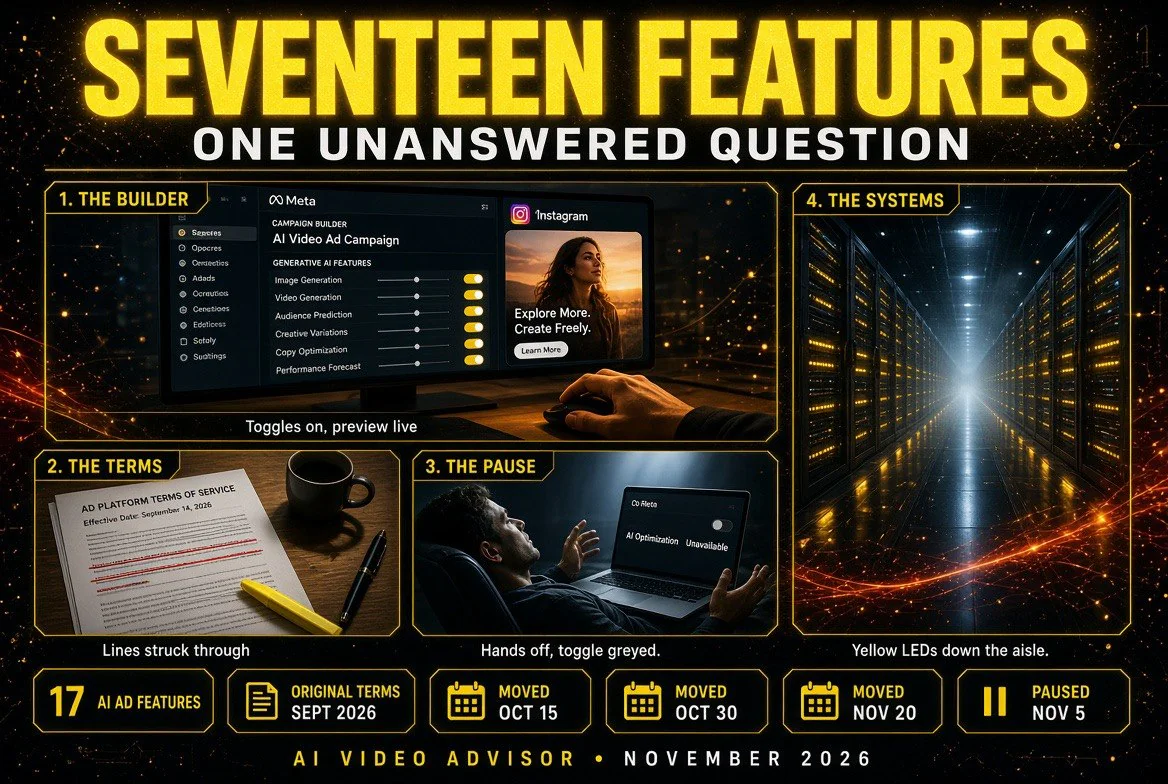
The revised Ad Creative Generative AI Terms were first published in September 2026. The effective date was set for 15 October 2026. It moved to 30 October. It moved again to 20 November. Then, on 16 October, Meta published a revision that deleted the word train from the document and narrowed the scope of the features covered to “advertising and business products.”
On 5 November 2026, a notice appeared in Meta’s Business Help Center: “These updates are now paused and will not take effect on November 20, 2026.” Andy Stone, speaking for Meta, said the company was “pausing the changes as we continue to engage with stakeholders and take our time to get this right,” adding that “our existing terms remain in effect.”
Read that language carefully, because two words matter. Paused, not withdrawn. And existing terms remain in effect — which is the sentence that should tell you everything about what comes next. Meta has not abandoned the clause. It has taken it off the table until the pressure drops.
The clause that caused all of this, quoted verbatim from the revised terms:
“You agree to assume any and all risks associated with your use of, or reliance on, any Generative AI Features… You agree to defend, indemnify, and hold harmless Meta.”
Three verbs, in order. Assume the risk. Defend Meta. Indemnify Meta. If a generated ad using Meta’s own tool, trained on Meta’s own data, produced an image that infringed a photographer’s copyright or a model’s likeness, the person answering for it would have been the advertiser who clicked the checkbox.
| What the Clause Said | Plain English | Who Carried the Risk |
|---|---|---|
| “assume any and all risks” | You own every legal outcome of using the tool | The advertiser |
| “defend… Meta” | You pay the lawyers if Meta gets sued | The advertiser |
| “hold harmless Meta” | You cover any judgment against Meta | The advertiser |
| Scope after 16 October rewrite | Narrowed to “advertising and business products” | Reduced surface, same shape |
| Word “train” after rewrite | Deleted from the document | Silence where the widest risk sat |
| Status as of 5 November | Paused, not withdrawn, no new date | Unresolved |
Where the Liability Actually Sat — and Where It Still Sits
This is the detail most coverage of the pause has skipped, and it is the one that decides whether you were ever exposed in the first place.
The Ad Creative Generative AI Terms cover Meta’s own native generative features — the seventeen designated generative AI ad features inside Meta’s advertising products. If you used those, the indemnity clause was aimed at you.
If you used a third-party video model — Runway, Pika, Kling, HeyGen — and then uploaded the output to Meta as ad creative, that is a different contract. Third-party assets fall under the standard Self-Serve Ad Terms, and those contain no Meta indemnity. Different document, different risk, and in that case there was never an indemnity armed in Meta’s favour over the generative tool itself because Meta did not supply the tool.
Which means the exposure was always specific: the danger was concentrated in the exact place where the platform supplies the model, the interface, and the training data. Not the place where you brought your own model.
That distinction survives the pause. It also tells you where to look the next time a terms update lands, because the pattern will not disappear just because this version did.
| Where the Asset Came From | Which Terms Apply | Meta Indemnity in Force |
|---|---|---|
| Meta’s 17 native generative ad features | Ad Creative Generative AI Terms | Yes — the paused clause |
| Runway, Pika, Kling, HeyGen output | Standard Self-Serve Ad Terms | No |
| Stock footage or licensed music | The licensor’s own agreement | No |
| Your own filmed footage | Self-Serve Ad Terms only | No |
| A real person’s face or voice, cloned | Likeness rights, jurisdiction dependent | No |
| Anything where you cannot say which of these | Unknown | Treat as yours |
The Court That Moved Fastest Was Not in America
Meta did not pause because advertisers objected. Meta paused because three separate jurisdictions moved against it inside a month, and the pressure came from places you would not guess in that order.
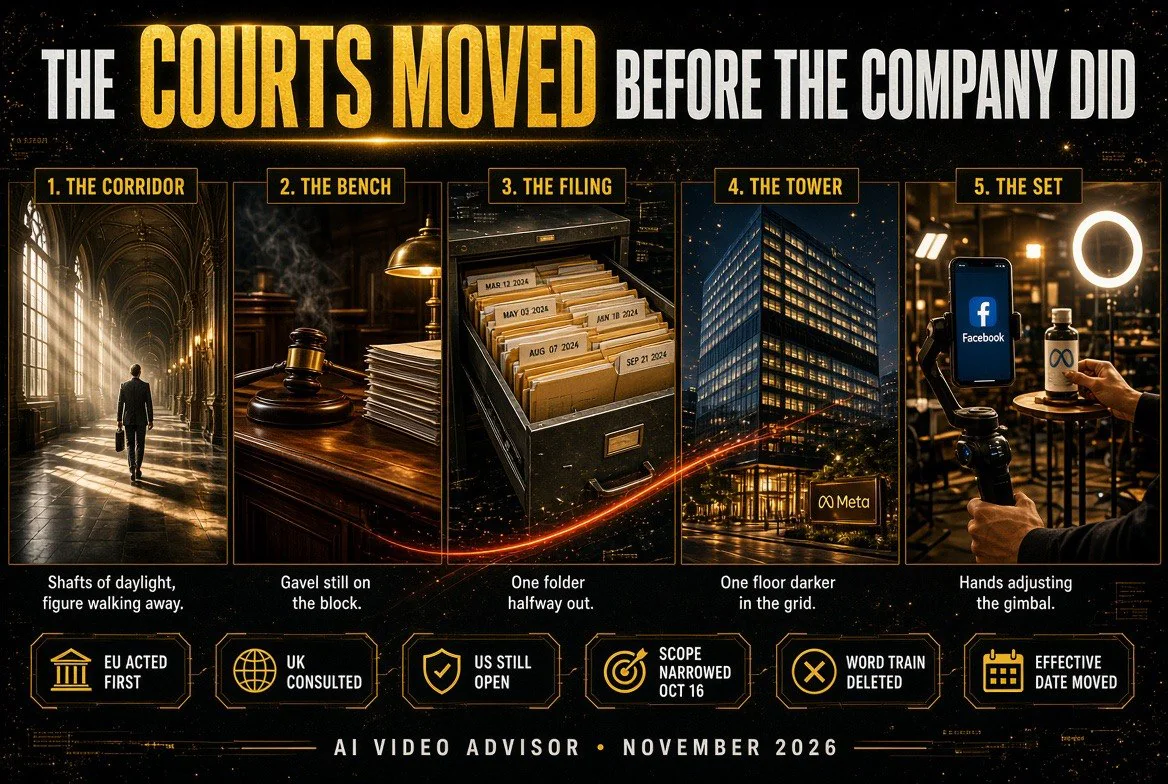
Norway moved first. The Oslo District Court — Oslo tingrett — granted an injunction. The filing came from MBL, Mediebedriftenes Landsforening, the Norwegian media publishers’ association, on 27 October 2026, representing 180 outlets across 10 media groups. The part worth understanding is the legal theory: the ruling leaned on competition law and Meta’s dominant position, not on copyright. That is a harder argument to dismiss than a fair-use fight, because it does not depend on whether training on published work is permitted. It depends on whether a dominant platform can impose terms that only it benefits from.
The UK followed within days. The Competition and Markets Authority opened its own investigation on 30 October 2026 under Chapter II of the Competition Act 1998 — abuse of dominance, the same theory the Norwegians used. That investigation remains open after the pause, which is the detail that makes the pause temporary rather than final. Sarah Cardell runs the CMA.
Brazil applied the pressure that hurts. A São Paulo court fined Meta R$1 million per day, capped at R$100 million, on a filing brought by three publisher associations. Ongoing, per-day, capped but enormous.
Europe’s publishers piled on. ENPA, News Media Europe, and the US News/Media Alliance all objected formally. The Irish Data Protection Commission and the European Commission were reported to be engaged informally, which is the polite way that story is told before anything becomes formal.
Notice what is missing from that list. Every single objector is a media organisation or a competition authority. No dedicated small-business body filed, objected, or issued a statement. The people who actually would have signed the indemnity — the freelancers, the solo agencies, the small e-commerce shops running AI-generated video ads — had no seat in any of those proceedings and no organisation speaking for them.
That is the structural problem. The clause was stopped by parties with in-house counsel and trade associations. If you are a one-person operation, your protection from the next version is not a lobby group. It is a checklist.
The Clause Meta Deleted Without Explaining What Replaced It
Two edits in the 16 October revision deserve separate treatment, because the coverage of this story reduced them to a line and they are the most interesting part of the whole document.
The first is the deletion of the word train. In the September version, the terms reached training. In the October revision, that word is gone. Meta has not published an explanation of what the removal means in practice, and it has not said that training is unaffected. What it has done is remove the word from the scope of a document whose scope was simultaneously narrowed to advertising and business products. Two narrowing moves at once, with no stated reason.
The second is the phrase “advertising and business products.” That is not the language of a whole-platform policy. It is the language of a carve-out, and it invites an obvious question: what sits outside it? Meta’s consumer products, its messaging surfaces, its own creative tools used outside the ad system — none of those are named. A reasonable reading is that the indemnity survived where it could be enforced against businesses and retreated where it could not.
Neither edit makes the clause gentler in the places it still reached. Narrowing a document’s scope while removing the language that triggered the loudest objection is a way of keeping the mechanism and dropping the argument. When the terms return, expect the same shape with the word that caused the fight left out of the title.
Why “Paused” Is Not “Gone”
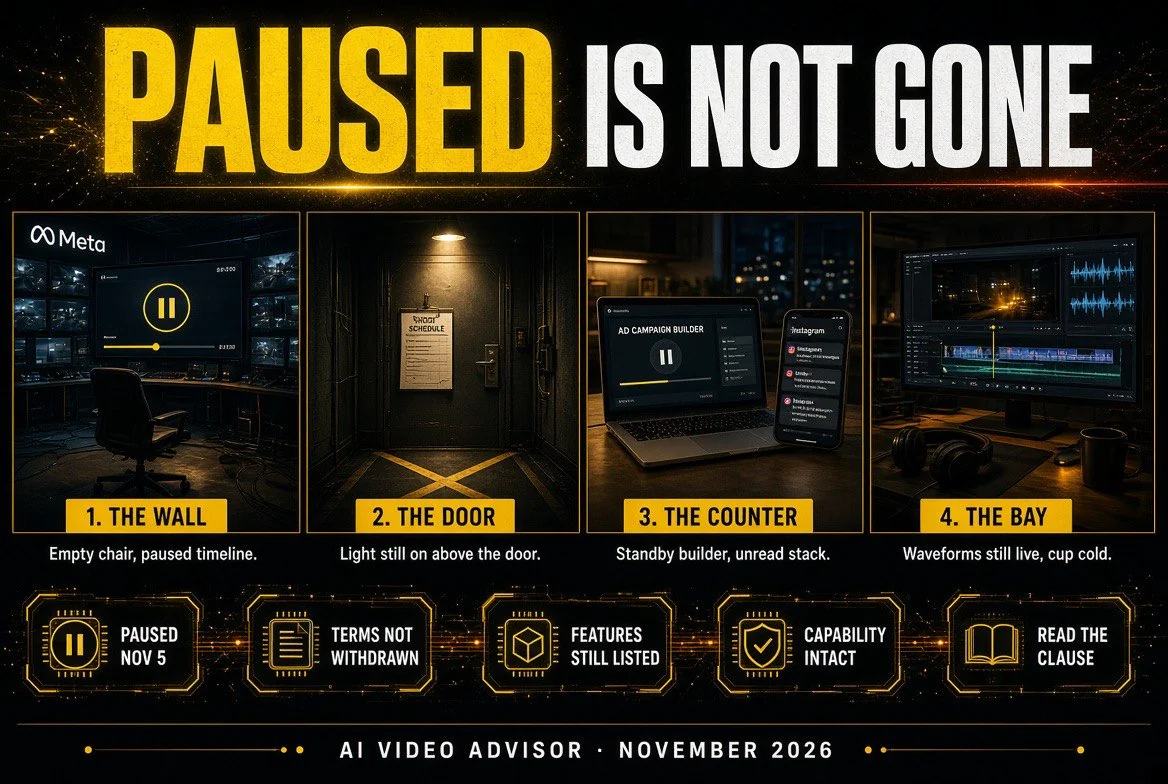
Meta’s own words rule out relief. Paused carries a specific meaning in a terms dispute: the document still exists, the intent still exists, and the timing is now a matter of when the objections are resolved rather than whether the clause was ever wanted.
The company explicitly did not use withdrawn, retracted, or abandoned. It said it would “continue to engage with stakeholders and take our time to get this right” and that existing terms remain in effect. Both halves of that sentence point the same direction: the terms are coming back, revised, and the question is only what shape they take.
There is also an unpleasant asymmetry in the interim. While the revised terms are paused, the legacy terms govern — which means the weak protections you had before September are what you have now. You did not gain anything on 5 November. You returned to the position you were in in August.
And a point that matters if you clicked through a consent screen in October: acceptances of the earlier versions are void. The versions you accepted are not in force. If a dispute arises over work you created while the revised terms were supposed to be live, the governing document is the legacy one — which is better for you, but also means any risk assessment you did against the revised terms was measuring the wrong document.
What This Means for Anyone Making AI Video Ads
The pause buys time, and time is only worth something if you spend it. Five things worth doing before the terms come back.
Know which tools are Meta’s and which are not. The indemnity clause only ever reached the seventeen native generative ad features. If your workflow runs through Runway, Pika, Kling, or HeyGen and you upload finished files to Ads Manager, you were never inside the clause — but you also never had any protection from Meta, and the risk on the output was always yours. Write down which of your tools sits in which bucket. Most people cannot answer this question about their own workflow, and the answer determines your exposure.
Keep the acceptance record. Screenshot the terms version, the date, and the notice that appears when you next open Ads Manager. If the terms change again — and the timeline suggests they will — the ability to prove which document governed which campaign is the difference between a defensible position and an argument.
Read the watermark clause as a production constraint. AI-generated ad creative can carry provenance signals, and those signals can be visible or it can change how the asset is treated downstream. If your deliverable goes to a client, know what is embedded before you hand it over. A client discovering a provenance marker on their brand video after publication is a conversation you do not want to have.
Do not rely on the platform’s silence as permission. The clause was aimed at advertising and business products, narrowed from something wider, and it deleted the word train without explaining what replaced it. Silence in a legal document is not a grant of rights. It is a gap someone will eventually fill in their own favour.
Get likeness and voice rights in writing. This was true before the pause and will remain true after the next revision. If a generated ad puts a recognisable face or a cloned voice in front of an audience, the platform’s terms are not the operative question. The person’s rights are.
The Bigger Lesson: Terms Updates Are the New Product Risk
Strip away the specifics and there is a generalisable pattern here, and it is going to repeat across every platform that ships generative features.
Step one: a platform introduces generative tools that create legal exposure for itself. Step two: it rewrites its terms so that exposure sits with the customer instead. Step three: it publishes those terms quietly, with a date far enough out that nobody reads them in time. Step four: regulators in three countries object, and the platform pauses.
The pause is not a victory for advertisers. It is what happens when a company misjudges which counterparties have lawyers. The next platform that tries this will have watched Meta do it, and will design the rollout to avoid the specific mistakes — a shorter notice window, softer language, a clause split into sections where the indemnity is less visible.
For anyone making AI video, the durable defence is not outrage. It is a habit: when a platform updates its advertising terms, read the indemnity section first, and check which of your tools it reaches. That habit costs ten minutes. Not having it cost advertisers a clause that would have made them pay Meta’s legal bills.
What the Three Jurisdictions Tell You About Enforcement
The pattern in those three proceedings is worth more than any of the individual outcomes, because it tells you which arguments actually moved a platform in five days.
Norway went to competition law rather than copyright. That is the strategic choice that mattered. A copyright argument asks whether training on published work is permitted, which is contested everywhere and takes years. A competition argument asks whether a dominant platform can impose terms that extract value from the businesses that depend on it. That question can be answered in a week, which is why an injunction landed in a week.
The UK CMA used the same theory under Chapter II of the Competition Act 1998 and opened on 30 October. Crucially, that investigation was not closed when Meta paused. Abuse-of-dominance proceedings do not evaporate because the conduct stopped voluntarily — they examine whether the conduct happened and whether it was unlawful. A pause removes the urgency. It does not remove the case.
Brazil added the dimension that actually forces action: R$1 million per day, capped at R$100 million, in a São Paulo court, on a filing from three publisher associations. Daily penalties with a cap run to eight figures in local currency create a budget line that no legal department ignores.
Notice what none of those proceedings needed: a US regulator. None of the pressure came from Washington. It came from Oslo, London and São Paulo, and it worked. If you are an American advertiser who assumed this story was about the FTC, it was not, and that is worth remembering the next time a clause lands in your consent screen with a two-week notice period.
The Advertiser Cohort That Had No One Speaking for It
Look at who was in the room for those proceedings and who was not, and the shape of the whole episode becomes clear.
In the room: MBL with 180 outlets across 10 media groups, ENPA, News Media Europe, the News/Media Alliance, three Brazilian publisher associations, and two competition regulators. Organised, resourced, and speaking a language courts respond to.
Not in the room: every freelancer, solo creative, small agency and small e-commerce shop whose Meta ads would have been covered by the same clause. There is no trade body for the person making $400 animated product ads with a third-party model and uploading them to Ads Manager, and there was no filing in any of those three jurisdictions on their behalf.
That gap is the actual lesson of this story for anyone on this site. The publishers were protected because they had institutions. The advertisers were protected incidentally, because the publishers’ fight happened to target the same document. Those are not the same thing, and a later revision could easily separate them: narrow the clause to advertising products only, and the publishers lose interest while the indemnity lands squarely on the people with no representation at all.
That is the scenario to prepare for, because it is the version that does not generate injunctions. A clause that only reaches small advertisers has no 180-outlet association to sue over it.
What This Costs You if You Build Ads for Clients
Here is the part that never appears in policy coverage: the practical cost of a clause like this lands in your contracts, not your legal bills.
If you make AI video ads for clients, your own service agreement needs a line that survives whatever the platform does. Most freelance agreements are silent on which party eats platform-level risk, which means the default is a fight after something goes wrong. The indemnity that Meta tried to put on you is the same indemnity your client will try to put on you if a generated ad causes a problem, and the pause does nothing about that.
The fix is specific and small. State in your agreement which tools you use, that outputs are generated using those tools’ models, and that the client owns the output while responsibility for the underlying model’s behaviour sits with the platform’s terms rather than with you. If the platform’s terms shift, you have a documented position rather than a verbal one. If a client refuses that framing, that refusal is also information.
None of this is legal advice, and none of it requires a lawyer to execute. It requires knowing which document governs your work, which is exactly the thing the last month demonstrated that most advertisers do not know about their own campaigns.
Four days from liability, and it was a Norwegian publishers’ association that bought the extension. If that sentence does not make you want to read your next terms update, nothing will.
Frequently Asked Questions
Did Meta cancel its new AI ad terms?
No. Meta paused them. The Business Help Center notice said the updates “are now paused and will not take effect on November 20, 2026,” and Meta said its existing terms remain in effect while it engages with stakeholders. The clause has not been withdrawn and no new effective date has been announced.
What did the indemnity clause actually require?
Verbatim, it required users to “assume any and all risks associated with your use of, or reliance on, any Generative AI Features” and to “defend, indemnify, and hold harmless Meta.” In practice that meant an advertiser would cover the legal costs and any judgment if Meta were sued over content produced with Meta’s own generative tools.
Why did the effective date keep moving?
It was published in September 2026 with a 15 October date, moved to 30 October, then to 20 November. Separately, on 16 October Meta revised the document to delete the word “train” and narrow the scope to “advertising and business products.” Each move came after objections from publishers and regulators.
Do the paused terms apply to third-party AI video tools?
No. The Ad Creative Generative AI Terms cover Meta’s seventeen designated native generative ad features. Output from Runway, Pika, Kling, HeyGen or similar falls under the standard Self-Serve Ad Terms, which contain no Meta indemnity. The exposure differs by which tool produced the asset.
Who objected strongly enough to trigger the pause?
Norwegian publisher association MBL, representing 180 outlets across 10 media groups, won an injunction at Oslo District Court on a competition-law theory. The UK CMA opened a Chapter II abuse-of-dominance investigation on 30 October. A São Paulo court fined Meta R$1 million per day capped at R$100 million. ENPA, News Media Europe and the News/Media Alliance also objected. No dedicated small-business body filed.
What should a creator using AI video ads do now?
Identify which of your tools fall under Meta’s native generative features and which do not, keep records of which terms version was live when, check for embedded provenance signals before delivering assets to clients, and secure likeness and voice rights in writing. Treat the pause as a window, not a resolution.

About Barak Schurr
Barak Schurr built and exited a major ticketing platform, ran global operations at Eventbrite, and now tests AI video tools against real production deadlines instead of demo reels. He writes about what survives contact with a client brief — the workflows that hold up, the costs nobody quotes, and the terms nobody reads.
Email: [email protected]
More Resources for Creators