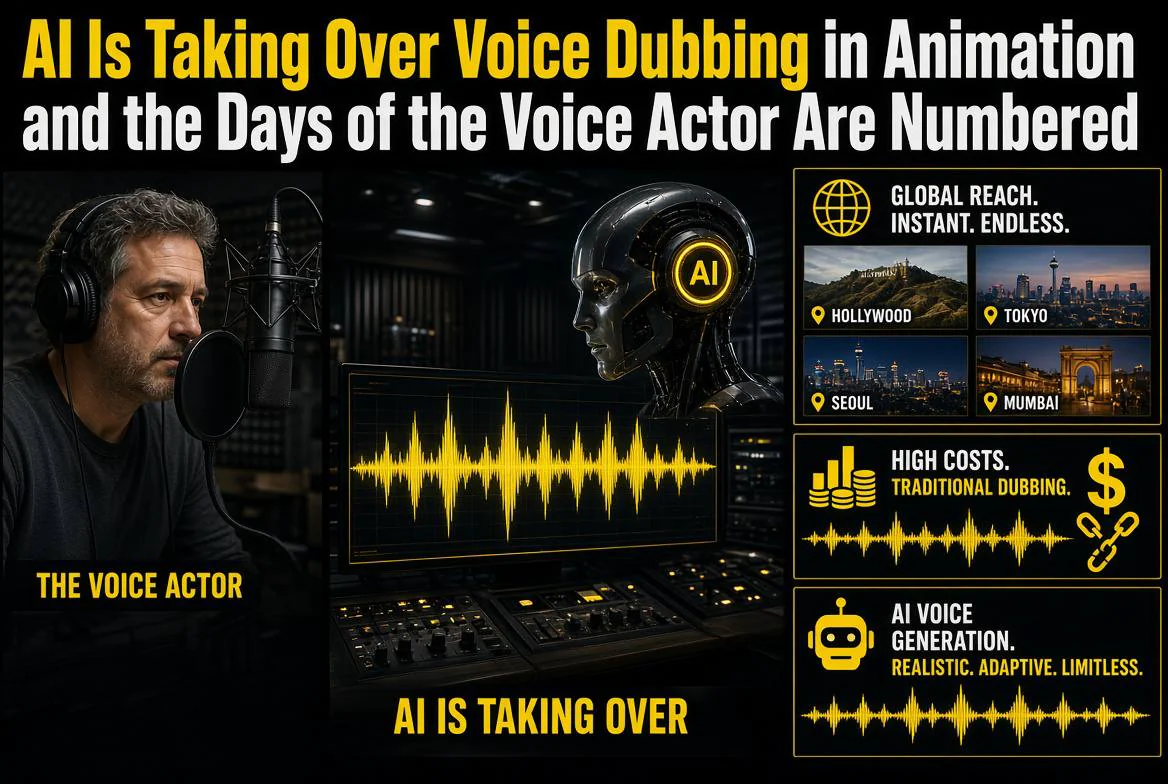
AI Is Taking Over Voice Dubbing in Animation and the Days of the Voice Actor Are Numbered
AI Is Taking Over Voice Dubbing in Animation and the Days of the Voice Actor Are Numbered
⚡ Expert Summary: The union contract that was supposed to protect voice actors from AI dubbing binds only producers inside its jurisdiction. A dubbed episode made in Mexico City, Paris or Tokyo by a studio outside that pact is outside the protection entirely. Meanwhile the Federation of International Actors reports 30 to 50 percent revenue drops at independent dubbing studios on non-flagship catalog since 2024, and a traditional dub of one animated episode into 10 to 15 languages runs $50,000 to $150,000 or more.
There is a version of this story where the machines arrive, the actors negotiate, and everybody finds a new arrangement. That version is already dead, and it died quietly in a clause nobody outside the industry read.
AI dubbing is not coming for animation voice work. It has arrived, it is in distribution, and the people it replaced are not the stars whose names are on the poster. They are the working actors who did the Spanish, French and Japanese versions of a show you have watched, the ones paid per episode in a booth in Burbank, Mexico City or Tokyo, who found out their job had changed when a producer described the new workflow at a panel.
Before getting to what happened, it is worth being precise about the thing that makes this different from every previous automation scare in entertainment. This one did not need to win an argument. It needed to be cheaper, and it needed the paperwork to permit it.
What a Dub Actually Cost Before
Traditional dubbing is not a small line item. Dubbing one episode of an animated series into ten to fifteen languages — the standard breadth for a show going global on a streaming platform — runs $50,000 to $150,000 or more per episode, depending on the language set, cast size and how much lip-sync work is required.
That number is why the pressure exists, and it is genuinely enormous. A 12-episode season in fifteen languages is a seven-figure localisation budget on a show that may not earn it back. Every studio finance department has looked at that spreadsheet and asked the obvious question.
AI dubbing answers it. ElevenLabs has publicly documented work with Gaia, a studio that reported cutting production time by 25 percent and costs by 10 percent using the platform. Ten percent is not the collapse some headlines imply — it is the number a studio can defend to a client while it learns the tool. The collapse comes next, when the tool is the workflow rather than an experiment bolted onto one.
| Cost Line | Traditional Dub | AI-Assisted Dub |
|---|---|---|
| Per episode, 10 to 15 languages | $50,000 to $150,000+ | A small fraction of that |
| Gaia studio, reported result | Baseline | 25% faster, 10% cheaper |
| Who gets paid per take | A cast, in a booth | Nobody, after the asset exists |
| Marginal cost of language 16 | Full session fee again | Near zero |
That last row is the whole business case. A studio that has cloned a voice for a dub can produce the sixteenth language for close to nothing. The economics of localisation go from linear to flat, and every studio finance team on earth understands what that means for the people who used to be paid by the session.
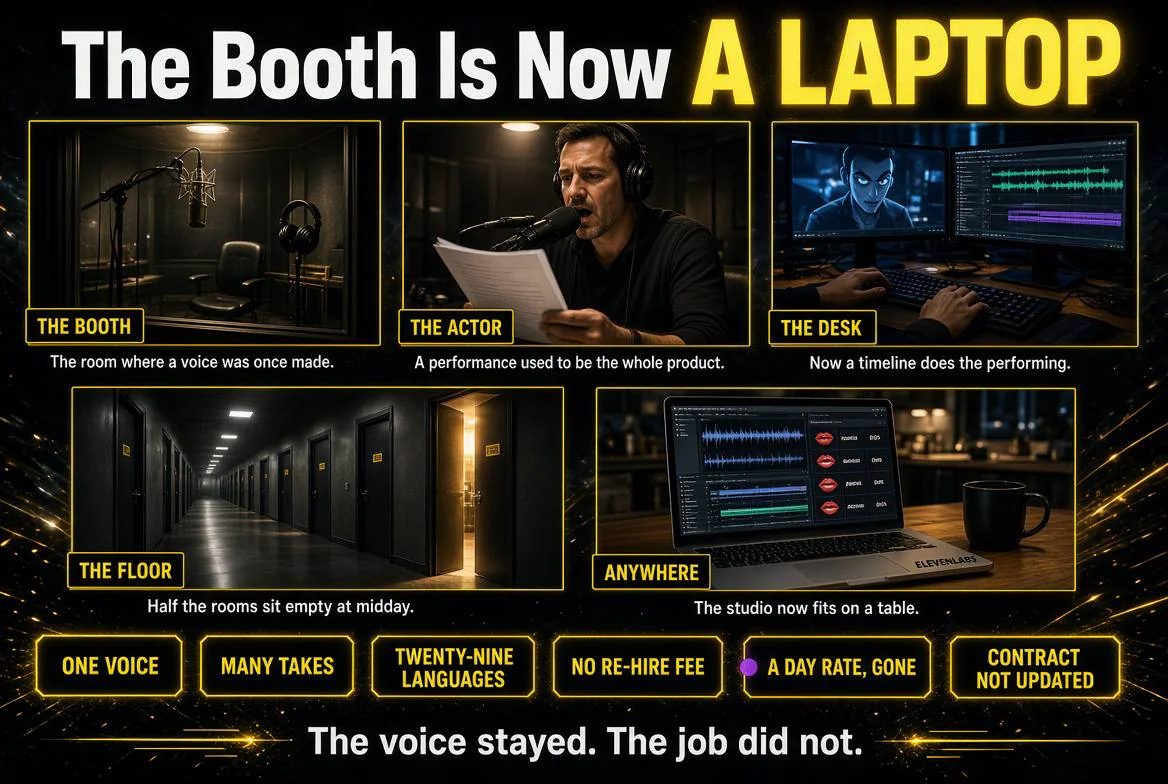
The Clause That Does Not Follow The Show
Here is where a reasonable person expects the union to step in, and here is why it did not.
SAG-AFTRA spent 2026 negotiating and ratifying a television animation agreement that includes AI protections. Those protections are real, and they bind signatory producers. They refer to the union’s own jurisdiction — the producers who have signed the agreement and are making the show inside the territory the contract governs.
A dub is not made by the show’s producer. It is made by a localisation studio, in a different country, under a different contract or no union contract at all. A French dub of an American animated series is negotiated in Paris. A Japanese dub is recorded in Tokyo. A Spanish dub for Latin America is produced in Mexico City. None of those sessions are governed by the Los Angeles agreement, and no clause in it reaches them.
So the protection exists, it is well-drafted, and it applies to the wrong side of the transaction. The actor recording the dub in a non-signatory territory has no AI clause protecting her voice, because the agreement she is not covered by was written by a union she is not represented by, in a country she does not work in.
This is not a loophole someone found. It is the structural shape of localisation, and it means the most exposed workers in the chain were never inside the room where the rules were written.
What the Old Contract Did and Did Not Say
The previous framework, the Modified Dubbing Agreement, was built for a world where dubbing meant humans in booths. It covered “voice assets or recordings as recorded” — the performance as it was captured, in the session, on tape or in a file.
It said nothing about synthesis, because in the era it was drafted, synthesis was not a thing a producer could order from a vendor.
The new 2026 summary closes part of that gap and leaves another part open. On page 5, it states plainly: “Consent generally will be required before using a voice actor’s digital replica to dub a performance into another language.” That is a meaningful sentence, and it is the first time the line has been drawn in ink.
Read the rest of the document and the shape changes. The synthetic performance provisions run to 30 June 2030 — a term, with an expiry, not a permanent settlement. Producers are required to have an “articulable business reason” before ordering a body scan, and they are not required to disclose what that reason is to the performer.
Put the two together: a performer can be scanned, told nothing about why, and the entire synthetic regime has a clock on it that stops in 2030. That is not a protection designed to hold a line. It is a protection designed to survive until the next negotiation.
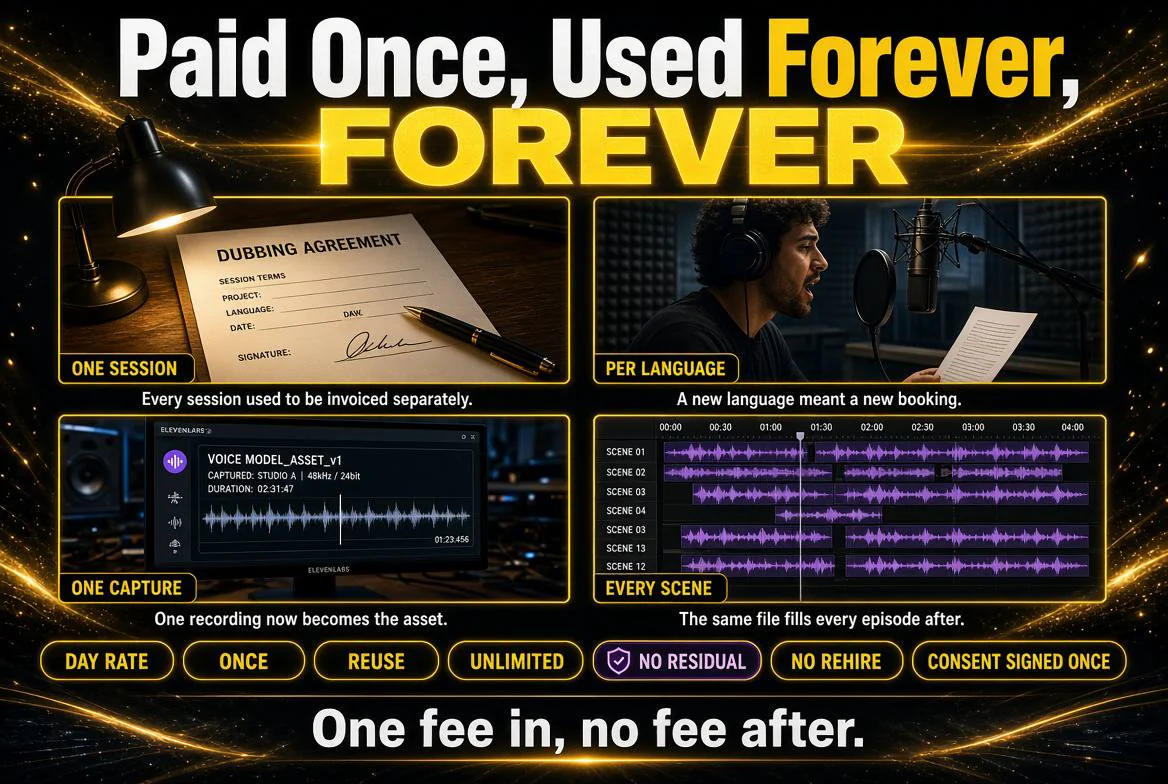
The Studios That Already Lost The Work
The clearest evidence of what has happened is not in a contract. It is in the invoices.
The Federation of International Actors has reported revenue drops of 30 to 50 percent at independent dubbing studios on non-flagship catalog since 2024. Non-flagship catalog means the back catalogue, the library titles, the shows that are not the tentpole release of the quarter — exactly the work that sustained a mid-sized studio between big jobs.
That qualifier matters more than the number. Nobody dubbing a blockbuster has been told to stop. What has thinned out is the layer of steady, unglamorous, reliable work that a studio used to build a year around: the library refresh, the market-by-market versioning, the show that needed six languages and no press tour. That is where the humans were, and that is where the humans are gone.
The studios report the drop without naming titles, and no production has publicly confirmed a cast swap. That gap is worth naming rather than papering over — it means the displacement is visible in aggregate revenue and invisible at the level of any single credit, which is precisely how an industry loses a job class without anyone being able to point at the day it happened.
| Job Type | 2019 Workflow | 2026 Workflow |
|---|---|---|
| Original English voice, flagship show | Union cast, named actors | Still human, still protected |
| Foreign dub, flagship show | Local cast per market | Mixed, increasingly synthetic |
| Foreign dub, library title | Local cast, per-episode fee | Synthetic, near zero marginal cost |
| Living inside the union’s reach | Protected by contract | Protected, if the producer signed |
| Working outside it | Protected by local law, maybe | Exposed, and the contract never reached them |
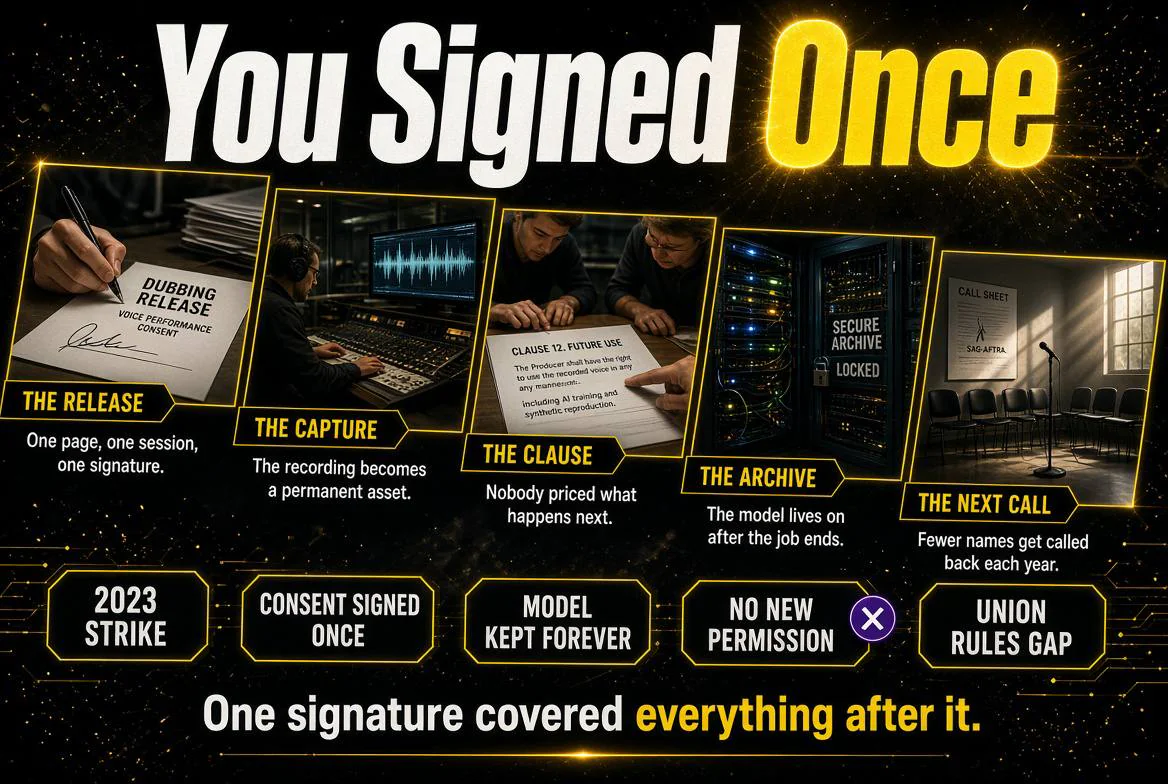
Why Consent Was Always Going To Be The Weak Point
Every AI voice system needs the same raw material: a recording of a human voice, in enough quantity to model it. That recording has to come from somewhere, and the terms under which it was captured determine everything downstream.
For a named actor with an agent, the terms are negotiated. For a session performer on a library title, they are a standard release form signed in a lobby, in a hurry, on the way into a booth. Nothing in that form contemplated a model trained on the output, because nobody who drafted it imagined one.
The 2026 agreement addresses this by requiring consent before a digital replica dubs a performance. It is the right requirement. It is also — and this is the part that decides whether the requirement means anything — enforceable only against the producers who agreed to it.
The actor in Mexico City recording a dub for a show produced by a signatory has no lever. Her session is the local studio’s contract, and the local studio’s contract is not the Los Angeles agreement. The consent that was required of the producer does not follow the show into a booth in a different country.
This is the same structural problem that has turned every AI consent fight in entertainment into a fight about paperwork rather than ethics. The tools are not the hard part; the paperwork in the countries where the work actually happens is the hard part, and nobody at the negotiating table had jurisdiction over it.
The Argument The Industry Will Make
The defence of AI dubbing, and it is a real one, is reach. A show dubbed into fifteen languages reaches audiences that would never see it otherwise, and the cost structure of traditional dubbing made some of those markets economically impossible. Animation is the best case for this argument, because a mouth shape is forgiving and a lip flap is not a human face.
Take the argument seriously. Then note what it concedes: if the benefit is access, and the cost is the working actor who used to be paid to provide it, then the benefit was paid for by the least powerful people in the chain while the cost saving accrued to the studio and the platform.
Cross the German market and the American market and the pattern is identical. Where there is a union with jurisdiction, there are guards and a term that expires in 2030. Where there is not, there is revenue down 30 to 50 percent at the studios that used to employ those people, and no public record of which shows changed.
The Bottom Line
AI did not take animation dubbing by winning an argument about art. It took it by being cheaper at the exact moment the industry needed to be cheaper, and by the fact that the contract drawn up to stop it was written in a jurisdiction where the work does not happen.
The voice actor is not being replaced by a machine that sounds like them. They are being replaced by a licensing discussion they were never a party to, in a country they never worked in, about a performance they were paid a session fee for a decade ago and signed away on a form in a lobby.
The days of the working voice actor in animation dubbing are not numbered by the technology. They were numbered by the map.
Frequently Asked Questions
Why don’t union AI protections cover dubbed animation?
SAG-AFTRA’s 2026 television animation AI protections bind signatory producers inside the union’s jurisdiction. A dub produced in Mexico City, Paris or Tokyo by a non-signatory localisation studio falls outside the agreement, so those sessions are not covered by its consent or replica provisions.
How much does traditional animation dubbing cost?
Dubbing one episode into 10 to 15 languages typically runs $50,000 to $150,000 or more, depending on the language set, cast size and lip-sync requirements. AI-assisted workflows reduce that by removing per-language session fees.
Did the 2026 union agreements address voice cloning?
Partly. The 2026 summary states that consent generally will be required before using a voice actor’s digital replica to dub a performance into another language, and the synthetic performance provisions run to 30 June 2030. Producers must have an articulable business reason before a body scan but are not required to disclose it.
How much work have dubbing studios lost to AI?
The Federation of International Actors has reported revenue drops of 30 to 50 percent at independent dubbing studios on non-flagship catalog since 2024. No production has publicly confirmed a cast swap.
What did the old Modified Dubbing Agreement say about AI?
Nothing. It covered “voice assets or recordings as recorded” — the performance as captured — and was silent on synthesis, because synthesis was not a service a producer could order when it was drafted.
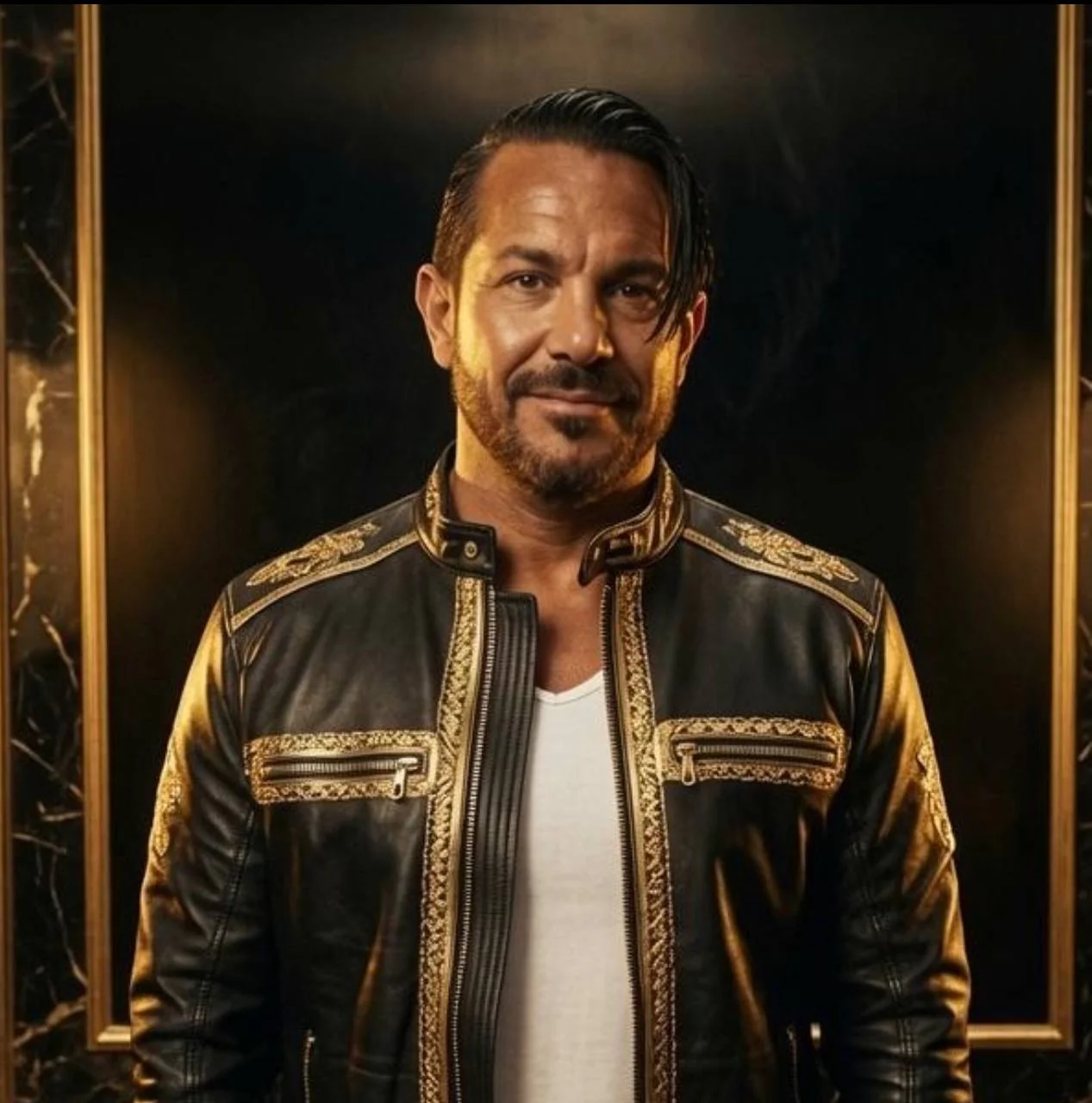
About Barak Schurr
Barak Schurr is a serial entrepreneur who built and exited a major ticketing platform before turning his attention to AI and content. He runs three AI-focused research sites and writes about the tools, workflows, and strategies that let solo creators build real channels — without a crew, a studio, or a Hollywood budget.
Email: [email protected]
More AI Video Resources


More AI Video Resources