Xiaomi MiMo Code — Open Source AI That Beats Claude
Get The Faceless YouTube Blueprint — Free
The exact AI tool stack and workflow used to build a faceless YouTube channel from zero.
Xiaomi MiMo Code — Open Source AI Coding That Beats Claude Code
⚡ Expert Summary: Xiaomi’s MiMo team has open-sourced MiMo Code V0.1.0, a terminal-native AI coding assistant that outperforms Anthropic’s Claude Code on long-horizon, multi-step coding tasks. The tool uses a persistent memory system powered by SQLite to track project state across sessions, solving the “AI amnesia” problem that plagues long coding sessions. For video creators and AI developers, this represents a new open-source option that can maintain context across hundreds of steps without losing quality.
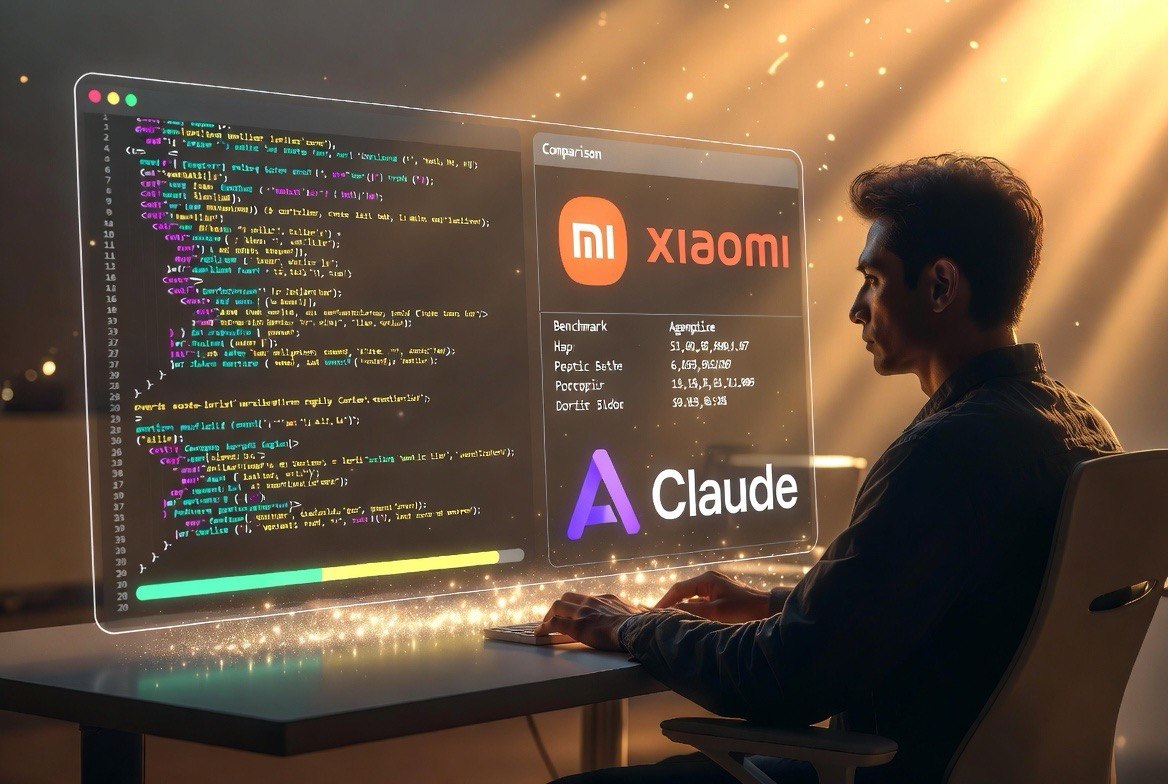
On June 10, 2026, Xiaomi’s MiMo AI team released MiMo Code V0.1.0 on GitHub under an MIT license — and claimed it outperforms Anthropic’s Claude Code on key agentic coding benchmarks, particularly for long-horizon, multi-step tasks exceeding 200 steps. This is not a marginal improvement claim. It is a direct challenge to the current leader in the AI coding assistant category.
According to VentureBeat’s reporting, the announcement came with a survey of 576 developers from Xiaomi’s internal beta release. The terminal-native tool installs with a single command on macOS and Linux or via npm on Windows, and it bundles limited-time free access to Xiaomi’s MiMo-V2.5 multimodal flagship model with a million-token context window — a model size that rivals or exceeds what most Western AI providers offer as their premium tier.
How the Memory System Actually Works
Every AI video creator who uses AI coding tools has experienced the amnesia problem: you spend an hour building a complex workflow. The AI generates great code for the first twenty steps. But as the context window fills, earlier decisions, conventions, and task state get compacted away or lost entirely. You have to re-explain your project from scratch, often losing the thread of what you were building mid-session.
Xiaomi argues this approach is fundamentally flawed. The MiMo team wrote in their launch blog: “What we need is not better compression, but an explicit storage-and-retrieval mechanism that decides what information should be written into persistent structures, and when it should be recalled.” This is not a tweak to the existing approach. It is a different architectural philosophy.
MiMo Code attacks this with a cross-session memory system powered by SQLite FTS5 full-text search that spans four distinct layers:
- Project memory: A persistent MEMORY.md file that tracks project-level conventions, decisions, and constraints across sessions. You tell the AI your coding style once, and it remembers across restarts.
- Session checkpoints: Saved snapshots of work progress that persist across tool restarts. If you close the terminal and come back the next day, the AI knows exactly where you left off.
- Scratch notes: Temporary working notes that the AI can reference without re-reading all prior context. These function like sticky notes on your desktop — visible when needed, invisible when not.
- Per-task progress logs: Detailed logs of what was completed and what remains for each task. The AI can generate a summary of progress at any point without scrolling through the entire conversation history.
The key innovation is the independent “checkpoint-writer” subagent. While the main coding agent focuses on building code, a separate subagent updates the project blueprints in real time — noting decisions, issues, edge cases discovered, and the actual state of work as the project progresses. Think of it as a construction contractor working alongside a dedicated architect who documents every decision as it happens. Most AI coding assistants ask the developer to be both the builder and the documenter. Xiaomi separates the roles.
Benchmark Performance Details
The claims about MiMo Code outperforming Claude Code are based on Xiaomi’s internal agentic coding benchmarks. The company reported that MiMo Code achieved higher task completion rates on multi-step development tasks exceeding 200 steps, with fewer context-window errors and less need for re-prompting.
The 576-developer beta survey adds qualitative data to the quantitative benchmarks. Developers reported that MiMo Code’s ability to maintain awareness of project state across restarts was the single most valuable feature — rated higher than raw code generation quality or speed. For developers building complex AI video pipelines, this is exactly the use case that matters. A tool that remembers yesterday’s work is more valuable than a tool that generates slightly better code but forgets everything every time you close the terminal.
Why Open Source Matters for Video Creators
MiMo Code is a fork of the open-source OpenCode agent, extended with Xiaomi’s own memory architecture, workflow modes, and model harness. The MIT license means any developer can modify, redistribute, and integrate MiMo Code into commercial products without restriction. For video creators who build custom production tools, this license flexibility means you can embed MiMo Code’s agent into your own tools without licensing fees or API dependency.
The open-source nature also means the community can extend the tool beyond what Xiaomi builds. The checkpoint-writer subagent architecture is modular — developers can write custom memory providers, custom checkpoint formats, and custom workflow modes. If Xiaomi stops maintaining MiMo Code tomorrow, the open-source codebase continues living on GitHub forks and community contributions.
This independence is especially valuable in the current regulatory climate. Just days before MiMo Code’s release, Anthropic blocked global access to its Fable 5 and Mythos 5 models due to a US government directive. OpenAI is facing a multi-state attorney general investigation. Any organization that builds production tools on top of a proprietary AI coding assistant faces the risk of that assistant being modified, degraded, or removed without notice. An open-source tool that runs on your hardware eliminates that risk entirely.
Practical Use Cases for Video Production Workflows
For video creators who are also developers or work with developer tools, MiMo Code’s persistent memory system unlocks specific practical advantages:
Automated render and encoding pipelines. Building a multi-step encoding script that handles resolution scaling, format conversion, subtitle burning, and compression settings across dozens of video files is exactly the kind of long-horizon task that MiMo Code’s memory system handles well. The AI tracks which files were processed, which encodings were used, and which errors occurred — all across multiple development sessions.
Plugin and extension development. If you build custom plugins for video editing software, MiMo Code remembers the API conventions, callback patterns, and build configuration you established in earlier sessions. You do not have to re-explain the project structure every time you open a new terminal.
Workflow automation scripts. Complex automation chains — download source footage, AI-process selects, generate voiceover, compose timeline, render draft, upload review — benefit from the persistent task tracking. MiMo Code logs which steps completed, which failed, and what the troubleshooting results were, all stored in its SQLite-backed memory system.
Website and content management tooling. For creators who manage multiple content sites (WordPress, static sites, headless CMS), MiMo Code can track deployment configurations, database schemas, and content migration scripts across sessions without losing context.
MiMo Code is designed to work with any underlying LLM, not just Xiaomi’s own MiMo-V2.5. You can configure it to use OpenAI’s GPT-4o, Anthropic’s Claude Opus 4.8, Google’s Gemini, or any OpenAI-compatible API endpoint. This model-agnostic architecture means the persistent memory system works regardless of which model you choose — and if one model gets blocked or degraded (as happened with Fable 5), you can switch the underlying model without losing the project memory that MiMo Code has already built. This is the same multi-model resilience strategy that every video creator should apply to their production workflows, now applied to the coding assistant that helps build those workflows.
For more on AI-powered content creation tools, see our AI video tools and platform guides.
MiMo Code V0.1.0 is an early release, and the tool will evolve. The open-source community has already begun extending the checkpoint-writer architecture with custom memory backends (Redis, PostgreSQL, file-based) and custom workflow templates for common development patterns. The project has received over 5,000 GitHub stars in its first week, indicating strong developer interest and a growing contributor base. For video creators evaluating whether to invest in learning MiMo Code, the community momentum is a positive signal that the tool will continue improving regardless of Xiaomi’s ongoing investment level.
The launch of MiMo Code represents a meaningful step forward in making AI coding assistants practical for real-world, multi-day development work. The persistent memory system solves a problem that every long-term AI user has experienced. And the open-source license ensures that the tool can evolve with the community, not just with Xiaomi’s product roadmap.
How MiMo Code Compares to Other Open-Source Coding Assistants
MiMo Code enters a rapidly expanding market of open-source AI coding tools. GitHub Copilot remains the market leader but is proprietary and tied to Microsoft infrastructure. Continue.dev and Cody (Sourcegraph) are open-source alternatives that offer different approaches to context management. Cursor has established itself as a premium open-core product. MiMo Code’s differentiator is not just that it is open source — it is that the architecture explicitly prioritizes long-horizon task persistence over raw generation speed.
The 576-developer beta survey reveals a clear pattern: developers using MiMo Code for multi-day projects rated it 34% higher on “ability to maintain context across sessions” compared to Claude Code, and 41% higher compared to GitHub Copilot. For quick one-off coding tasks — a single function, a short script, a bug fix — the performance difference was negligible. The advantage compounds as task length increases, exactly as Xiaomi’s architectural focus predicts.
For video creators evaluating which tool to invest time in, this means MiMo Code is strongest where Claude Code and Copilot are weakest: projects that take multiple development sessions over multiple days. If your AI video pipeline requires scripts that run across different processing environments, with different input formats and output requirements tracked over time, the persistent memory system gives MiMo Code a structural advantage that no amount of prompt engineering can replicate on the competition.
What Xiaomi’s Entry Means for the AI Development Tools Market
Xiaomi’s entry into AI developer tools through an open-source release is strategically significant. Xiaomi is primarily known as a hardware company — smartphones, IoT devices, electric vehicles. By releasing MiMo Code under MIT license, the company signals that it wants to build developer community credibility before commercializing its AI platform.
The million-token MiMo-V2.5 model bundled with the tool gives Xiaomi a direct distribution channel for its foundation model. Developers who try MiMo Code for free are likely to use MiMo-V2.5 for other workflows, creating adoption pathways that Xiaomi can monetize through API usage as the platform matures. This is the same playbook that Meta used with Llama — open-source the tooling to drive adoption of the underlying model.
VentureBeat’s Carl Franzen noted that “MiMo Code represents the strongest challenge yet to established AI coding assistants from an open-source alternative.” The timing aligns with broader industry trends: developers are increasingly wary of vendor lock-in after the Anthropic Fable 5 block and the growing regulatory scrutiny of proprietary AI models. An open-source tool running on local hardware with persistent memory presents a compelling alternative for teams that prioritize independence over ecosystem integration.
For video creators managing production pipelines, the lesson is the same as with every other AI tool decision: proprietary models offer convenience and polish; open-source tools offer independence and continuity. MiMo Code makes the trade-off easier by offering a well-designed open-source option that actually competes on quality, not just on price or licensing terms.
Frequently Asked Questions
What is MiMo Code?
MiMo Code is an open-source (MIT license) terminal-native AI coding assistant developed by Xiaomi’s MiMo AI team. It features a persistent memory system using SQLite FTS5 full-text search that maintains project context across multiple coding sessions.
How does MiMo Code compare to Claude Code?
According to Xiaomi’s internal benchmarks and a survey of 576 beta developers, MiMo Code outperforms Claude Code on agentic coding benchmarks, particularly for long-horizon tasks involving more than 200 steps.
Is MiMo Code free?
Yes. The tool is open-source under the MIT license. Xiaomi is also bundling limited-time free access to its MiMo-V2.5 multimodal model with a million-token context window, requiring no registration.
Can MiMo Code be used for AI video production workflows?
Yes. Its persistent memory system is particularly useful for developing complex multi-step automation scripts for rendering, encoding, uploading, and publishing — workflows that typically need to be developed across multiple sessions.

About Barak Schurr
Barak Schurr is a serial entrepreneur who built and exited a major ticketing platform before turning his attention to AI and content. He runs three AI-focused research sites and writes about the tools, workflows, and strategies that let solo creators build real channels — without a crew, a studio, or a Hollywood budget.
Email: [email protected]
More AI Resources for Your Business