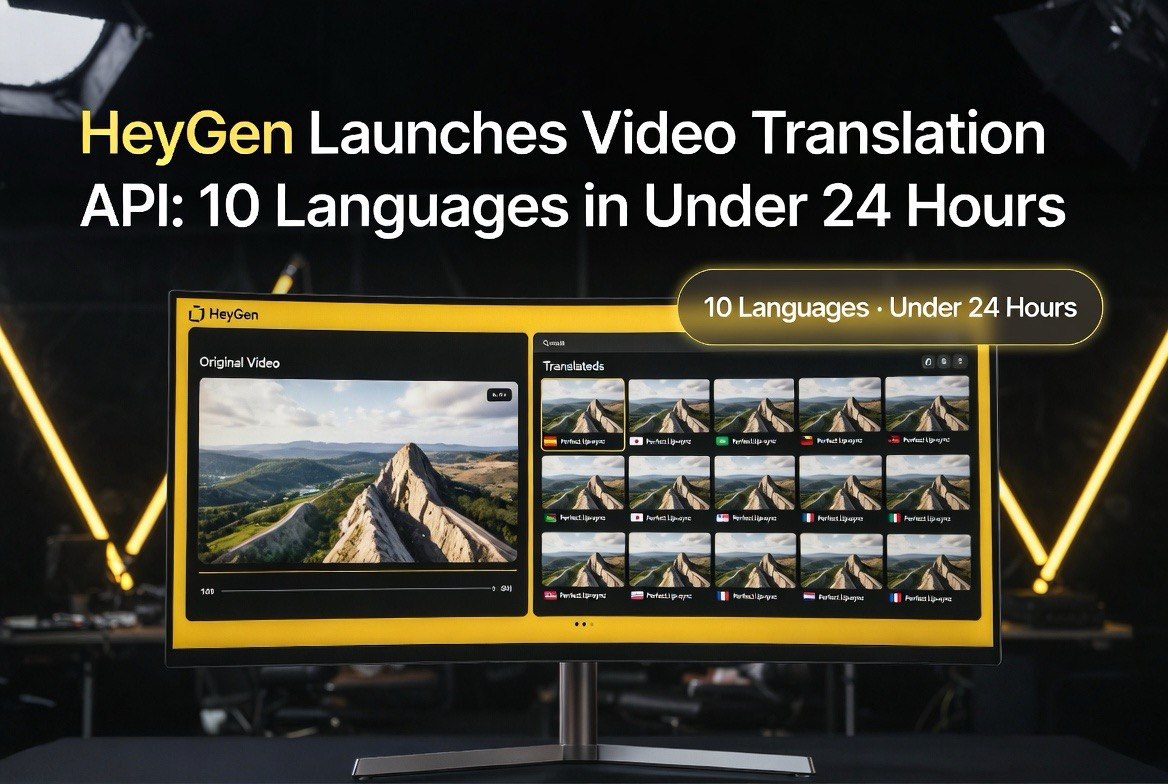
HeyGen Launches Video Translation API: 10 Languages in Under 24 Hours
Get The Faceless YouTube Blueprint — Free
The exact AI tool stack and workflow used to build a faceless YouTube channel from zero.
HeyGen Launches Video Translation API: 10 Languages in Under 24 Hours
⚡ Expert Summary: HeyGen launched its Video Translation API on July 23, 2026, enabling creators and media companies to translate videos into up to 10 languages simultaneously with accurate subtitles, lip-sync dubbing, and voice preservation — all in under 24 hours through batch processing. The API supports 175+ languages and dialects, with a batch endpoint designed for channel-wide localization. For video creators with global audiences, this turns a multi-week translation process into a same-day workflow.
What the HeyGen Video Translation API Does
HeyGen’s Video Translation API converts a single video — or a batch of videos — into multiple language versions with synchronized subtitles, lip-sync dubbing that matches the original speaker’s mouth movements, and voice cloning that preserves the speaker’s tone, pitch, and speaking style in every target language. Upload your content once, select up to 10 target languages, and the API returns fully localized video files that are ready to publish.
The batch endpoint is the headline feature. Previous workflows required submitting one video per language and waiting for each to process independently. The new batch API handles multiple videos for multiple languages in a single request, with estimated completion within 24 hours for a full channel localization. A YouTube creator with 50 English-language videos can submit all 50 for Spanish, Portuguese, French, German, and Japanese localization in one batch and have all 250 localized videos ready the next day.
The Global Content Opportunity
The video creator economy has a language problem. English-language content reaches approximately 1.5 billion English speakers worldwide — a massive audience by any measure. But the remaining 6.5 billion people on earth speak other languages, and video consumption in non-English languages is growing faster than English-language video consumption in virtually every market. A creator who publishes only in English is leaving 80% of the potential global audience on the table.
The barrier has never been awareness. Every creator with international analytics knows they have viewers watching in markets where they cannot publish. The barrier is production cost. Translating one 10-minute video into five languages with human dubbing costs $500-$2,000 and takes 2-5 business days. Translating a full catalog of 100 videos into 10 languages costs more than most creators make in a year and takes months. The result is a self-reinforcing cycle: creators do not translate because it is too expensive, so international audiences watch less, so platforms do not prioritize international content, so creators see less incentive to translate.
AI video translation breaks this cycle. HeyGen’s batch API can localize an entire video catalog into 10 languages for a fraction of the cost of human translation, in a fraction of the time. The quality is not identical to professional human dubbing — the lip-sync can feel slightly artificial in close-ups, and voice cloning cannot perfectly capture emotional nuance across all languages — but for most content types, it is good enough to unlock global audiences that were previously inaccessible.
For context on the revenue opportunity: YouTube’s Partner Program pays creators a share of ad revenue from viewers in each market. CPM rates vary dramatically by region. US and Canadian viewers generate $5-$15 CPM. Viewers in India, Latin America, and Southeast Asia generate $0.50-$3 CPM. But volume compensates: a creator who adds Spanish, Portuguese, and Hindi translations can often double or triple total viewership while adding minimal production cost. The net revenue increase can be 50-100% depending on the content category and existing international audience.
How the Technology Works
HeyGen’s Video Translation API combines three AI capabilities: automatic speech recognition transcribes the original audio into text in the source language; neural machine translation converts the transcript into each target language while preserving context, idiom meaning, and tone; and generative voice and video synthesis generates new audio in the target language with the same speaker’s voice characteristics, then adjusts the video to match the new audio — lip movements, facial expressions, and timing.
The lip-sync capability is the most technically demanding component. Matching mouth movements to different phonemes in different languages requires precise frame-level video editing. HeyGen has been refining this technology across multiple product versions over the past two years, and the Video Translation API represents its most mature implementation. The result is that translated videos maintain the visual authenticity of the original speaker rather than cutting to a generic voiceover or dubbing actor.
Practical Considerations for Creators
Before committing to a full catalog translation, creators should consider a few practical factors. The translation quality depends heavily on the source video quality — clear audio, minimal background noise, consistent lighting, and a visible speaker face produce the best results. Heavily edited videos with frequent jump cuts, green screen backgrounds, or heavy visual effects can confuse the lip-sync algorithm and produce artifacts in translated versions.
Content category also affects quality. Educational and tutorial content translates well because the vocabulary is predictable and the pacing is deliberate. Narrative content with emotional nuance, sarcasm, or culturally specific humor is harder to translate well — AI translation captures the words but may miss the emotional context or cultural reference.
Finally, creators should consider the audience experience. Some viewers in non-English markets prefer subtitled original audio over dubbed AI audio. The API generates both, so creators can offer options and let data determine which performs better in each market.
Key Features of the API
Multi-Language Batch Processing
Submit up to 10 target languages per video in a single API request. The batch endpoint accepts multiple videos simultaneously. The system processes all language variants in parallel, returning completed files as each language finishes rather than requiring sequential processing.
Voice Preservation
The cloned voice in each target language maintains the original speaker’s vocal characteristics — pitch, pacing, emphasis patterns, and speech rhythm. Viewers watching a Spanish-translated version hear what sounds like the original speaker speaking Spanish, not a generic AI voice or a different human voice actor.
Accurate Subtitles and Dubbing
Both subtitle tracks and dubbed audio are generated for each language version. Subtitles use the exact translated transcript, while dubbing uses the lip-synced voice. Creators can publish with embedded subtitle tracks, dubbed audio, or both depending on the target platform and audience preferences.
Language Coverage
175+ languages and dialects are supported, covering virtually all major markets with significant video consumption. The 10-language batch limit covers the most important expansion languages for most creators: Spanish, Portuguese, French, German, Japanese, Korean, Arabic, Hindi, Mandarin, and one additional language of choice.
Developer-Friendly Endpoints
The API is designed for integration into existing content workflows. Upload via direct file upload or URL reference (YouTube link, cloud storage URL). Webhook callbacks notify when each language version is complete. Paginated results for batch jobs let developers track progress across hundreds of videos without polling.
Target Use Cases
YouTube creators with established English-language channels represent the largest immediate market. Translating an entire back catalog into 5-10 languages opens new revenue streams through international ad revenue, sponsorship opportunities in local markets, and audience growth in regions where the creator’s content category is underserved.
E-learning and course creators can localize educational video content for international students. Course platforms like Udemy, Coursera, and Teachable already have global distribution — localized video content dramatically improves completion and satisfaction rates for non-English-speaking students.
Media companies and news organizations can publish the same story in multiple languages simultaneously, maintaining editorial consistency across markets without maintaining separate production teams for each language.
Enterprise training and internal communications teams can produce training videos in the languages spoken by their global workforce, ensuring consistent messaging across geographies without requiring employees to consume training content in a non-native language.
How HeyGen Compares to Other Video Translation Tools
The AI video dubbing market is growing rapidly with several competitors offering different trade-offs. ElevenLabs offers excellent text-to-speech dubbing and industry-leading voice cloning fidelity, but does not provide lip-sync video output — you get audio files that need to be synced manually to video in a separate editing step, which adds time and requires video editing skills. Rask AI offers video translation with lip-sync capabilities but lacks batch processing for multiple languages and has lower voice preservation quality — the translated speaker sounds noticeably different from the original. Deepdub targets enterprise media localization with human-in-the-loop quality control and professional-grade results, but at significantly higher price points and longer turnaround times that make it impractical for individual creators.
HeyGen’s competitive advantage is the combination of batch API, voice preservation quality, and lip-sync accuracy in a single product aimed at the creator market. The 10-language batch capability with 24-hour turnaround is unmatched among tools at its price point. The developer API enables integration into automated content workflows — a creator can set up a pipeline where new English videos are automatically translated and published to language-specific channels without manual intervention.
The Future of Multilingual Video
HeyGen’s Video Translation API is part of a broader trend toward language-agnostic content production. Within the next 2-3 years, single-language video production will start to feel as limited as releasing a mobile app in only one language does today. Creators who build multilingual audiences early will have a compounding advantage: each new video generates audience and revenue in multiple languages simultaneously, while single-language creators are limited to their native market.
The technology is not perfect today. But it is good enough to start, and it will improve rapidly. Creators who wait for perfect translation will miss the window of lower competition in non-English markets. Those who start now, with imperfect but functional translated content, will have established audiences and algorithmic momentum in those markets by the time the technology matures.
Pricing and Availability
HeyGen has not published detailed pricing for the Video Translation API. Current HeyGen plans include video translation capabilities within their existing credit-based system. The API is live as of the July 23 announcement, with developer documentation available at developers.heygen.com. Creators and businesses interested in high-volume batch translation should contact HeyGen through their website for custom pricing.
FAQ
What is the HeyGen Video Translation API?
Launched July 23, 2026, the Video Translation API enables batch translation of videos into up to 10 languages simultaneously with accurate subtitles, lip-sync dubbing, and voice preservation. A full channel catalog can be localized in under 24 hours through the batch endpoint.
How many languages does HeyGen Video Translation support?
The API supports 175+ languages and dialects. A single batch job can translate into up to 10 languages simultaneously, covering major markets like Spanish, Portuguese, French, German, Japanese, Korean, Arabic, Hindi, and Mandarin.
Does HeyGen preserve the original speaker’s voice in translation?
Yes. The API clones the original speaker’s voice characteristics — pitch, pacing, emphasis patterns, and speech rhythm — and applies them to the translated audio in each target language. Viewers hear what sounds like the original speaker speaking their language.
How fast is the batch translation?
HeyGen advertises that a full channel catalog can be localized into 10 languages in under 24 hours through the batch endpoint. Individual language versions return progressively as they complete rather than requiring all to finish before any are available.
What types of content work best with HeyGen Video Translation?
The API works best for talking-head videos, tutorials, presentations, and narrative content where the speaker is the primary visual element. Fast-paced content with frequent cuts, loud background music, or multiple speakers requires more preprocessing for optimal results.
Does the API require developer integration?
The API is developer-facing with REST endpoints, webhook callbacks, and paginated batch job tracking. HeyGen also offers a web interface for video translation, but the batch processing and high-volume capabilities are primarily accessed through the API.

About Barak Schurr
Barak Schurr is a serial entrepreneur who built and exited a major ticketing platform before turning his attention to AI and content. He runs three AI-focused research sites and writes about the tools, workflows, and strategies that let solo creators build real channels — without a crew, a studio, or a Hollywood budget.
Email: [email protected]