
A Judge Just Ruled That Scraping YouTube to Train AI Video Models May Be Illegal
A Judge Just Ruled That Scraping YouTube to Train AI Video Models May Be Illegal
⚡ Expert Summary: On 3 November 2026, Judge Lewis A. Kaplan of the Southern District of New York refused to throw out a claim that Runway AI broke the DMCA’s anti-circumvention rules by pulling YouTube videos through downloaders to train its video models. The ruling does not ban scraping and it does not award a dollar. It does something quieter and more serious: it puts statutory damages of $200 to $2,500 per act on the table for every clip ingested. If it survives appeal, every AI video model trained on other people’s footage inherits a per-video liability it never priced.
For two years the AI video industry has operated on a comfortable assumption: the training data question would be settled eventually, by someone else, after the money was made.
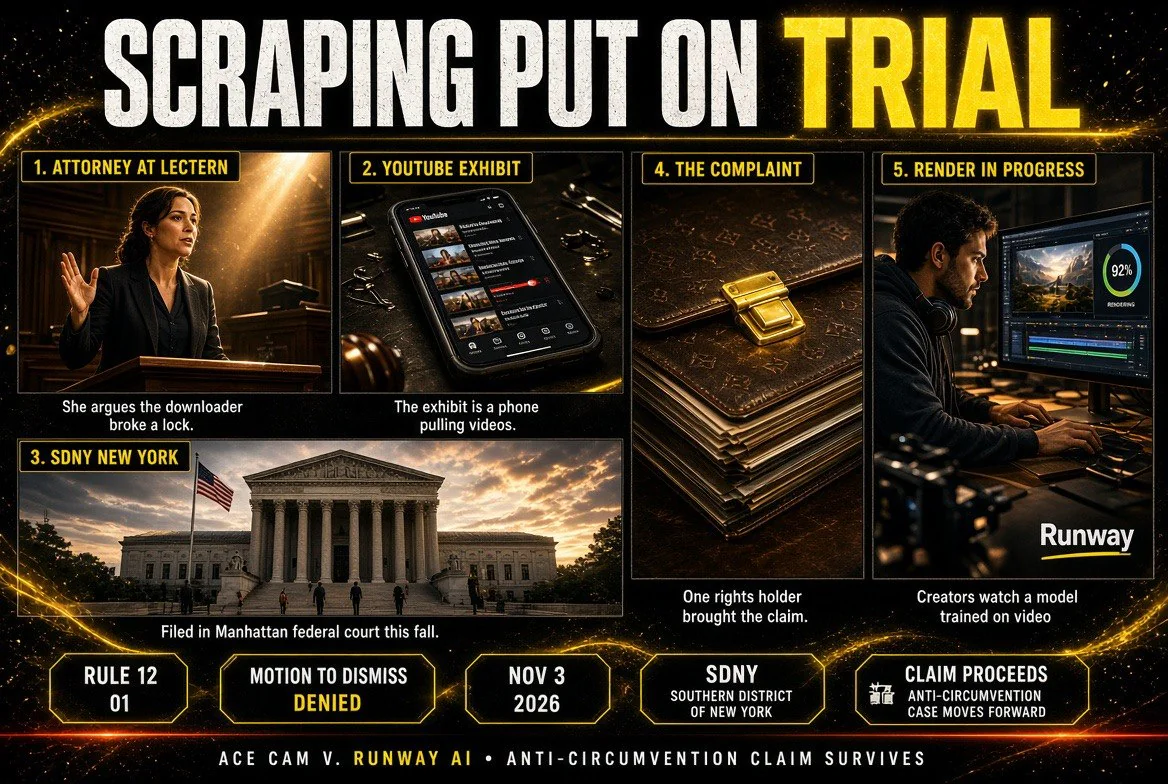
On 3 November 2026, Judge Lewis A. Kaplan of the U.S. District Court for the Southern District of New York made the first real move on that assumption, in Ace Cam, Inc. v. Runway AI, Inc., No. 1:26-cv-01362. He declined to dismiss a claim that the defendant violated the anti-circumvention provisions of the Digital Millennium Copyright Act, section 1201, by using tools to pull YouTube videos down and feed them into its training pipeline.
The case is not over. Nothing has been proven. Runway has every right to appeal and will.
But read what the ruling actually does, because the shape of it is worse for the industry than a loss would be on its own. It does not say scraping is theft. It says the thing you use to scrape — the downloader that walks past YouTube’s technical protections — may itself be a federal violation, and that the statute attaches a per-act dollar figure to each video that went through it.
That per-act structure is the part model labs are not built to absorb. A settlement is a number you can budget. Statutory damages multiplied across a training corpus is a number that ends companies.
What the Court Actually Decided
Strip the procedure and the holding is narrow and specific.
Ace Cam, a rights holder, sued Runway over the way its training data was assembled. Runway moved to dismiss, arguing among other things that the anti-circumvention claim did not fit the facts. Judge Kaplan refused to dismiss that claim.
What that means in plain language: the court found that the plaintiff had plausibly alleged a violation of section 1201, which bars circumventing technological measures that control access to a copyrighted work. YouTube’s platform employs controls against automated bulk downloading. The plaintiff’s theory is that tools built to defeat those controls are circumvention devices, and using them to harvest videos for training is circumvention in service of a commercial purpose.
What the ruling is not:
It is not a finding that scraping is copyright infringement. That is a separate question under section 106, and it is not what this claim is about. The anti-circumvention theory is deliberately parallel to infringement rather than dependent on it — you can violate section 1201 without ever producing an infringing copy.
It is not a ruling that Runway did anything wrong. A motion to dismiss tests whether a claim can proceed, not whether it is true. The plaintiff still has to prove it.
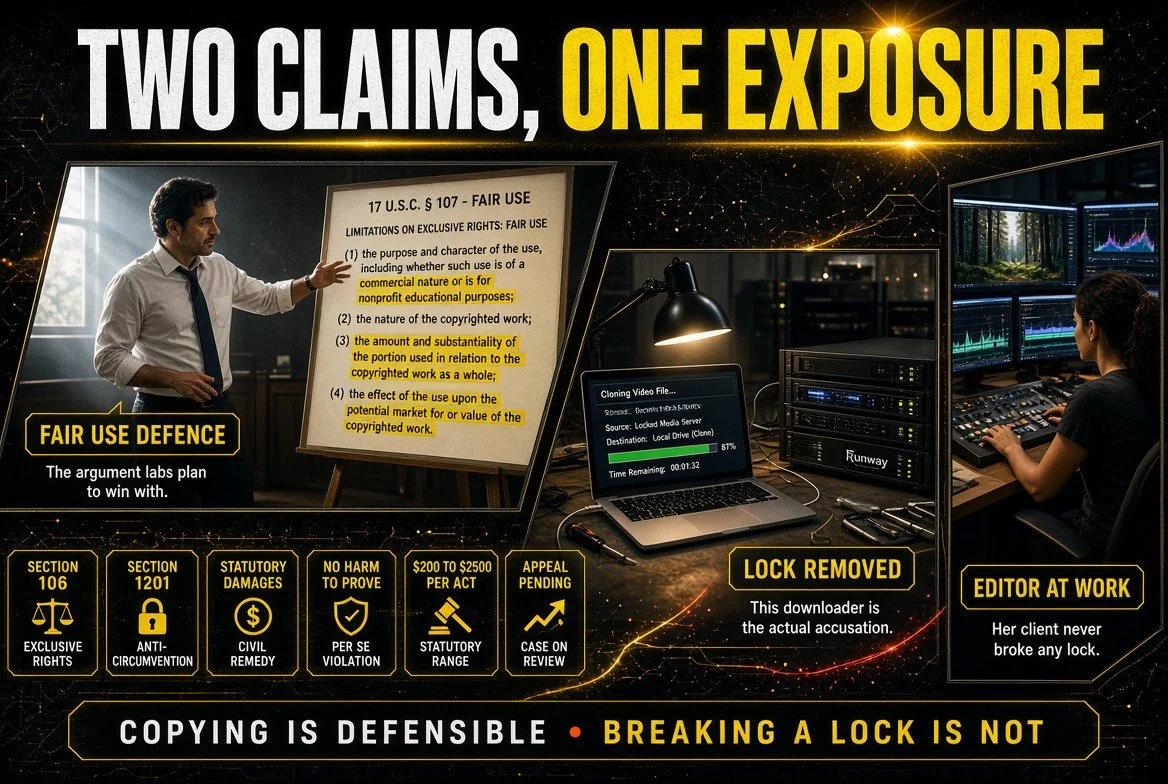
It is not a final judgment on fair use. Fair use is a defense to infringement, not a blanket licence to defeat access controls. That distinction, which the industry has spent two years pretending was blurry, is the one this ruling sharpens.
Why Section 1201 Is a Much Bigger Problem Than Infringement
The AI industry has built its legal strategy around one word: fair use.
That is a reasonable bet on infringement claims. Training a model on published works is arguably transformative, courts have been receptive to that framing, and the analysis is fact-intensive enough that a defendant with good lawyers can fight for years. Fair use is a defense that costs time, and time is money the labs have.
Section 1201 has no such defense. It is not about whether your use of the work was fair — it is about whether you broke a lock to get to it. And it carries its own damages provision, independent of any actual harm to the rights holder.
That structure produces three problems the industry has not priced.
One: damages are statutory, not compensatory. The range is $200 to $2,500 per act of circumvention, with the court setting the amount. There is no requirement to prove the rights holder lost a dime. Multiply the bottom of that range across a corpus of a few million videos and the exposure is not a legal bill, it is a balance sheet event.
Two: intent is not the defence the labs think it is. The argument “we did not know the downloader circumvented anything” runs into the fact that the downloader exists for precisely that purpose, is marketed as such, and the entire point of using it at scale is to bypass the limits the platform imposed. Courts are unimpressed by that framing in other contexts.
Three: every tool in the chain is exposed. The defendant did not have to build the downloader. Using one may be enough. That puts the scraping middlemen, the dataset resellers, and every vendor that sold a “curated video corpus” in the same posture as the lab that bought it.
| Legal Theory | What It Targets | The Industry’s Defence |
|---|---|---|
| Copyright infringement | Making or distributing copies of the work | Fair use — training is transformative |
| DMCA section 1201 | Defeating the access controls on the work | Weak — fair use is not a licence to break a lock |
| Contract and terms of service | Violating the platform’s usage terms | Contested enforceability against non-users |
| Statutory damages | Each act of circumvention, per work | No defence available — this is the exposure |
The Number Nobody Wants to Say Out Loud
Here is the arithmetic every AI video lab is now running privately, and that creators should run too because it tells them what their footage is worth.
Take a hypothetical model trained on two million short clips scraped from a public video platform. Take the low end of the statutory range, $200 per act. That is $400 million in exposure. Not a settlement negotiation — the floor, assuming the plaintiff class covers every clip and the court awards the minimum.
Now take a model trained on ten million clips. Two billion dollars.
The numbers are absurd, which is why nobody has litigated this to judgment yet: the damages structure is designed for a person ripping a DVD, not for an industry ingesting a decade of public video. Courts have discretion to reduce statutory awards when the total is disproportionate, and a judge facing a $2 billion calculation against a startup will consider whether that is what Congress intended.
| Clips Ingested | At $200 Per Act | At $2,500 Per Act |
|---|---|---|
| 10,000 clips | $2 million | $25 million |
| 100,000 clips | $20 million | $250 million |
| 1 million clips | $200 million | $2.5 billion |
| 2 million clips | $400 million | $5 billion |
| 10 million clips | $2 billion | $25 billion |
But the point of a statutory scheme is not that it always produces proportional awards. It is that the plaintiff does not have to prove harm, which means the defendant cannot argue “you cannot show damages.” That argument — the one that wins so many copyright suits — is simply unavailable here.
And there is a second figure that matters more to a creator than any of these: what your footage was actually worth to the lab that took it. The answer, in this model, is somewhere between two hundred dollars and twenty-five hundred dollars a clip, decided by a court, in the event someone sues. For a creator with a thousand videos and no lawyer, the realistic outcome is zero — not because the law fails, but because the litigation cost exceeds the recovery.
That asymmetry is the whole reason class action and state AG action exist. Individual creators cannot enforce section 1201 at scale. The rights holder that brought this case can.

What This Means for the Tools You Already Pay For
Now the part that lands in your own workflow.
You do not scrape ten million videos. You generate clips on Runway, Kling, Veo, Vidu or Higgsfield, upload a prompt, and download the result. The training data question is supposed to be the vendor’s problem.
It stays the vendor’s problem legally. But it becomes your problem commercially, in three specific ways.
Model risk becomes subscription risk. A lab facing a nine-figure damages exposure has three options: raise prices, restrict what the model will output, or pull the model. You have seen vendors rewrite their terms mid-contract already — our breakdown of why every AI video stack now has an expiration date covers the mechanics. A copyright ruling significantly increases the speed at which that happens.
Commercial indemnification will get priced, or removed. Enterprise AI video contracts increasingly carry indemnification for training data claims. If liability that was theoretical becomes a live per-act exposure, indemnities shrink and the price of the ones that remain goes up. That cost arrives on your invoice, not the lab’s.
Model provenance starts to matter to your clients. If you produce commercial video with a model that is later shown to be trained on scraped work, the question of whether your output is tainted arrives on your desk, not the lab’s. No court has decided that question. A brand-side legal department does not need it decided to decline a deliverable.
None of that means stop using AI video. It means read the terms you are agreeing to, note which models your pipeline depends on, and keep one alternative in every category. That is a five-minute habit with an outsized payoff the first time a vendor changes a model mid-project.
The Argument the Labs Will Make, Stated Fairly
Fairness requires stating the strongest version of the other side, and it is genuinely strong.
The industry’s argument runs like this. Public video is public. A viewer can watch it, a browser can cache it, and a researcher can analyse it. Training a model is closer to reading than to copying — the output does not contain the input, the model learns statistical structure, and the resulting generator does not reproduce the source videos. Treating a download as an act of circumvention when the content is freely available to any human with a browser elevates a technical access control into a perpetual veto over machine learning.
There is a real policy problem in that argument. If every platform can place a technical measure on publicly viewable content and thereby criminalise analysis of it, the measure becomes a tool for controlling uses Congress never contemplated. That is the same worry that limits anti-circumvention claims in other contexts.
Judge Kaplan’s ruling does not resolve that worry. It says the claim is plausible enough to proceed, which is a much lower bar. On appeal, and in later cases, the industry will argue that section 1201 was aimed at piracy, not at the ingestion of content the public can already watch.
That argument could win. It has won in narrower contexts before.
But notice what it concedes: if the measure only deserves protection when it guards something the public genuinely cannot access, then the labs are relying on the target platform’s own openness to defeat the claim. And the platform whose videos were scraped is not a party here arguing for that openness. Its incentive runs the other way.
Why YouTube Is the Half of This Story Nobody Is Litigating Yet
Every version of this case that gets written ignores the largest party in it.
YouTube built the platform, set the controls, and now watches third parties argue in federal court over whether defeating those controls is lawful — without being a plaintiff. That position is unsustainable, and everyone in the industry knows it.
The platform’s interest here is not copyright sympathy; it is licensing revenue. YouTube and its parent have been building a legitimate market for training data, with terms, licences and payment. Every lab that scrapes is a customer that never showed up to that market. A ruling that makes scraping expensive is a ruling that makes the licensing market viable, which is exactly the outcome the platform wants without having to spend a decade in court arguing for it.
That is why the practical consequence of this ruling will arrive before any final judgment. Once a court says the anti-circumvention theory can proceed, the cost of the scraping route is no longer zero, and the licit route stops looking like a premium. The price of scraped video on the open market — the datasets sold to labs short on data — moves first. Our analysis of what release of 200 million dollars in AI video weights actually changed traced where that data pressure goes when weights get cheap. This ruling pushes the same pressure onto the inputs.
Creators have a specific stake in that shift. A licensing market that pays for training footage is the first mechanism in a decade that would pay a creator for a video that goes viral in a model rather than a feed. Whether that money arrives in any meaningful quantity depends on collective licensing, which depends on scraping becoming legally expensive. The ruling is the first step toward your archive being an asset instead of free fuel.
What to Do This Week
The ruling does not change your workflow today. It changes what you should know about it.
Document what you make and with what. A simple log — project, model, version, date — costs nothing and answers the first question a client asks. The creators who get blindsided are the ones who cannot say which model produced a deliverable from eight months ago.
Read the model clause in your subscription terms. Not the marketing page. The clause about how the vendor may change, discontinue or retrain the model you are paying for. That clause is where this ruling eventually reaches you.
Do not build a one-model pipeline. Every category — text-to-video, image-to-video, lip sync, voice — should have a second option you have actually tested. Not because the ruling will kill anyone tomorrow, but because the industry just got a live liability structure, and businesses react to those on short notice.
Keep your best footage as an asset. If a licensing market for training data materialises, the creators with organised, rights-clear archives are the ones who can participate. The ones with footage sprayed across six platforms and no rights records will not be found.
The full library of tool and business analysis lives in our AI video tools category. If you are still choosing a generator, why prompt-to-video is already over explains what changed in how these models are actually used, and how your API key gets resold is the other half of what your vendor agreement really says.
Frequently Asked Questions
What did the judge actually rule in the Runway case?
Judge Lewis A. Kaplan of the Southern District of New York declined to dismiss a claim that Runway AI violated the anti-circumvention provisions of the Digital Millennium Copyright Act, section 1201, by using tools to download YouTube videos for model training. The ruling allows the claim to proceed; it is not a finding of liability.
Does this ruling make scraping YouTube illegal?
No. It allows a specific legal theory to proceed to discovery, which means courts are willing to hear the argument that defeating platform access controls is itself a violation. Whether scraping is ultimately lawful will be decided later, and any judgment is subject to appeal.
What are the potential damages?
Statutory damages under section 1201 range from $200 to $2,500 per act of circumvention, set at the court’s discretion, with no requirement to prove actual financial harm. Applied across a training corpus of millions of videos, the theoretical exposure reaches into the hundreds of millions or billions of dollars.
Are creators who use AI video generators liable?
Generally no. Liability for training data rests with the party that assembled the dataset, not the user of the resulting tool. The practical risk for creators is commercial rather than legal: vendor term changes, indemnification costs, and client-side questions about model provenance.
Does fair use protect training on scraped video?
Fair use is a defence to copyright infringement, not to anti-circumvention claims. That is the key distinction in this ruling: section 1201 is about defeating access controls rather than about the fairness of the copying, so the fair use argument does not dispose of the claim.
What happens next in the case?
Discovery proceeds, and Runway can pursue appeal on the motion ruling. Resolution on the merits is likely to take a year or more, and the practical effects on licensing markets and vendor pricing will move before any final judgment is entered.
What This Means for Creators
The most common reaction to this story will be relief on the industry’s behalf — no ban, no injunction, no shutdown — and that reaction will be correct and irrelevant.
The relevant fact is smaller and harder. A court has now said that the mechanism the entire AI video industry used to build its training sets may itself be a federal violation, and that the statute attaches a fixed dollar amount to each video pulled through it. That does not stop the industry. It reprices it.
And repricing moves, always, in the direction of the person with the least leverage in the transaction. The lab pays legal fees; the lab raises prices or narrows what the model will do; the studio cuts a clause; and the freelancer discovers that the tool they built a business on now costs more, does less, or no longer exists in the version they learned.
The creators who come out of this well are the ones who treated model dependency as a risk before a judge made it fashionable. They keep a second option tested, they log what made what, and they hold their own footage as something with a value attached rather than raw material for anyone with a downloader.
The ruling is one decision by one judge. The habit it should install is permanent.

About Barak Schurr
Barak Schurr is a serial entrepreneur who built and exited a major ticketing platform before turning his attention to AI and content. He runs three AI-focused research sites and writes about the tools, workflows, and strategies that let solo creators build real channels — without a crew, a studio, or a Hollywood budget.
Email: [email protected]
More AI Video Resources