200 Million Dollars Just Made AI Video Weights Free
200 Million Dollars Just Made AI Video Weights Free
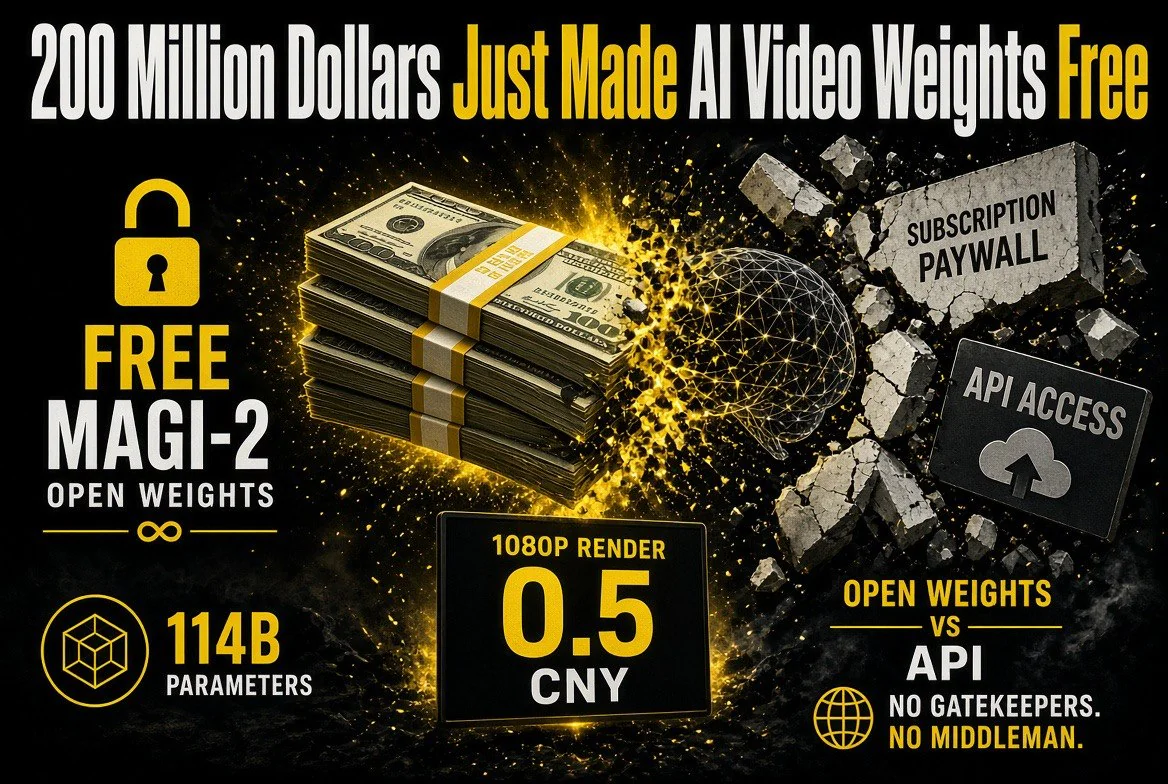
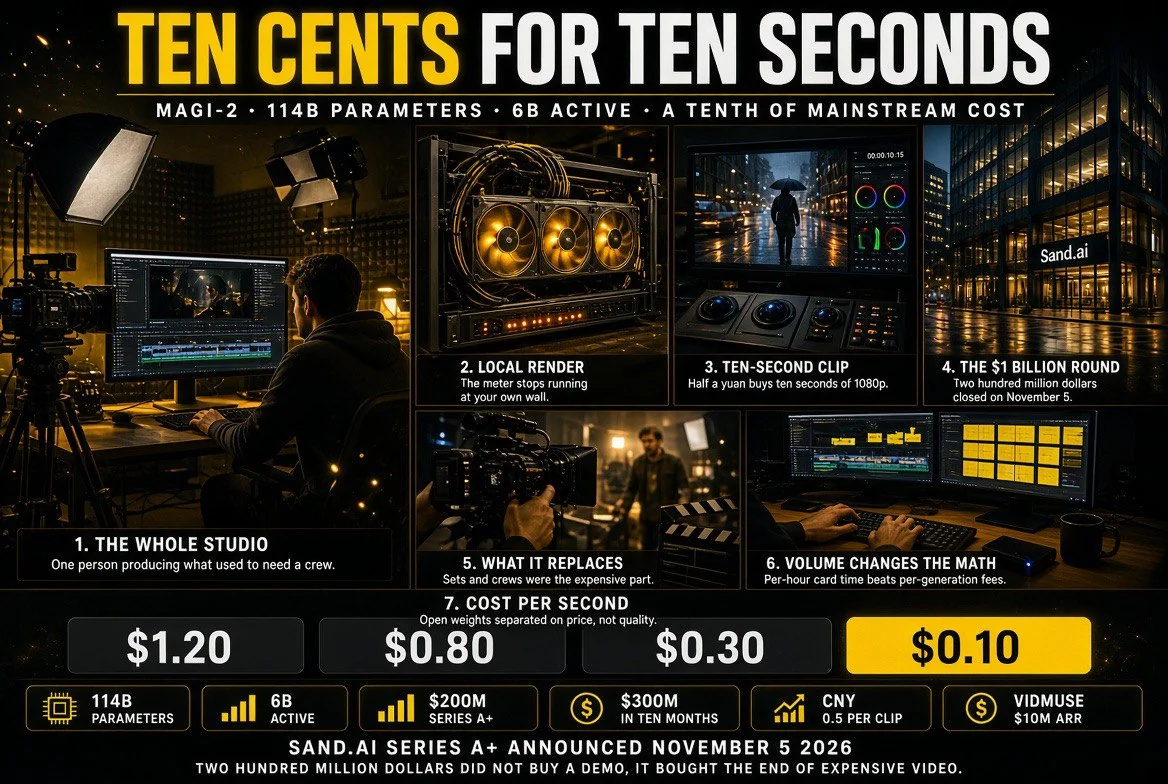
⚡ Expert Summary: Sand.ai closed $200 million in a Series A+ on November 5, 2026, at a valuation above $1 billion, and it has now raised roughly $300 million in ten months. The model behind that valuation, MAGI-2 Preview, is open-weight: 114 billion parameters, about 6 billion active per pass, and a distilled version that renders a 10-second 1080p clip for roughly CNY 0.5. That is about a tenth of what mainstream models charge per second. This is the moment open AI video stopped being a hobbyist curiosity and became the cheap option.
Ten cents of compute for a ten-second 1080p clip.
That is the number that should reorganise how you think about AI video, and it came out of a funding round this week rather than a product launch. Sand.ai raised $200 million in a Series A+ on November 5, 2026, crossing a $1 billion valuation and taking its total to roughly $300 million in ten months.
Cornerstone Capital and Wangsu Science & Technology co-led the round. New backers include Times Capital, Panlin Capital, Orient Securities Capital, Pudong Venture Capital and Shanghai Guofang.
But the money is the boring part. The reason a creator should care is what Sand.ai built with the previous two rounds: an open-weight video model that undercuts the platforms on cost by an order of magnitude.
What MAGI-2 Actually Is
Sand.ai released MAGI-1 as an open-source project in May 2025 and won Physics-IQ’s video continuation benchmark with it. In August 2026 came MAGI-2 Preview — a 114-billion-parameter mixture-of-experts model.
Here is why the number matters, and it is the number most coverage skips. Of those 114 billion parameters, only about 6 billion are active in each pass. That is the entire trick of a mixture-of-experts architecture: you carry a huge model on disk and only light up the slice you need per token. You get the quality of something enormous for the compute cost of something small.
Which is why the pricing works. A distilled MAGI-2 model renders a 10-second, 1080p video for approximately CNY 0.5. Per second of output, that is roughly a tenth of what mainstream models charge.
Read that again. Not ten percent cheaper. Roughly a tenth of the cost per second.
| Detail | Fact | Why a Creator Cares |
|---|---|---|
| Round size | $200M Series A+, valuation above $1B | The model survives past this quarter |
| Total raised | Roughly $300M in ten months | Four more years of training budget |
| Architecture | 114B params, ~6B active per pass | Big-model quality at small-model cost |
| Render cost | 10s of 1080p for roughly CNY 0.5 | About 1/10 mainstream per-second pricing |
| Licensing | MAGI-1 open source; MAGI-2 full release coming | Weights you can run without permission |
Why Open Weights Beat a Cheaper Subscription
There is a difference between a cheap API and open weights, and it is not a small one.
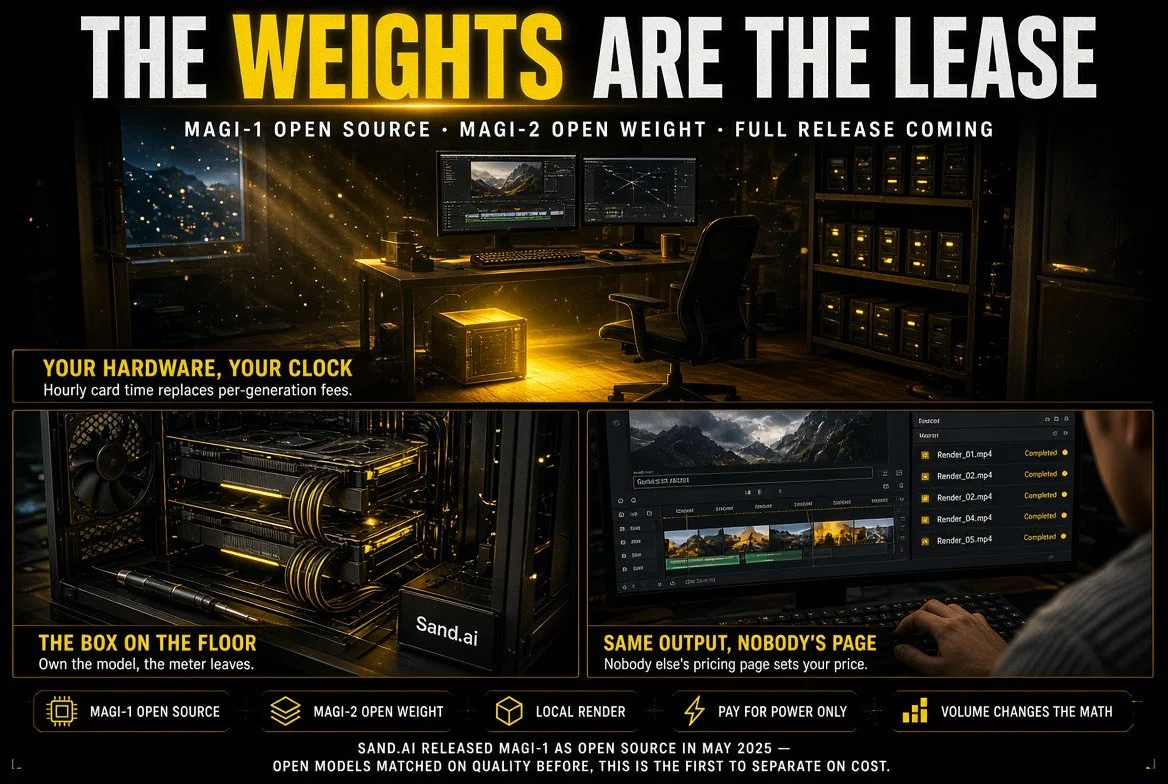
A cheap API means somebody else’s pricing page decides your cost per video next quarter. Open weights mean you download the model and the meter stops running at somebody else’s discretion — you pay for hardware and electricity, and that is it.
For a creator producing long-form video, the cost profile inverts. Cloud rendering charges per generation. A local model charges per hour of card time, whether you run one clip or forty. If you are producing at volume — YouTube channels, faceless shorts, ad variants, product loops — the second model wins on math alone once your output passes a modest threshold.
The open-weight lineage on this site is not new. LTX Studio’s LTXV pushed open video to 60-second clips. ByteDance’s Bernini framework claims to rival closed models. GLM-5.2 put open weights in front of creators, and Higgsfield published Seedance 2.0 production recipes as public cinematic prompts.
What is new is the price. Open models have matched on quality before. This is the first time one has comprehensively separated on cost per second.
Who Is Cao Yue, and Why He Picked the Hard Road
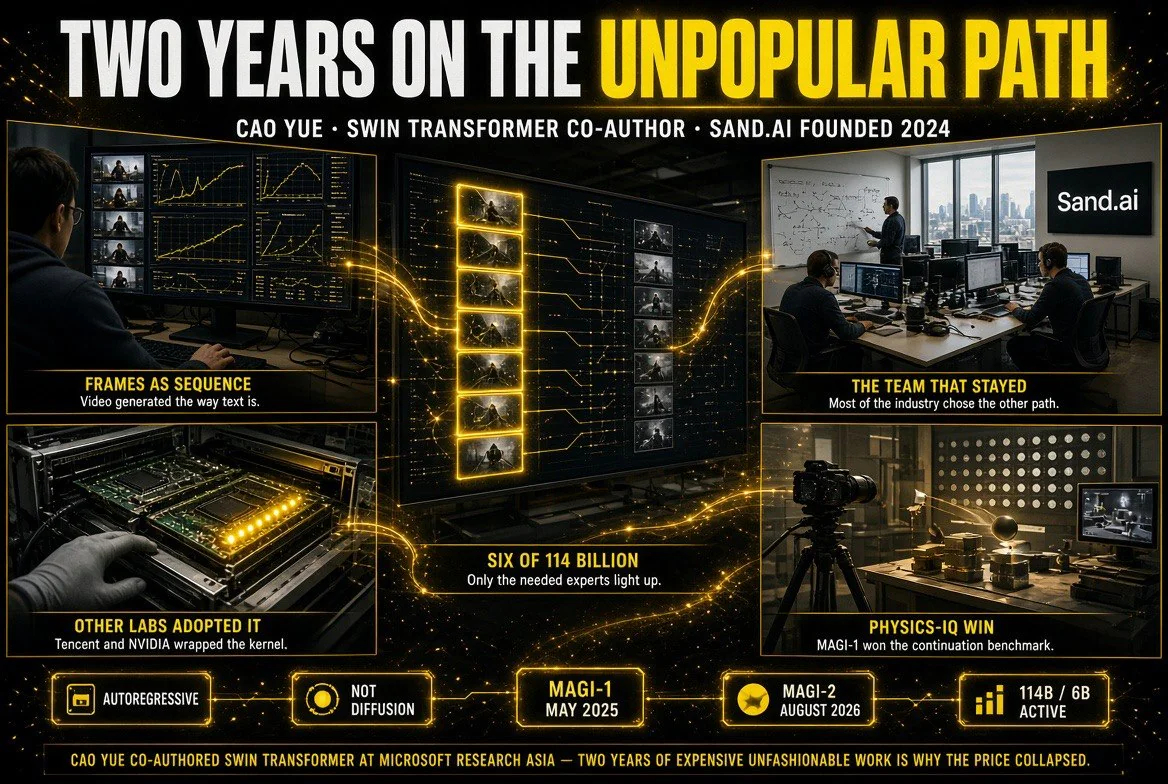
Sand.ai was founded in 2024 by Cao Yue, a former principal researcher at Microsoft Research Asia. He co-authored Swin Transformer, a vision model that won a best paper award at ICCV.
That background explains the bet. While most of the industry went all-in on diffusion models for video, Sand.ai went with an autoregressive approach. It was not a popular call, and Cao has since admitted the team still underestimated how hard that path would be.
They were wrong about the difficulty and right about the destination. Autoregressive video generation treats video as a sequence, which is why the mixture-of-experts trick transfers cleanly from language models — you generate frames the way a language model generates tokens, and you light up only the experts you need. Diffusion models are heavier per step by design.
Two years of expensive, unfashionable work is exactly why the cost curve fell off a cliff this month.
The Silent Endorsement: MagiAttention
Here is the part investors noticed and creators mostly missed.
Sand.ai built a library called MagiAttention. Tencent’s Hunyuan team is adopting it, and it is supported by NVIDIA’s NeMo AutoModel framework.
That is not a marketing claim. That is infrastructure from a Chinese lab being adopted by another major Chinese lab and wired into NVIDIA’s own tooling. When the people who build the training stack reach for your attention kernel, your architecture has stopped being an opinion.
For a solo creator this reads as one thing: the model will be supported. Custom kernels are the part of open-source video that usually rots. If the big frameworks wrap it, the tool survives.
VidMuse Made $10 Million ARR in Two Months
The product side is where the open-weight pitch turns into a business.
VidMuse, Sand.ai’s AI video creation app, passed $10 million in annual recurring revenue within two months of launch.
Plenty of AI labs post flashy demos and struggle to sell anything. That gap is the reason the AI video market has been so volatile for creators — tools appear, trends rotate, and the model you built a workflow on gets deprecated. Sand.ai is showing it can ship research and sell a product on top of it at the same time.
That combination is what pulled the $200 million. Not the benchmark. The revenue.
| Factor | Sand.ai / MAGI-2 | Platform-Owned Models (Kling, Seedance) |
|---|---|---|
| Weights | Open, downloadable, runnable locally | Closed, API or app only |
| Cost per second | About 1/10 of mainstream | Platform sets it |
| Ownership | Independent lab, neutral to platforms | Owned by a competing platform |
| Funding position | $300M raised, unicorn valuation | Kuaishou raised about $2.9B at $18B valuation |
| Revenue proof | VidMuse passed $10M ARR in two months | Seedance reportedly above CNY 1B monthly |
| Main risk | Foundation models burn cash continuously | Platform incentives favour their own tooling |
The Wangsu Deal Is Not Just a Check
Wangsu Science & Technology co-led the round, and CNY 300 million of that — about $45 million — is its own capital committed to the project.
Wangsu is a CDN and edge computing company. It is not buying equity for fun; it wants to collaborate with Sand.ai on video inference at the edge with low latency.
Look at Wangsu’s client list: ByteDance, Tencent, JD.com. If that partnership works, Sand.ai’s models get exposure to some of the largest video customers in China through infrastructure they already use.
The new money goes to model research, training and inference infrastructure, product enhancements, and overseas expansion.
That last item is the one to watch from outside China. Overseas expansion means the weights and the API arrive in Western markets with a price advantage nobody can match on a closed platform — and without the platform incentive to keep you inside one app.
What This Does to Your Production Budget
Concrete consequences, not theory.
Your cost per finished minute just became a strategy decision. At roughly a tenth of mainstream per-second pricing, a channel producing daily video can cut the render line by an order of magnitude. That money does not vanish — it moves to scripting, editing and distribution, which are the parts that actually differentiate you.
Batch testing is now affordable. The reason creators shoot one version of a video is that each generation costs real money. When a clip costs cents, you generate ten hooks and pick the best. That is a workflow change, not a discount.
Local rendering becomes the hedge. Open weights mean the model runs on hardware you control. If a platform raises prices, changes terms, or deprecates your model, your pipeline does not die with it. Given how many AI video tools have rotated features this year, that hedge is worth more than the savings.
The neutral-vendor argument is real. Kling is owned by Kuaishou. Seedance is ByteDance’s. If you build a channel on a model owned by a competing platform, your costs and roadmap are set by someone whose interests are not identical to yours. An independent lab with open weights has no reason to throttle you.
Verify before you rebuild the pipeline. The full MAGI-2 release is still coming, and Preview is not the finished model. Test the distilled version on your own footage first. Open weights are only a cost advantage if the output clears your quality bar, and no benchmark settles that for your specific content.
The Race Is Now About Being Neutral
China’s AI video market is enormous and moving fast. Kuaishou just raised approximately $2.9 billion, valuing the company at $18 billion. ByteDance’s Seedance is said to generate more than CNY 1 billion in monthly revenue.
Sand.ai is not trying to outspend either of them. It is playing a different game: independent, open-source, and cheap to run.
For developers and brands who do not want to depend on a rival’s platform, that is the entire appeal. And for individual creators outside China, it is the first credible path to professional video generation without a subscription that scales with your success.
The risks are real. Foundation models burn cash continuously, and early leads in this market disappear fast — the last eighteen months are a graveyard of models that were briefly the best. A $1 billion valuation is a promise, not a result.
But the price is already shipping. MAGI-1 is open source. MAGI-2 Preview runs. The distilled model renders at a tenth of the cost. And $300 million says the next version is funded.
Two hundred million dollars did not buy a demo this week. It bought the end of expensive video.
Frequently Asked Questions
What is Sand.ai and how much did it raise?
Sand.ai is a Chinese AI video startup founded in 2024 by Cao Yue, a former Microsoft Research Asia researcher. It raised $200 million in a Series A+ on November 5, 2026, at a valuation above $1 billion, bringing its total to roughly $300 million in ten months.
What is MAGI-2 and why does the parameter count matter?
MAGI-2 Preview is a 114-billion-parameter mixture-of-experts video model released in August 2026. Only about 6 billion parameters are active in each pass, so it delivers large-model quality at a fraction of the compute cost, which is what makes the low pricing possible.
How much does Sand.ai video generation actually cost?
A distilled MAGI-2 model produces a 10-second 1080p video for approximately CNY 0.5. Per second of output that is roughly one tenth of what mainstream video models charge.
Are Sand.ai models really open source?
MAGI-1 was released as an open-source project in May 2025. MAGI-2 Preview is open-weight, with a full MAGI-2 release announced as coming soon. Open weights mean you can run the model locally instead of paying per generation.
What is VidMuse?
VidMuse is Sand.ai’s AI video creation app. It passed $10 million in annual recurring revenue within two months of launch, which is the commercial proof that made the funding round possible.
Should creators switch to Sand.ai right now?
Test it before you rebuild anything. The full MAGI-2 release is still pending, so run the preview and distilled versions on your own footage, compare against your current tool, and only then move your production pipeline.

About Barak Schurr
Barak Schurr is a serial entrepreneur who built and exited a major ticketing platform before turning his attention to AI and content. He runs three AI-focused research sites and writes about the tools, workflows, and strategies that let solo creators build real channels — without a crew, a studio, or a Hollywood budget.
Email: [email protected]
More AI Video Resources