The Company OpenAI Named a Feature After Is Now Suing It
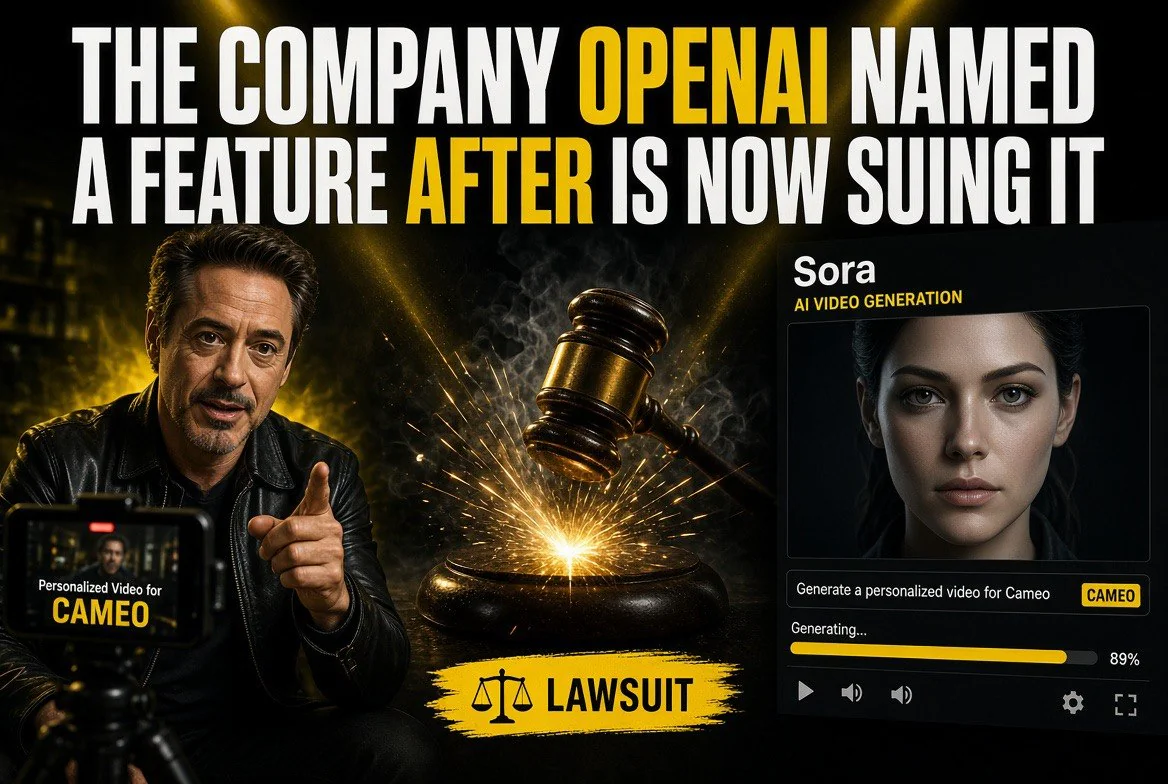
The Company OpenAI Named a Feature After Is Now Suing It
⚡ Expert Summary: Cameo built a business on selling personalized videos from famous people. OpenAI shipped Sora with a feature called Cameo that lets anyone put a recognizable face into a generated clip. Cameo’s response was a lawsuit. Strip the names away and the legal question is one every video creator will eventually hit: when a company builds a commercial product around your likeness, do you get a say, and what is it worth? Cameo’s argument is that its name and its business model were both taken. OpenAI’s is that a feature name is not a trademark claim on a person’s face. Whichever way it lands, the era of generating a specific human being on demand has a price tag attached now, and it is being set by lawyers.
There is a specific kind of absurdity in being the company that made personalized celebrity video a product, and then watching an AI lab ship a button with your company’s name on it.
Cameo spent years building a marketplace out of a simple transaction: pay a few hundred dollars, get a short video from a recognizable person saying happy birthday, congratulations, or whatever the occasion required. The company’s entire asset was access to faces that people recognized and the consent of those faces to be used in that way. It is the one product category in entertainment where the moat is a signed permission slip.
Then OpenAI built Sora, its video generation model, and gave one of the features a name that Cameo had already spent years owning in the public mind: Cameo. The feature lets a user place a recognizable person into a generated video clip. Not a generic face. A specific, identifiable human being, rendered by a model, moving in a scene that never existed.
Cameo’s answer was a lawsuit.
For anyone whose livelihood depends on video, this is not a corporate spat to skim past. It is the first serious legal test of the arrangement that every AI video workflow now rests on: you can generate footage of a person, and the law has not finished deciding who owns what happens next.
What “Cameo” Actually Did
Get the technical distinction right before the legal one, because most coverage blurs it.
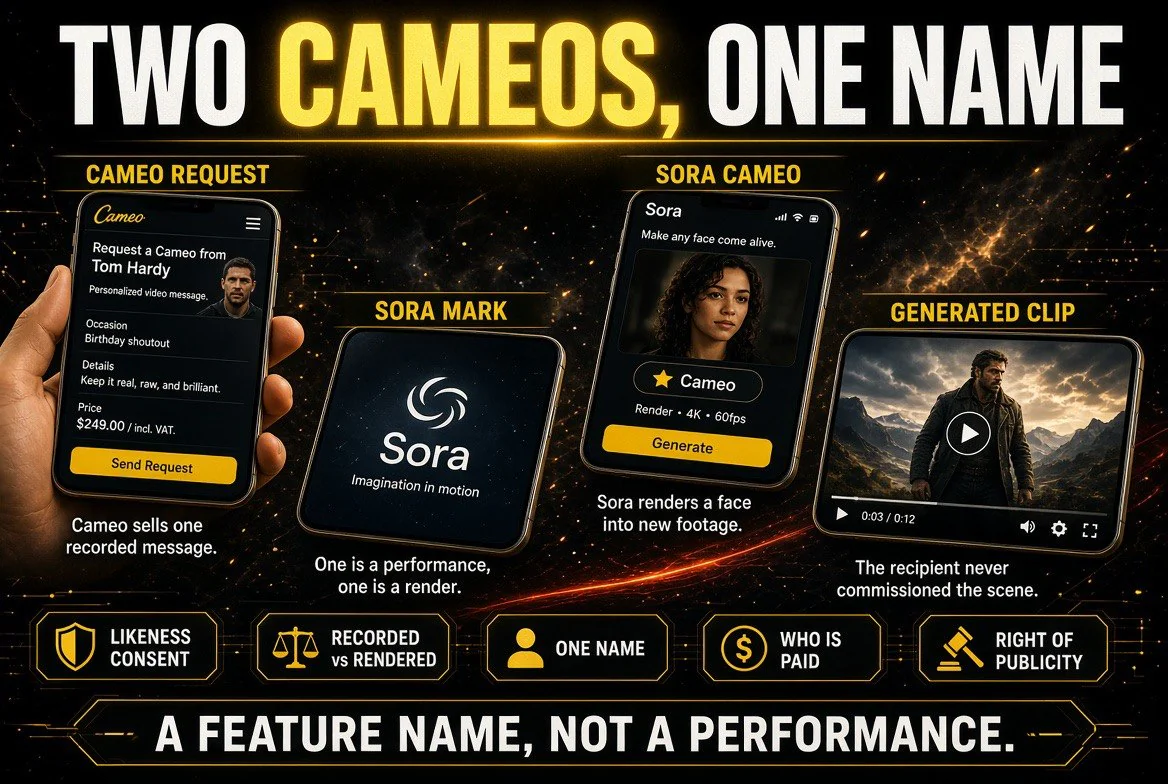
Cameo, the company, sold a performance. A person agreed to record a message, for a fee, in their own voice, on their own camera, for a specific recipient. Every element of it traced back to a human being who said yes and was paid for saying yes. The company’s business depended on that consent chain being real, because a marketplace where celebrity cameos happen without celebrity consent is a marketplace with no celebrities in it.
Sora’s Cameo feature does something structurally different. It places a likeness into footage that the model generates. The person may have consented to the feature. The recipient certainly did not commission a performance. And the output is not a recording of a human being; it is a plausible rendering of one, in a scene the model invented.
That difference is the whole ballgame, and it maps onto a legal distinction that has been developing for years without resolving: a person’s right to control the commercial use of their own likeness. In the United States this is a patchwork of state law, strongest where the person is famous and the use is commercial, and remarkably undefined where a generative model is doing the rendering.
| Dimension | Cameo’s Model | Sora’s Cameo Feature |
|---|---|---|
| Source of the likeness | Recorded by the person | Rendered by a model |
| Who was paid | The person appearing | The platform |
| Consent chain | Per performance, per recipient | Per likeness, once, platform-wide |
| What the buyer receives | A real recording | A generated scene |
| Control after delivery | Limited; a personal message | Unbounded; any scene, any context |
| Core legal issue | Contract and trademark | Right of publicity in generated media |
Notice the asymmetry in that last row. Cameo’s grievance against OpenAI is not really that a model can render a face. It is that OpenAI put the name Cameo on the feature that does it, which does two things at once: it trades on Cameo’s recognition in the market, and it associates Cameo’s brand with a product Cameo does not control and did not build.
That is a trademark argument, and it is the older, better-trodden half of the case. The harder half is the one that matters to every video creator in the country, and it will outlive this lawsuit.
The Part That Affects You Even If You Never Touch Sora
Here is the practical version for someone who makes video for a living.
Over the last two years, every major AI video tool added some form of likeness feature. Put yourself in the shot. Put a client in the shot. Put a presenter in the shot without booking a presenter. The sale pitch is always the same word: consistency. The model keeps the same face across shots, across scenes, across an entire campaign, which is exactly what a client wants and exactly what used to require hiring the same actor for a week.
That capability is now the center of the biggest unresolved question in commercial video: who has to consent to a generated face, how specific that consent must be, and what happens when the consent was given for one thing and the output is another.
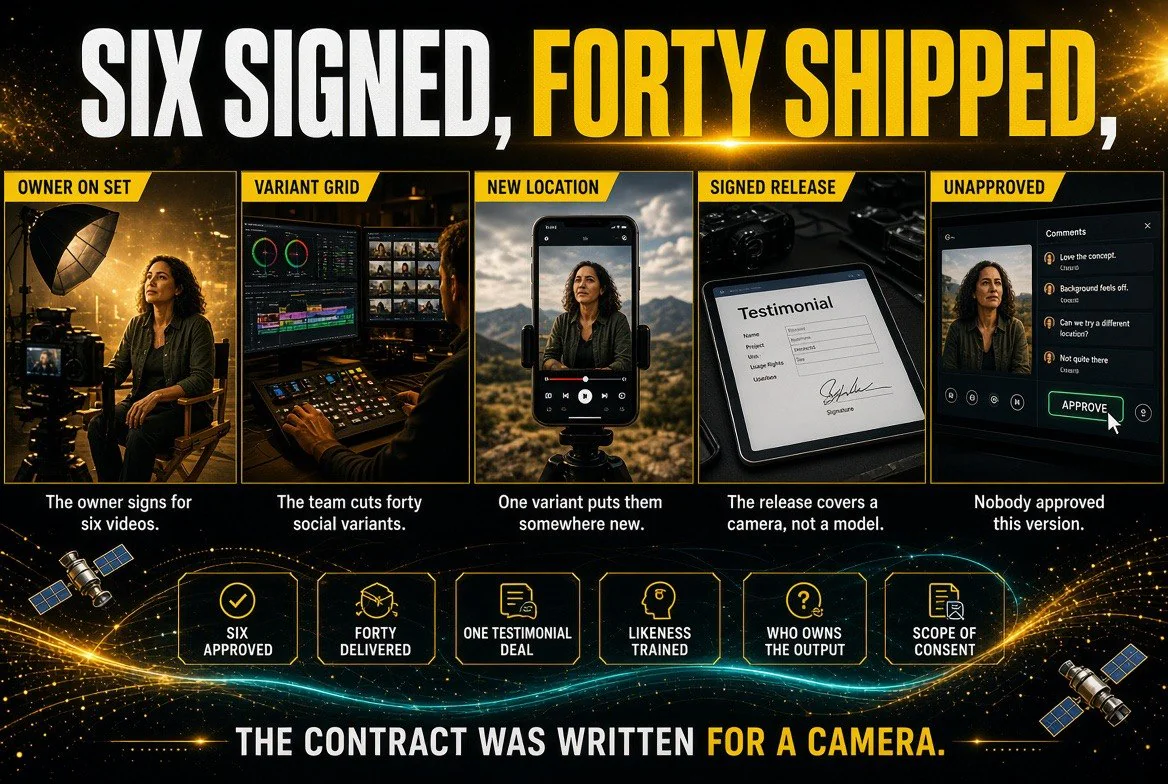
Consider a plausible job. A small agency signs a local business owner to a testimonial campaign. The owner consents to appearing on camera for six videos. The agency, being efficient, creates a likeness model and produces forty variants for social, some in scenes the owner never shot, saying things the owner never said. The contract did not mention any of that because the contract was written for a camera and a tripod.
Nothing in current US federal law cleanly resolves that. State right-of-publicity statutes vary enormously, some covering only commercial use of a name or likeness in advertising, others broader. Several states have moved to add explicit protections for digital replicas. The result is that the answer to “can I do this” depends on where your client is standing and whether their contract contemplated a model trained on their face.
Cameo’s lawsuit will not settle all of that. But it is the first time a company with a real business built on likeness consent has taken a frontier lab to court over a likeness feature, and the pleadings in that case will become the template for how everyone else argues about it. If you are drafting talent agreements this quarter, the language that comes out of this dispute is the language you will be copying next year.
Why This Lawsuit Is a Business Problem, Not Just a Legal One
Look at the timing from Cameo’s side and the suit stops looking like a trademark reflex.
The company’s core product — a personalized video from a famous person, sold as a gift — was already under pressure before generative video got good. Its value proposition depended on scarcity: personal access to a recognized face was something you could not otherwise buy. Sora’s Cameo feature attacks that scarcity directly. If a user can generate a recognizable person into a clip for the price of a subscription, the $300 birthday video is competing with something that costs nothing and takes twelve seconds.
The trademark claim is the legally clean part. The business claim underneath it is that a feature named Cameo did more damage than a feature named something else would have, because it told the market that the thing Cameo sold was now a default capability.
| What Changed | Before Generative Video | After |
|---|---|---|
| Cost of a famous face in a video | Hundreds of dollars, booked in advance | Subscription price, generated on demand |
| Turnaround | Days to weeks | Seconds |
| Scarcity | Structural; access is the product | Collapsing; rendering is the product |
| Who controls the output | The person in the video | The platform and the user |
| Legal clarity | Established contract law | Contested, state-by-state, unsettled |
| Who bears the risk | The person whose face it is | Currently the person whose face it is |
That last row is the one to underline. Consistently across every likeness feature shipped so far, the risk has stayed with the individual whose face appears, not with the platform that generated it and not with the creator who prompted it. If a client comes back angry about a video featuring their face in a context they never approved, the platform’s terms of service will point at you.
Which means the practical work for anyone doing commercial video in 2026 is contractual hygiene, not tool selection. Get likeness consent in writing, scoped to specific uses and specific scenes. Put in a clause covering synthetic or model-generated reproductions of the likeness. Set a termination right that requires deletion of any trained model. Spell out who owns the output. None of that is glamorous. All of it is cheaper than a dispute.
What Comes Next, and What to Watch
Three things will determine how much this case actually changes.
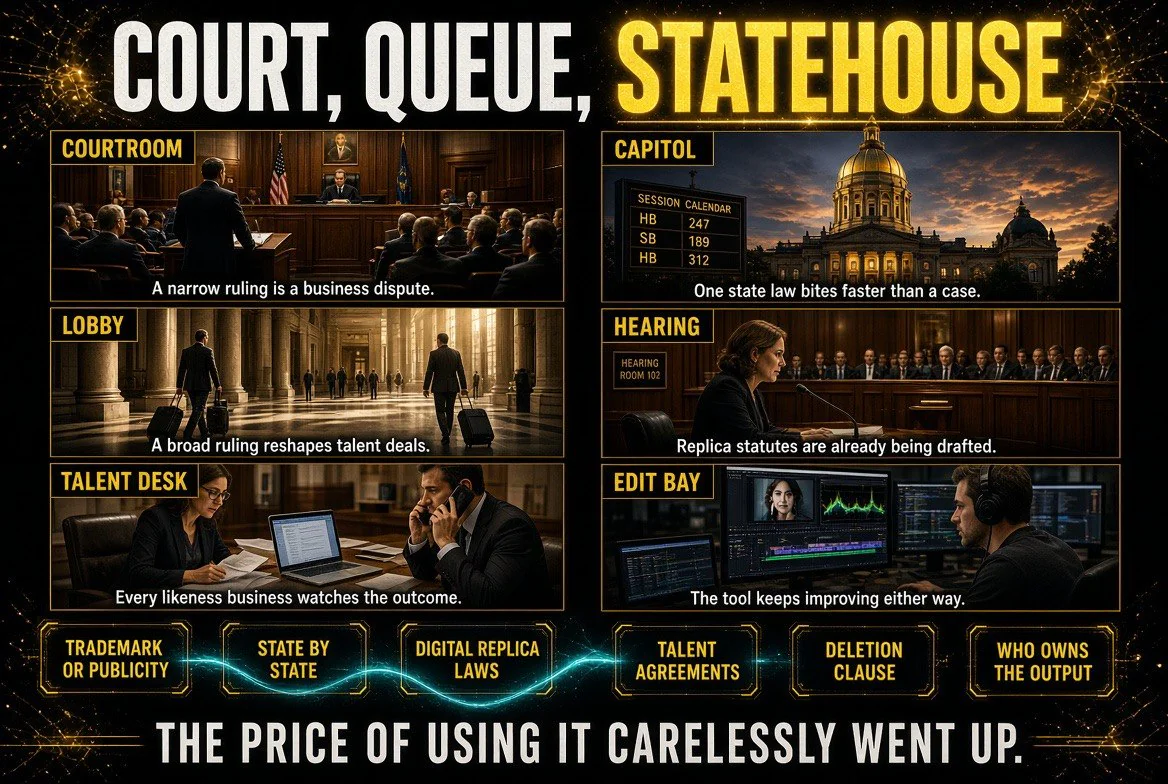
First, whether the court treats the naming issue as a straightforward trademark question or lets the likeness question in alongside it. A narrow trademark ruling would be a forgettable business dispute with a big headline. A ruling that reaches the right-of-publicity question in generated media would reshape every talent agreement in the industry.
Second, whether other likeness-dependent businesses follow. Cameo is unusual in that its entire product was the consent chain. If a company like that wins or settles on favorable terms, expect a queue. If it loses badly, expect the queue to disappear and every other platform to treat generated likeness as settled territory.
Third, and most likely to reach you first: state legislatures. Right-of-publicity law in the United States is state law, and several states have been drafting digital replica statutes for the last two years. A single state passing a strong replica law does more practical damage to unrestricted likeness features than any federal case, because it gives every person in that state a cause of action that does not require proving trademark confusion.
None of this makes Sora’s video model worse. The capability is real and it is only going to improve. What changed is the price of using it carelessly. For two years the AI video industry has operated on the assumption that if a tool can generate something, using that thing is your business. Cameo’s lawsuit is the first serious attempt to put a boundary around that assumption, and it is being filed by the one company whose entire business model depended on the boundary existing.
The company OpenAI named a feature after is now suing it. The real question the case asks is who owns a face once a model can draw it, and right now the honest answer is nobody knows, which is why the lawyers are billing by the hour.
Frequently Asked Questions
Why is Cameo suing OpenAI?
Cameo built its business on paid personalized videos from recognizable people. OpenAI shipped Sora with a likeness feature called “Cameo,” which Cameo argues both trades on its brand recognition and reproduces the core thing it sells. The case turns on trademark use of the name and on how likeness is handled in generated video.
What does Sora’s Cameo feature do?
It lets a user place a recognizable person’s likeness into an AI-generated video clip, so that person appears in scenes the model invents. Unlike a recorded message, the output is a rendering rather than a recording, and the person appearing did not perform the specific scene.
Does this affect creators who do not use Sora?
Yes. Every major AI video tool has shipped some form of likeness feature, and the consent and ownership questions are identical across them. If you put a client, presenter, or actor’s face into generated footage, this litigation is defining the rules you will be governed by.
Who owns the rights to a generated likeness?
Unsettled in the United States. Right of publicity is state law, varying widely, with several states adding digital replica provisions. Platform terms of service generally place the risk on the user, which means the creator who prompted the video rather than the platform that generated it.
What should be in a talent or likeness agreement now?
Written consent scoped to specific uses and scenes, an explicit clause covering synthetic or model-generated reproductions, a termination right requiring deletion of any trained model, and a clear statement of who owns the output. Generic camera-and-tripod contracts do not cover any of this.
What is the likely outcome of the lawsuit?
Too early to call. A narrow trademark ruling would be a business dispute with a big headline. A ruling that reaches right of publicity in generated media would reshape talent agreements across the industry. State-level digital replica statutes may move faster and matter more.
About Barak Schurr
Barak Schurr is a serial entrepreneur who built and exited a major ticketing platform before turning his attention to AI and content. He runs three AI-focused research sites and writes about the tools, workflows, and strategies that let solo creators build real channels — without a crew, a studio, or a Hollywood budget.
Email: [email protected]
More AI Video Resources