
Your AI Video Stack Has an Expiration Date Nobody Prints On the Box
Your AI Video Stack Has an Expiration Date Nobody Prints On the Box
⚡ Expert Summary: Four AI video vendors made silent, material changes to their products in four months. OpenAI retired Sora’s models and Videos API on September 24, 2026 and announced no replacement. Google scheduled the shutdown of Veo 3.1’s preview API identifiers for October 22 while still listing Veo 3.1 as its current generation. Kling replaced its Ultra plan on October 17. Runway announced a “unified pricing change” without publishing the new numbers. The question in this market stopped being which model is best and became which of your production tools is about to change its terms and not tell you. Audit every video API endpoint for preview identifiers, price your quotes assuming generation costs rise, and keep a tested fallback for each model you depend on.
There is a specific kind of email nobody in this industry enjoys writing. It goes something like: “Hi, the tool we delivered your campaign in has been discontinued, so we’re rebuilding it in something else, and the new version won’t look identical.”
That email got easier to write in 2026, because the reasons got better. It is no longer a vendor’s fault or a freelancer’s incompetence. It is the structure of the market now. Five video generators survive where six competed a year ago, the survivor list changes without press releases, and the model names printed in last quarter’s comparison guides describe software that quietly stopped accepting requests.
Most coverage of this treats it as a ranking problem — which model wins now. That misses the actual risk. Rankings measure quality. Nobody’s ranking measures survivability and notice, and those are the two variables that decide whether your workflow still exists next year. A model that generates slightly worse footage but tells you six months ahead of a change is worth more to a working creator than a beautiful model that vanishes on a Tuesday.
Here is what four vendors did in four months, and what each one actually cost the people relying on them.
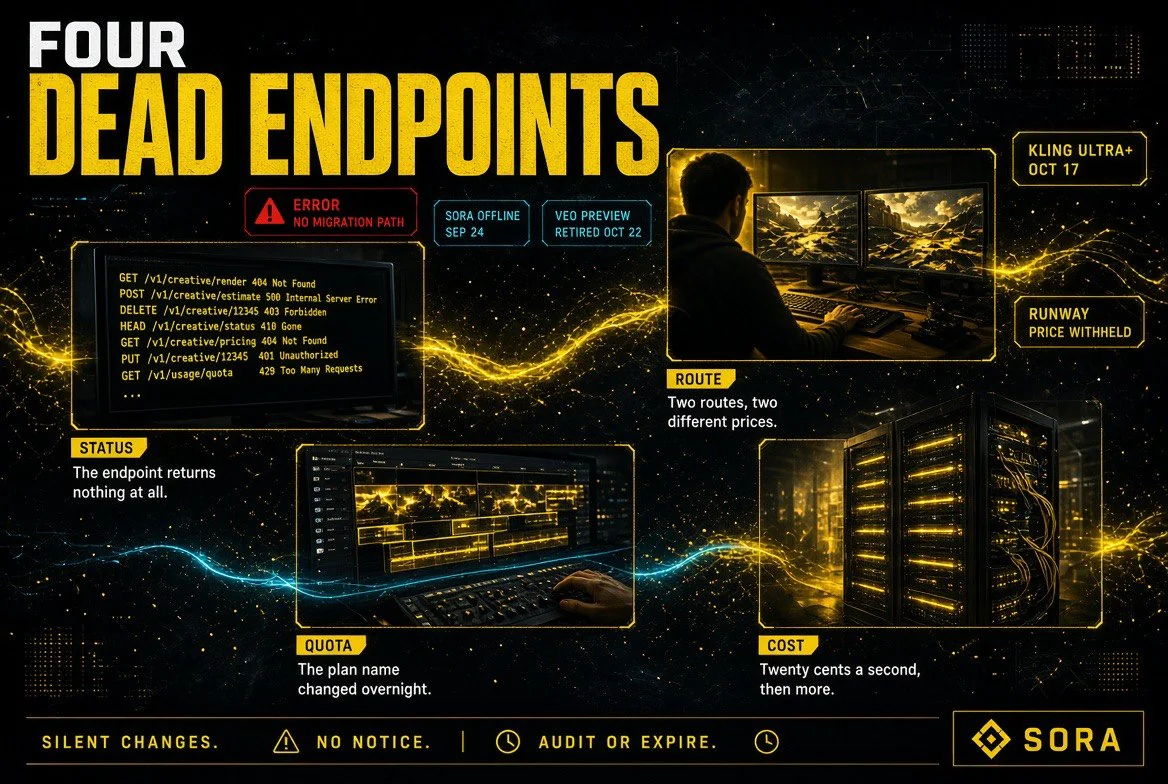
The Four Silent Changes Nobody Sent You an Email About
The pattern is not that vendors retire things. Everyone retires things. The pattern is that the retirement arrives as a line in a changelog, a deprecation table nobody bookmarked, or — worse — as errors from a job that used to work.
| Vendor | What Changed | Date | Was There a Migration Path? |
|---|---|---|---|
| OpenAI | Sora consumer app shut down | April 26, 2026 | No successor product announced |
| OpenAI | Sora 2 models and Videos API taken offline | September 24, 2026 | None listed in deprecation docs |
| Kuaishou | Kling Ultra plan swapped for Ultra+ | October 17, 2026 | Plan rename; credit allocations shifted |
| Veo 3.1 / 3.1 Fast / 3.1 Lite preview API identifiers retired, replaced by Gemini Omni Flash | October 22, 2026 | Model string change, not a brand retirement | |
| Runway | Unified pricing change announced | Late October 2026 | New numbers not published at announcement |
Look at the right-hand column. Three of those five rows describe a change where the vendor did not tell you what to do next. That is not a communications failure. It is a choice, and it is a rational one for the vendor: a migration path is a gift you give a customer you are afraid of losing.
OpenAI’s case is the starkest. When the Sora 2 models and the Videos API went offline on September 24, the deprecation documentation listed no replacement. Anyone who built on the sora-2 endpoint was handed a terminal event and a shrug. There was no “here’s where to move your prompts,” no compatibility layer, no equivalent tier at a sister product. The team behind it pivoted toward world-simulation research aimed at robotics training, which is a defensible strategic call and also completely irrelevant to the freelancer whose client-facing portal stopped rendering previews that morning.
Google’s version is subtler and arguably more dangerous, because Google did not retire a product — it retired a string. The Veo 3.1 preview identifiers for Veo 3.1, Veo 3.1 Fast, and Veo 3.1 Lite were scheduled to shut down on October 22, 2026, with Gemini Omni Flash reported as the replacement. Meanwhile Google’s own pages still describe Veo 3.1 as the current generation. Read that twice. The model is current. The identifier you call it by is dead. If your integration passes a model string, you can be running a perfectly supported product and still get errors, because the thing that broke was the address, not the house.
Kling’s change looks minor until you do the arithmetic. Swapping the Ultra plan for Ultra+ on October 17 moves creators between credit allocations at a moment when they are mid-project. Nobody’s render fails. Your quota just means something different than it did when you scoped the job.
And then there is Runway, which announced a unified pricing change and did not publish the new numbers. In a category where per-second costs range widely enough that the same model can be materially cheaper depending on the door you walk through, an unpublished price change is the most expensive kind of silence.
Why Per-Second Pricing Has Become a Trap
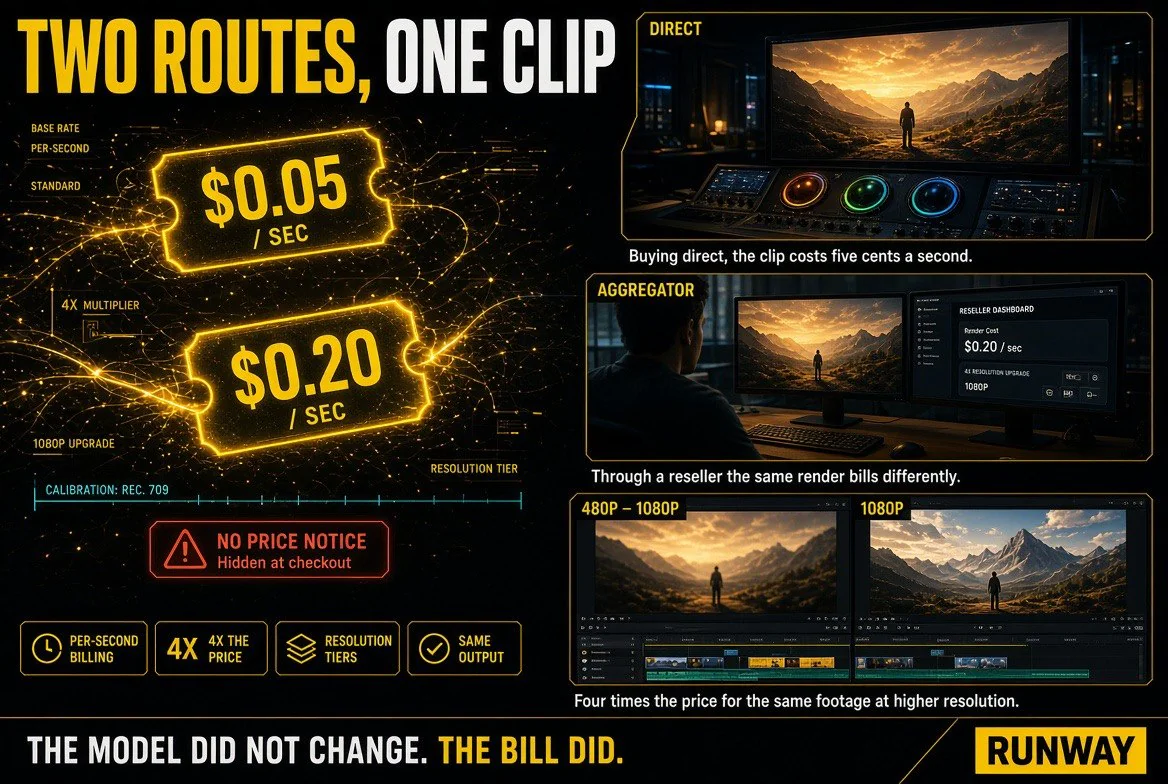
The cost conversation in AI video has been stuck on one number: dollars per second. That framing is useful right up until the moment it isn’t, because it treats a price as a property of a model rather than a property of a route to that model.
Runway now resells Veo, Kling, Seedance, and Wan through a single API alongside its own Gen-4.5 and Aleph 2.0. That is genuinely convenient — one bill, one key, one dashboard to experiment across vendors. It also inserts a layer between you and the model’s real price, and that layer is free to change what it charges without changing what the model does.
| Generator | Owner | Longest Clip | Native Audio | Cost Exposure |
|---|---|---|---|---|
| Veo 3.1 | Google DeepMind | Not confirmed | Yes | Preview identifiers already retired once; string churn is the live risk |
| Runway (Gen-4.5, Aleph 2.0) | Runway AI | Not confirmed | Not listed for Gen-4.5 | Unified pricing change with withheld numbers |
| Kling 4.0 | Kuaishou | 30 seconds | Reported stereo | Ultra replaced by Ultra+ on Oct 17; quota meaning shifted |
| Seedance 2.5 | ByteDance | 30 seconds | Yes | 4K tier invite-only; capacity gating can move |
| Wan 3.0 | Alibaba | Not confirmed officially | Reported, not confirmed | $0.05/sec at 480p, $0.20/sec at 1080p via Runway’s dev platform |
Those Wan numbers are the cheapest listed in the category, and they are worth staring at for a second, because they tell you where the leverage sits. Twenty cents a second at 1080p. If you are generating hundreds of clips for a product catalog, that gap compounds into real money, and it is exactly the kind of number that gets you to build your pipeline around a vendor. Then the vendor changes something and the number that justified your architecture no longer exists.
The trap is not that Wan is bad or that Runway is greedy. The trap is that cost-per-second comparisons are snapshots, and people build permanent systems on them. Every price in this category, including every price in the table above, is a photograph of a moving object. The source material for this article was itself dated and flagged as a snapshot — that is how fast the numbers move.
The Market Shift Underneath All of This
Strip out the individual changes and a structural fact becomes visible. The AI video market has reorganized into three unequal roles.
Google holds the premium first-party slot. Veo 3.1 is the only video model still sold directly by a company that also runs a chat assistant, a video editor in Google Vids, and a streaming platform in YouTube. Nobody else can put a generated clip in front of a viewer without handing it to a platform they do not own. That vertical integration is the moat, and it is why Google can churn API identifiers without losing customers — the customers are already inside the building.
Runway holds the aggregator slot. It stopped competing purely on model quality and became the place you go to run everyone else’s models next to its own. That is a smart position and a fragile one. Aggregators live on margin spread and convenience, and both are vulnerable to a vendor deciding to sell direct, or to a customer deciding the spread is too wide.
Three Chinese-owned models compete on price and clip length. Kling from Kuaishou, Seedance from ByteDance, Wan from Alibaba. They win on cost and on the 30-second clip ceiling, and they serve an audience that does not care which company owns the model, only what it costs and how long a take it will give them.
Notice what is missing from that list. There is no Western independent lab in the video category anymore. OpenAI left, and did it without a replacement. For an industry that spent two years arguing about which lab would dominate generative video, the answer turned out to be that the labs mostly stopped showing up, and the tools that survived belong to Chinese conglomerates and to Google.
That matters to a creator for a boring, practical reason: your vendor’s interests and your interests stopped being aligned the moment video became a feature rather than a product. A dedicated video company has to keep video creators happy. A conglomerate with a video model has to keep a much larger business happy, and you are one line on a spreadsheet next to a cloud division.
What Actually Protects You
There is no version of this market where you avoid vendor risk. You can only decide how much of it you are holding at any moment. Three practices do most of the work.
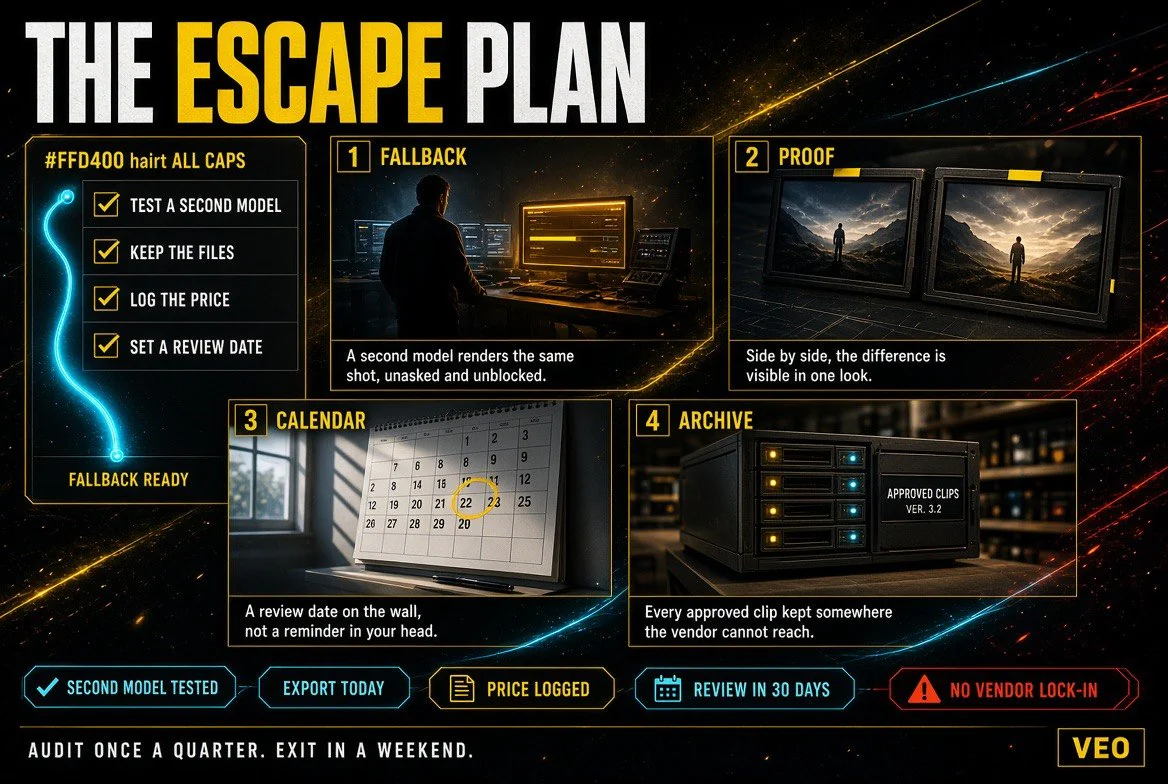
First, treat every preview identifier as a countdown timer. Preview endpoints are promises of change. Google’s Veo 3.1 preview strings shut down on October 22, 2026, and the replacement was a differently named model. If any part of your stack passes a model string with “preview” in it, that integration has a date on it, and the date was probably printed somewhere you did not read. Grep your codebase for preview identifiers this week. It is a twenty-minute job that prevents the four-minute apology email.
Second, price your work assuming generation costs rise. This is the least popular advice in the category and the most financially sound. Every vendor in this market has been subsidizing access relative to the compute it consumes, and subsidies end. When you quote a video job, add a margin for the possibility that your generator gets more expensive before delivery. If it doesn’t, that margin is profit instead of a loss. Quoting at today’s best price assumes a stability that four vendors just demonstrated they will not provide.
Third, keep one tested fallback per model you depend on, and actually test it. Not a mental list of alternatives. A real, working, current integration you have run in the last thirty days. When Sora went offline, the people who recovered fastest were not the ones who had read about the alternatives — they were the ones whose fallback had already been exercised and was sitting there working.
There is a fourth habit that separates professionals from hobbyists in this space, and it is unglamorous: read the deprecation documentation of every vendor you pay, on a schedule. Not the marketing blog. The deprecation table, the changelog, the API reference notes. Vendors bury the expensive news in the accurate place, which is the place nobody visits, and that is not malice — it is just where accurate news goes.
What This Costs a Working Creator
Abstract risk is easy to ignore. Concrete cost is not, so here is what vendor breakage actually costs when it lands mid-project.
The obvious line item is rework. A model change means re-rendering shots, and re-rendering means both compute spend and your own hours, and your hours are the expensive part. A ten-shot sequence that took two days in one model can take two more days in another, because prompts do not transfer cleanly between generators. Nobody’s prompt language is portable, which means “just use a different model” is a sentence spoken by someone who has never tried it.
The less obvious line item is trust. A client who watched a deliverable change appearance after the fact is a client who asks harder questions next time and negotiates from a stronger position. Creative work survives on the assumption that the thing you showed is the thing you will deliver. Vendor churn breaks that assumption, and the breakage is charged to your reputation, not the vendor’s.
And the line item nobody budgets for is the scramble itself. The days spent evaluating replacements, testing them, discovering the pricing changed again, and rewriting an integration are days you did not bill. In a good month that is an annoyance. In a tight month it is the difference between a project being profitable and being a favor you did for exposure.
All of which is why the ranking question — which model is best — deserves to be second. The first question is: which of my tools has a habit of changing without telling me, and what does it cost me when it does?
What to Do This Week
None of this is dramatic, and that is the point. The people who got wrecked by Sora’s shutdown were not reckless. They simply built on a tool that was working, in an industry that had taught them the tool would keep working. Four vendors spent four months demonstrating that the lesson no longer applies. The ones who adapt fastest are the ones who stop treating their video stack as a purchase and start treating it as a subscription to someone else’s decisions.
Frequently Asked Questions
Is Sora completely gone?
Yes, in every practical sense. The consumer web and app experiences ended on April 26, 2026, and the Sora 2 models plus the developer Videos API went offline on September 24, 2026. The deprecation documentation listed no replacement. Any guide still ranking Sora as an option is describing software nobody can access, which is a useful reminder of how fast this category’s reference material rots.
What did Google actually change with Veo 3.1 on October 22?
Google retired the Gemini API preview identifiers for Veo 3.1, Veo 3.1 Fast, and Veo 3.1 Lite, with Gemini Omni Flash reported as the replacement. This is a change to the model strings your code passes, not a retirement of the Veo 3.1 line — Google’s own pages still list Veo 3.1 as the current generation. If you call Veo through a preview endpoint, check your strings now. The product is supported and the address is dead, which is the most confusing possible failure mode.
Is it cheaper to use Runway’s API or go direct to each vendor?
It depends on the model and it changes. Runway resells Veo, Kling, Seedance, and Wan alongside its own Gen-4.5 and Aleph 2.0, and prices can differ significantly between running a model natively and running it through an aggregator. The convenience is real — one bill, one key, cross-model experimentation. The catch is that you have added a pricing layer between you and the vendor, and that layer announced a unified pricing change without publishing the new numbers. Price both routes for your specific workload before you commit an architecture to either.
Which AI video generator should I build my workflow on right now?
Pick based on the job rather than on a leaderboard. Veo 3.1 leads on cinematic realism and audio sync. Kling 4.0 and Seedance 2.5 target long clips, with Kling offering a 30-second ceiling and up to 10 keyframes for multi-shot sequences, and Seedance offering native audio with invite-only 4K. Wan 3.0 wins on cost for volume work. But treat any of those choices as a lease, not a marriage, and keep a tested fallback for whichever one you pick.
Why does this matter if I just use the consumer app and not the API?
Because consumer products die faster than APIs. Sora’s consumer app went first, in April, and the API followed in September. Consumer AI video tools are features attached to business models that change frequently, and when the business model shifts, the app is the cheapest thing to close. If your work depends on a consumer AI video product, export your masters and keep the originals somewhere the vendor cannot touch.
Is the AI video market actually shrinking?
No — it reorganized. Five active generators compete where six did, and the survivors now occupy three distinct roles: Google as the premium first-party provider, Runway as the platform aggregator, and Kuaishou, ByteDance, and Alibaba competing on price and clip length. What shrank is the number of Western independent labs in the category. That is a consolidation of ownership, not a contraction of demand.
How often do prices in this category actually change?
Faster than most people assume. In roughly two weeks of late October alone, Kling swapped its Ultra plan for Ultra+ and Runway announced a unified pricing change without publishing the numbers — on top of Google retiring Veo preview identifiers and OpenAI having pulled Sora offline a month earlier. Treat any published price as a snapshot with a date on it, including the ones in this article. The source material used here was dated October 25, 2026, and it was explicitly flagged as a snapshot by its own author.
What is the single highest-value habit to build here?
Read the deprecation tables, not the marketing blog. Vendors put accurate, expensive news in the deprecation documentation because that is where it legally and practically belongs, and almost nobody visits. Thirty minutes a quarter in the right documentation prevents the worst week of your year.
The uncomfortable truth about this category is that the tools got good enough to build a business on at almost exactly the moment they stopped being stable enough to build a business on. The winners over the next two years will not be the creators with the best model access. They will be the ones whose workflows survive a vendor changing its mind on a Tuesday.

About Barak Schurr
Barak Schurr is a serial entrepreneur who built and exited a major ticketing platform before turning his attention to AI and content. He runs three AI-focused research sites and writes about the tools, workflows, and strategies that let solo creators build real channels — without a crew, a studio, or a Hollywood budget.
Email: [email protected]
More AI Video Resources