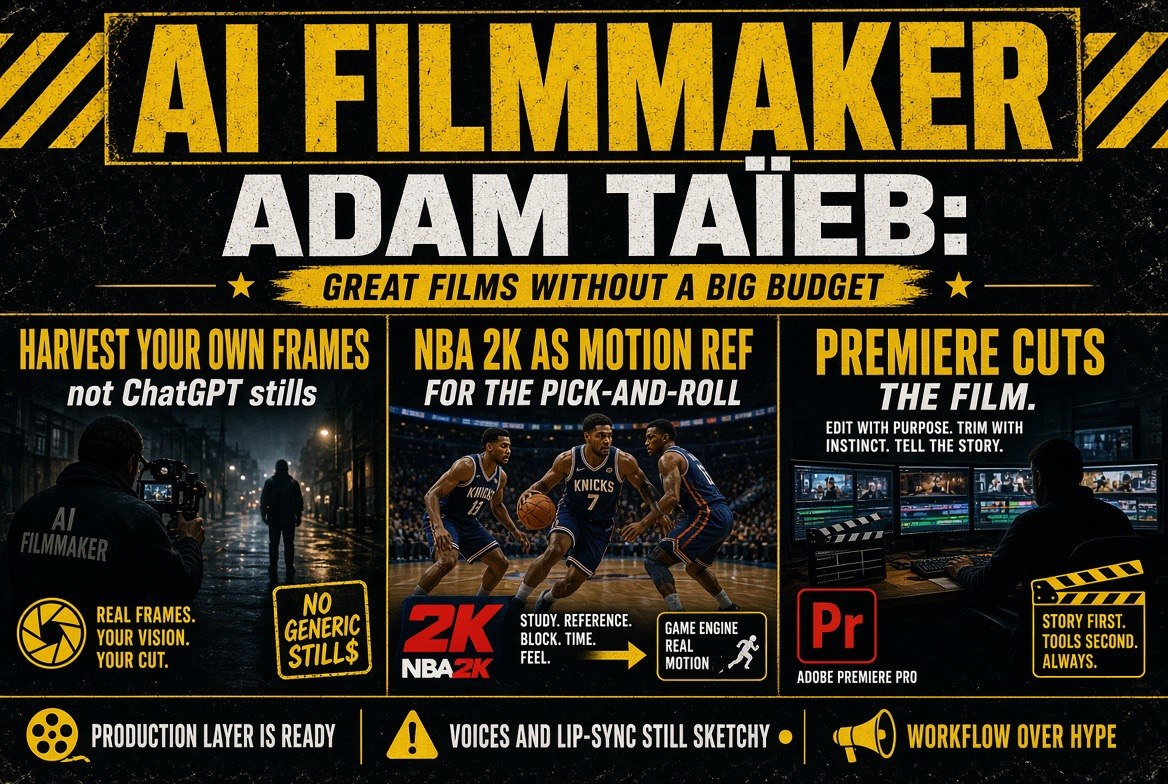
AI Filmmaker Adam Taïeb: Great Films Without a Big Budget
Get The Faceless YouTube Blueprint — Free
The exact AI tool stack and workflow used to build a faceless YouTube channel from zero.
AI Filmmaker Adam Taïeb: Great Films Without a Big Budget
⚡ Expert Summary: Adam Taïeb’s GATES and 100 were made on a ~$200 token budget per short using ChatGPT for character sheets, Seedance 2.5 via Dreamina for generation, and Premiere Pro for the edit — but his most transferable trick is reusing frames from his OWN generated video as references instead of the original ChatGPT stills, and using NBA 2K gameplay footage as a motion reference to teach the model a pick-and-roll alley-oop. Output still reads as a sketch in the voices and lip-sync. Workflow is the part that is actually ready.
Adam Taïeb makes AI short films that look like they cost money. His two most recent, GATES and 100, were built entirely with generative tools — no crew, no camera, no set. And the number that matters is not the render quality. It is the line in his own workflow where he stops trusting his own references.
That line is worth understanding if you are an American creator trying to decide whether AI video is ready to carry a project. Because the honest answer from the person actually doing it is more specific — and more useful — than either the hype or the backlash.
Who Adam Taïeb Is, and Why His Workflow Is the Story
Taïeb describes himself, plainly, as “an AI filmmaker specializing in cinematic comedy. Short films, commercials and narrative experiments made with generative tools.” The last clause is the one that tells you he is not selling you a course. Mostly arguing with the tools is his own phrasing for the rest of it.
His channel hosts GATES, a ~3-minute comedy built on the Zhuge Liang empty-fort stratagem — the 空城计 beat where a commander with no troops opens the city gates and plays music to bluff an army into retreating. It is a period piece, it is funny, and every frame of it came out of a model. The second film, 100, takes on Wilt Chamberlain’s 1962 hundred-point game — a performance, famously, with no surviving footage.
Both films are on the same channel. Both were made the same way. And neither one was made the way most AI video tutorials tell you to make things.
Step One: Character Sheets Are Not the Reference You Think They Are
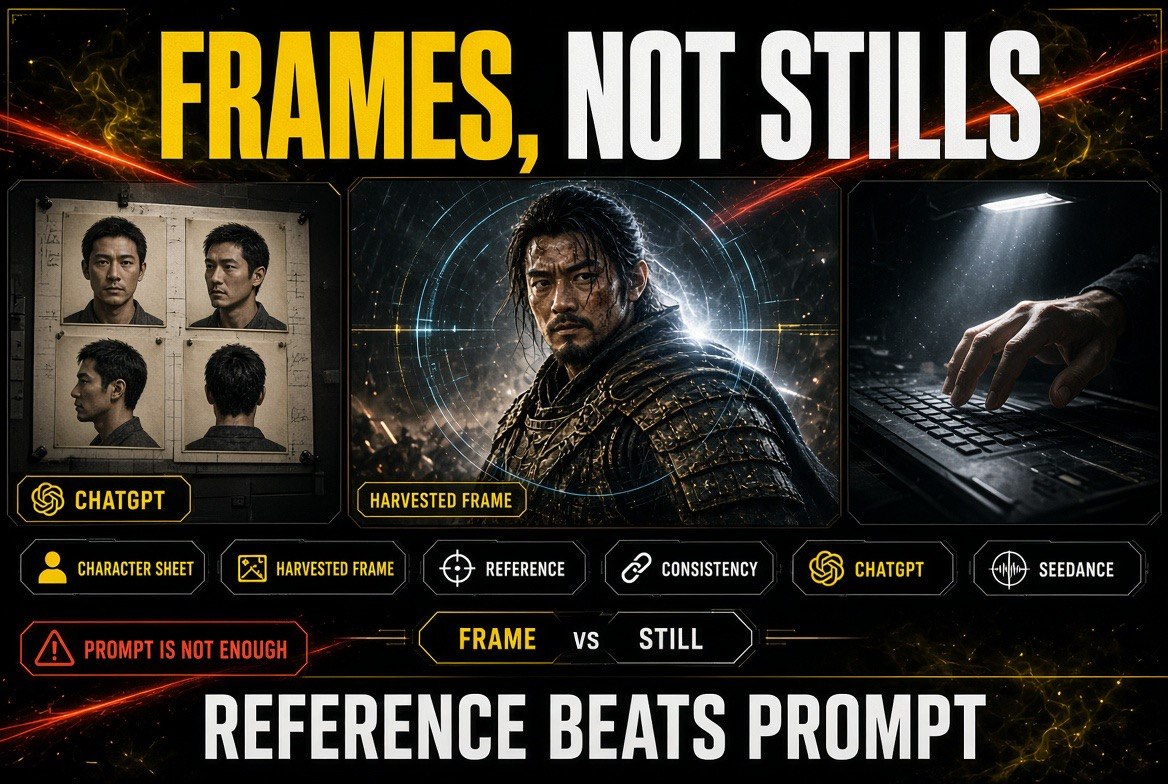
The default advice for character consistency is to build a sheet — front view, side view, expression studies — and feed those images into every generation. Taïeb does build the sheets. He builds them in ChatGPT. Character and environment sheets, generated as stills, then handed to the video model.
Then he stops using them, and this is the part worth writing down.
Instead of feeding the ChatGPT stills into the video model as references, he reuses frames from his own already-generated video. His stated reason is exact, and it is a technical observation rather than a preference: “ChatGPT stills tend to look too much like frozen photographs rather than film frames.”
Read that twice, because it is a real constraint and not a workflow quirk. An image model and a video model are trained on different material. A still generated to look like a photograph carries photographic texture — a certain flatness, a certain level of micro-detail, a certain relationship between subject and background. When you hand that still to a video model as an identity reference, you are asking the video model to reproduce photographic qualities inside a motion medium. It inherits the look of a photograph in a context where the look should be a frame from a moving picture.
Taïeb’s fix costs nothing and requires no new tool. Generate, then harvest. The first pass of video gives you frames that already sit in the model’s own visual language. Those frames become the reference for the next shot, and the identity stays consistent inside the medium you are actually working in.
That is the single most portable thing in his entire pipeline, and it exists because he noticed a difference in texture that most creators never look for.
GATES: Frames From the Film
Frames from GATES by Adam Taïeb. Watch GATES.
100: Frames From the Film
Frames from 100 by Adam Taïeb. Watch 100.
Step Five: The Edit Is Boring, and That Is the Point
After generation, Taïeb cuts in Premiere Pro. Conventional editing. Timeline, cuts, pacing, sound design.
This is the step most AI video coverage skips, and its absence is why so much AI video looks like a demo reel rather than a film. Generation gives you material. Editing is what turns material into a story — deciding where a shot ends, what happens between shots, how long a beat holds. Taïeb’s films read as films largely because a human with an editing background assembled them, and no model did that part.
The practical implication for a solo creator is straightforward: budget your time for the edit. If you spend your entire effort on generation and twenty minutes on the timeline, you will get a demo. The edit is not the cleanup step. It is the filmmaking.
What It Actually Costs: $200 Is a Floor, Not a Total
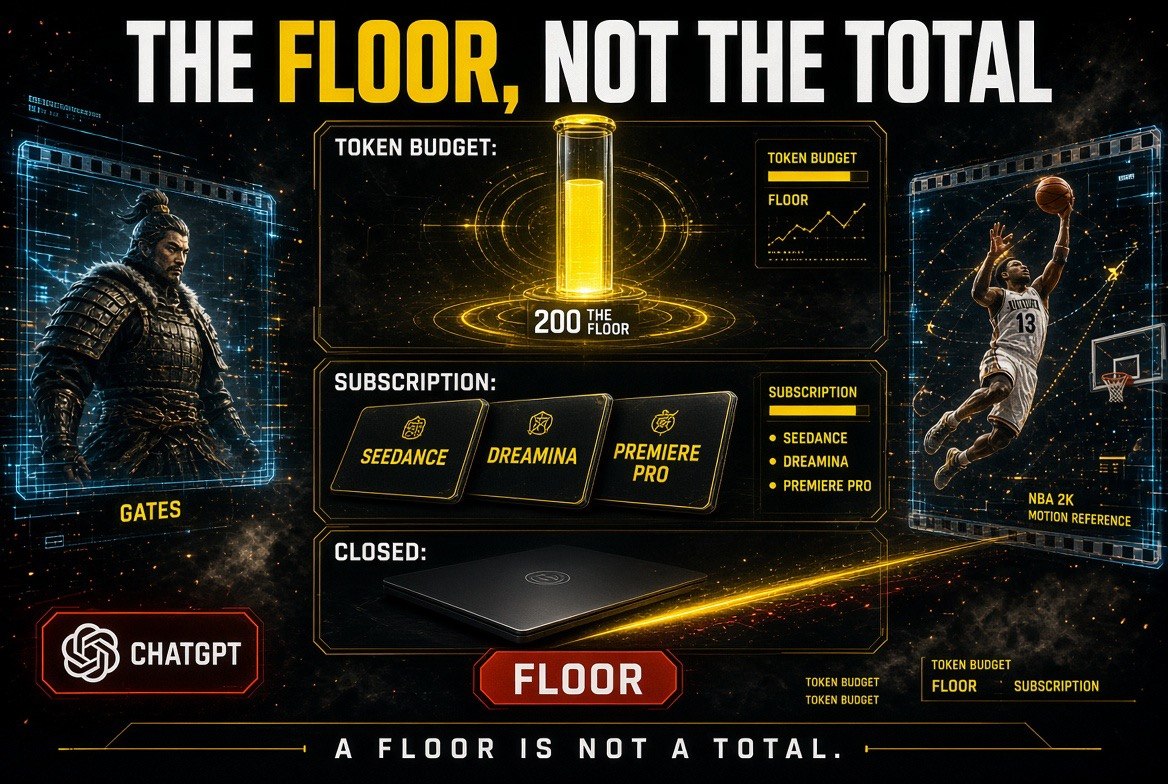
Taïeb puts the cost of a short at roughly $200. He said it unprompted, which is the kind of detail that tells you a number is real rather than a marketing figure.
But read the definition carefully, because it is narrower than it sounds. That $200 covers Seedance generation tokens only. It does not include subscriptions, does not include other tools in the pipeline, and does not include his time — and his time is the largest input in the entire project.
So $200 is a floor, the marginal cash cost of generation. It is genuinely useful as a benchmark, because it prices the one part of the workflow that used to require a crew. What it is not is a total cost of production, and anyone quoting it as one is selling something.
| Cost Line | Covered by the $200? | What It Means for a Solo Creator |
|---|---|---|
| Seedance generation tokens | Yes — this is the whole figure | The one line that replaced a crew. Budget it per project, not per shot. |
| Tool subscriptions | No | Recurring, fixed, and unrelated to project length. Spread across all your work. |
| ChatGPT usage for sheets and frame repair | No | Real but small; scales with how much repair your prompts need. |
| Premiere Pro subscription | No | Fixed cost you likely already carry. |
| Your time | No — and this is the biggest input | 30-second sequence generation plus local repair is a large time sink. Price your own hour. |
If you are an American solo creator weighing AI video against a traditional shoot, that table is the honest version of the comparison. The generation bill is small and shrinking. The labour bill is real and is where the project actually costs something.
What Still Doesn’t Work
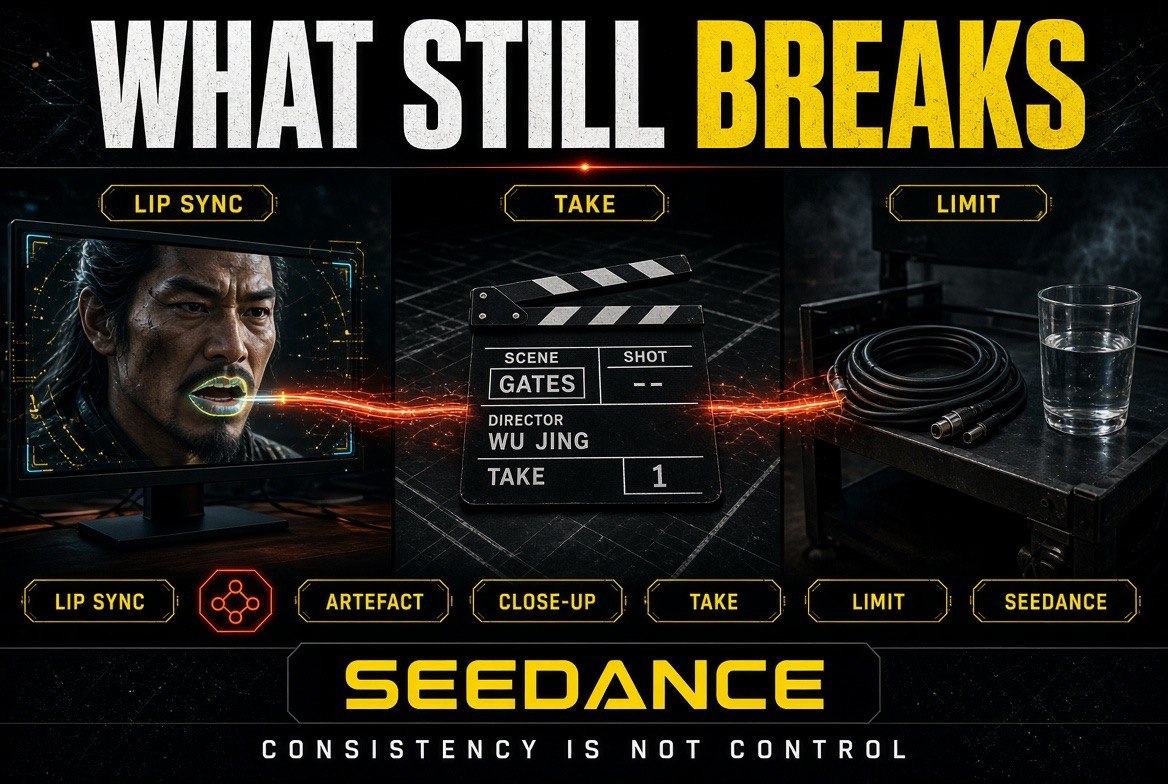
Taïeb’s workflow is impressive. His output still reads as a sketch in specific, identifiable places, and the interesting question is which places.
Voices remain the weakest link. Model-native audio is flat in a way that is hard to fix downstream. Delivery has a synthetic quality, and performance — the small, specific choices an actor makes — is limited. This is the limitation Taïeb’s own tooling has not solved.
Lip-sync is imprecise. Close enough to read, not close enough to forget you are watching a generation. In a comedy, where timing is the whole joke, this costs more than it would in a mood piece.
Facial performance is narrow. The subtle register — a flicker of doubt, a suppressed laugh — is not reliably available. Generated faces do the big emotions well and the small ones poorly, which is precisely backwards for comedy.
Character consistency held, though, and it held for a specific reason: the reference-frame trick. Swap stills for harvested frames and identity survives across a three-minute film. That is a real, reproducible win, and it is the part of this workflow most worth copying.
The correct read is not “AI video is here” or “AI video is fake.” It is that the production layer is now genuinely usable and the performance layer is not. Plan around that split and you can ship. Ignore it and you will spend a budget discovering it.
The One Disclosure That Matters
Taïeb is a Dreamina partner creator. Dreamina is the platform through which he runs Seedance 2.5, and “partner” is worth reading plainly: he has a relationship with the platform whose tool his workflow is built on. That does not make his numbers wrong — the $200 figure and the reference-frame observation both hold up on their own logic — but you should know it when you read a creator describing their own toolchain. Disclosed here rather than buried.
What to Copy, In Order
If you take nothing else from this, take the workflow in the order it actually matters:
1. Harvest frames, don’t hoard stills. Generate video first. Pull frames from your own output. Use those as identity references. It costs nothing and it fixes the texture mismatch between an image model’s output and a video model’s expectations.
2. Work in sequences, repair locally. Thirty seconds at a time, keep the best, re-generate the failures in short passages. Never commit to a shot list before you know what the model can hold.
3. Steal motion from simulations. When you need physically accurate movement, feed the model gameplay footage — sports titles especially. It is a corpus of accurate motion that someone else paid to build.
4. Edit like a filmmaker. Generation is not the film. The timeline is. Give it the time it deserves.
5. Budget on labour, not tokens. $200 of tokens is the cheap part. Your hours are the expensive part, and they are the part no one quotes.
Should You Use This Workflow in 2026?
Yes, with a constraint that depends entirely on your format. If your project can survive voices that read synthetic and a facial performance that only handles broad strokes — comedy sketches with stylized premises, period pieces, anything where the visual gag carries the moment — this workflow will get you to a finished film on a token budget. GATES is proof of that, and so is 100.
If your project depends on a performance being subtle, then in 2026 you are still waiting. Not because the pipeline cannot generate a face, but because it cannot act with one. Taïeb is open about this, which is the main reason his account is worth reading: he is not claiming the tools are finished. He is claiming — accurately — that he shipped two films with them and listed exactly where they held.
For an American creator deciding whether to start, the practical answer is that the barrier to a first finished film is now measured in tokens and hours, not in equipment and crew. The barrier to a first good film is unchanged, and it is the same barrier it has always been: knowing what a story needs and cutting to it.
Frequently Asked Questions
What tools did Adam Taïeb use to make GATES and 100?
Character and environment sheets were built in ChatGPT. Video generation ran through Seedance 2.5 via Dreamina. Post-production and editing were done in Premiere Pro. Voices were generated by Seedance itself rather than by a separate text-to-speech tool or a human performer.
Why does he reuse frames from his own video instead of the ChatGPT character sheets?
In his words, “ChatGPT stills tend to look too much like frozen photographs rather than film frames.” Stills generated for photographic realism carry photographic texture, which the video model then inherits. Frames harvested from his own generated video already look like frames from a film, so using them as references keeps identity consistent inside the right medium.
What is the pick-and-roll alley-oop reference in 100, and why does it matter?
The pick-and-roll alley-oop is a two-man play: one player screens a defender, then rolls to the basket while the ball handler draws the defense and lobs the ball for a finish at the rim. It requires precise, coordinated timing between two bodies. Taïeb used NBA 2K gameplay footage as a motion reference to teach the model the movement, because describing coordinated athletic motion in text does not produce it reliably.
Is $200 the real cost of making an AI short film?
No — it is the floor. Taïeb’s $200 covers Seedance generation tokens only. It excludes tool subscriptions, ChatGPT usage, Premiere Pro, and his own time. His time is the largest input in the project. Treat $200 as the marginal cash cost of generation, not as a total cost of production.
Can AI video replace a film crew in 2026?
It can replace the generation layer, which used to require cameras, lighting, locations, and performers. It cannot yet replace the performance layer — subtle delivery, precise lip-sync, and narrow facial expression remain unreliable. The edit still requires a human making story decisions. The honest position is that production is usable and performance is not.
What is GATES about?
GATES is a roughly three-minute AI-generated comedy built on the Zhuge Liang empty-fort stratagem, the 空城计 episode in which a commander with no troops opens the city gates and plays music to bluff an invading army into retreating. It uses period setting and English dialogue.
Is Adam Taïeb a Dreamina partner creator, and does that affect his claims?
Yes, he is a Dreamina partner creator, and Dreamina is the platform carrying Seedance 2.5. That relationship is disclosed here for transparency. It does not invalidate his workflow observations, but readers should weigh a creator’s account of a toolchain they have a relationship with accordingly.

About Barak Schurr
Barak Schurr is a serial entrepreneur who built and exited a major ticketing platform before turning his attention to AI and content. He runs three AI-focused research sites and writes about the tools, workflows, and strategies that let solo creators build real channels — without a crew, a studio, or a Hollywood budget.
Email: [email protected]
More AI Video Resources