Hollywood’s First AI Actor: What Synthetic Performers Mean for Creators
Get The Faceless YouTube Blueprint — Free
The exact AI tool stack and workflow used to build a faceless YouTube channel from zero.
Hollywood’s First AI Actor: What Synthetic Performers Mean for Creators
⚡ Expert Summary: Tilly Norwood is a computer-generated character built by London production company Particle6 through its AI division, Xicoia — and she has already done a CNN interview, a CBS interview, and a live segment on ITV’s Good Morning Britain. SAG-AFTRA’s response was blunt: it is “opposed to the replacement of human performers by synthetics,” and says Norwood was “trained on the work of countless professional performers — without permission or compensation.” No major studio or agency signing is confirmed. The real story for creators is not the character. It is the contract clauses and disclosure rules that now decide whether synthetic performers get used at all — and those changed in 2026.
Every few years something forces the creator economy to answer an uncomfortable question about what a performer actually is.
The last one was de-aging. Before that it was digital doubles in crowd scenes. Neither required anyone to write a new definition, because in both cases a human had signed the contract.
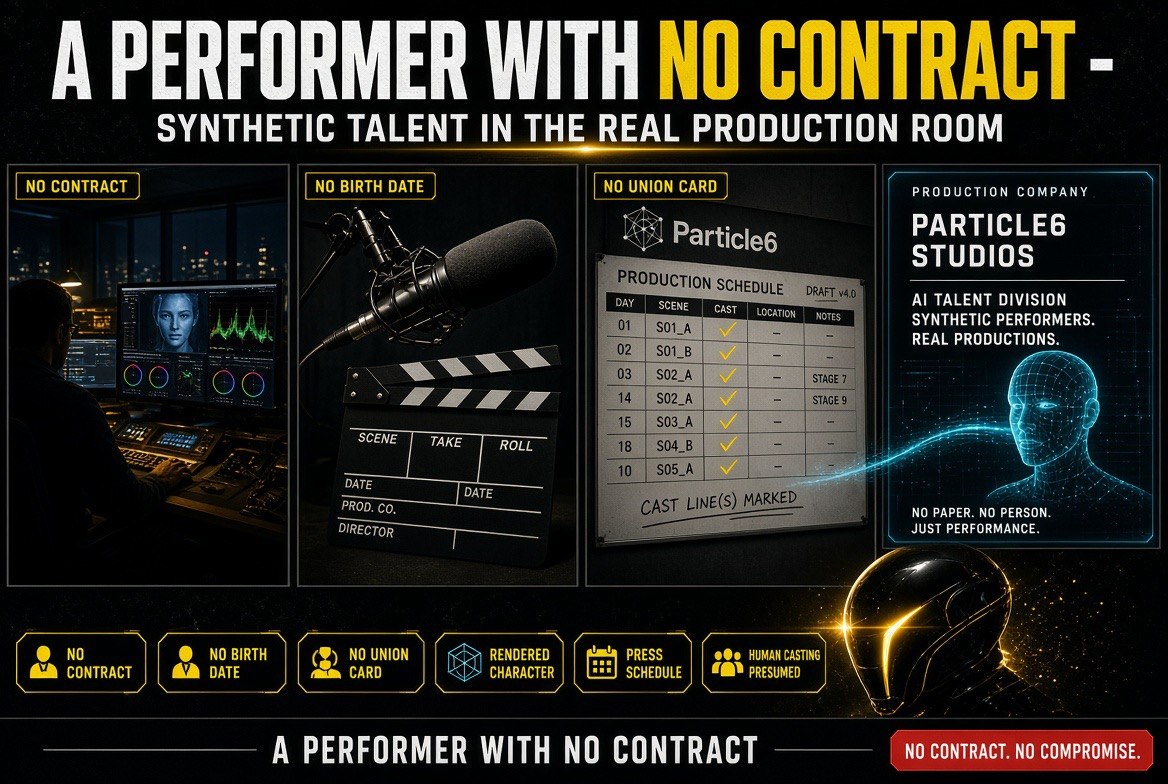
Tilly Norwood does not have a contract. She does not have a birth date, a union card, or a legal name. She is a rendered character with a face, a voice model, a press schedule, and — according to her creator — a starring role in a feature film. And she has now been interviewed on national television by credentialed journalists who treated the exchange as an interview.
If you make things for a living, this is not a curiosity. It is the first test case for a business model that could touch every creator who has ever been paid for their face, their voice, or their likeness. Here is what is actually confirmed, what is not, and what it means for the people making things in 2026.
What Tilly Norwood Actually Is
Norwood was created by Eline Van der Velden, a Dutch actor, comedian, writer, and founder of Particle6, a London-based production company. The character sits inside Xicoia, Particle6’s AI talent division — an operation explicitly built to create, manage, and monetize synthetic characters.
The distinction matters. Xicoia is not a research lab that happened to produce an interesting model. It is a talent management business, structured like representation, for a performer who does not exist. That is the part the industry noticed.
Van der Velden has described the intent in promotional terms and has been candid that the technology is not doing something magical. In her CBS interview, the character answered questions about how the work functions, noting that when a production happens, real people — directors, writers, editors — get paid. The character also said that the AI was not independently researching the interviewer in real time, which is worth reading twice. The realism is a production choice, not autonomy.
The project attached to Norwood is Misaligned, described as the story of an AI trying to become more human. What is confirmed is that Particle6 has promoted the film publicly and used Norwood as its face. What is not confirmed is completion, distribution, acquisition, or a conventional production contract with Norwood cast as lead. Treat “starring role” as promotional framing until someone in a trade publication says otherwise.
The Press Tour, and Why It Mattered
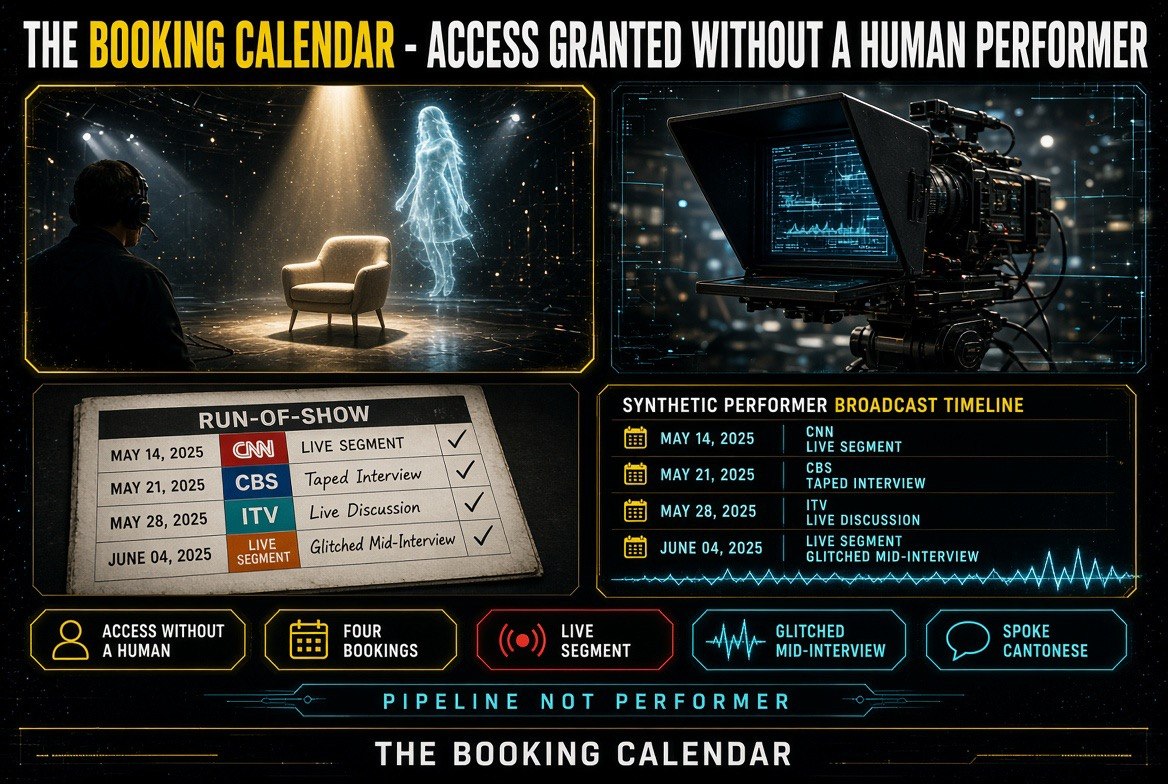
What made this a story rather than a demo was not the rendering quality. It was the booking calendar.
Norwood appeared on CNN on 8 September 2026. NBC followed on 14 September with a profile built around a genuinely uncomfortable framing — that the character does not need sleep, a living wage, or a say in its roles. CBS published an interview on 15 September in which the interviewer was transparent that the experience was disquieting. On the same day, ITV’s Good Morning Britain put the character on air in a segment presented as a live, unscripted conversation.
Those appearances broke a rule most creators understand instinctively: access is supposed to be earned by a person. A synthetic character receiving the same platform as a working actor is not a technology milestone. It is a gatekeeping decision, and the people who decide who gets access made it.
Then the technical reality arrived. During a later appearance, the character glitched mid-interview and unexpectedly began speaking Cantonese before recovering. A single malfunction, and arguably the most informative thing to happen across the entire press tour — it demonstrated to a mass audience that the system is a pipeline with failure modes, not a performer with composure.
| Timeline Beat | What Happened | Why Creators Should Care |
|---|---|---|
| Character created | Tilly Norwood built by Particle6 via its Xicoia AI talent division | Synthetic talent is being run as a representation business, not a tech demo |
| Press tour | CNN (8 Sept), NBC (14 Sept), CBS and ITV’s Good Morning Britain (15 Sept) | Access to major platforms was granted without a human performer attached |
| On-air failure | Character glitched mid-interview and switched to Cantonese before recovering | Proves the pipeline fails in public — clients need fallback plans, not just renders |
| Union response | SAG-AFTRA opposed replacement of human performers by synthetics and objected to training on performers’ work without permission or compensation | The rules that govern whether you can be replaced are contract language, not ethics |
| Representation status | No major agency or studio signing publicly confirmed; at least one major agency publicly declined | The industry’s gatekeepers have not actually signed on — the narrative ran ahead of the deals |
What SAG-AFTRA Actually Said — and What It Won
The union’s position is the most consequential part of this story, and it is more specific than the headlines suggest.
SAG-AFTRA stated that it “is opposed to the replacement of human performers by synthetics,” and that Norwood “was trained on the work of countless professional performers — without permission or compensation.” The union has consistently framed the principle as one sentence: creativity is, and should remain, human-centered.
That statement is an objection. What matters far more for a working creator is what the union negotiated afterward.
Reporting on SAG-AFTRA’s contract provisions in 2026 describes a framework with three load-bearing elements:
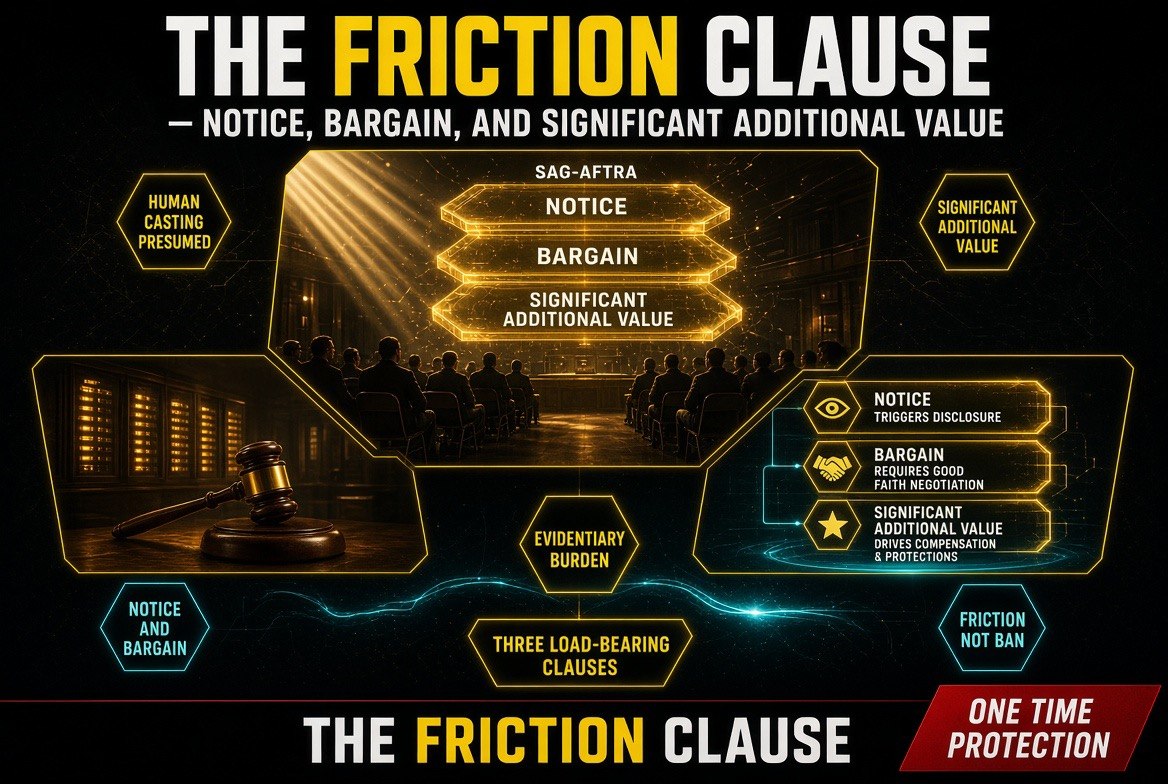
- A presumption of human casting. Producers agreed to continue using union performers overwhelmingly.
- A narrow exception. A synthetic performer cannot replace a role that a union performer could do unless the synthetic provides “significant additional value.”
- A notice-and-bargain requirement. Producers using a synthetic performer must notify and bargain with the union, and demonstrate that additional value.
Read those three together and the business model changes shape. A synthetic performer is not banned. It is taxed with process. Every use triggers notification, a bargaining obligation, and an evidentiary burden that a purely generative pipeline is usually not set up to satisfy.
That is a smarter outcome than an outright ban, because an outright ban would have been unenforceable and easy to route around. What the union built instead is friction. And friction is what actually determines whether a technology gets adopted in production — not whether it is legal, and not whether it looks good.
The Question Nobody Has Answered: Where Did the Training Data Come From?
The objection about training on performers’ work without permission or compensation is the part with the longest tail, and it applies far beyond one character.
If a synthetic performer’s appearance, mannerisms, or vocal qualities are derived from the work of identifiable professionals, then every creator whose work appears in that training set has a claim that is currently unresolved. The same logic that makes a musician’s voice a protectable asset makes a working actor’s on-screen physicality one — or it will, once a court or a legislature says so definitively.
Creators should notice that this argument cuts in their direction, and it is not confined to Hollywood. If you have spent three years building a recognizable on-camera persona, a distinct vocal delivery, or a signature editing style, you have generated exactly the kind of data that synthetic performer systems are hungry for. You are not a bystander in this debate. You are inventory.
| Creator Type | Exposure to Synthetic Performer Risk | What to Do This Quarter |
|---|---|---|
| On-camera creator with a recognizable face | High — your likeness is the product being imitated | Audit your platform contracts for likeness clauses; know who can license your face and on what terms |
| Voice-first creator or narrator | High — voice cloning is cheaper and harder to detect than video | Keep a documented library of your own recordings and confirm your client contracts prohibit cloning |
| Faceless channel operator | Low on likeness, high on disclosure | Disclose AI generation clearly — platform labelling is moving faster than the law |
| Editor or post-production freelancer | Indirect — synthetic pipelines reduce the roles you are hired into | Move up the stack into direction, consistency, and quality control — the parts a generator cannot own |
| Brand or agency producing content | Contractual — you may already be bound by union terms you have not read | Confirm whether your production agreements carry synthetic performer notice obligations |
What This Means for You, Specifically
Strip away the spectacle and the practical consequences sort into four areas.
Your likeness is now a contract term. If you sign anything that includes a broad likeness or “digital replica” grant, you have probably authorized the thing that makes a synthetic version of you possible. Read those clauses. Ask what the term is, whether it survives the end of the engagement, and whether derivative works are included.
Disclosure is becoming infrastructure, not etiquette. Platform-level labelling and provenance standards are moving faster than legislation. Creators who adopt clear disclosure now avoid a compliance scramble later — and, more immediately, avoid the credibility hit when an audience discovers a synthetic element on its own.
The value has moved to consistency and direction. The most fragile parts of any generative pipeline are continuity of character, performance direction, and knowing when a take is unusable. That is where human judgment still clears a quality bar a model cannot. If your skill is only execution, you are exposed. If your skill is deciding what good looks like, you are not.
Nobody has signed the deals yet. No major studio or agency representation has been publicly confirmed for Norwood, and at least one major agency publicly declined. The press tour happened ahead of the business agreements, which is common in technology launches and rare in talent representation. That gap is your window. The rules are still soft.
What Not to Believe
A few claims circulating around this story do not hold up, and creators repeating them look careless.
- “A major agency signed her.” Not confirmed. Reporting describes an unnamed agency expressing interest around a film festival appearance, with no verified representation agreement and at least one prominent agency publicly declining.
- “She’s starring in a distributed film.” Not confirmed. The project has been promoted publicly. Completion, acquisition, and release are not established.
- “This is autonomous.” No. It is a generated character produced through a software pipeline, with human operators, as the character itself acknowledged when asked about how the interview worked.
- “The tech is ready.” The Cantonese glitch on a live broadcast is the honest review.
The useful takeaway is not that synthetic performers are coming. It is that one arrived, was marketed like a person, failed live on air, and ran straight into a union contract that governs how it can be used. Every creator now works downstream of those events.
Frequently Asked Questions
Who created Tilly Norwood, and what is Xicoia?
Tilly Norwood was created by Eline Van der Velden, a Dutch actor, comedian, writer, and founder of Particle6, a London-based production company. The character operates under Xicoia, Particle6’s AI talent division — a unit built to create, manage, and monetize synthetic characters. Reporting is consistent that Particle6 is the parent production company and Xicoia is its AI-focused operation, though the exact corporate phrasing varies between outlets.
Is Tilly Norwood actually signed to a talent agency or studio?
No major signing is confirmed. At a film festival, Van der Velden said an unnamed agency had signed or was in the process of signing the character, and one trade publication described an unnamed agency taking her on as a client. But the agency’s identity has never been confirmed, no representation agreement has been verified, and at least one major agency publicly declined — Gersh said it was not in talks, and a WME co-chair reportedly said that if she has a future, it will not be at WME. No major studio deal is confirmed either.
What exactly did SAG-AFTRA say about synthetic performers?
The union stated that it “is opposed to the replacement of human performers by synthetics,” and that Norwood “was trained on the work of countless professional performers — without permission or compensation.” The union’s guiding principle is that creativity is, and should remain, human-centered. Its formal statement also reminded signatory producers that synthetic performers cannot be used without complying with contractual obligations requiring notice and bargaining.
What did SAG-AFTRA actually win in its contract?
Reporting on the union’s 2026 contract provisions describes three elements: producers agreed to continue using union performers overwhelmingly; a synthetic performer cannot replace a role a union performer could do unless the synthetic provides “significant additional value”; and producers using one must notify and bargain with the union and demonstrate that additional value. The practical effect is not a ban but friction — every use triggers process, and most fully generative pipelines are not built to satisfy it.
Did Tilly Norwood really glitch on live television?
Yes — during a later broadcast appearance, the character glitched mid-interview and unexpectedly began speaking Cantonese before recovering. It is arguably the single most informative moment of the entire press tour, because it demonstrated to a mass audience that the system is a software pipeline with visible failure modes rather than a performer with composure. Note that some widely circulated claims about specific appearances are not confirmed by reliable reporting; the verified broadcast appearances include CNN, NBC, CBS, and ITV’s Good Morning Britain.
Does any of this affect creators who are not actors or in Hollywood?
Yes, and more directly than most people expect. If you have spent years building a recognizable on-camera persona, a distinct vocal delivery, or a signature style, you have generated exactly the kind of data that synthetic performer systems train on. The same argument that makes a professional performer’s work protectable applies to yours. The immediate practical step is auditing your platform and client contracts for likeness, digital replica, and cloning language — because that is where the right to create a synthetic version of you is granted or withheld.
Is Misaligned released, and is Norwood confirmed as its star?
Not confirmed. Particle6 has publicly promoted the project, described as the story of an AI trying to become more human, and has used Norwood as its face. But reliable reporting does not confirm that the film is complete, theatrically released, acquired by a distributor, or formally cast with Norwood as an agreed production performer. Treat “starring role” as promotional framing until a trade publication confirms otherwise. The character’s own creator has described the film as a demonstration of what can be done with AI.
Should a creator use a synthetic performer in their own content?
That depends entirely on who is paying and under what agreement. If your production touches a union signatory, the notice-and-bargain requirement applies and the “significant additional value” test is a real hurdle. For fully independent work with no union involvement, the constraints are the platform’s AI disclosure and labelling rules, which are tightening faster than legislation. The safest posture is transparent labelling plus written confirmation that any likeness or voice model you use was licensed with permission — because the unresolved training-data question is the one that reaches backwards into content you have already published.

About Barak Schurr
Barak Schurr is a serial entrepreneur who built and exited a major ticketing platform before turning his attention to AI and content. He runs three AI-focused research sites and writes about the tools, workflows, and strategies that let solo creators build real channels — without a crew, a studio, or a Hollywood budget.
Email: [email protected]
More AI Video Resources