Stability AI Rebuilt Around Music: What Sean Parker’s Bet Means for Solo Video Creators
Get The Faceless YouTube Blueprint — Free
The exact AI tool stack and workflow used to build a faceless YouTube channel from zero.
Stability AI Rebuilt Around Music: What Sean Parker’s Bet Means for Solo Video Creators
⚡ Expert Summary: Stability AI, the company that shipped Stable Diffusion and then spent two years bleeding executives, is rebuilding itself around music generation rather than image generation. Sean Parker is involved. For solo video creators this matters more than it sounds: the bottleneck in a one-person channel has never been footage, it has been the sound — the score, the sting, the beat that makes a cut land. If Stability gets audio right, the cheapest hard part of video gets cheaper.
Stability AI is not a company most creators think about in 2026. It won the image generation race in 2022, then lost the plot: a revolving door of CEOs, a very public funding squeeze, and a market that moved to Midjourney, Flux, and whatever Google shipped that month. TechCrunch reported on October 2, 2026 that the company is now rebuilding itself around music, with Sean Parker in the picture.
That is a strange-looking pivot until you look at what solo video creators actually struggle with. Footage is solved. Stock libraries are enormous, phone cameras are absurdly good, and AI video generation has gotten cheap enough that a one-person channel can produce a decent shot in a browser tab. Sound is not solved.
Why Audio Is Still the Hard Part of Solo Video
Watch any small creator’s video with the sound off and then with it on. Same footage, completely different result. A good score tells the viewer how to feel about a cut. A bad one, or a stock loop that repeats every eight seconds, tells them the video was made cheaply — and viewers act on that judgment within seconds.
The problem is licensing and money. Production music libraries charge by the track and by the platform, and the good ones are priced for agencies, not for someone publishing three videos a week. Free libraries are recognizable, and recognizable music reads as generic.
Generated audio attacks exactly that gap. If a creator can describe a mood, a tempo, and an instrumentation and get a usable sixty-second bed with a license they already own, the last expensive dependency in solo video production goes away.
| Cost Center | Old Solo Workflow | What Generated Audio Changes |
|---|---|---|
| Licensing | Per-track fees, platform restrictions, takedown risk | Music generated against your own account terms |
| Fit to edit | Browse lists, settle for approximate mood and length | Describe the mood and target duration directly |
| Uniqueness | Free tiers re-used by thousands of channels | Each render is specific to that video |
| Iteration speed | Re-browse and re-download for every revision | Re-render a variation in the same session |
None of those four rows are about quality. They are about friction, and friction is what stops a solo channel from shipping consistently. A creator who spends forty minutes hunting a track is a creator who publishes one fewer video that month.
What Stability Actually Announced, and What It Did Not
Stability’s pivot to music is a bet on a market where the incumbent tools are weak. Image generation is crowded and commoditized: Midjourney, Flux, and the major labs all ship strong models, and the price per image has collapsed toward zero. Music generation is different. The output quality is inconsistent, the editing controls are thin, and most tools give you a finished track with almost no way to steer it.
What Stability has not announced is the part creators should care about: pricing, licensing terms, and whether output is cleared for commercial use on monetized channels. A model that produces beautiful music with an ambiguous license is worse than useless to someone whose revenue depends on staying in the clear. Until those terms are published, the honest answer is that this is a promising direction, not a tool you can plan around.
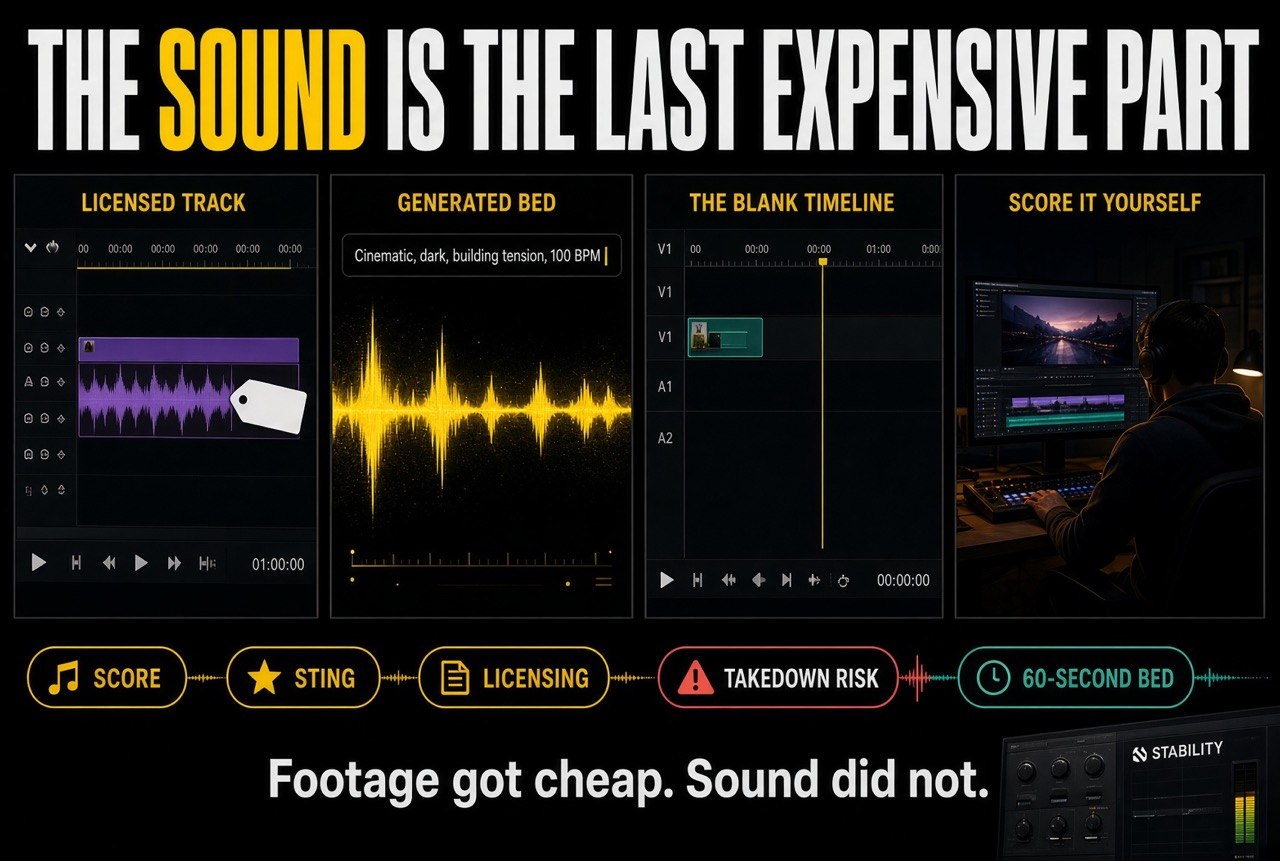
Licensed tracks carry per-platform fees and takedown risk. A bed generated against your own account terms is the first time the audio lane in a solo video edit stops being the expensive part.
Where Generated Music Actually Fits a Workflow
The useful framing is not replacement, it is triage. There are three jobs in a solo video edit that need audio, and they have very different tolerances for imperfection.
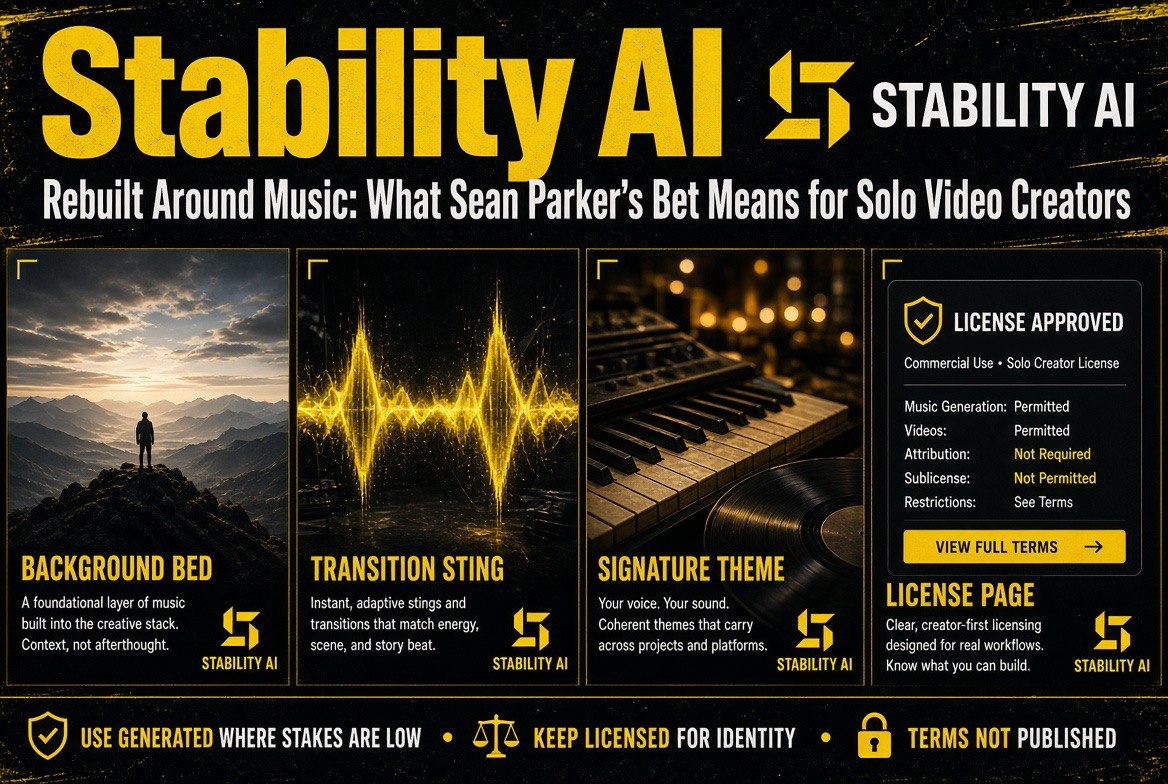
Background bed: long, low, and unremarkable. A generated loop can do this today with almost no risk, because nobody is listening closely. Transitions and stings: short punctuation that a cut lands on. Generated audio is decent here if you are willing to render a few options. Title theme or recurring signature: the sound that becomes your channel’s identity. This is the one job where generated audio still feels risky, because identity is the thing audiences remember and a generic theme is a wasted opportunity.
Generated vs Licensed vs Original: An Honest Comparison
| Factor | Licensed Library | Generated Audio |
|---|---|---|
| Time to first usable track | Minutes, from a curated library | Minutes, once you learn the prompt |
| Licensing clarity | Explicit, documented, predictable | Varies by vendor, still maturing in 2026 |
| Exact length control | Fixed track lengths, edit to fit | Can target duration in the request |
| Uniqueness to your channel | Shared with everyone on the same tier | Unique per render, but often sounds similar |
| Best suited job | Signature themes where polish matters | Beds, stings, and rapid iteration |
Read the last row as the actual recommendation. Use generated audio where the stakes are low and the volume is high. Keep a licensed library for the handful of tracks that carry your channel’s identity. The two are not in competition nearly as much as the marketing suggests.
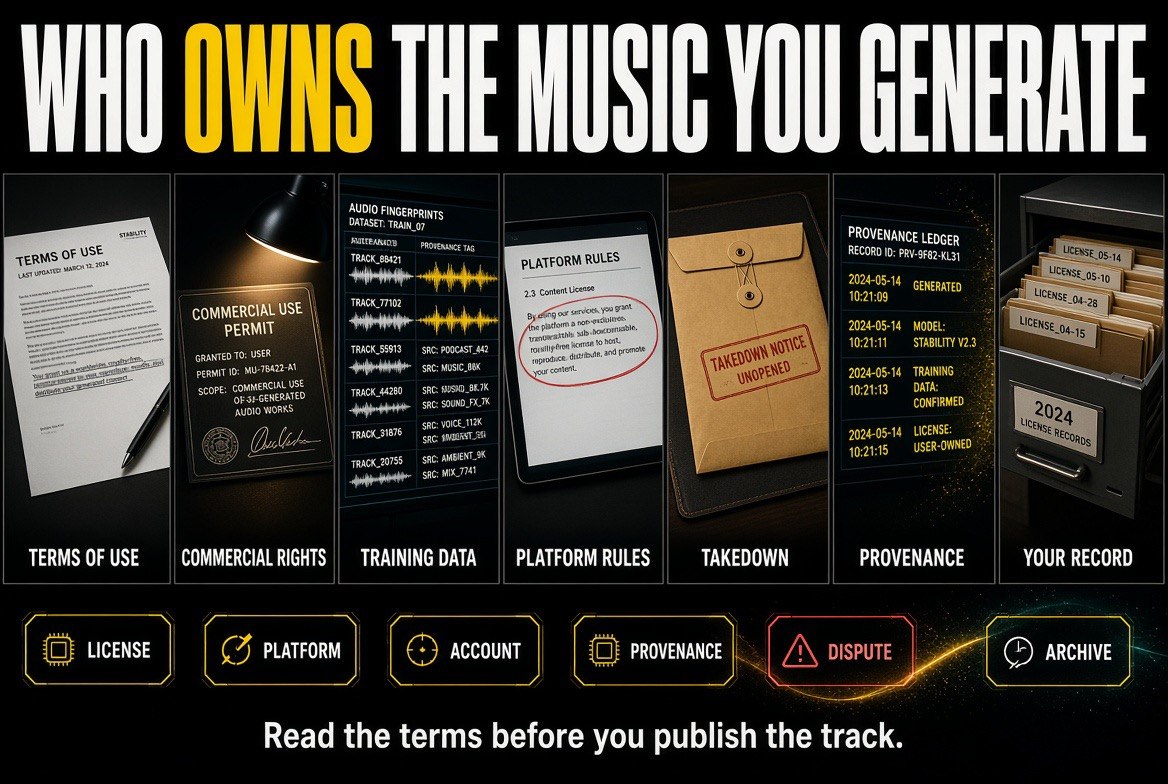
Ownership is not one question but seven: the terms you agreed to, the commercial rights granted, whether your audio trained a model, the platform’s rules, takedown exposure, provenance, and the records you keep yourself.
What This Means If You Never Touch an Audio Model
There is a version of this story that matters even to creators who ignore Stability entirely: the price of music licensing is going to move. When a credible lab points a serious research budget at music generation, the commercial libraries that charge forty dollars a track have a reason to reconsider their pricing, their platform restrictions, and their attitude toward small creators.
That is usually how these shifts show up for people on the ground. Not as a dramatic replacement, but as the incumbent suddenly offering a cheaper tier because the alternative got real. Watch for library pricing changes in the next two quarters. That will tell you more about whether Stability’s pivot worked than any benchmark.
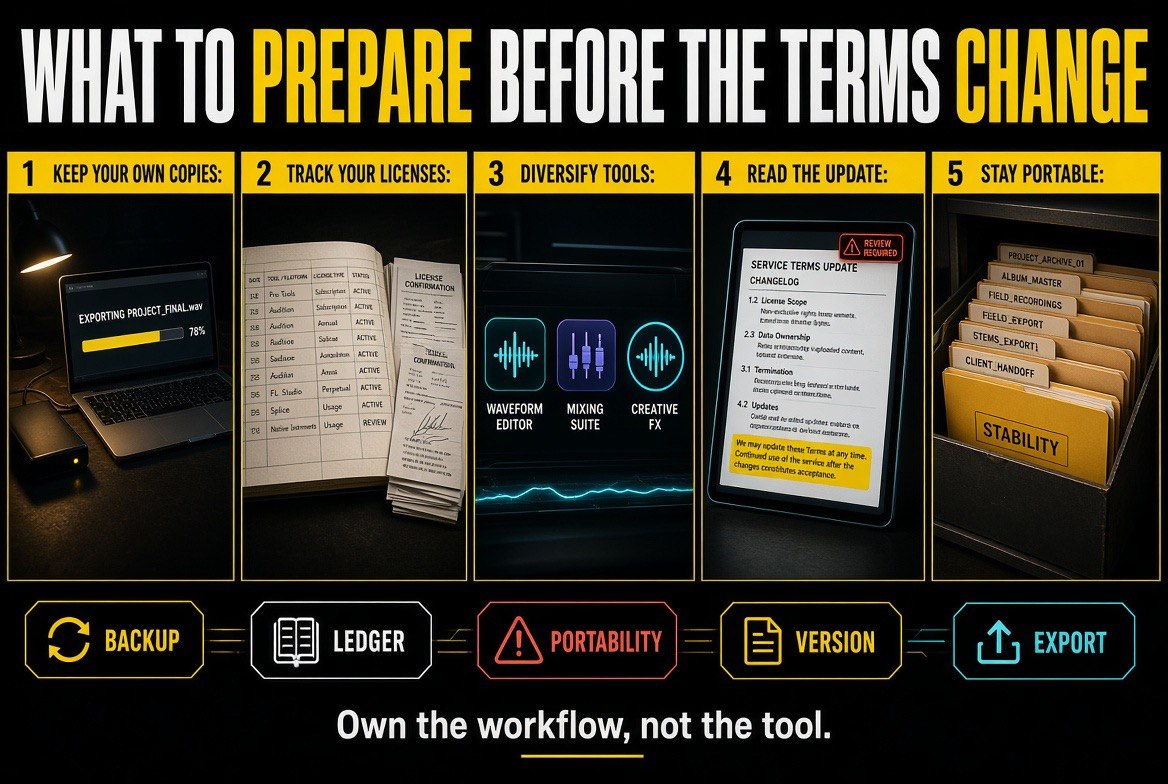
You cannot control a vendor’s terms. You can control whether your workflow survives them changing: own your copies, keep a license ledger, and never depend on one tool.
How to Prepare Without Betting on Any One Tool
Do not restructure your workflow around an unreleased product with unpublished terms. Do audit what you are currently paying for audio and how much time you spend sourcing it. Most solo creators can tell you their camera, their editor, and their microphone, and cannot tell you what they spent on music last year.
Then test one generated-audio tool on the lowest-stakes job in your videos, which is almost always the background bed. If it holds up across five videos without anyone in the comments mentioning the music, you have a new default. If it does not, you have lost an afternoon.
The correct posture toward Stability’s music pivot is not excitement or dismissal. It is attention. Audio has been the unglamorous bottleneck in solo video for a decade, and any serious money pointed at it is worth watching — as long as you watch the licensing page as closely as the demo reel.
Why Stability Picked a Harder Market on Purpose
The obvious read is that Stability is running from a fight it lost. The more useful read is that image generation stopped being a business worth owning. When the leading models are within a few percentage points of each other on quality and the price per image is racing to zero, the winner is whoever has the cheapest compute, not whoever has the best product.
Audio is at a different stage. It is where image generation was in 2022: the output is inconsistent enough that a creator notices the difference between tools, and the controls are thin enough that there is real headroom for a product team to build something a competitor cannot instantly copy. Picking a market where quality still varies is a legitimate strategy. It is also a much harder one, because you have to actually be good rather than merely cheap.
The Question Every Creator Should Ask Before Adopting This
When Stability — or any vendor — ships a music model, the demo will be beautiful. It always is. The question that decides whether it goes into your workflow is narrower and less exciting: what happens to a video that uses this music if the licensing terms change next year?
With a licensed library, that question has a documented answer. With generated audio, it depends entirely on what the vendor commits to in writing. Ask for the terms in plain language before you build a library of tracks you cannot replace. If a vendor will not state clearly whether output is cleared for monetized use in perpetuity, treat the tool as an experiment rather than infrastructure.
Frequently Asked Questions
What is Stability AI doing with music in 2026?
Stability AI, best known for Stable Diffusion, is rebuilding its business around music generation rather than image generation, with Sean Parker involved, as reported by TechCrunch on October 2, 2026. The strategic logic is that image generation has become commoditized while audio remains comparatively unsolved.
Does generated music replace licensed production music?
Not wholesale. Generated audio is strongest for background beds, transitions, and stings where volume is high and stakes are low. Licensed libraries still make more sense for a channel’s signature theme, where polish and licensing certainty matter most.
Will AI music tools lower the cost of production music?
Probably, though indirectly. When a credible competitor emerges, commercial libraries have reason to introduce cheaper tiers and looser platform restrictions. Creators should watch library pricing over the next two quarters as the real signal of whether this shift has teeth.
What should solo creators do right now?
Audit what you currently spend on audio, in money and in editing time. Then test one generated-audio tool on your lowest-stakes audio job, usually the background bed, across five videos. Keep your licensed library for signature themes until generated licensing terms are clearly published.
What is still missing from Stability’s music announcement?
Pricing, licensing terms, and explicit commercial-use clearance for monetized channels had not been published at the time of reporting. Until those exist, the pivot is a credible direction rather than a tool creators can plan a workflow around.

About Barak Schurr
Barak Schurr is a serial entrepreneur who built and exited a major ticketing platform before turning his attention to AI and content. He runs three AI-focused research sites and writes about the tools, workflows, and strategies that let solo creators build real channels — without a crew, a studio, or a Hollywood budget.
Email: [email protected]
More AI Video Resources