No-Camera YouTube Economics 2026: Cost, RPM and Real Margin
Get The Faceless YouTube Blueprint — Free
The exact AI tool stack and workflow used to build a faceless YouTube channel from zero.
No-Camera YouTube Economics 2026: Cost, RPM and Real Margin
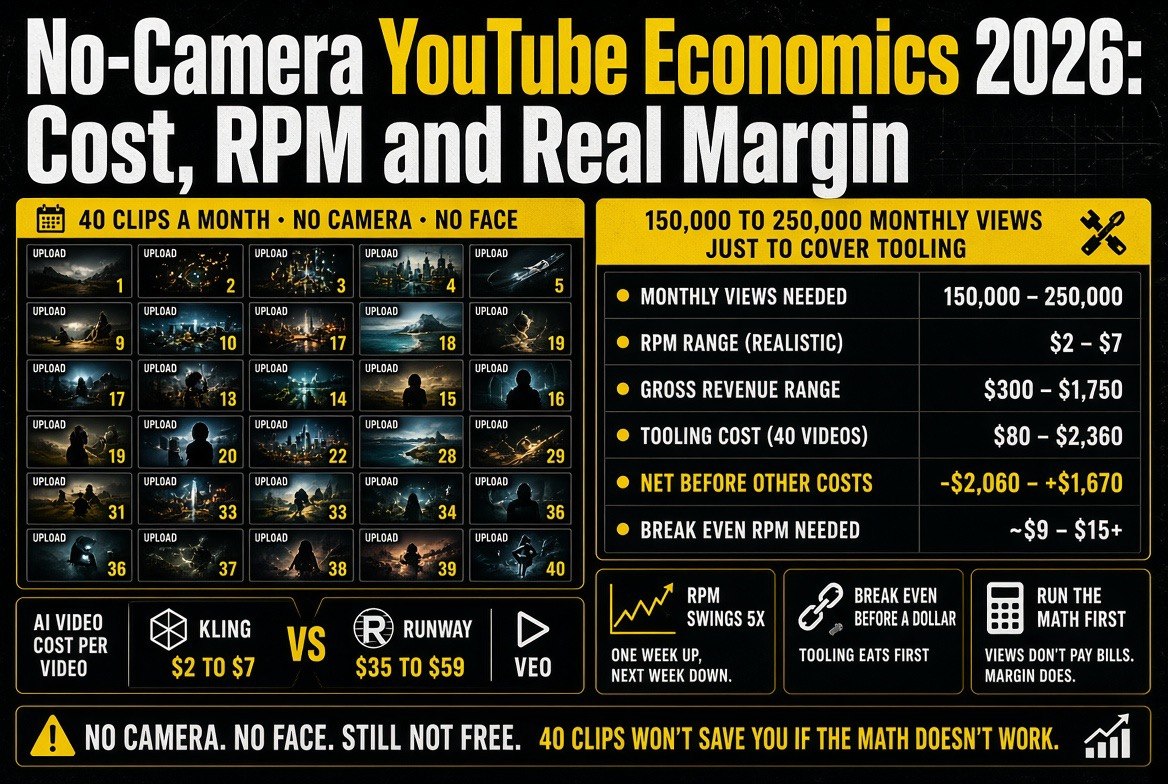
⚡ Expert Summary: The no-camera YouTube model is sold as a money printer. The honest version is narrower: a channel that ships 40 clips a month on AI still spends real money on render credits, voice, music licensing, thumbnails and editing, and the RPM that pays for it varies by a factor of five between niches. Run the math before you run the workflow. On a realistic 2026 cost base, a mid-volume no-camera channel needs roughly 150,000 to 250,000 monthly views just to cover its own tooling before it pays the creator a dollar.
Every guide to the no-camera YouTube model starts the same way: pick a niche, script with AI, generate the visuals, publish daily. Almost none of them start with the part that decides whether you have a business or a hobby, which is the arithmetic.
The model is real. Channels that never show a face do produce durable revenue in 2026, and the tooling that makes it possible costs a fraction of what a studio cost five years ago. But “a fraction” is not “nothing,” and the creators who wash out are usually not the ones who picked a bad niche. They are the ones who never multiplied their cost per video by the number of videos they planned to publish.
So this is the other side of the no-camera channel: what a video actually costs, what a view actually pays, and where the margin hides. If you want the build steps, this site has them. This is the ledger.
What One AI Video Actually Costs in 2026
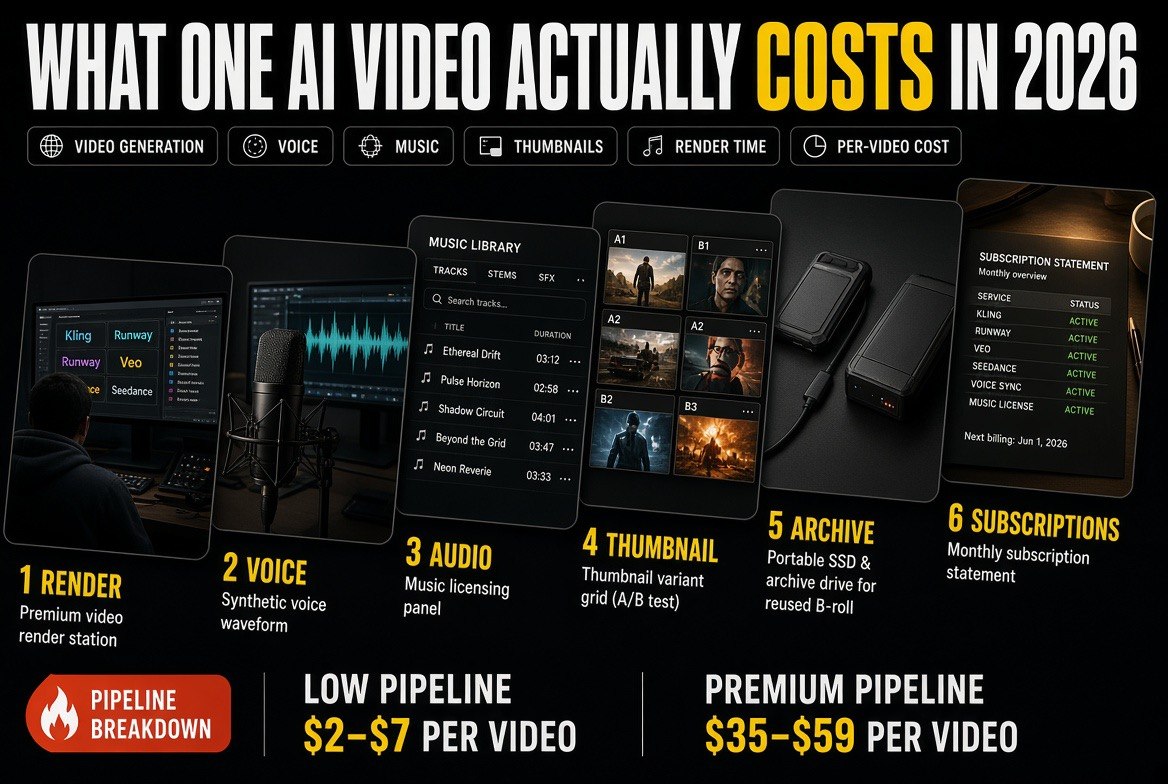
There is no single number, because cost per video depends on how much of the pipeline you generate rather than assemble. A no-camera explainer built from stock footage and a synthetic voice costs almost nothing per minute. A cinematic AI short generated shot by shot on a premium video model costs real money per second, and that is before you pay for the voice, the music and the thumbnail.
The honest way to price it is to break the pipeline into the four places money leaves your account: video generation, voice, audio and music, and the small stuff that adds up quietly. Published per-second rates for the leading video models explain most of the variance. As of 2026, Kling 3.0 lists at roughly $0.084 per second, Seedance 2.0 around $0.10, Runway Gen-4.5 about $0.12, and Google Veo 3.1 near $0.15, and a premium tier can run several times its own base rate once you move into higher resolution output.
Translate that into a finished video. A five-minute no-camera video that is fully generated rather than assembled contains roughly 300 seconds of footage. Even at the cheapest rate on that list, 300 seconds is about $25 of raw render for one video. At the top rate it is $45, and a single 4K-heavy tier can push a five-second clip past $2.50 on its own. Publish 40 of those a month and the render line alone lands between $1,000 and $1,800.
| Line Item | Per Video (Low) | Per Video (High) | What Moves It |
|---|---|---|---|
| Video generation | $1-$3 | $25-$45 | Stock assembly vs fully generated seconds |
| Voice | $0.50 | $3 | Subscription tier vs per-character API |
| Music and audio | $0 | $4 | Free library vs licensed track per video |
| Thumbnail and assets | $0.20 | $2 | Image credits and A/B variants |
| Editing and render time | $0 | $5 | Your own hours, or outsourced at hourly rates |
| Total per video | $2-$7 | $35-$59 | — |
That table is the single most useful object in this article. The gap between the low column and the high column is not a rounding difference, it is a different business. A channel at $5 a video can publish daily on pocket change. A channel at $50 a video has to earn $50 back before it earns anything, every single time.
The RPM Reality: What a View Actually Pays
RPM is revenue per thousand views, and it is where most no-camera projections fall apart. Creators quote RPMs of $10 to $20 and build revenue models on them, then discover that those numbers come from finance and investing content aimed at US viewers, and that their channel sits in a dramatically lower tier.
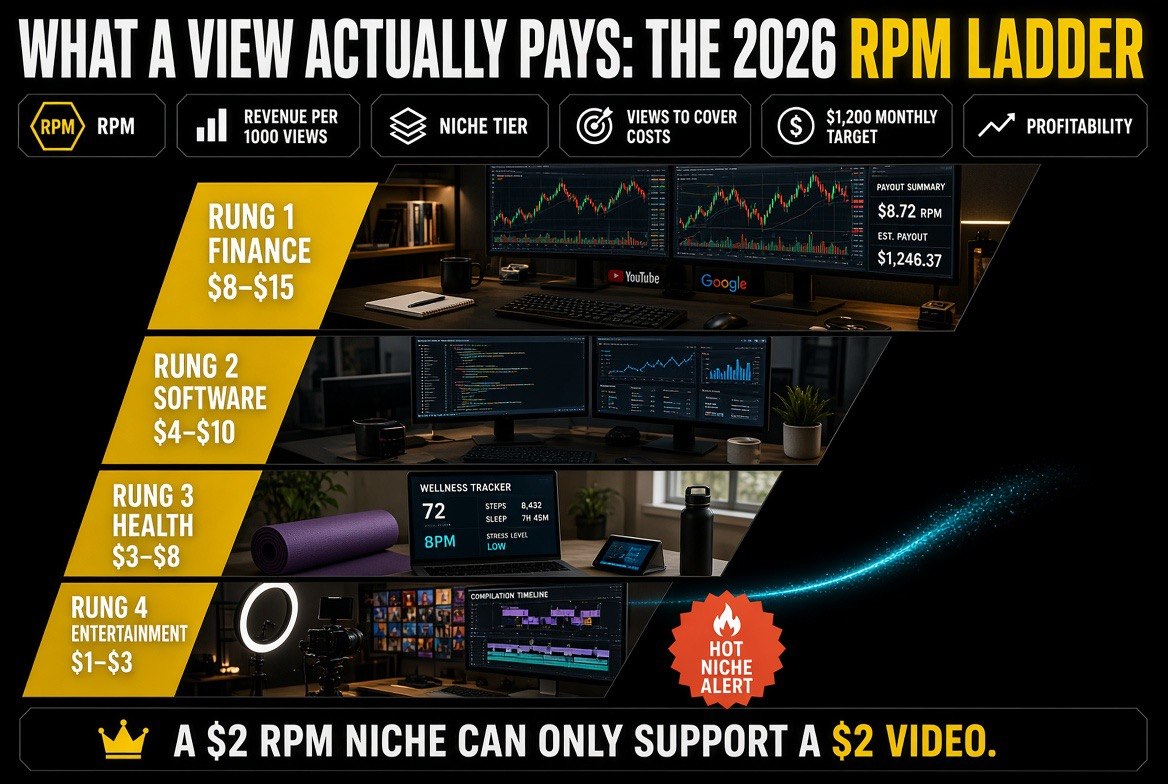
The realistic 2026 spread is wide enough to be the deciding variable in the whole business. Personal finance and investing sits at the top of the market. Technology and software sits comfortably in the middle. General entertainment, compilation and reaction content sits at the bottom, often at a small fraction of what a finance channel earns for the identical view count.
| Niche | Typical RPM | Views to Cover $1,200/mo Costs | Verdict |
|---|---|---|---|
| Personal finance, investing | $8-$15 | 80,000-150,000 | Fastest to profitability |
| Software, AI, tech explainers | $4-$10 | 120,000-300,000 | Workable with low cost per video |
| Health, self-improvement | $3-$8 | 150,000-400,000 | Needs volume, punishes expensive video |
| Entertainment, compilation, reaction | $1-$3 | 400,000-1,200,000 | Only viable at near-zero cost per video |
The RPM figures here reflect what US AdSense rates and creator-reported earnings look like in practice across niches. If you are still deciding where to publish, the same logic applies to choosing the niche in the first place — start with the RPM data, not the subscriber count. Read the table above as a constraint rather than a ranking. It is not that entertainment is a worse niche. It is that a $2 RPM niche can only support a $2 video. If your pipeline generates cinematic seconds on a premium model, entertainment is mathematically closed to you unless you are operating at a scale that almost nobody reaches.
This is also the number to check before you commit. Revenue per thousand views tells you whether a niche actually pays, and it is far easier to verify in advance than audience appetite. A niche with high RPM, evergreen demand and low production complexity is worth more than a bigger niche that pays less per view.
Where the Margin Actually Hides
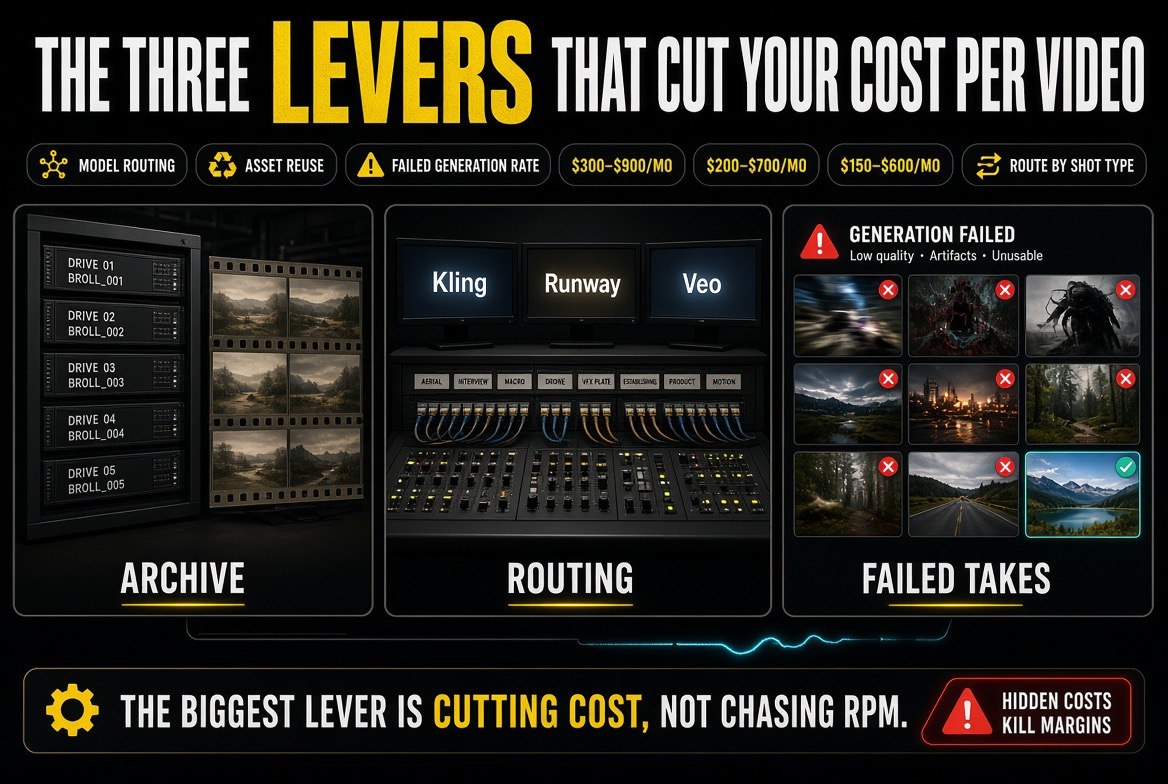
Once you have a cost per video and an RPM, the model becomes simple arithmetic, and the arithmetic tells you something counterintuitive: the biggest lever is not making more videos or earning a higher RPM. It is reducing the cost of the videos you already publish.
There are three places that happens. The first is routing. Most creators pick one video model and use it for everything, which means paying premium rates for shots that a cheaper model renders indistinguishably. Routing by shot type rather than by habit is the single largest cost lever available, and on a 40-clip month the difference between careful routing and lazy routing is roughly $21 a month on model choice alone — a gap that grows with resolution and volume.
The second is reuse. A no-camera channel that generates a fresh B-roll library for every video is paying for footage it already owns. Asset libraries compound, and a video built from 70% archived material and 30% new generation cuts the render line by more than half.
The third, and the one almost nobody accounts for, is failed generations. A model that takes four attempts to produce a usable five-second clip has a real cost per usable second that is four times its sticker rate. Cheap models with poor control are frequently more expensive than premium models with good control, and the published per-second rate will not tell you which one you bought.
| Factor | High-Cost Approach | Low-Cost Approach | Monthly Difference at 40 Videos |
|---|---|---|---|
| Model routing | One premium model for every shot | Route by shot type and stakes | $300-$900 |
| Asset reuse | Generate everything fresh | Reuse an archived B-roll library | $200-$700 |
| Failed generation rate | 4 attempts per usable clip | 1.5 attempts per usable clip | $150-$600 |
| Audio strategy | Licensed track per video | Generated beds plus one signature theme | $60-$160 |
| Editing labour | Outsourced per video | Templated, in-house, batch edited | $400-$1,600 |
Stack those lines and the difference between a disciplined no-camera operation and a careless one is frequently more than $1,000 a month at the same output. That is the entire margin. It is not hiding in a smarter niche or a luckier thumbnail. It is sitting in the pipeline, unclaimed.
The Break-Even Number Nobody Publishes
Put the two halves together and you get the figure that decides whether a channel is a business: the monthly view count required to cover your own costs.
Take a mid-volume channel publishing 40 videos a month at a low-cost pipeline of $6 per video. That is $240 a month in production. Add the subscriptions that make the pipeline run — a video model plan, a voice plan, an editing tool, an image tool, a scheduling tool — and a realistic all-in operating cost lands between $400 and $1,200 a month depending on tier.
Now apply RPM. In the software and AI explainer niche, at an RPM of $6, covering $1,200 a month requires 200,000 views a month. In a funded channel where each video is generated at premium rates and the pipeline costs $2,000 a month, the same $6 RPM requires more than 330,000 views before the creator keeps a dollar. And in a $2 RPM entertainment niche, $1,200 of costs needs 600,000 views, which is why so many compilation channels quietly run at zero margin while looking successful.
This is the number to write on a wall before you start. Not the subscriber target, not the upload cadence, not the twelve-month projection. The monthly view count at which your channel pays for itself, calculated from your own cost per video and your own niche RPM, using your own numbers rather than a creator screenshot.
The uncomfortable corollary is that the cheapest possible channel is not the one that skips tools. It is the one whose cost per video is set below the RPM its niche can support, at the volume it can actually sustain. A creator who works that backwards — picking the niche to match the pipeline rather than the pipeline to match the dream — is the one who is still publishing in year three.
What Actually Changes the Math in Your Favour
Four things move a no-camera channel from thin to durable, and none of them involve publishing more.
First, treat shot routing as an editorial decision. The shots that carry the story deserve the premium model. The connective footage does not. This single discipline is worth more than any subscription downgrade.
Second, build the archive before you need it. Every video should leave behind reusable footage. Within six months a disciplined channel is assembling new videos from owned material, and the cost per video falls without any quality loss.
Third, measure cost per published video, not cost per generation. The only number that matters is what a finished, uploaded video cost you end to end, including the attempts you discarded. Track it in a spreadsheet for one month and the waste becomes visible immediately.
Fourth, add a revenue line that is not ad-dependent. RPM is set by your niche and by an algorithm you do not control. Sponsorship, an affiliate tool stack, or a paid product decouples part of your income from cost per thousand views, and it is the difference between a channel that survives a bad algorithm month and one that does not.
None of that is glamorous, and none of it will show up in a thumbnail. It is the difference between a channel that looks like a business and one that is one.
Frequently Asked Questions
How much does an AI-generated YouTube video cost in 2026?
It depends on how much of the video is generated rather than assembled. A no-camera explainer built from stock footage and a synthetic voice can land between $2 and $7 per finished video. A fully AI-generated video with cinematic footage on a premium model typically lands between $35 and $59 per finished video once voice, music, thumbnails and editing time are included.
What is a realistic YouTube RPM for a no-camera channel in 2026?
Revenue per thousand views varies by roughly a factor of five across niches. Personal finance and investing content sits at the top of the market, software and AI explainers sit in the middle, and general entertainment, compilation and reaction content sits at the bottom. A niche with an RPM in the low single digits can only support a very cheap pipeline.
How many views does a no-camera YouTube channel need to break even?
Divide your total monthly operating cost by your RPM and multiply by one thousand. A channel spending $1,200 a month in a niche earning a $6 RPM needs roughly 200,000 views a month to cover its own costs. The same channel in a $2 RPM niche needs around 600,000 views.
Is it cheaper to generate video or use stock footage?
Stock assembly is dramatically cheaper per finished video, often by a factor of five or more, because you are licensing existing footage rather than paying per generated second. Generated footage wins on uniqueness and control. The efficient answer is usually a hybrid: generate the shots that carry the story, assemble the rest.
How do failed AI generations affect cost per video?
Directly and severely. If a model needs four attempts to produce a usable clip, your real cost per usable second is roughly four times its advertised rate. A cheaper model with poor control is often more expensive in practice than a premium model that gets it right on the first or second attempt.
What is the biggest cost mistake no-camera creators make?
Using one model for every shot. Routing premium generation only to the shots that carry the story, and cheap or stock footage to the connective material, is the single largest cost lever available, and it requires no reduction in output or quality.

About Barak Schurr
Barak Schurr is a serial entrepreneur who built and exited a major ticketing platform before turning his attention to AI and content. He runs three AI-focused research sites and writes about the tools, workflows, and strategies that let solo creators build real channels — without a crew, a studio, or a Hollywood budget.
Email: [email protected]
More AI Video Resources