Runway AI Film Festival 2026 Just Wrapped — Inside the 0K Grand Prix and What Creators Should Take Away
Get The Faceless YouTube Blueprint — Free
The exact AI tool stack and workflow used to build a faceless YouTube channel from zero.
Runway AI Film Festival 2026 Just Wrapped — Inside the $50K Grand Prix and What Creators Should Take Away
Expert Summary: Runway’s 2026 AI Film Festival wrapped after galas in New York, Los Angeles, and Tokyo, with winners announced across six expanded tracks – Film, New Media, Gaming, Design, Advertising, and Fashion. The Grand Prix reached $50,000 in cash with up to 1,000,000 Runway credits. Submissions were free, open worldwide to creators 18 and older, and required genuine generative video. The festival closed for 2026, but it sets the blueprint for how AI-native creativity is being rewarded – and what you need to prepare if you want a shot at the 2027 edition.
Runway closed out its fourth annual AI Film Festival in mid-2026 with in-person galas across New York, Los Angeles, and Tokyo — and a Grand Prix worth up to $50,000 in cash plus 1,000,000 Runway credits. The festival quietly grew from a niche film contest into a six-track showcase that now spans gaming, design, advertising, and fashion. Here is what actually happened, what won, and why a creator should be planning for the 2027 edition instead of shrugging this off as an event you missed.
The Runway AI Film Festival is easy to underestimate if you have never watched one of its winning films. The early editions felt like tech demos – a few minutes of impressive AI-generated imagery that proved the models could produce cinematic footage. The 2026 edition was different. It grew into a genuinely competitive showcase with six tracks, real cash prizes, and a global, multi-city gala circuit. That is a meaningful signal for anyone working in AI video, because it tells you exactly where the bar has moved.
This was the festival’s fourth year, and it closed the loop on its 2026 cycle with galas held in New York on June 11, Los Angeles on June 18, and Tokyo on July 30. Winners across the tracks were announced and showcased at those events. Submissions for the 2026 edition have now closed entirely, so the window to enter has passed – but the takeaways are exactly what you should be building toward for 2027.
What the 2026 Festival Actually Covered
The single biggest change in 2026 was scope. The festival dropped the “film only” framing and expanded into six distinct tracks, each judged on its own terms:
- Film – the flagship track, for fully contained, linear narratives that run 3 to 15 minutes and must incorporate generative video.
- New Media – interactive and experimental work built with AI-generated content.
- Gaming – AI-generated game projects, art, and experiences.
- Design – AI-driven visual and product design work.
- Advertising – AI-generated ad creative and campaigns.
- Fashion – AI-produced fashion visuals, lookbooks, and concepts.
Someone who thinks of Runway as “just a video generator” is looking at the past. The company is positioning its festival as a showcase for generative AI creativity across the whole media landscape, and the track list is a direct statement about where it wants the community to take its tools.
The Prize Money, in Plain Numbers
The headline number is the Grand Prix: up to $50,000 in cash plus 1,000,000 Runway credits. That is a serious prize for a creator-focused festival, and the credit component is arguably the more valuable part for an active AI video user – 1,000,000 credits buys a substantial amount of generation time on the platform.
The prize structure was tiered beyond the single Grand Prix. The festival awarded across Gold, Silver, Honoree, and Merit levels, with lower cash and credit amounts at each tier. That means even if you did not take the top prize, placing in one of the lower tiers still returned real value – which matters for how you should think about entering in future years. Winning is not an all-or-nothing gamble; there are multiple payout rungs.
| Track | Format | Length / Scope | Entry |
|---|---|---|---|
| Film | Linear narrative, generative video required | 3-15 minutes | Free, worldwide, 18+ |
| New Media | Interactive / experimental | Project + case study | Free, worldwide |
| Gaming | AI-generated game work | Art / experience / demo | Free, worldwide |
| Design | AI-driven visual / product design | Portfolio-style entry | Free, worldwide |
| Advertising | AI-generated ad creative | Campaign / spot | Free, worldwide |
| Fashion | AI fashion visuals | Lookbook / concept | Free, worldwide |
How the six 2026 tracks broke down and what each required to enter.
According to the official festival site at aif.runwayml.com and its terms page, the 2026 edition ran free, worldwide, with the prize structure and track requirements documented publicly.
The 2026 Submission Timeline, So You Know the Rhythm
Timing is where most creators trip up, so it is worth being precise about how 2026 actually ran. The non-film tracks – New Media, Gaming, Design, Advertising, and Fashion – opened their entry window on January 28, 2026 at 9:00 a.m. ET and closed it on April 27, 2026 at 4:59:59 p.m. ET, with winners announced around April 30. The Film track ran a later, separate window that extended into the summer, closing in early August before the June-to-July gala season.
The pattern is the lesson: Runway staggers the deadlines by track, and the gaps are wide. If you wait until the film deadline looks close, the non-film tracks have already closed almost three months earlier. Planning for 2027 is not one deadline but six, and they hit at different points in the year.
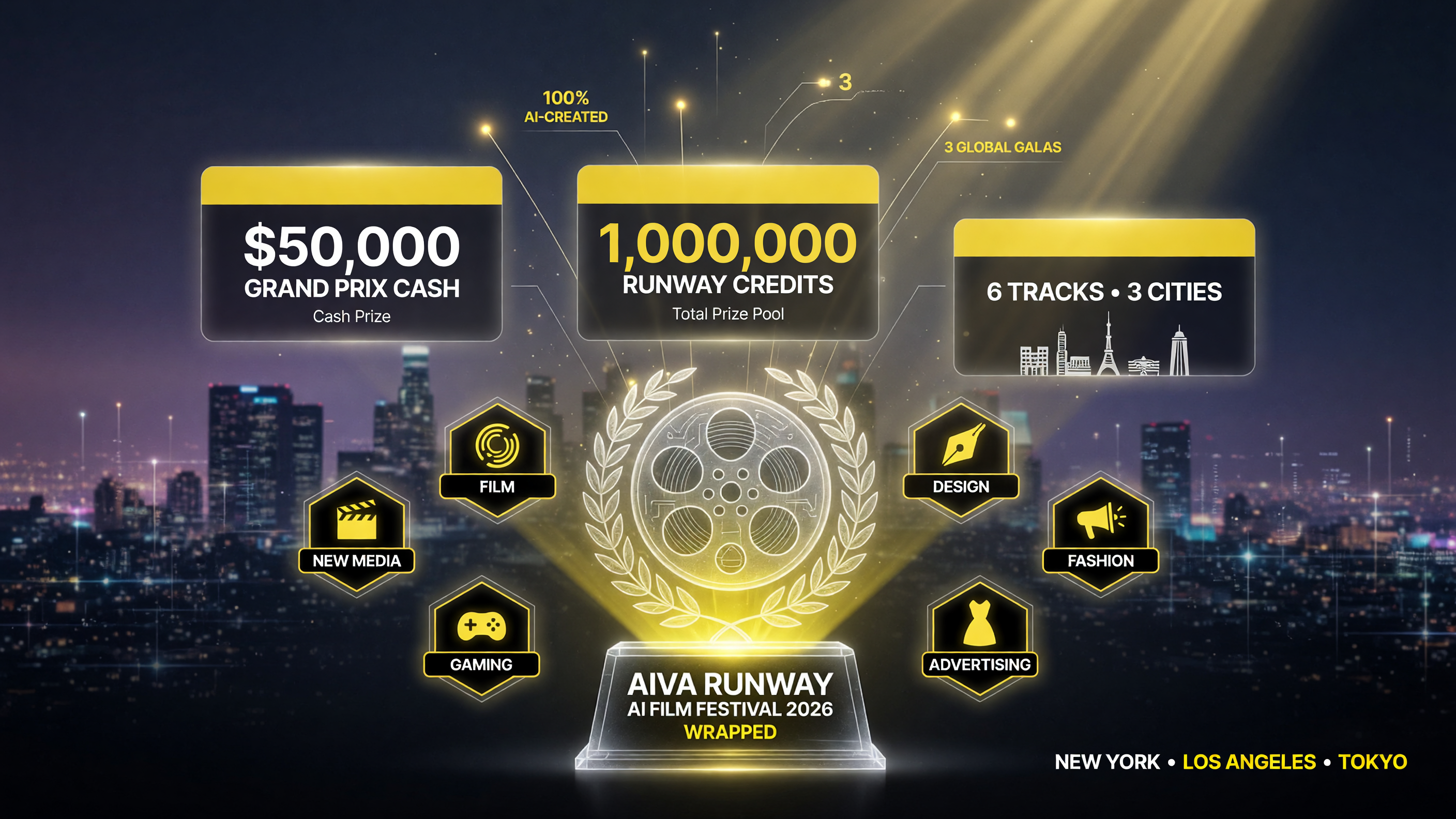
The 2026 festival wrapped with galas in New York, Los Angeles and Tokyo, with a staggered submission timeline that closed non-film tracks in April and the film track in early August.
Who Could Enter, and How
The barrier to entry was deliberately low, which is why the festival drew submissions from a genuinely global base. Every track accepted entries from eligible creators worldwide – anyone 18 or older (or at the local age of majority, depending on country) was welcome, with a few country-specific restrictions. There was no entry fee, and teams were allowed, provided a designated captain submitted on the group’s behalf.
For the film track specifically, the format requirements were clear: a self-contained, linear narrative, 3 to 15 minutes, that genuinely used generative video – not a traditional shoot with an AI filter slapped on. The non-film tracks leaned more on project summaries, case-study videos, and short descriptions of the AI techniques used, plus links to the actual work, game, or site.
That last requirement is the one most people overlook. The judges do not just want a pretty result; they want to understand how you built it and what role AI played. A submission that documents its workflow and names its techniques is more competitive than a bare glamour reel every time.
What This Means for Your 2027 Strategy
If you are serious about AI video, the 2026 festival is not trivia – it is a roadmap. Here is what the winning approach looked like and how to apply it next year:
Lead with narrative, not effects. The film track demanded a fully contained linear story, not a montage of impressive shots. Judges rewarded work that used generative video to serve a story. Build the narrative first and let the AI carry the images.
Document your workflow. The submission criteria asked for a description of the AI techniques used. That is your chance to show deliberate craft – which models you used, how you kept characters consistent, how you handled lip sync and audio. A documented pipeline reads as professional.
Pick your track by your strengths. You do not have to be a filmmaker to enter. The gaming, design, advertising, and fashion tracks all accepted work that a digital creator might already be producing. If your strength is motion graphics or product visuals, the design track may be your faster path to a prize than the film track.
Watch the staggered deadlines. The non-film tracks closed in late April; the film track ran into summer. Map all six deadlines onto your calendar early, and do not assume one window covers everything.
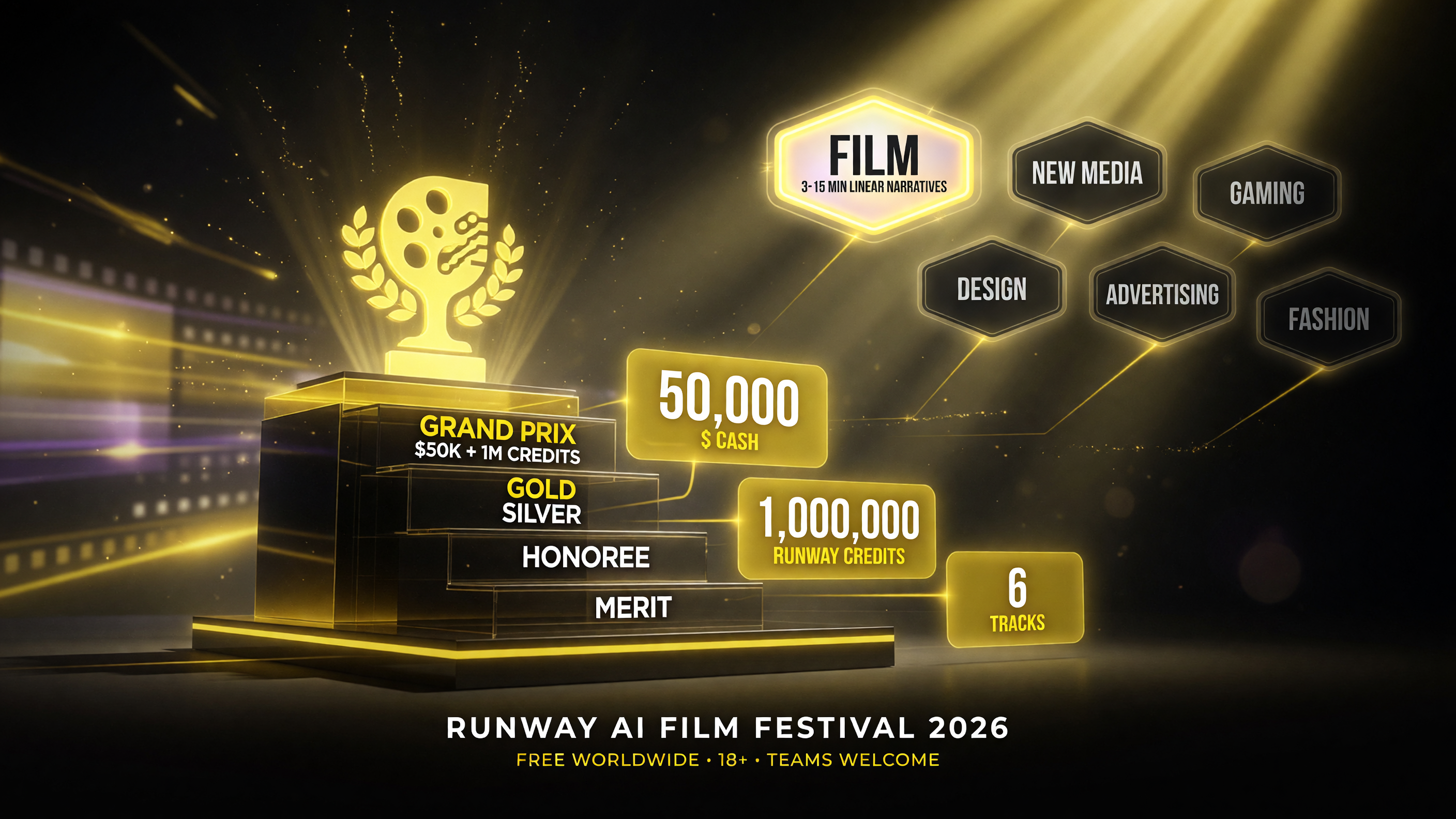
The 2026 Grand Prix was worth up to $50,000 in cash plus 1,000,000 Runway credits, with Gold, Silver, Honoree and Merit tiers below it – so placing at any level returned real value.
Why This Matters Even If You Never Enter
Even a creator who has no intention of submitting should pay attention to what this festival signals. Runway putting $50,000 cash and a million credits behind AI-native creative work is a statement that generative video has moved past the novelty phase. The industry is now rewarding people who can shepherd a coherent, finished, well-documented piece of work out of AI tools – which is exactly the skill that has commercial value beyond the festival.
The same discipline that wins a festival entry – a strong story, consistent characters, clean audio, a reproducible workflow – is what clients pay for in AI video production. The festival is effectively a public benchmark for the skill set that is becoming the standard in the field.
What the Winning Work Really Demonstrated
Look past the prize numbers and the winning entries in 2026 pointed to a consistent set of craft skills worth naming, because they are directly transferable to commercial work:
- Long-form coherence. The film track demanded 3 to 15 minutes of linear narrative. That length forces you to solve the hard problems that a 15-second clip never reveals – keeping a character consistent across dozens of shots, maintaining a single visual language, and holding an audience through a full arc rather than a highlight reel.
- Working audio as a first-class element. A film without sound is a slide show. The entries that felt like real films had dialogue, music, and atmosphere baked in – which is exactly where native audio and lip-sync in modern AI video models pull their weight.
- Editorial restraint. The most striking AI filmmaking rarely shows off every effect available. The winning work used AI where it served the story and let quieter scenes breathe, rather than stacking generation on generation to prove the tool could do it.
That last point is the one that separates festival-worthy work from a tech demo. The bar is no longer, can this tool make an impressive image. It is, can you direct an AI model to serve a finished piece of work. That is a skill you can build today, before any deadline, by finishing real projects.
A Practical Checklist for the 2027 Edition
Because the 2026 window is closed, the smart move is to start the 2027 cycle now. Here is a concrete checklist to make your next submission competitive:
- Pick your track by your production strengths – if you are not a narrative filmmaker, the design, gaming, or advertising tracks are faster to a strong entry.
- Lock the six staggered deadlines as soon as the 2027 calendar is published – the non-film tracks are not the same window as the film track.
- Document your workflow as you build – screen captures, model names, prompts, and test clips become the case-study material the judges want to see.
- Finish three short pieces before the deadline so your entry is a polished best-of-the-batch, not your first attempt.
- Send a complete submission – the work itself plus the summary, the techniques used, and the links. Incomplete entries are the easiest ones to disqualify.
None of this requires waiting. The tooling is available now, and the festival has already shown what the winning standard looks like. The only difference between a creator with a shot at 2027 and the rest is starting before the calendar is urgent.
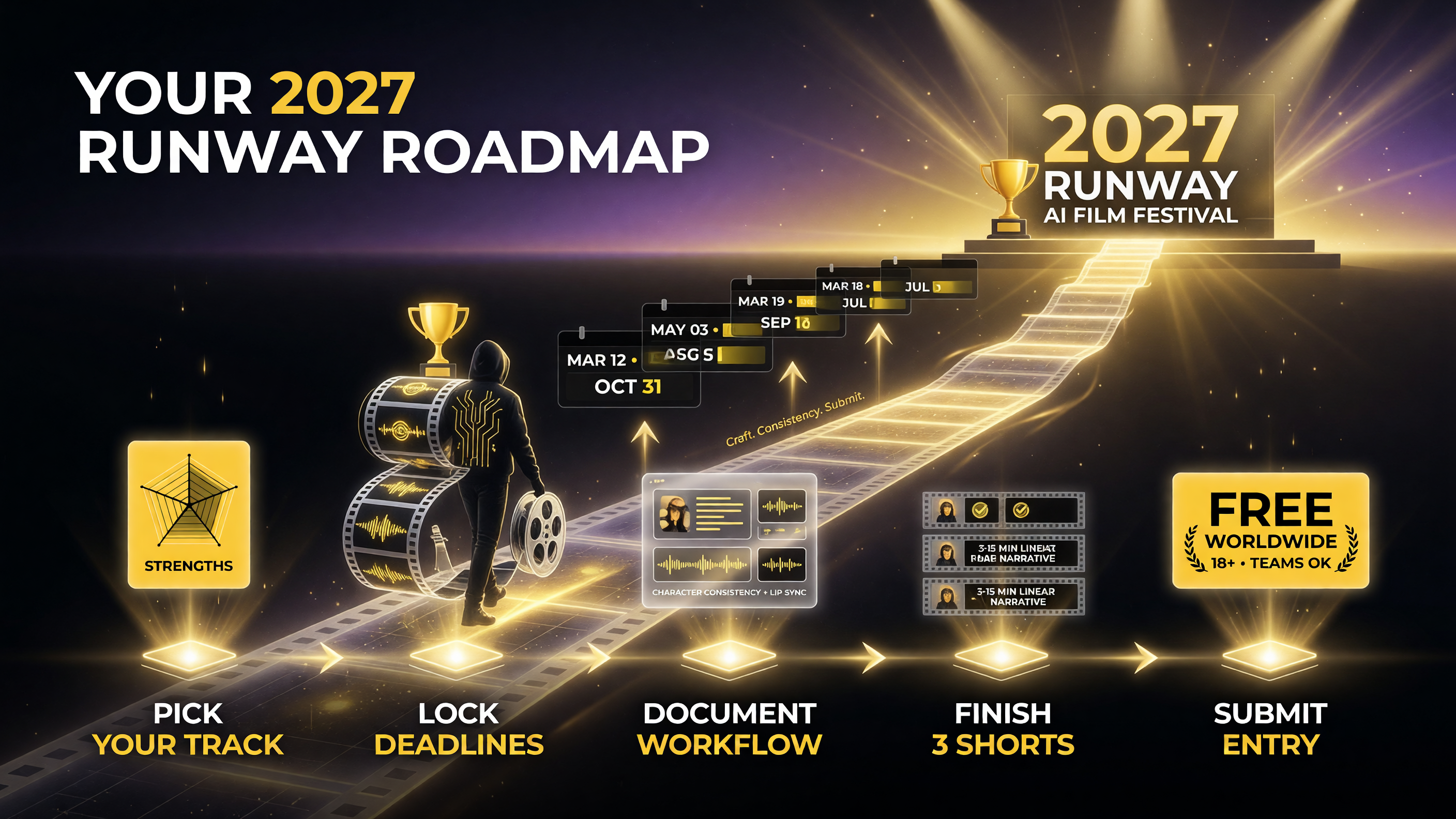
Start the 2027 cycle now: pick a track to match your strengths, lock the six staggered deadlines, document your workflow, finish three short pieces, and submit a complete entry.
Frequently Asked Questions
Is the Runway AI Film Festival still open for 2026?
No. Submissions for the 2026 edition have closed. The non-film tracks closed on April 27, 2026, and the film track window ran into early August before the gala season, with the festival concluding after its Tokyo event on July 30.
What are the Runway AI Film Festival tracks?
The 2026 festival expanded to six tracks: Film, New Media, Gaming, Design, Advertising, and Fashion. Each has its own format requirements but all require genuine generative AI content.
How much did the Runway AI Film Festival Grand Prix pay?
The Grand Prix was worth up to $50,000 in cash plus 1,000,000 Runway credits. Lower tiers (Gold, Silver, Honoree, Merit) paid smaller cash and credit amounts.
Can anyone enter the Runway AI Film Festival?
Yes. Entries were free, open to eligible creators worldwide aged 18 or older (subject to local age of majority and some country restrictions). Teams were allowed with a designated captain.
What makes a winning AI film festival entry?
Judges reward a coherent, self-contained piece that genuinely uses generative video – a strong narrative for the film track, plus documented workflow showing which AI techniques you used. Proof of craft beats a bare montage of impressive shots.
When should I plan for the 2027 Runway AI Film Festival?
Early. The 2026 deadlines were staggered – non-film tracks closed in late April and the film track ran into summer. Map all six track deadlines onto your calendar and start your entry well before the earliest window.

About Barak Schurr
Barak Schurr is a serial entrepreneur who built and exited a major ticketing platform before turning his attention to AI and content. He runs three AI-focused research sites and writes about the tools, workflows, and strategies that let solo creators build real channels — without a crew, a studio, or a Hollywood budget. Contact: [email protected]
More AI Resources