ElevenLabs Dubbing v2 Keeps Your Voice Across 90+ Languages
Get The Faceless YouTube Blueprint — Free
The exact AI tool stack and workflow used to build a faceless YouTube channel from zero.
ElevenLabs Dubbing v2 Keeps Your Voice Across 90+ Languages
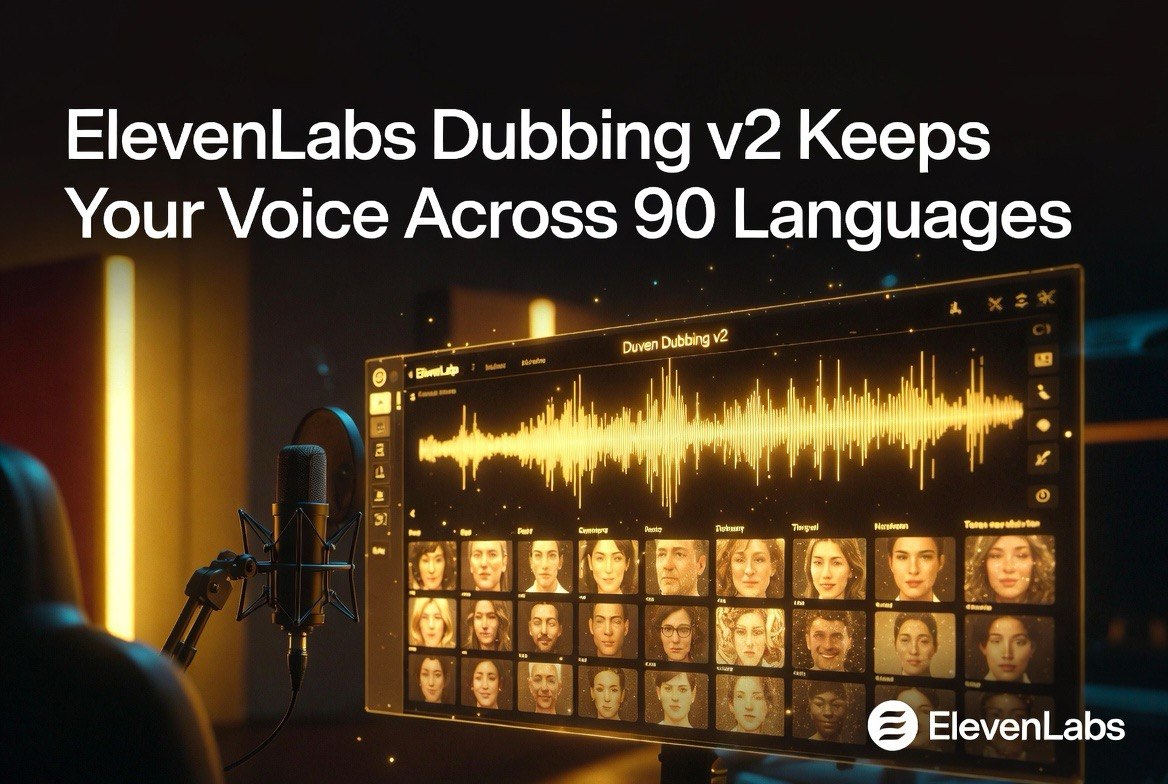
⚡ Expert Summary: ElevenLabs launched Dubbing v2 in late May 2026, bringing emotionally aware AI dubbing to video creators. Unlike earlier tools that translate text and paste it over footage, Dubbing v2 preserves the original speaker’s tone, pacing, emphasis, and identity across 90+ languages. It auto-clones the voice, syncs phrasing to lip movements, and delivers the full performance — not just the words. Available now in ElevenCreative for one-click video localization. This guide covers how it works, what changed from v1, and how video creators should use it.
Why Dubbing v2 Is Different From Every AI Dubbing Tool Before It
AI dubbing tools have existed for years, but they all shared the same limitation: they translated text, not emotion. You’d upload a video, get a foreign-language voiceover that said the right words with none of the energy. Sales pitches landed flat. Tutorials sounded bored. Character-driven content lost its personality.
ElevenLabs Dubbing v2 changes that equation by conditioning directly on the original audio performance rather than working from a transcript. The model analyzes pitch contour, rhythm, emotional intensity, and breath patterns from the source recording, then rebuilds those elements in the target language. The result is a dub that sounds like the same person speaking the same line with the same intent — just in a different language (ElevenLabs, May 2026).
For US video creators expanding into international markets, this removes the single biggest barrier to localization: the uncanny valley of emotionless dubbing. Audiences in Germany, Japan, or Brazil now hear a version of you that sounds like you — not a generic text-to-speech voice reading your translated script.
For more AI video tools and strategies, visit our AI Video Tools hub.
Who Dubbing v2 Is Actually For
This tool makes sense for specific creator types. If you publish educational content, tutorials, or how-to guides and your audience is growing outside the US, Dubbing v2 lets you open new markets without re-recording every video. A tech reviewer on YouTube with 200,000 subscribers and 30% international traffic can dub their catalog into Spanish, Portuguese, and German in days instead of months.
SaaS companies producing product demos and onboarding videos benefit directly. International customers convert better when they see the product explained in their language by someone who sounds like the original presenter. Enterprise sales teams using personalized video outreach can dub proposals into the prospect’s language while keeping the sales rep’s vocal presence.
Independent filmmakers and documentarians working on international distribution can dub narration and interview segments without hiring separate voice actors for each territory. For content where the creator’s voice IS the brand — think educational channels, podcasters posting video clips, and video newsletter hosts — the voice clone preservation across languages maintains brand identity in every market.
What Changed From Dubbing v1 to v2
The jump from v1 to v2 is substantial enough that ElevenLabs positioned it as a new product tier, not a minor update. Here’s what specifically changed:
Emotion Preservation (The Headline Feature)
Dubbing v1 translated speech accurately but output in a neutral, broadcast-announcer tone. Every sentence had roughly the same energy regardless of context. Passionate product pitches, angry customer service complaints, and whispered storytelling all came out at the same volume and cadence.
Dubbing v2 conditions on the original audio waveform, not just the transcript text. That means rising pitch during an excited reveal stays rising. Pauses for dramatic effect stay paused. The slight crack in someone’s voice during an emotional testimonial carries through. The model reproduces prosody — the musical elements of speech — across language boundaries (ElevenLabs Blog, May 2026).
In practical terms: if you sound excited in English, you sound excited in Spanish. If you sound serious in French, you sound serious in Mandarin. The performance survives translation.
Automatic Voice Cloning
Dubbing v2 creates an automatic voice clone of the original speaker for every video you dub. You don’t upload samples, train a model, or set up a voice profile. The system extracts vocal identity — pitch, timbre, resonance — directly from the source audio and applies it to the output in all 90+ languages.
This matters for creators who produce serialized content. If you publish weekly YouTube videos and dub them into five languages, your audience hears the same voice across every episode of your series. Brand voice doesn’t just mean writing style anymore — it means the actual sound of your presence in every market.
Sync-Aware Translation
Early dubbing tools produced translations that had to be stretched or compressed to fit video timing, creating unnatural pacing. Dubbing v2 uses sync-aware translation that aligns phrasing, starts, stops, and natural breaks with the original source timing.
The system doesn’t just match word count to duration. It understands that a punchline needs a beat before it lands, that a question needs rising intonation at the end, and that a long pause carries meaning. The translated audio fits the existing video timeline without manual adjustment (ElevenLabs Dubbing Studio, 2026).
How Dubbing v2 Works in Practice
The workflow is designed for speed. Open ElevenCreative, upload a video file or paste a URL (YouTube, Vimeo, direct MP4), select target languages, and click dub. The system processes the video in the background and returns a localized version with the original audio replaced.
Supported formats include MP4, MOV, and direct platform links. Output resolution matches input resolution — no downscaling during processing. Maximum video length depends on your ElevenLabs plan tier, with higher tiers supporting longer-form content up to feature-length projects.
Languages and Accuracy
Dubbing v2 supports 90+ languages and regional accents at launch. Coverage extends beyond major world languages to include regional variants — Brazilian Portuguese separate from European Portuguese, Latin American Spanish separate from Castilian Spanish, and multiple Chinese dialects.
Accuracy benchmarks from ElevenLabs show Dubbing v2 outperforming v1 on both BLEU score (translation fidelity) and speaker similarity (voice preservation). Independent testing by TVBEurope confirmed that “emotionally nuanced delivery” carried across language pairs that typically flatten performance, including English-to-Japanese and English-to-Arabic (TVBEurope, June 2026).
Why US Video Creators Should Care About AI Dubbing Right Now
The international video market is growing faster than the domestic US market. According to Cisco’s 2026 Visual Networking Index, video traffic from non-US markets will account for 62% of global video consumption by 2027. US creators who localize their content capture that growth. Those who don’t leave it on the table.
The cost comparison is stark. Professional human dubbing for a 10-minute video runs $500-$2,000 per language, depending on the language pair and the talent required. A five-language localization package can easily hit $5,000-$10,000 per video. Dubbing v2 processes the same content in minutes at a fraction of that cost, with per-minute pricing that scales linearly regardless of language count.
For a US creator publishing twice a week, the annual savings from AI dubbing vs. human dubbing across five languages exceeds $250,000. The quality gap between AI and human dubbing still exists for nuanced performance (actors, comedians, dramatic content), but for tutorials, reviews, explainers, and vlogs, Dubbing v2 closes it to within practical usability.
Where Dubbing v2 Falls Short (And Where to Use Human Dubbing Instead)
No tool is perfect, and honest assessments serve creators better than hype. Dubbing v2 has three meaningful limitations:
Complex Emotional Range
For content that requires rapid emotional shifts — comedy sketches, dramatic monologues, multi-character scenes — the model occasionally flattens the range. It preserves the dominant emotion well but can miss subtle secondary emotions like irony layered over anger or sadness behind a smile. Human dubbing remains superior for performance-heavy content.
Language Pair Variance
Quality is not uniform across all 90+ languages. English-to-Spanish and English-to-German produce the most consistent results because the training data for those pairs is densest. English-to-Thai, English-to-Hindi, and English-to-Arabic are usable but show more variance in timing and emotional preservation. ElevenLabs publishes per-language quality benchmarks in their documentation, and creators should test their specific language pair before committing to a dubbing pipeline.
Background Audio Handling
Dubbing v2 focuses on the spoken voice and leaves background music and ambient sound intact. That’s the right call for most content, but creators who layer voiceover over dynamic sound design will need to check that the dubbed audio sits correctly in the mix. In some cases, the background music masks subtle emotional cues in the dubbed voice that were audible in the original.
Multi-Speaker Videos
The auto voice clone targets the primary speaker in each video. For interview formats, panel discussions, or podcasts with multiple hosts, Dubbing v2 assigns the cloned voice to the dominant speaker and uses ElevenLabs’ default voices for others. The result is coherent but loses the distinct vocal identity of secondary speakers. Human dubbing with multiple voice actors is still the right choice for multi-speaker formats.
API Availability
As of June 2026, Dubbing v2 is available through ElevenCreative’s self-serve interface but the API is not yet live. This limits integration into automated workflows and pipeline-based content operations. ElevenLabs has confirmed the API is coming in the following weeks, but creators building automated localization pipelines today need to work through the UI (ElevenLabs Documentation, June 2026).
Pricing and Value Comparison vs. Traditional Dubbing
ElevenLabs pricing for Dubbing v2 follows a per-minute model that varies by plan tier. The Creator tier offers a set number of minutes per month at a flat rate, while the Pro and ElevenProductions tiers unlock longer videos, faster processing, and higher priority queues. Compared to professional human dubbing at $500-$2,000 per video per language, the AI route cuts costs by 80-95% depending on video length and language count.
The value case is strongest at scale. A US creator producing 50 videos per month and dubbing each into 5 languages would spend $7,500-$15,000 per month with human dubbing services at mid-range rates. The same volume with Dubbing v2 costs a fraction of that, with the exact figure depending on plan tier and per-second pricing.
How to Start Using Dubbing v2 for Your Video Content
Getting started requires an ElevenLabs account with ElevenCreative access. The Dubbing Studio is available within the ElevenCreative interface under the Dubbing tab.
Recommended Settings for Video Creators
Stick with the default v2 Alpha model for highest quality. The standard v1 model remains available as a fallback, but v2 outperforms it across all quality metrics.
For language selection, start with the top five markets for your content category. Business and technology content typically performs best in Spanish (Latin America), German, Japanese, Portuguese (Brazil), and French. Lifestyle and entertainment content adds Italian, Korean, and Arabic to that list based on platform consumption data.
Export and Distribution
Dubbing v2 outputs a separate video file per language. Upload each localized version to the corresponding regional YouTube channel or platform. ElevenCreative supports direct export to YouTube, Vimeo, and Wistia, or download as MP4 for manual distribution.
The file naming convention includes the language code, making it straightforward to batch-upload. Keep the original audio track available for reference — some platforms allow multi-audio-track uploads where viewers can select their language within a single video.
Frequently Asked Questions
What is ElevenLabs Dubbing v2?
Dubbing v2 is ElevenLabs’ next-generation AI dubbing model that preserves the original speaker’s emotion, tone, and vocal identity across 90+ languages. It launched in late May 2026 and is available through ElevenCreative.
How is Dubbing v2 different from the original Dubbing?
Dubbing v2 conditions on the original audio performance rather than just the transcript, preserving emotion, pacing, and emphasis. It also includes automatic voice cloning and sync-aware translation for better timing.
How many languages does Dubbing v2 support?
Dubbing v2 supports 90+ languages and regional accents, including variants like Brazilian Portuguese and Latin American Spanish.
Is the ElevenLabs Dubbing v2 API available?
Not yet. As of June 2026, Dubbing v2 is available through the ElevenCreative interface. API access is expected in the coming weeks per ElevenLabs.
How much does Dubbing v2 cost?
Pricing follows ElevenLabs’ per-minute dubbing rates, which vary by plan tier. Higher tiers include longer maximum video lengths and faster processing.
Can Dubbing v2 handle multi-speaker videos?
It handles single-primary-speaker content best. For multi-speaker formats like interviews or panels, secondary speakers use default voices rather than voice clones.

About Barak Schurr
Barak Schurr is a serial entrepreneur who built and exited a major ticketing platform before turning his attention to AI and content. He runs three AI-focused research sites and writes about the tools, workflows, and strategies that let solo creators build real channels — without a crew, a studio, or a Hollywood budget.
Email: [email protected]