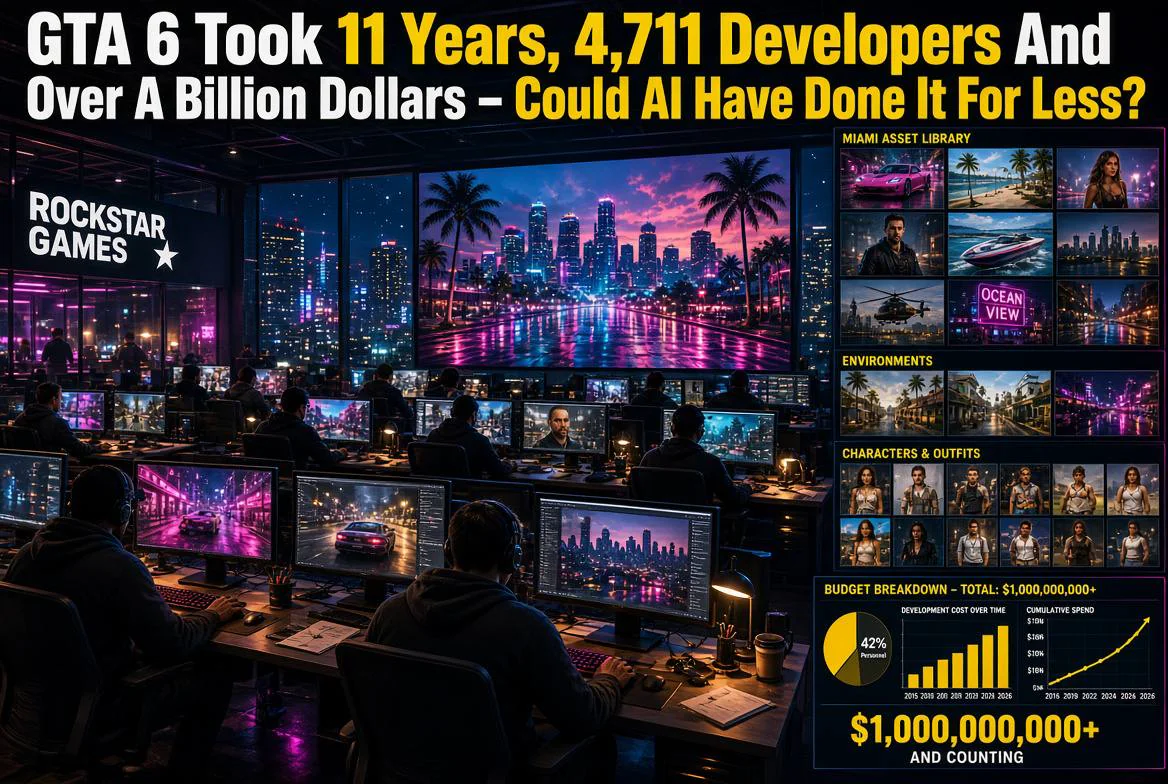
GTA 6 Took 11 Years, 4,711 Developers And Over A Billion Dollars – Could AI Have Done It For Less?
GTA 6 Took 11 Years, 4,711 Developers And Over A Billion Dollars — Could AI Have Done It For Less?
⚡ Expert Summary: GTA 6 shipped on 19 November 2026 to a 99 Metacritic, built by 4,711 people over roughly a decade for a sum Take-Two has never disclosed and analysts put somewhere between one and a half a billion dollars. Ask whether AI could have done it cheaper and you hit something strange: Take-Two’s chief executive says generative AI had zero part in it, while Morgan Stanley’s own analyst published a model saying AI can cut the industry’s $50 billion production spend by nearly half. Both are true, and the gap between them is the story. AI can write your test cases and paint your texture maps. Nobody has shown it can make you feel something on a Miami causeway at 3am. GTA 6 is the last monument anyone can afford, and the bill is why.
There is a question that has been going around since the game shipped, and it sounds like a gotcha: could AI have made GTA 6 for less?
It is a good question with a bad premise, and the premise is the interesting part. Nobody has ever published it. It is not in a Morgan Stanley note, not in a Rockstar press release, not in a Take-Two earnings call. It is a question people ask each other, which means the honest answer starts by admitting we are arguing about a claim nobody has actually made on the record.
So let me put the real numbers on the table, then say what they do and do not prove. If you want the wider picture of what these AI video tools are doing to production budgets, that is where this thread continues.
What GTA 6 Actually Cost — and What Nobody Will Say
Start with the number everyone quotes and nobody can source. Take-Two has never disclosed the budget. On the 9 November 2026 earnings call, Strauss Zelnick was asked directly and said: “We haven’t spoken about budgets at all.”
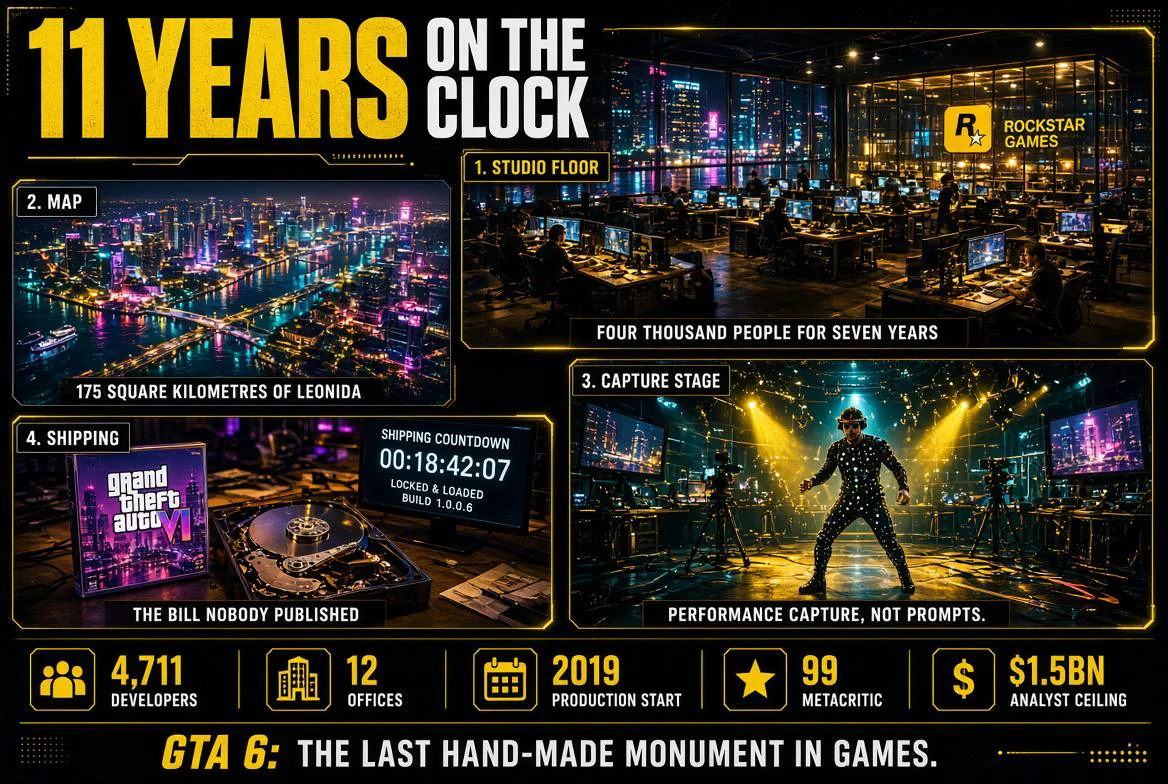
The estimates that filled the gap run from about $1 billion to $1.5 billion, from Bloomberg and Business Insider reporting. Konvoy Ventures put it near $2 billion. Viral claims of $3 to $5 billion circulate with no sourcing whatsoever. And in October 2026, Jennifer Kolbe, Rockstar’s head of publishing, denied to Bloomberg that the budget had topped $1.5 billion – dismissing a figure that would have made it “more than it cost to build Dubai’s Burj Khalifa.”
The one hard number in the whole argument is in Take-Two’s own filings. The FY26 10-K shows $2.15 billion in capitalised software development costs across all unreleased titles as of 31 March 2026, and by 30 September 2026 that long-term line had reached $2.49 billion. GTA 6 is not broken out of it. Anyone quoting a GTA 6 figure to four decimal places is doing arithmetic on a number nobody published.
What is documented is the headcount. Rockstar had 2,441 employees in 2018. By August 2026 it had 4,711 across 12 offices, per its own figures reported by Bloomberg – with a dedicated Los Angeles studio staffed with writers, directors and producers doing nothing but NPCs.
The timeline is more modest than the headline. Pre-production traces to a Miami research trip in 2015, but most of the studio was pulled onto Red Dead Redemption 2, and GTA 6 work only began in earnest in 2019. So it is roughly seven to eight years of principal production and about eleven from conception. Both numbers are true. Which one you use depends on whether you are writing a headline or a history.
The Analyst Who Says AI Cuts the Bill in Half
Now the other side, and this one is properly sourced.
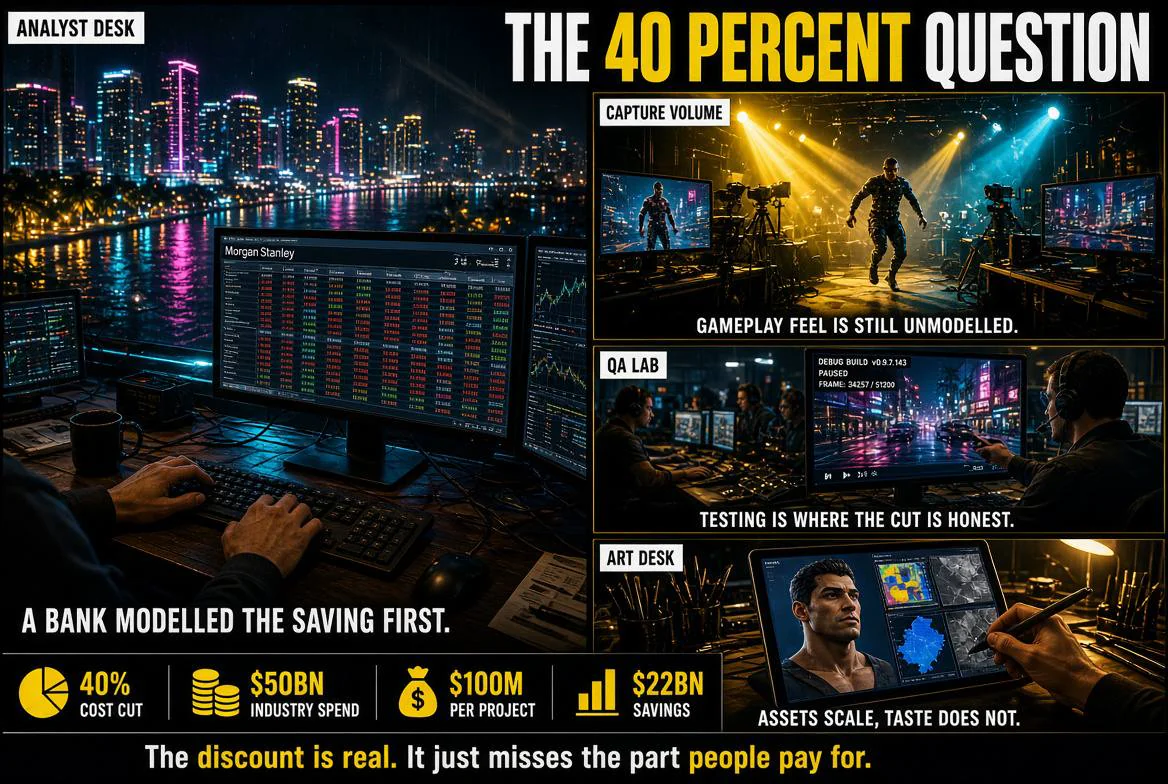
Matthew Cost, Morgan Stanley’s US internet analyst, published a model in April 2026 (“AI in Gaming: Unlocking $22B”) and repeated it on Thoughts on the Market in May. His words: “We expect consumers to spend more than $275 billion on video games in 2026. And the industry is reinvesting over $50 billion of that into game development and operations. But AI could cut that by nearly half.”
He is specific about the mechanism and honest about the deduction: “Even after accounting for AI compute and asset-generation expense, we think that cost savings could exceed 40 percent. That’s over $100 million per game project. Across the industry, that could generate savings of roughly $22 billion.”
Read what that is and is not. It is an industry-wide model across coding, asset creation, testing and “many other processes that are manual today.” It is not an audit of GTA 6. Nobody at Morgan Stanley ran Rockstar’s books.
And Cost, to his credit, says plainly where AI stops: “AI can help generate worlds, characters, and digital assets, but great gameplay is harder. Gameplay is the feel, the challenge, the feedback, and the fun. Models still struggle to measure that, let alone deliver it consistently.”
That sentence is the entire article. The 40% is real. It is a discount on the parts of the work that can be specified. GTA 6’s 99 score was not earned in the parts that can be specified.
| What AI can plausibly take 40% off | What it has not touched | Evidence |
|---|---|---|
| Boilerplate code, tooling, build and test pipelines | Game feel – challenge, feedback, the thing that makes it fun | Cost, Morgan Stanley: models “still struggle to measure that” |
| Texture and asset variation at volume | Performance, direction, writing that lands | Rockstar built an entire LA studio for NPCs alone |
| QA sweeps and regression coverage | Live operations, which Cost calls a “moat” | Zelnick: “We haven’t spoken about budgets at all” – no AI credit claimed |
| Localisation first drafts | Studio-scale creative direction across 12 offices | 4,711 staff; 175km2 map; 22 radio stations |
| The unglamorous half | The half people paid $70 for | 99 Metacritic, 3.3M Twitch peak |
The other side of the ledger, and this is where the argument gets uncomfortable for the AI optimists: Take-Two laid off Luke Dicken, the head of its own AI division, along with part of his team, in April 2026 – while shipping the biggest game in the industry without generative AI in it. The company that would benefit most from the discount declined to take it, and cut the department that was meant to deliver it.
The 3-to-5-Year, $300-Million Version Does Not Exist
Somewhere in the last year a version of this story hardened into a fact: that AI could have made GTA 6 in three to five years for $300 million to $700 million.
I have looked for the source. There isn’t one. It is not Cost’s number, not Morgan Stanley’s, not Take-Two’s. It is an extrapolation – take the roughly 40 to 50% saving Cost models and apply it to the GTA 6 base – and it gets quoted as though someone qualified published it.
If you want that arithmetic, own it as arithmetic. Apply 40% to the upper end of the analyst band and you land near $900 million and a shorter schedule, not $300 million. Apply 50% to the lower end and you get a discount, not a different project. Nothing in the published record gets you a three-year GTA 6, because the seven to eight years of principal production were not spent on the tasks the model discounts. They were spent on the thing nobody has automated: deciding what the game is.
That is the honest version. The premise of the question is borrowed, and when you trace it back it evaporates.
The Studios Already Trying It Are Walking It Back
The best evidence for what AI does to games is not a forecast. It is what happened to the studios that shipped it first.
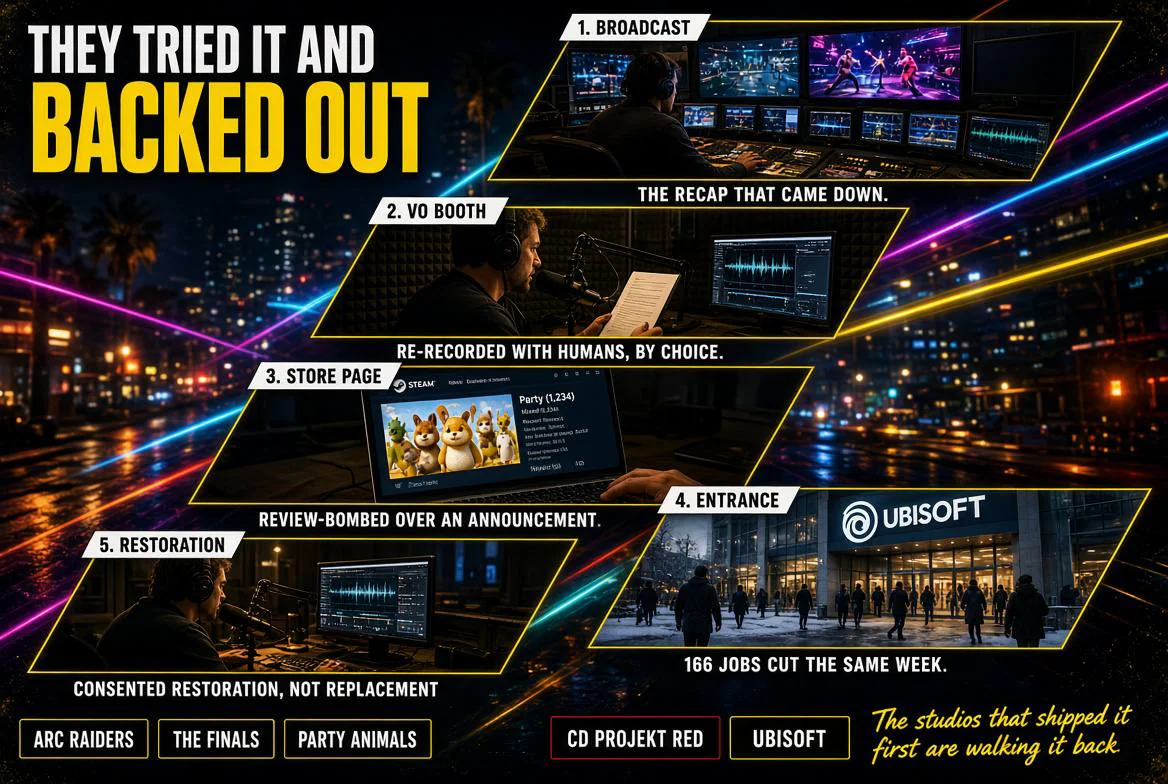
Embark put generative text-to-speech voice pings into ARC Raiders and The Finals, trained on paid voice work. In November 2026 it began re-recording with human actors after criticism. Audio director Bence Pajor told PC Gamer: “There was some really fair criticism” – and explained the temptation honestly, that the training data was “too impractical to record every possible version.”
Then, on 18 November 2026, Embark apologised and deleted an esports recap video after swapping its human casters for AI voices. Its statement: “The video is down and won’t return in this form. The AMER and EMEA recaps planned in the same format won’t go out as planned either, and we’re rethinking all three.”
Two retreats in one month, at a studio that had shipped the technology.
Contrast that with the one case where the reaction was warm: CD Projekt Red used Respeecher, with the actor’s consent, to restore Geralt’s Polish voice after Jacek Rozenek’s stroke. Audiences accepted it because it was repairing a human performance, not replacing one. CDPR was explicit that it was not “planning to rely on AI making complete games.”
And the backlash has a hair trigger. In May 2026, Party Animals was review-bombed on Steam over merely announcing a $75,000 AI-generated short-film contest. The game contained zero AI content. The announcement alone was enough.
| Studio | What they used AI for | What happened |
|---|---|---|
| Embark (ARC Raiders, The Finals) | Generative TTS voice pings trained on paid VO | Re-recording with human actors after criticism, Nov 2026 |
| Embark (esports recaps) | AI voices replacing human casters | Video deleted, apology issued, EMEA recap cancelled |
| CD Projekt Red | Voice restoration with actor consent (Respeecher) | Accepted – it repaired a performance rather than replacing one |
| Recreate Games (Party Animals) | Nothing – announced an AI film contest | Review-bombed on Steam, page tipped to Mostly Negative |
| Take-Two / Rockstar | Nothing generative, by the CEO’s own account | 99 Metacritic – the highest score in years |
The Contract Clause Nobody Talks About
There is a reason developers are cautious beyond taste. Publishers contractually prohibit unvetted generative AI in shipped assets. The stated reason, from people who write those contracts: major publishers cannot indemnify against AI-generated material yet, so they ban it by contract until the courts establish firmer ground.
That is not ideology. That is legal exposure being priced. A texture that arrives with a copyright claim attached to its training data is a liability that follows the game for its commercial life.
Meanwhile the workforce is not in a mood to be experimented on. GDC’s November 2026 survey found 34% of developers had been laid off in the previous two years, 55% said generative AI was negative for the industry, and 40% used it at work anyway. All three numbers can be true simultaneously: people are using the tool, hating what it is doing to the industry, and watching colleagues go.
Ubisoft made the contradiction literal on 19 November 2026 – 166 layoffs in Montreal and Quebec City, attributed to cancelled and reworked projects, announced the same day it unveiled a new generative AI studio. Note the attribution carefully: the layoffs were tied to project cancellations, not proven to automation. Nobody should claim otherwise.
So Could AI Have Made GTA 6 for Less?
Here is my answer, and it is not the one either side wants.
Cheaper: probably yes, by some amount, on the parts of the work that can be described. A 40% saving across an industry spending $50 billion a year is not fantasy – it is a model published by a bank with its working shown. The unglamorous half of game development is enormous, and most of it is exactly the kind of work a model does well.
Cheaper by enough to matter: no, and this is where the question collapses. Take the analysts’ upper estimate of $1.5 billion and apply the rosiest 50% cut. You get $750 million and still no GTA 6, because the $750 million you kept was spent on the things that make it GTA 6 – the writing, the direction, the 175 square kilometres of Leonida, 22 radio stations, five counties and six regions, roughly twice the map of GTA 5 and three times Red Dead Redemption 2, a 99 score and 3.3 million concurrent Twitch viewers on launch night.
You cannot discount your way to taste. Cost said it himself: gameplay is “the feel, the challenge, the feedback, and the fun,” and models struggle to measure that.
The part of the question that is right, though, is the fear underneath it. The industry is spending $50 billion a year to make games, and the most expensive one ever built could only be made by a company with a decade of Grand Theft Auto money behind it. If AI cuts 40% off the rest of the industry, the studios that survive will be the ones that spend the saving on ambition rather than on dividends.
GTA 6 is not proof that AI cannot make games. It is proof that nobody has yet figured out how to make a game people love without a very large number of people caring about it. That is the expensive part. It always was.
Frequently Asked Questions
How much did GTA 6 cost to make?
Take-Two has never disclosed it. Strauss Zelnick said on the 9 November 2026 earnings call: “We haven’t spoken about budgets at all.” Analyst estimates run from about $1 billion to $1.5 billion, with Konvoy Ventures near $2 billion; viral figures of $3 to $5 billion have no sourcing. Rockstar’s Jennifer Kolbe denied to Bloomberg that the budget exceeded $1.5 billion.
Did Rockstar use AI to make GTA 6?
According to Strauss Zelnick, generative AI had zero part in what Rockstar built. Take-Two also laid off the head of its AI division and part of his team in April 2026. There is no published evidence of generative AI in shipped GTA 6 assets.
Could AI have made GTA 6 in half the time for half the money?
No published source makes that claim. It is an extrapolation of Morgan Stanley’s industry-wide model, which projects savings above 40% on coding, asset creation and testing. That model is not a GTA 6 audit, and the analyst behind it says models still struggle with gameplay feel. The three-to-five-year, $300 to $700 million version has no source at all.
What does Morgan Stanley actually say about AI and game costs?
Matthew Cost wrote that the industry reinvests over $50 billion a year into development and operations, and that AI “could cut that by nearly half,” with savings above 40% even after AI compute and asset-generation costs – roughly $22 billion industry-wide. He also says AI helps generate worlds, characters and assets, but that great gameplay is harder because it depends on feel, challenge and fun.
How many people made GTA 6 and how long did it take?
Rockstar grew from 2,441 employees in 2018 to 4,711 across 12 offices by August 2026. Pre-production traces to a 2015 Miami research trip, but most of the studio worked on Red Dead Redemption 2 first and GTA 6 began in earnest in 2019 – roughly seven to eight years of principal production, about eleven from conception.
Are game studios actually using generative AI?
Selectively, and often reluctantly. 40% of developers told GDC in November 2026 they use generative AI at work, while 55% called it negative for the industry. Embark shipped generative voice pings and is now re-recording with human actors; CD Projekt Red used it only for consented voice restoration. Publishers commonly prohibit unvetted generative AI in shipped assets because they cannot indemnify against it yet.

About Barak Schurr
Barak Schurr is a serial entrepreneur who built and exited a major ticketing platform before turning his attention to AI and content. He runs three AI-focused research sites and writes about the tools, workflows, and strategies that let solo creators build real channels — without a crew, a studio, or a Hollywood budget.
Email: [email protected]
More AI Video Resources