

AI Is Making 90,000 Tracks a Day and the Music Industry Is in Free Fall
AI Is Making 90,000 Tracks a Day and the Music Industry Is in Free Fall
⚡ The Short Version: Deezer says nearly 90,000 fully AI-generated tracks now arrive every day — more than half of all daily uploads on peak days, up from about 10,000 a day in January 2025. Those tracks take between one and three percent of streams, and up to 85 percent of the streams they do get in 2025 were found fraudulent. At the same time the record business posted its best year ever: IFPI reported $31.7 billion in global recorded music revenue for 2025, up 6.4 percent. Both numbers are true, and that is the problem. The flood is not stealing the industry’s money yet. It is stealing the attention, the shelf space and the discovery layer that the money depends on — while Suno sits at $300 million annual recurring revenue and a $5.4 billion valuation, and the lawsuits pile up in three countries.
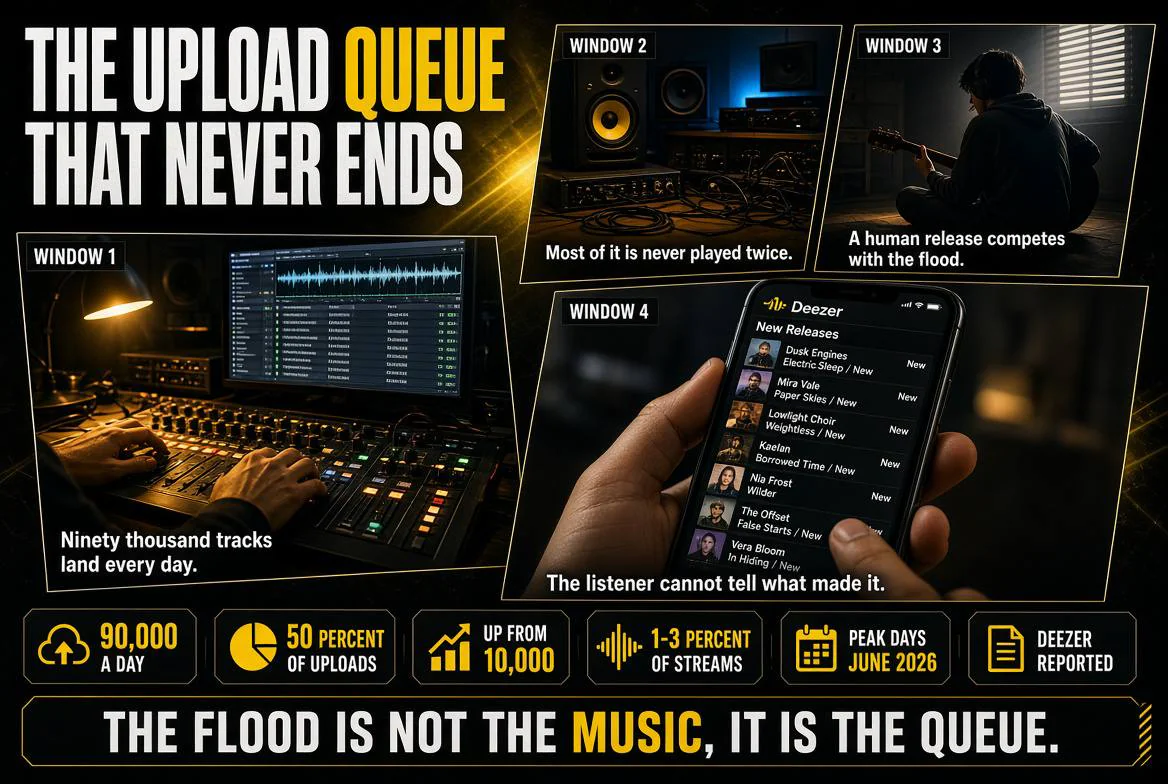
Here is a sentence from Deezer that should be on a wall somewhere: on peak days in June 2026, more than half of everything uploaded to the service was generated by a machine. Nearly 90,000 fully AI tracks a day. In January 2025 that figure was about 10,000, roughly ten percent of uploads. Eighteen months, and the volume went up nine-fold while the artists writing the other half kept doing what they always did.
Now the counter-sentence. In March 2026 the IFPI reported global recorded music revenue of $31.7 billion for 2025, up 6.4 percent, another record. UK Music put the country’s music gross value added at a record £8.4 billion. The business has never earned more.
So which is it — drowning or thriving? Both, and the interesting part is which one is structural.
The Flood Is Real, and It Is Arithmetic
Start with the number in the headline, because it is the one that gets argued about. Deezer’s figure is company-reported, not an outside audit: nearly 90,000 fully AI-generated tracks per day, over 50 percent of daily uploads on peak days in June 2026, up from roughly 10,000 a day and about ten percent in January 2025. Deezer also says its detection tool is 99.8 percent accurate, which is the only reason the number exists at all — nobody else is counting.
Here is what those tracks do once they are uploaded. They account for between one and three percent of streams on the platform. And of the streams that fully AI tracks did attract in 2025, up to 85 percent were found fraudulent.
Read that again, because it is the whole business argument in one statistic. The flood is enormous, the flood is barely listened to, and most of what little listening it gets is fake. This is not a creative rival. It is a fraud engine wearing a creative rival’s clothes.
Why the Fraud Matters More Than the Music
Every streaming service divides a pool of subscription money according to streams. That model is indifferent to who or what produced the stream, which means a bot playing an AI track takes exactly the same fraction of the pool as a human playing a human song.
Spotify knows this and said so when it shipped its music spam filter in September 2025: “Left unchecked, these behaviors can dilute the royalty pool and impact attention for artists playing by the rules. Our new music spam filter will protect against this behavior and help prevent spammers from generating royalties that could be otherwise distributed to professional artists and songwriters.”
That is a platform describing the mechanism in its own words. The royalty pool is a fixed pot. Any stream that is fraudulent is money removed from somebody who earned it. The 85 percent fraud rate on AI tracks in 2025 is not a curiosity — it is the actual transfer of income from working musicians to whoever runs the bots.
And the platforms are tightening the screws in response. Spotify added AI credits in April 2026 and AI persona badges with recommendation defaults in October 2026, and it already applies a 1,000-stream annual threshold before a track earns anything. YouTube requires disclosure on realistic AI content, restricts unauthorised voice cloning, blocks repetitive mass-produced “inauthentic content” from monetisation, and started labelling generative AI songs on YouTube Music on 14 October 2026. Apple Music is reported to be adding “Made With AI” labels later in 2026. SoundCloud’s chief executive Eliah Seton announced updated community guidelines and terms on 17 November 2026, with the company writing that “AI slop has no place on SoundCloud” and reserving the right to withhold, reverse or recover payouts tied to AI abuse.
Notice what none of those policies do. None of them stop the upload. They label it, they de-monetise it, they claw back the payout after the fact. The flood is managed, not prevented, because preventing it would mean proving authorship at the door — and no platform wants to be the one that rejects a real artist’s record because a detector misfired.
The Money Is Moving the Other Way
If AI music were purely a threat, the labels would be suing and nothing else. That is not what is happening.
| Date | Deal | What it means |
|---|---|---|
| 31 Oct 2025 | Universal Music settles with Udio | Lawsuit ends, licensing begins; terms undisclosed |
| Nov 2025 | Warner Music settles with Suno and partners | Licensed AI music with artist opt-in for voices and likeness |
| Aug 2026 | Suno signs BMG | Publisher licensing rather than litigation |
| 8 Sep 2026 | Suno signs Believe and TuneCore | Distribution-side legitimacy |
| Aug 2026 | Stability AI raises $76M | Universal, Warner, Sony and EA reportedly participate |
That last row is the one to sit with. The three major labels are suing AI music companies in court and investing in AI music companies in the same quarter. UMG and Warner settled and licensed. Sony reportedly put money into Stability. Nobody in that building believes the technology is going away, and nobody is willing to be the label that arrives late to the licensing table.
Which makes the “free fall” framing more interesting than it first looks. The industry is not falling apart. It is being restructured so that the value of a recording shifts from the master to the licence — and the people who signed the old contracts are not automatically at that table.

The Lawsuits That Will Decide Who Gets Paid
While the deals get signed, the litigation keeps going, and it is now running in three jurisdictions at once.
The biggest one is Elvis. In the Northern District of California, case No. 3:26-cv-13398 before Magistrate Judge Joseph C. Spero, Elvis Presley Enterprises, LLC and ABG EPE IP LLC — the Authentic Brands Group entities controlling Presley’s name, image and likeness — joined by Raleigh Music Publishing and other rights holders, sued Suno. The initial filing came 6 November 2026; the First Amended Complaint landed 13 November 2026 as Dkt. 5, and it expanded the exhibits to allege “no less than 42 examples of additional infringing output of songs involved in this action, and 76 infringing outputs of other Elvis songs not involved in this action.” Coverage puts the works at 859.
The complaint’s own language is unusually blunt about what the output is. It alleges the tracks are “synthetic and unlicensed uses of Elvis’ voice and likeness, which have been reproduced, published, publicly performed, distributed, displayed and made available to the public by Suno to sell its products and services,” and it states directly that the outputs “are NOT examples of Elvis Presley singing.” One named track: “He Is Still The King.”
The pleaded arithmetic, as reported from Dkt. 5: $128,850,000 in copyright statutory damages at $150,000 for each of 859 works, $21,475,000 on the § 1202 claim for removal of copyright management information, and $2,147,500 under § 1201 for circumvention. Those are pleaded maximums, not an award, and the docket shows no ruling on a motion to dismiss yet.
The same legal team filed against Anthropic on 23 October 2026 over 274 songs and lyrics. Eminem’s publisher Eight Mile Style sued Suno on 6 November 2026 over 269 compositions including “Lose Yourself,” “The Real Slim Shady” and “Stan,” with reported damages claims above $41 million. In Germany, GEMA won a first-instance ruling against Suno in the Munich District Court I on 31 July 2026, subject to appeal. And the RIAA-backed label suits against Suno and Udio, filed 24 June 2024, are still live, with a scheduling order in the Massachusetts Suno case setting dispositive motions for 22 June 2027.
That 2027 date is the whole ballgame. Fair use in music training has not been decided. A US appeals court rejected fair use in a non-music training case on 30 September 2026, Munich rejected it in July, and the American music question is scheduled to be argued a year from now. Everything else — the licensing deals, the valuations, the label investments — is priced on an assumption about how that comes out.
What This Costs the Person Who Sings or Plays
Follow the money down to the individual, because that is where the “free fall” stops being a metaphor.
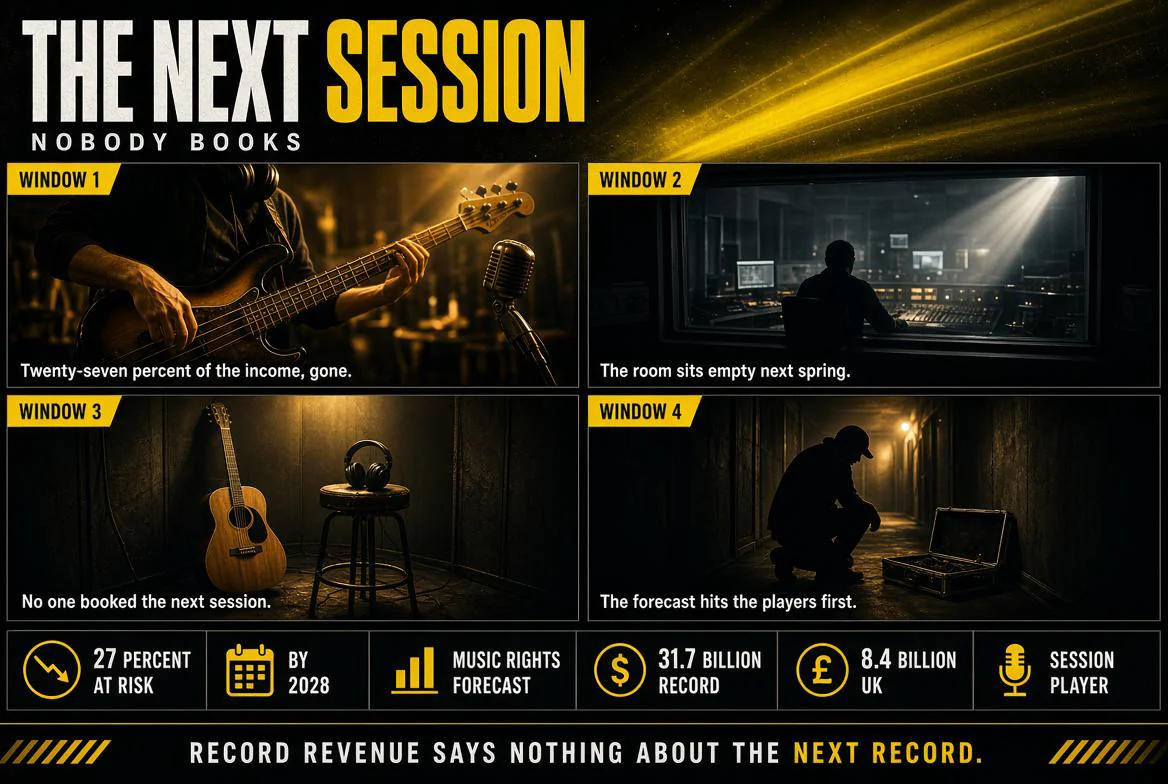
The Musicians’ Union, in a 17 November 2026 statement, pointed at two numbers side by side: the record £8.4 billion gross value added in the UK Music report, and a Goldmedia study for GEMA and SACEM forecasting that 27 percent of members’ revenue could be at risk by 2028.
Twenty-seven percent of a working musician’s income, inside two years. That is not a hypothetical about the future of art. That is a number about whether a session player books the room next spring.
| Number | What it measures | Who published it |
|---|---|---|
| ~90,000 / day | Fully AI tracks uploaded to Deezer, June 2026 peak | Deezer (company-reported) |
| 50%+ | Share of daily uploads on peak days | Deezer |
| 1–3% | Share of streams those tracks take | Deezer, 2026 |
| up to 85% | Streams on fully AI tracks found fraudulent, 2025 | Deezer |
| $31.7B | Global recorded music revenue 2025, +6.4% | IFPI, March 2026 |
| 27% | Members’ revenue at risk by 2028 | Goldmedia for GEMA and SACEM |
| $300M ARR | Suno annual recurring revenue, Feb 2026 | Reported |
The Distribution Choke Point
Here is the part most coverage of the flood misses: the platforms that carry AI music are also the only route to market for everyone else, and they are starting to choose.
CD Baby prohibits 100 percent generative AI audio and unauthorised AI vocal clones outright, with takedowns, account termination and held earnings. DistroKid permits AI uploads provided there is no impersonation or mass spam. RouteNote requires links to the AI tool used. LANDR requires disclosure and caps AI releases at 12 songs a month.
Four distributors, four different rules, and the artist picking one of them is making a career decision they did not know they were making. A musician who signs with CD Baby and later uses a generative tool for a backing track has broken their terms. A musician who signs with DistroKid and gets swept up in a mass-spam detection wave has the same problem from the other direction.
And underneath all of it, the payouts. Third-party blended estimates put Spotify near $0.003 to $0.005 per stream and Apple Music near $0.006 to $0.010. Spotify’s 1,000-stream annual threshold means a track that does not clear 1,000 plays a year earns nothing at all. In a world where 90,000 machine tracks arrive daily, the threshold is not a spam filter. It is a filter on everything.
What Nobody Has Settled
A piece that pretends the case is closed is not worth reading, so here is what is genuinely open.
Fair use for training on copyrighted recordings has not been decided in US music litigation; the dispositive motions in the Massachusetts Suno case are set for 22 June 2027. No settlement amount has ever been disclosed in any AI music deal — the UMG–Udio and Warner–Suno terms are private. Nobody has published a verified side-by-side cost of a studio session versus an AI track, which means the “it is cheaper” claim, endlessly repeated, has no auditable figure behind it. And no jurisdiction has issued a blanket operating ban on an AI music company; Munich’s injunction is first instance and under appeal.
The one thing that is settled: purely AI-generated works without human authorship are not eligible for US copyright protection. A musician replaced by a track the label cannot own outright is a strange kind of progress, and nobody has explained how that ends.
So Is It Free Fall?
Not in revenue. Revenue is at a record and the majors are licensing their way into the new business rather than fighting it to the death.
In structure, yes. The flood has already taken the discovery layer — half of everything uploaded on a peak day is machine-made, which makes finding a human song a search problem rather than a matter of taste. It has taken the royalty pool’s integrity, with up to 85 percent of AI track streams flagged as fraud. And it is forecast to take 27 percent of a working musician’s income by 2028.
Record revenue measures what the catalogue earns. It says nothing about who gets to make the next record. Those are two different industries now, and only one of them is posting growth.
Frequently Asked Questions
How many AI-generated songs are uploaded every day?
Deezer reports nearly 90,000 fully AI-generated tracks per day as of June 2026, more than half of all daily uploads on peak days. That is up from about 10,000 a day, or roughly ten percent of uploads, in January 2025. Deezer’s detection tool is company-reported at 99.8 percent accuracy, and no other major platform publishes a comparable figure.
Are AI-generated songs actually getting streams and royalties?
Barely, and fraudulently. Deezer says fully AI tracks account for one to three percent of streams, and that up to 85 percent of the streams those tracks received in 2025 were found fraudulent. Because streaming royalties come from a fixed pool divided by stream share, a fraudulent stream removes money from artists who earned a real play.
Is the music industry really in decline?
Not in revenue. IFPI reported $31.7 billion in global recorded music revenue for 2025, up 6.4 percent and another record, and UK Music put UK music gross value added at a record £8.4 billion. The pressure is structural rather than financial: Goldmedia, in a study for GEMA and SACEM, forecasts 27 percent of members’ revenue at risk by 2028.
What is the Elvis lawsuit against Suno about?
Elvis Presley Enterprises, LLC and ABG EPE IP LLC, with Raleigh Music Publishing and other rights holders, sued Suno in the Northern District of California, case No. 3:26-cv-13398, before Magistrate Judge Joseph C. Spero. The initial filing was 6 November 2026 and the First Amended Complaint was filed 13 November 2026 as Dkt. 5, covering 859 works. The complaint alleges the outputs are synthetic and unlicensed uses of Elvis’ voice and likeness and states they are not examples of Elvis Presley singing.
Has fair use been decided for AI music training?
No. The dispositive motions on fair use in the Massachusetts Suno litigation are scheduled for 22 June 2027. A US appeals court rejected fair use in a non-music training case on 30 September 2026, and the Munich District Court I rejected it in the GEMA v. Suno ruling on 31 July 2026, but no US music ruling on fair use exists yet.
Can you copyright a song made entirely by AI?
No. Under current US Copyright Office practice, purely AI-generated works without human authorship are not eligible for protection. That matters commercially: a label replacing a songwriter with a generated track cannot own the result the way it owned the master.
What are streaming platforms doing about AI music?
Labelling, de-monetising and clawing back rather than blocking. Spotify shipped a music spam filter in September 2025, AI credits in April 2026 and AI persona badges in October 2026, and applies a 1,000-stream annual threshold. YouTube requires disclosure, restricts voice cloning and added generative AI labels to YouTube Music on 14 October 2026. SoundCloud updated its terms on 17 November 2026 and says it may withhold, reverse or recover payouts tied to AI abuse.
Does any distributor ban AI music outright?
CD Baby does, prohibiting 100 percent generative AI audio and unauthorised AI vocal clones, with takedowns, account termination and held earnings. DistroKid permits AI uploads without impersonation or mass spam, RouteNote requires links to the AI tool used, and LANDR requires disclosure and caps AI releases at 12 songs per month.

About Barak Schurr
Barak Schurr is a serial entrepreneur who built and exited a major ticketing platform before turning his attention to AI and content. He runs three AI-focused research sites and writes about the tools, workflows, and strategies that let solo creators build real channels — without a crew, a studio, or a Hollywood budget.
Email: [email protected]
More AI Video Resources