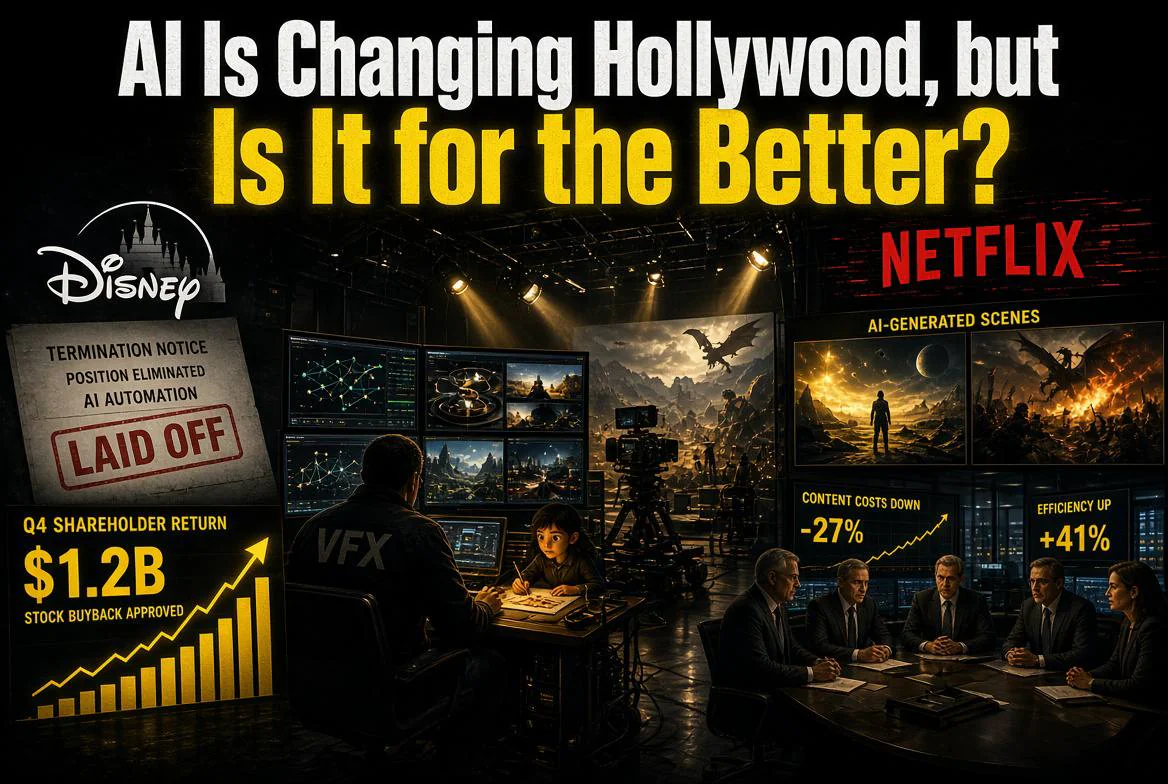
AI Is Changing Hollywood, but Is It for the Better?
AI Is Changing Hollywood, but Is It for the Better?
⚡ Expert Summary: Hollywood is not adopting AI because the technology got good. It is adopting AI because the balance sheets got bad. Skydance is carrying $87 billion in debt after buying Warner Bros. Discovery and needs $6 billion a year in savings inside three years. Disney is cutting $3 billion in annual operating costs by fiscal 2029 while spending $9 billion buying back its own stock. Netflix spent $4.8 billion on buybacks in a single quarter and cut roughly 1,000 jobs weeks later. Three studios, one pattern: every one of them produced a shareholder-return number, and not one of them produced a number for what AI actually saves them.
The word “efficiency” is doing a lot of work in Hollywood right now. It appears in shareholder letters, on earnings calls, and in memos about integration. Almost nobody using it has attached a figure to it, and the two companies that did attach figures attached them to something else entirely: debt service and share repurchases.
That is the story. Not robots writing scripts. Three legacy studios discovering that AI is the most socially acceptable reason to shrink a workforce that shareholders have been asking them to shrink for years.
The Debt Frame: Skydance’s $87 Billion
Start with the number that explains everything else.
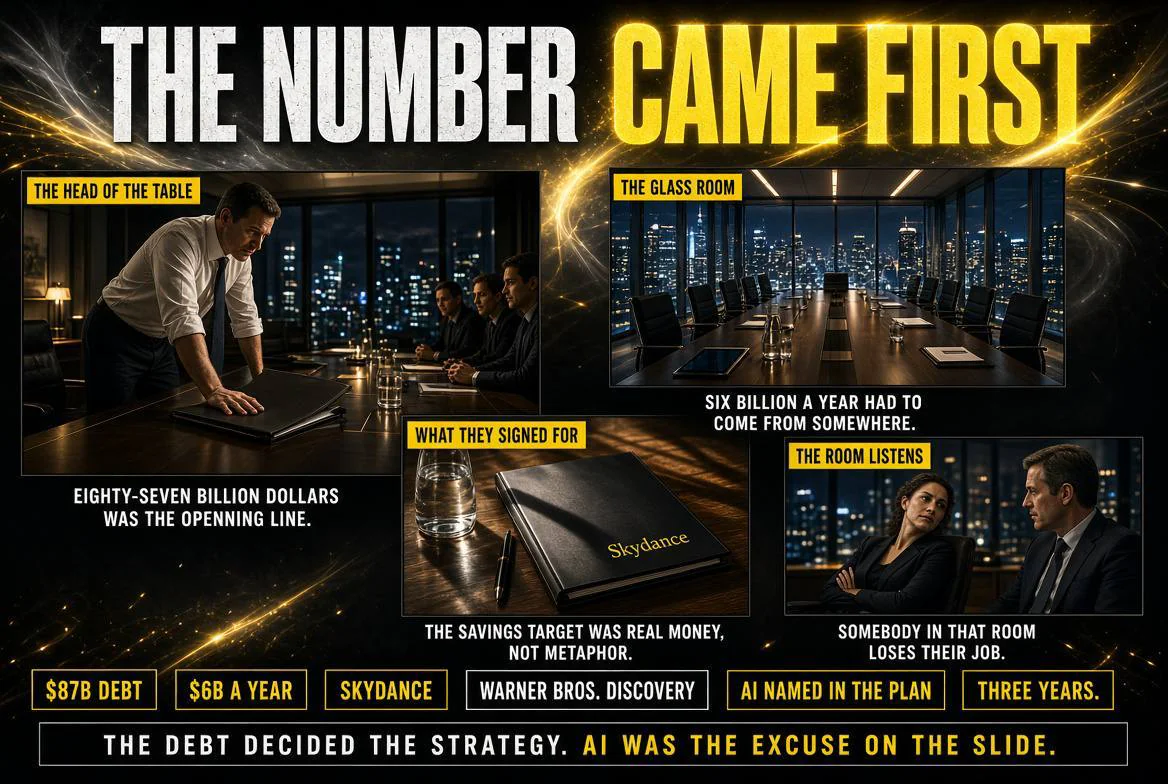
After its $111 billion acquisition of Warner Bros. Discovery, Skydance carries $87 billion in debt. On November 9, 2026, it outlined a plan to save at least $6 billion a year within three years, with AI named as a key role in office work, computer programming and film production.
The shareholder letter stated the priority plainly: “Growing our business and paying down debt are our top priorities.”
Now look at how that $6 billion actually breaks down, because the detail is where the honesty lives.
| Savings target (annual, within 3 years) | Amount | How it is achieved |
|---|---|---|
| Corporate operations | $2.2 billion | Combining departments, eliminating overlapping jobs, reducing office space, AI for administrative work |
| Technology | $1.4 billion | Combining streaming and computer systems, merging tech teams, AI coding tools |
| Marketing | $1.0 billion | Combining advertising campaigns, reducing promotional spending |
| Outside contractors and suppliers | $1.4 billion | Fewer vendors, cheaper contracts |
| Total | $6.0 billion | AI appears in two of four line items, with no dollar figure attached |
Read the right-hand column again. AI is named in corporate operations and in technology. It is not named in marketing or supplier costs. And the company has not specified how much AI will contribute to either line, or how much it expects to save on labour.
Chief executive David Ellison went further than that, and the admission is buried in most coverage: potential AI-driven savings in film production are not yet included in the forecasts. Which means the $6 billion is being delivered by the parts of the business that are not the movies.
Ellison’s framing of the technology was warmer than his balance sheet. “Artificial intelligence is a tool for artists and will never be a replacement for them,” he said, adding that “every discipline across the business will use these tools and productivity will improve as a result.” He predicted AI could transform filmmaking more dramatically than CGI and digital compositing did in the 1990s.
Both things can be true. The tools can be for artists and the savings can come from the artists’ colleagues.
The cuts already underway are not hypothetical. Employee buyouts were offered. Layoffs were confirmed in the games division, with at least 25 workers reportedly losing jobs. On the same day the savings plan went out, James Gunn and Peter Safran were removed as DC Studios chiefs, with Variety reporting that disappointing returns on expensive projects contributed to the ouster.
The Buyback Frame: Disney’s $9 Billion
Disney is the cleaner case study because it is not in distress. Its numbers are good, and it is still cutting.
Fourth-quarter net income came in at $2.6 billion, nearly double a year prior. Revenue was $25.9 billion, up 16%. Profit before taxes reached $3.5 billion, up 71%, helped by an extra week in the quarter. Full-year profit before taxes rose 18% to $14.2 billion.
And then: roughly $3 billion in annual operating expense cuts by fiscal 2029, including layoffs. Another $9 billion earmarked for buying back its own stock next year. $11.6 billion already returned in buybacks and dividends in fiscal 2026. A board-declared dividend of $2 per share, up 33% year on year.
Cartoon Brew put the contrast in one sentence and it deserves quoting in full: “Disney can tell investors exactly how much it intends to spend buying its own shares and when the next dividend checks will go out. Workers heading into another round of cuts are still waiting to find out whose jobs are on the line, or which benefits will be the next to go.”
The 2026 cut timeline reads like a schedule. January: marketing operations consolidated. April: roughly 1,000 positions eliminated. Summer: another large round, particularly hard on Pixar. August: health coverage restricted for employees’ spouses from 2027. September: top lawyer Horacio Gutierrez warned that legal and global affairs would become “a much smaller organization,” with automation and outsourcing under review.
Bloomberg reported that Disney managers were asked to cut annual costs by 20%, with thousands of jobs expected to go. That figure is a cost-savings target, not a companywide plan to eliminate a fifth of the workforce — a distinction that mattered less than the headline.
The AI Trail Inside Disney Is Stranger Than the Strategy
If AI were the engine of these cuts, you would expect a coherent deployment. What Disney actually did is more interesting.
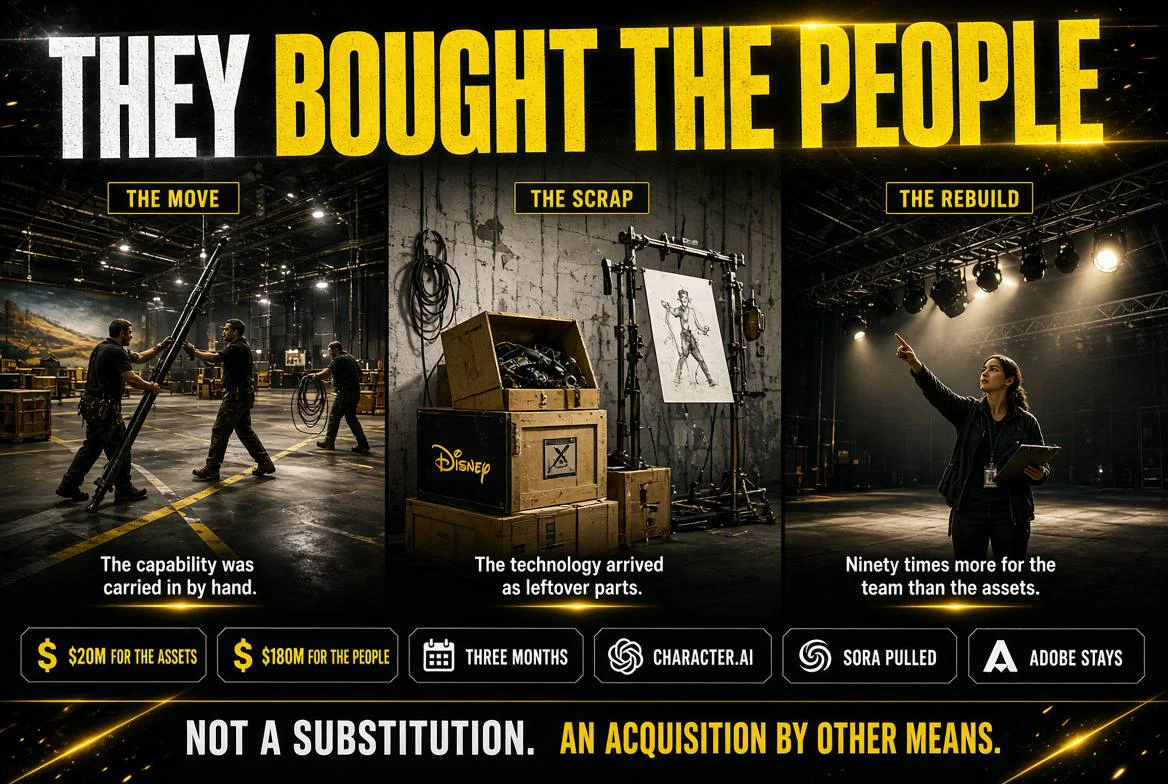
A $1 billion deal with OpenAI lasted barely three months before OpenAI pulled the plug on its Sora video generator. Disney then moved to Character.AI — a company it had previously sent a cease-and-desist letter to over unauthorised use of its characters — and hired its then-chief executive, Karandeep Anand, as its first companywide CTO. Character.AI filed for bankruptcy days later. Disney offered $20 million for the leftover assets and reportedly budgeted $180 million to recruit its workers.
That is not a strategy of substitution. It is a strategy of acquisition by other means: buy the team, take the technology as scrap, absorb the capability. Ninety times more money to hire the people than to buy what they built.
The steadier partnership is with Adobe. The multiyear alliance makes Adobe Disney’s official “AI Innovation Partner,” with access to Firefly, Firefly Foundry, Premiere, Photoshop and dedicated engineering resources. The bespoke models are trained on Disney IP to generate what the companies describe as commercially safe and production-ready outputs. Walt Disney Imagineering is already using Firefly Foundry to generate 2D concept art from human-made drawings and IP-based graphics for parks development. Adobe is also working with Disney StudioLAB on experimental production workflows and with ESPN Edge on AI-powered sports content.
Note which division gets the real deployment and which gets the rhetoric. The theme parks — the highest-margin, most capital-intensive, least unionised-by-writers part of the empire — get bespoke models generating concept art at industrial scale. Film and television get a $3 billion savings target and a schedule of layoffs.
The Netflix Version: Buybacks First, Then the Memo
Netflix did the honest sequence, in the wrong order for anyone on the receiving end.
In the third quarter of 2026 it spent $4.8 billion buying back its own stock — the largest quarterly repurchase in company history, 63.9 million shares. It has authorisation to spend another $22.3 billion. Revenue was $12.9 billion, up 12%. Operating income after operating expenses was $4.46 billion, up 37%. The company kept nearly 35 cents of every revenue dollar as operating profit, up from about 28 cents a year earlier.
Shortly after the quarter ended, it announced roughly 1,000 job cuts. About 6% of the workforce, the largest round since 2022. Cuts concentrated in product, technology, legal and human resources, with TV and film divisions also affected. Shares fell about 7% in premarket trading to under $64, their lowest since August 2024.
Co-CEO Greg Peters described the layoffs on the earnings call as a way to decide where Netflix should concentrate resources, saying some areas had become overinvested as the company grew and that the organisation sometimes needed a “forcing function” to make difficult decisions.
The memo from co-CEOs Ted Sarandos and Peters to the remaining staff opened with: “Our business is strong and growing, and we remain on track to deliver our full-year forecast.”
Netflix is the one studio in this group that did not name AI as a savings lever. It still followed the same shape: record shareholder returns, then a workforce reduction described in the language of focus. If AI is what makes the smaller team viable, the company has not said so. If it isn’t, the cuts happened anyway.
Three Studios, One Quarter, One Shape
| Studio | AI named as the lever | Money to shareholders | Jobs |
|---|---|---|---|
| Skydance | $6B/yr savings; AI in two of four line items | $87B debt to service | Buyouts; 25+ in games; DC chiefs out |
| Disney | ~$3B/yr operating cuts by FY2029 | $9B buyback + $11.6B returned FY2026 | ~1,000 in April; thousands more coming |
| Netflix | No explicit AI target | $4.8B Q3 buyback; $22.3B still authorised | ~1,000, about 6% of workforce |
The pattern is not subtle. None of the three produced a number for AI-attributable savings. All three produced a number for shareholder returns. The savings targets are real. The AI attribution is rhetorical.
Two studios are missing from this table, and their absence is worth stating rather than papering over. No AI cost-cutting or AI-savings announcement was found for Universal. No AI cost-cutting story was found for Sony — the loaded Sony material is expansion through Crunchyroll Storyworks and Aniplex, not retrenchment. Paramount outside the Skydance merger has no separate AI savings figure. Absence in this reporting is not proof of absence in the business, but it is not evidence of the trend either.
What the Merger Actually Costs, Measured
If the studios’ own figures are vague, someone else did the arithmetic.
A county-commissioned economic report by CVL Economics on the Paramount Skydance / Warner Bros. Discovery deal estimated approximately 4,495 direct film and television “job-years” at risk during the three-year integration period from 2027 to 2030. A job-year is one job sustained for one year — a measure of employment volume, not headcount, which means the real number of people affected is larger.
Including indirect jobs at production vendors and reduced household spending, total exposure rises to an estimated 10,360 job-years. Associated with $1.26 billion in labour income and $4.06 billion in economic output.
Animation, VFX and post-production were named specifically as at-risk work.
Those three disciplines are not incidental casualties. They are exactly the parts of production where generative models are furthest along, and exactly the parts that the studios have declined to put a savings number against. The report puts $4.06 billion of economic output on the line. The studios put nothing on the record.
The Workers Wrote It Into the Contracts
Here is the part that does not fit the “Hollywood is being steamrolled” narrative, and it is the most useful part for anyone outside the industry.
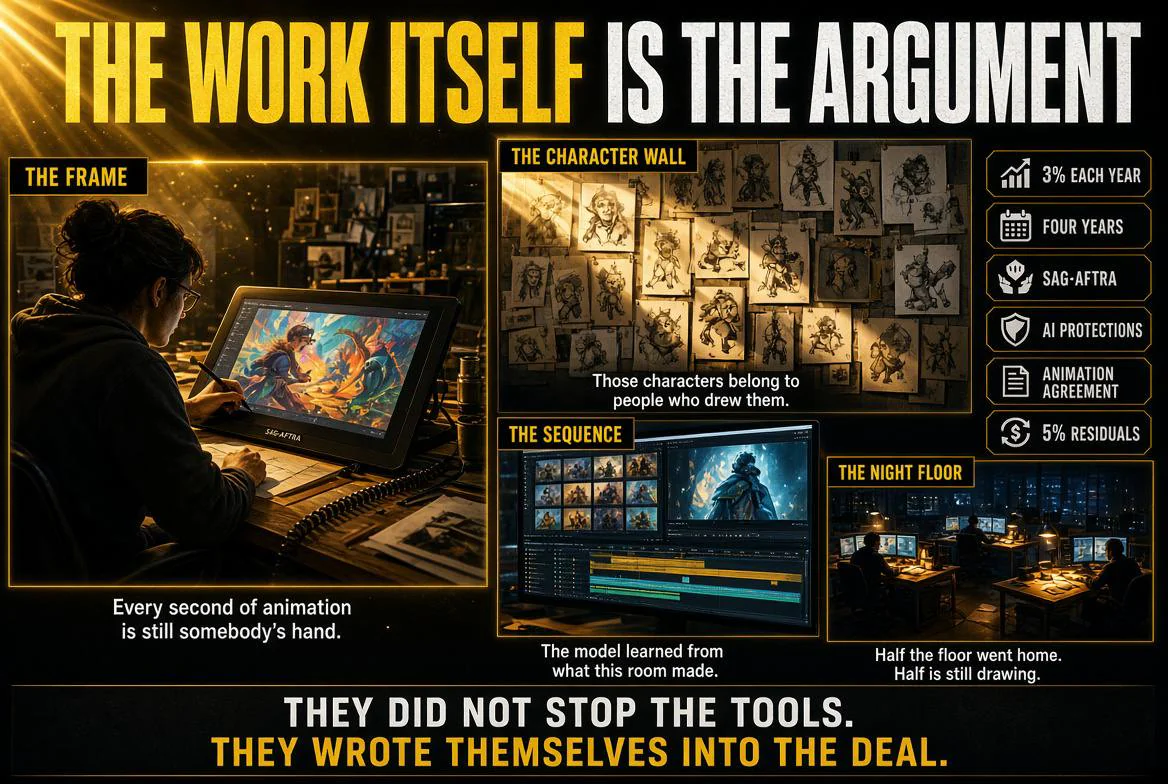
SAG-AFTRA reached a tentative 2026 Television Animation Agreement — four years, negotiated with the AMPTP, approved unanimously by the Executive Committee and sent to members for a vote. Three percent wage increases in each of the four years, the first retroactive to July 5, 2026. Expanded AI protections, incorporating improvements negotiated in the union’s 2026 live-action agreements while retaining animation-specific provisions; the 2024 contract had established the union’s first AI protections specifically for voice actors. An average 5% increase in residuals when programs move to subscription streaming, plus increased residual calculations for certain high-budget animated streaming productions and a raised subscriber factor for qualifying programs on large platforms.
Elsewhere the organising came first and the contract followed. Apple Studios refused voluntary recognition of its VFX workers’ union; the group voted 12-0 and secured a first collective bargaining agreement with IATSE more than two years after launching the push. That contract includes minimum pay rates for every covered title, annual increases tied to the IATSE-AMPTP Basic Agreement, minimum-hour guarantees, overtime protections for holidays and sixth and seventh consecutive workdays, employer-paid MPI health care and pension, retirement contributions retroactive to January 1, 2026 — and the AI protections contained in IATSE’s Basic Agreement with the AMPTP.
Blizzard’s roughly 1,900 workers ratified their first union contracts, including wage increases and AI guardrails. Netflix Animation production workers ratified a first contract after years of organising. Icon Creative in Vancouver is moving toward a first contract with the Canadian Animation Guild.
The studios are not going to volunteer AI protections. Four separate bargaining units proved they can be written in. That is the actual transferable lesson from 2026, and it applies to any industry where a model can do part of the work: the guardrails arrive through contracts, not through vendor promises.
Why the AI Attribution Is the Real Story
Strip out everything else and one fact remains uncomfortable for all three companies.
Every studio can tell you, to the dollar, what it will spend on buybacks. Not one can tell you what AI saves them.
That asymmetry is not a reporting failure. It is a choice, and it makes sense from the inside. A savings number names the jobs. A buyback number names the shareholders receiving them. Only one of those two numbers gets you a friendlier call with an analyst, and the studios know which one.
It also means the honest answer to “is AI taking Hollywood jobs” is currently unknowable from public disclosure. What is knowable is that the cuts are happening, that AI is named as a rationale in the plans announced alongside them, and that no studio has produced the evidence to separate the two.
What to Watch Next
Three things will settle this, and none of them require a press release.
Film production. Ellison explicitly excluded film-production AI savings from the $6 billion forecast. The moment Skydance starts including them is the moment the movies themselves are on the table, and that number will be visible when it moves.
The next contracts. The SAG-AFTRA animation agreement goes to a member vote. The IATSE and animation guild contracts set the template. Every AI clause that gets ratified becomes the floor for the next negotiation across the industry, and every one that gets dropped is a signal about leverage.
The CVL numbers. The 10,360 job-years estimate covers 2027 to 2030. If integration runs ahead of schedule, that figure is the first place it shows — because the report counted vendor work and household spending, not just studio payroll.
What is not in dispute is the direction. Hollywood has been consolidating for a decade, and the consolidation always had a human cost. What changed in 2026 is that the cost finally got a name that shareholders like. The cuts were going to happen either way. AI just gave them a better pitch deck.
Frequently Asked Questions
Is AI actually replacing jobs in Hollywood?
No studio has disclosed the number of jobs attributable to AI specifically. What is documented is that Skydance, Disney and Netflix all announced workforce reductions in the same period as they outlined AI initiatives, and none of them separated the two in their public figures.
How much debt does Skydance have?
After its $111 billion acquisition of Warner Bros. Discovery, Skydance carries $87 billion in debt, and has committed to at least $6 billion in annual savings within three years to service it.
How much of Skydance’s $6 billion in savings comes from AI?
The company has not said. AI is named as a factor in corporate operations ($2.2 billion target) and technology ($1.4 billion target), but no dollar figure has been attached to either. AI-driven savings in film production are explicitly excluded from the current forecast.
Why is Disney cutting jobs when profits are up?
Disney reported $2.6 billion in quarterly net income, nearly double the prior year, while targeting roughly $3 billion in annual operating expense cuts by fiscal 2029. In the same period it announced a $9 billion buyback and returned $11.6 billion to shareholders in fiscal 2026.
What happened with Disney and OpenAI?
A $1 billion deal between Disney and OpenAI lasted barely three months before OpenAI pulled the plug on its Sora video generator. Disney subsequently moved to Character.AI, hiring its chief executive as its first companywide CTO, then offered $20 million for the company’s assets after it filed for bankruptcy.
Did Hollywood workers get any AI protections?
Yes, through contracts rather than company policy. SAG-AFTRA’s tentative 2026 Television Animation Agreement expands AI protections for animation, Apple Studios VFX workers secured IATSE’s AI provisions after voting 12-0 to unionise, and roughly 1,900 Blizzard workers ratified contracts including AI guardrails.
How many jobs will the Paramount Skydance and Warner Bros. Discovery merger cost?
A CVL Economics report estimated approximately 4,495 direct film and television job-years at risk between 2027 and 2030, rising to about 10,360 job-years including vendor jobs and reduced household spending, tied to $1.26 billion in labour income and $4.06 billion in economic output.
Which parts of production are most exposed to AI?
Animation, visual effects and post-production were named specifically in the CVL Economics report as at-risk work, and they are the disciplines where generative models are most advanced.
About Barak Schurr
Barak Schurr is a serial entrepreneur who built and exited a major ticketing platform before turning his attention to AI and content. He runs three AI-focused research sites and writes about the tools, workflows, and strategies that let solo creators build real channels — without a crew, a studio, or a Hollywood budget.
Email: [email protected]
More AI Video Resources