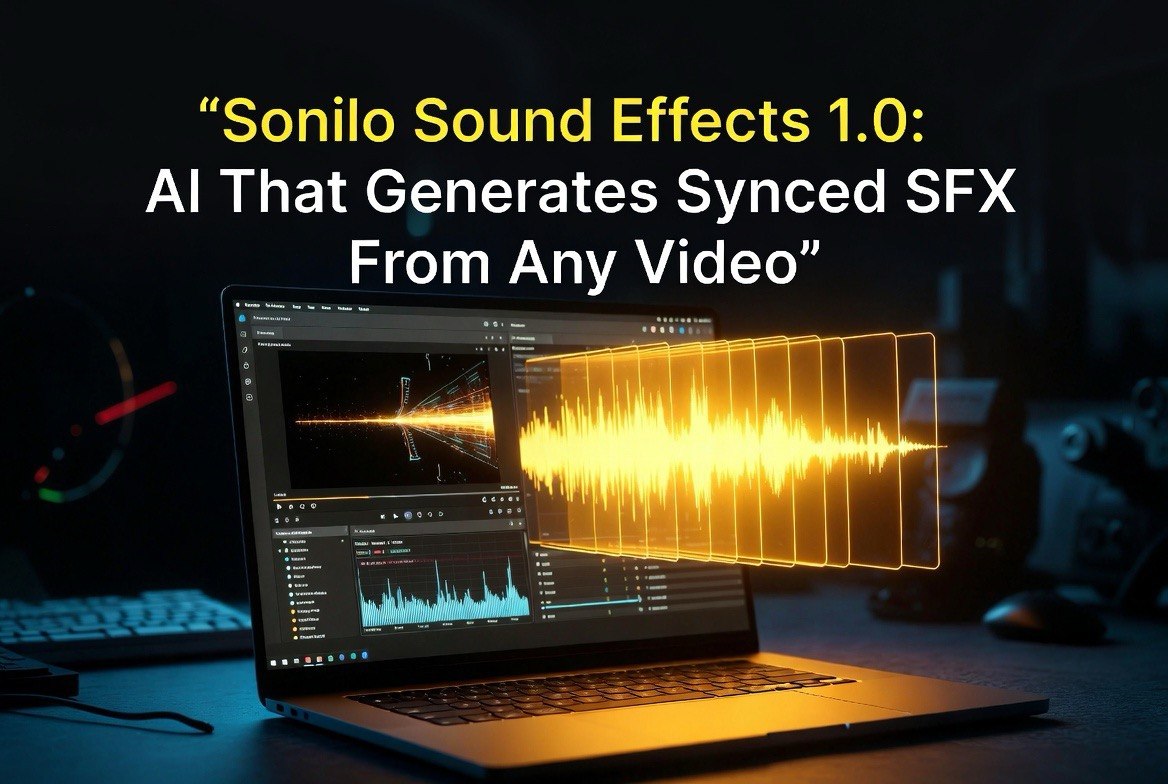
Sonilo Sound Effects 1.0: AI That Generates Synced SFX From Any Video
Get The Faceless YouTube Blueprint — Free
The exact AI tool stack and workflow used to build a faceless YouTube channel from zero.
Sonilo Sound Effects 1.0: AI That Generates Synced SFX From Any Video
⚡ Expert Summary: Sonilo Sound Effects 1.0 — launched July 21, 2026, on fal.ai — is the first “Sound World Model” that generates fully synchronized sound effects from video footage. Upload up to 3 minutes of video; the model analyzes on-screen action, motion, and scene context to produce a complete audio track where footsteps, impacts, ambient sounds, and motion effects align precisely with visual events. Text-to-SFX is also supported. All outputs are commercially safe — trained exclusively on a fully licensed catalog with zero scraped data.
The Problem Sonilo Solves
AI video generation has advanced faster than AI audio for video. A creator can generate a photorealistic 30-second clip in minutes using tools like Runway, Kling, or Pika. But getting matching sound effects still requires hours of Foley work, library searching, or manual syncing in a digital audio workstation. The audio post-production pipeline has not kept pace with the video generation pipeline.
This gap creates a practical bottleneck. A creator who can generate 50 video clips in an afternoon might only be able to finish audio for 5-10 of them in the same time. The rest sit unfinished, the video ready but the audio absent. For short-form content creators publishing daily, this bottleneck means either publishing without sound design (which hurts engagement) or limiting output to what the audio pipeline can handle.
Sonilo Sound Effects 1.0 closes that gap. It is the first production-ready model that treats audio generation as a first-class output of the video creation process — not an afterthought that requires a separate production pipeline.
The Audio Bottleneck in Modern Content Creation
To understand why Sonilo matters, it helps to understand the scale of the audio bottleneck in current content production. A typical short-form video creator generates 3-5 videos per day. Each video needs 2-4 sound effects: a whoosh for the intro transition, an impact for the main visual, ambient background throughout, and a stinger for the call to action. That is 6-20 sound effects per day, 180-600 per month. Sourcing, licensing, downloading, editing to length, and syncing each sound effect manually takes 3-10 minutes per effect depending on how specific the need is. For a creator producing 600 sound effects per month, that is 30-100 hours of audio work — more than a full-time job on top of the actual content creation.
Most creators do not do all that work. They reuse the same 10-20 sound effects across all their videos, which creates a uniform audio identity that makes content blend together. Or they publish without sound effects, which hurts engagement metrics. Sonilo eliminates the trade-off: every video can have unique, appropriate, synced sound effects in seconds instead of hours.
What Makes Sonilo a Sound World Model
Sonilo calls its technology a “Sound World Model” because it is not simply generating audio from text prompts. The model processes video holistically — analyzing on-screen action, motion timing, scene context, visual cues, and narrative flow — to produce audio that belongs with that specific video. It is not a sound effects library with an AI search engine on top. It is a generative model that understands the relationship between what happens visually and what should be heard.
This distinction matters for quality. A library-based approach can only return pre-recorded sounds that approximately match the scene. A world model generates sounds that fit the specific timing, intensity, and context of the video. A door slam in frame produces the exact acoustic profile of that specific door slam — not a generic door slam from a library recorded in a different room with different acoustics. Footsteps match the surface visible on screen: concrete, wood, carpet, gravel. The timing is frame-level precise, not approximately synced.
How Sonilo Sound Effects 1.0 Works
Video-to-SFX
Upload any video up to 3 minutes long. The model analyzes the entire scene: actions, object interactions, camera movements, environmental context, and pacing. It generates a complete sound effects track synchronized to the video timeline. The output is a single finished audio file where every sound event aligns with the corresponding visual event.
The model handles complex multi-sound scenes — a busy restaurant with overlapping conversations, kitchen noises, background music, and a door opening — without losing temporal alignment between any audio and video events. It maintains separation between foreground sounds (dialog adjacent effects, primary actions) and background ambience (room tone, environmental noise).
Text-to-SFX
Describe the sound you need in plain text — “heavy rain on a tin roof, medium distance” or “electric hum with intermittent crackle, 30 seconds” or “footsteps on wet pavement approaching and passing” — and the model generates it directly. Controls for type, texture, intensity, and exact duration give experienced sound designers fine-grained control when they need it.
Combined Video-to-Audio Output
The model also supports a video-to-video mode that adds the generated sound effects track directly onto the original footage and returns a finished video clip with embedded audio. This removes the need for any external audio editing software for creators who simply want a publish-ready video with proper sound design.
Why the Licensed Catalog Matters for Creators
One of the most significant differentiators of Sonilo Sound Effects 1.0 is its training data. Sonilo trained exclusively on a fully licensed music and sound catalog. No web scraping, no YouTube rips, no unlicensed training data. Every output Sound Effects 1.0 produces is cleared for commercial use in published content, advertisements, games, and streaming.
For creators and businesses, this removes the single biggest legal risk in AI-generated content today: copyright infringement from unlicensed training data. The legal landscape around AI training data is uncertain and evolving rapidly. Multiple high-profile lawsuits are working through the courts. Using AI tools with unlicensed training data creates a structural legal vulnerability for any published content.
Sonilo eliminates that concern entirely for its outputs. You can publish Sonilo-generated audio in revenue-generating content, client projects, or commercial advertisements without worrying about claims, takedowns, or litigation from rights holders whose work was scraped without permission.
Performance and Quality
Sonilo states that Sound Effects 1.0 outperforms leading models in benchmarks for both music and sound effects quality. The model’s ability to handle complex multi-sound scenes with precise temporal alignment is the key technical achievement. Independent testing by early users on fal.ai has confirmed that the model produces frame-accurate synchronization and natural-sounding audio that avoids the robotic or artificial quality of earlier AI audio generators.
Target Users and Use Cases
Sonilo Sound Effects 1.0 serves a broad range of creators and businesses with very different audio needs:
Short-form content creators generating daily video for TikTok, Instagram Reels, and YouTube Shorts can cut audio post-production from hours to minutes. A creator who publishes 2-3 videos per day can reclaim 10-15 hours per week that would otherwise go to sound effects sourcing and syncing.
Advertisers and marketing teams producing multiple video variants for A/B testing can batch-generate matching audio for each creative version without manual sound design. A product launch with 10 ad variants can have all 10 fully scored and sound-designed in the time it used to take to do one.
Indie game developers can create soundscapes for environments, character actions, UI interactions, and ambient effects without hiring a dedicated sound designer or purchasing expensive sound effects libraries. A single developer working on a small game can generate hundreds of sound effects in an afternoon.
Video repurposing workflows — taking one long video and cutting multiple short clips — can add auto-audio to each clip simultaneously rather than editing audio for each one individually. This is the use case with the highest time savings ratio: turning a single 20-minute video into 10 short clips with unique sound design for each.
Educational and tutorial creators can add interaction sounds (button clicks, transitions, highlight effects) to screen recordings without manual editing, making tutorials feel more polished without adding production time.
How Sonilo Compares to Other AI Audio Tools
The AI audio generation space has several players, but they serve different needs. ElevenLabs focuses on voice synthesis and text-to-speech — excellent for narration and character voices, but not designed for sound effects or video-native audio. Meta’s AudioCraft generates sound effects from text but requires technical setup and does not offer video-to-SFX capabilities. Runway offers audio generation within its video platform but with less precision and no licensed catalog guarantee.
Sonilo’s differentiation is the combination of video understanding, licensed training data, and production-ready API access through fal.ai. No other tool offers all three in a single product. The Sound World Model approach — generating audio that understands the video context rather than layering pre-recorded sounds — is technically distinct from anything else available as of July 2026.
Limitations to Consider
Sonilo Sound Effects 1.0 is impressive but not a complete replacement for professional sound design. Complex scenes with many simultaneous audio events can produce results where individual sounds compete for clarity. The model is strongest at generating environmental ambience, action impacts, and motion sounds — the bread and butter of video sound design. It is less reliable for specific, recognizable sounds where accuracy matters (a specific car engine, a particular musical instrument, a famous sound effect). The 3-minute video limit means it cannot yet handle long-form content in a single pass, though multiple clips can be processed individually and combined.
What Early Users Are Reporting
Since launching on fal.ai, Sonilo has received positive feedback from the creator community. Users on X/Twitter and Reddit have shared side-by-side comparisons showing Sonilo audio output versus traditional library-based sound design. The consensus is that Sonilo excels at environmental ambience and action effects — the most common needs for short-form content — but can be inconsistent with very specific sounds that require exact recognition. Several creators noted that the text-to-SFX feature is stronger than expected for a v1.0 release, producing usable results for descriptive prompts in most cases.
The licensed catalog has been a significant factor in positive reception. Multiple creators cited it as the differentiator that made them comfortable using Sonilo for client work, where copyright liability is a real concern. The general sentiment is that Sonilo Sound Effects 1.0 is not yet a complete replacement for professional sound design but is more than good enough for the daily content workflows of most creators.
Availability and Pricing
Sonilo Sound Effects 1.0 is live on fal.ai with API access available for developers through the fal platform. The model endpoints are accessible at fal.ai/models/sonilo with separate endpoints for video-to-sound-effects, text-to-sound-effects, and video-to-video-sound-effects. Pricing is usage-based through the fal platform. Direct access is also available through Sonilo’s website at sonilo.com, which includes a web interface for creators who prefer no-code access.
FAQ
What is Sonilo Sound Effects 1.0?
Sonilo Sound Effects 1.0 is an AI model that generates fully synchronized sound effects from video or text prompts. It is the first release from Sonilo’s Sound World Model technology and launched on fal.ai on July 21, 2026.
Can I use Sonilo SFX in commercial projects?
Yes. Sonilo trained exclusively on a fully licensed catalog — no web scraped data. All outputs are cleared for commercial use in published content, advertisements, games, and streaming without copyright concerns.
How long of a video can Sonilo process?
Sonilo Sound Effects 1.0 accepts video uploads up to 3 minutes long for video-to-SFX generation. Text-to-SFX has no length limitation and can generate sounds of any specified duration.
Does Sonilo also generate background music?
Yes. Sonilo has existing video-to-music capabilities that produce synced background music. Sound Effects 1.0 extends this to produce combined tracks where music and sound effects coexist naturally in a single audio output without manual mixing.
Where can I access Sonilo Sound Effects 1.0?
Sound Effects 1.0 is available on fal.ai with API access for developers. A no-code web interface is available at sonilo.com for creators who prefer direct access without API integration.
How is Sonilo different from AI music generators?
Sonilo is a Sound World Model that understands the relationship between video and audio. Unlike standalone music generators, it watches the video and generates sound effects synchronized to specific visual events, not just background atmosphere.

About Barak Schurr
Barak Schurr is a serial entrepreneur who built and exited a major ticketing platform before turning his attention to AI and content. He runs three AI-focused research sites and writes about the tools, workflows, and strategies that let solo creators build real channels — without a crew, a studio, or a Hollywood budget.
Email: [email protected]