PixVerse Raises 39M at B+ Valuation — AI Video Market Heats Up
Get The Faceless YouTube Blueprint — Free
The exact AI tool stack and workflow used to build a faceless YouTube channel from zero.
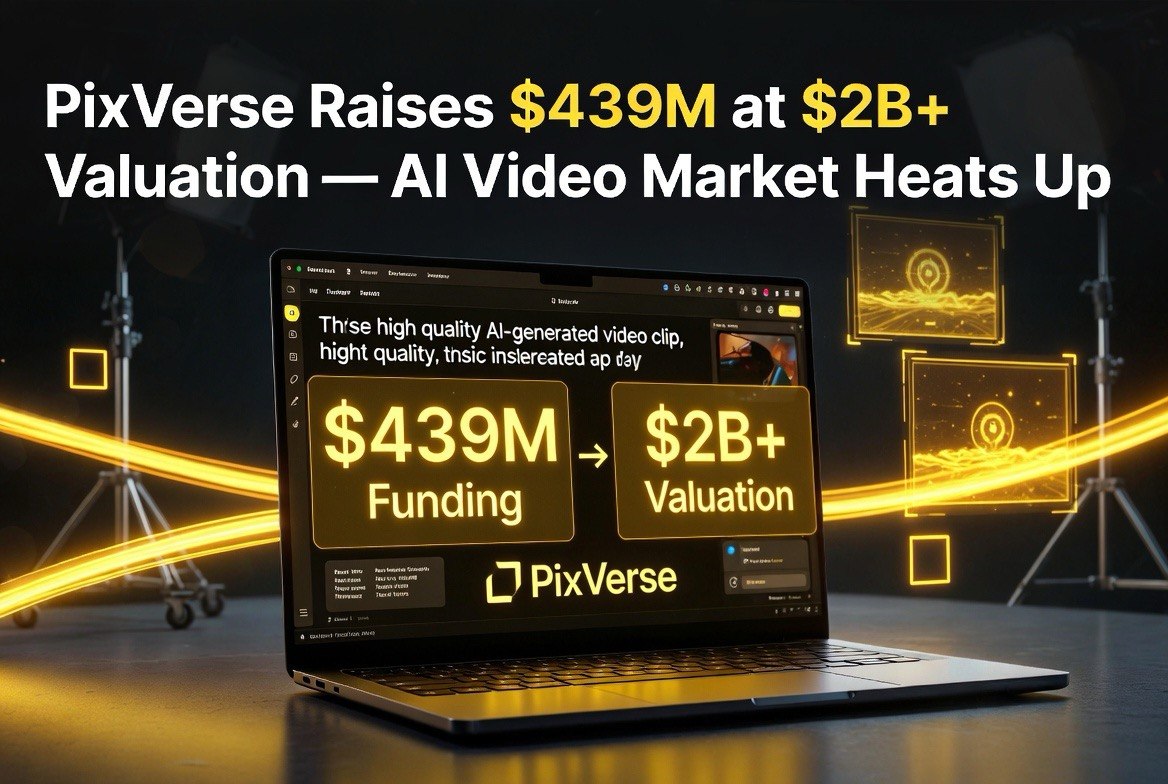
PixVerse Raises $439M at $2B+ Valuation — AI Video Market Heats Up
⚡ Expert Summary: PixVerse, an AI text-to-video startup, has raised $439 million in a funding round that values the company at over $2 billion — one of the largest AI video company raises to date. The investment signals strong investor confidence in AI video generation technology and comes as the market shifts from experimental demos to production-ready commercial tools. For content creators and businesses evaluating AI video platforms, PixVerse’s valuation and financial backing indicate it is positioned as a major player in the space.
Who Is PixVerse?
PixVerse is an AI-powered text-to-video and image-to-video generation platform that competes directly with tools like Pika, Runway, and Luma. The platform allows users to generate professional-quality video clips from text descriptions, reference images, or video inputs — without traditional video editing skills.
Unlike some of its competitors that focus on cinematic quality or specialized use cases, PixVerse has positioned itself as a broad-access platform for creators, marketers, and businesses. The platform offers several key features:
Text-to-video generation. Users describe a scene, and PixVerse generates a corresponding video clip. The model handles a variety of visual styles — realistic, animated, cinematic, product-focused — depending on the prompt.
Image-to-video. Upload a static image, and PixVerse animates it with motion, generating a short video clip that preserves the original image’s content and composition while adding movement.
Video-to-video. Existing video footage can be restyled or modified through AI prompts, allowing creators to change visual aesthetics, add elements, or transform the content without reshooting.
API access. PixVerse offers API integration for businesses that want to embed AI video generation into their own workflows, products, or platforms.
Why the $439M Raise Matters
The size of PixVerse’s funding round is significant for several reasons. It is one of the largest raises in the AI video generation space, signaling that major investors believe AI video is approaching a commercial inflection point.
Here is what the raise tells us about the market:
AI video is no longer experimental. In 2024 and 2025, most AI video funding went to research-focused companies still proving their technology could produce usable results. PixVerse’s $2 billion valuation at a $439 million raise suggests investors see a real commercial market, not just a research opportunity. The company is expected to use the funding to scale infrastructure, grow its team, and expand go-to-market operations.
The race for market share is accelerating. The AI video space is crowded — Runway, Pika, Luma, Kling, Seedance, Veo, Sora, and now Meta Muse are all competing for creators and businesses. A $439 million war chest gives PixVerse the resources to compete on features, pricing, and distribution. Expect aggressive product development and marketing campaigns as the company tries to establish itself as a top-tier player.
Infrastructure costs are front and center. AI video generation is computationally expensive. Running the models that produce high-quality video requires significant GPU capacity. A significant portion of PixVerse’s raise likely goes toward securing compute infrastructure. For users, this means the company is investing in speed, quality, and uptime — factors that matter for production workflows.
Consolidation pressure increases. With a $2 billion valuation, PixVerse becomes an attractive acquisition target for larger tech companies that want an AI video product. It also becomes a more formidable competitor to smaller players who lack similar financial backing. The market may see a wave of consolidation over the next 12-18 months as well-funded companies like PixVerse press their advantage.
How PixVerse Stacks Up Against Competitors
| Platform | Funding Raised | Key Strength | Best For |
|---|---|---|---|
| PixVerse | $439M+ ($2B+ valuation) | Broad access platform + API | Creators, marketers, business integration |
| Runway | ~$237M | Professional filmmaking tools | Video professionals, filmmakers |
| Pika | ~$135M | Creative control, motion brushes | Designers, creative professionals |
| Luma (Ray/Dream Machine) | ~$170M | 3D-aware video generation | Designers, product visualization |
| Kling (Kuaishou) | Private (parent company public) | Cost-effective high volume | Volume creators, budget-conscious |
What This Means for Video Creators
For content creators and businesses in the United States who use or evaluate AI video tools, PixVerse’s funding has practical implications:
More competition means better tools. When a company raises $439 million, it spends aggressively on product development. That means more features, better quality, and faster iteration. Users of all AI video platforms — not just PixVerse — benefit from the competitive pressure that well-funded players create.
Pricing pressure is real. PixVerse needs to acquire users to justify its valuation. That typically means competitive pricing, generous free tiers, and aggressive marketing. For creators evaluating AI video tools, the next 6-12 months are likely to be a buyer’s market as platforms compete on price.
Enterprise features will expand. With a $2 billion valuation, PixVerse is not just targeting individual creators. The company will build enterprise features — team accounts, API access, usage analytics, brand controls — to attract business customers. That is good news for businesses that want AI video tools with proper administrative controls and security.
The window for choosing a platform is now. As the market consolidates, the tools you adopt today will influence your workflows for years. The AI video platforms that survive and thrive will be the ones with strong funding, clear product roadmaps, and growing user bases. PixVerse’s funding round checks all three boxes.
What About Quality Compared to Other Tools?
PixVerse has generally been ranked as a strong but not top-tier contender in AI video quality comparisons. It competes well with Pika and mid-tier Runway features, but typically does not match the cinematic quality of Seedance 2.5, Veo 3.1, or Sora on high-end prompts. Where PixVerse differentiates is breadth of features and platform accessibility rather than pure output quality.
That calculus may change with the new funding. A $439 million raise allows PixVerse to invest heavily in model improvements, potentially closing the quality gap with top-tier competitors. For creators who have been waiting for a well-funded, broadly capable AI video platform without committing to a specific ecosystem, PixVerse is worth watching closely.
What PixVerse Offers Creators Today
If you are evaluating PixVerse as a video creation tool, here is what the platform currently delivers based on available user feedback and feature documentation:
Ease of use is a standout feature. PixVerse has invested heavily in user experience. The platform is designed to be accessible to non-technical creators, with a clean interface that guides users through prompt creation, style selection, and output refinement. For small business owners in the United States who want to generate video content without hiring a dedicated video editor, PixVerse’s low barrier to entry is a genuine advantage.
Style variety is solid. The platform supports multiple visual styles including realistic, cinematic, animated, 3D, and stylized outputs. While the top-end cinematic quality does not match Seedance or Veo at their best, the range of accessible styles means creators can achieve decent results across different use cases without switching tools.
Speed is competitive. PixVerse has focused on generation speed as a differentiator. For high-volume content creators who need to produce multiple video clips in a session, faster generation times translate directly to higher productivity. The platform’s API is also designed for low-latency integration into automated workflows.
Community and templates. Like many AI creative tools, PixVerse has built a community platform where users share prompts, styles, and best practices. This community layer reduces the learning curve for new users and provides inspiration for what is possible with the tool. For businesses adopting AI video for the first time, having a template library and community examples accelerates the path to useful output.
The gap between PixVerse and top-tier tools is narrowing, but it still exists. Creators who need the absolute best quality for client-facing cinematic work should evaluate Seedance 2.5 or Veo 3.1 first. Creators who need volume, API access, and a broad platform — and who are willing to accept good-but-not-top-tier quality — will find PixVerse increasingly compelling, especially with the resources that 39 million provides.
FAQ
When did PixVerse raise $439 million?
Who invested in PixVerse?
How does PixVerse compare to Runway for professional video work?
Is PixVerse available for businesses to integrate via API?
Will the funding improve PixVerse’s video quality?

About Barak Schurr
Barak Schurr is a serial entrepreneur who built and exited a major ticketing platform before turning his attention to AI and content. He runs three AI-focused research sites and writes about the tools, workflows, and strategies that let solo creators build real channels — without a crew, a studio, or a Hollywood budget.
Email: [email protected]