How to Pick a Faceless YouTube Niche With AI in 2026
Get The Faceless YouTube Blueprint — Free
The exact AI tool stack and workflow used to build a faceless YouTube channel from zero.
How to Pick a Faceless YouTube Niche With AI in 2026
⚡ Expert Summary: The niche decides whether your faceless channel ever gets paid. Pick wrong and you will publish 100 videos into a category where advertisers pay almost nothing. This guide shows you how to use AI to test a niche before you commit a single upload — validating demand, checking RPM economics, and scoring the gap between what viewers want and what already exists. The creators who skip this step are the ones who quit in month four.
Most faceless YouTube channels do not die because the videos are bad. They die because the niche was never going to pay. You can produce flawless AI-generated documentary content for a category with a $0.80 RPM and work for a year to earn what a finance channel earns in a month.
The old advice was simple: pick a niche you can talk about for 200 episodes. That advice assumed you were on camera, building a personal brand. Faceless channels are a different game. You are building a media asset, and media assets are valued on the spread between cost per video and revenue per thousand views.
That spread is set almost entirely by niche selection. And in 2026, the research phase that used to take a creator three months of guessing can be compressed into an afternoon with the right AI workflow.
This is the process I would run today if I were starting a faceless channel from zero.
Why Niche Selection Matters More Than Any Tool You Buy
Here is the uncomfortable math. Two channels, identical production quality, identical upload schedule, identical AI stack. Channel A is general motivation. Channel B is commercial insurance explained for small business owners. Both pull 100,000 views a month.
Channel A earns roughly $150 from ads. Channel B earns roughly $2,400. Same effort. Same tools. The only difference is that one content category attracts advertisers who sell expensive things to people with money, and the other attracts course sellers and app installs bidding pennies.
YouTube pays out of the advertiser pool attached to your content. You do not get paid for attention in the abstract. You get paid for attention that advertisers value. A faceless channel removes the one thing that traditionally justified a bad niche — the personality. Your face was the differentiator. Without it, the niche becomes almost the entire business.
This is also why faceless channels are so sensitive to niche drift. If you start in a high-RPM category and follow the algorithm into general entertainment, AdSense rates crater and the channel quietly becomes a job you are doing for free.
The Three Numbers That Decide Whether a Niche Is Worth Entering
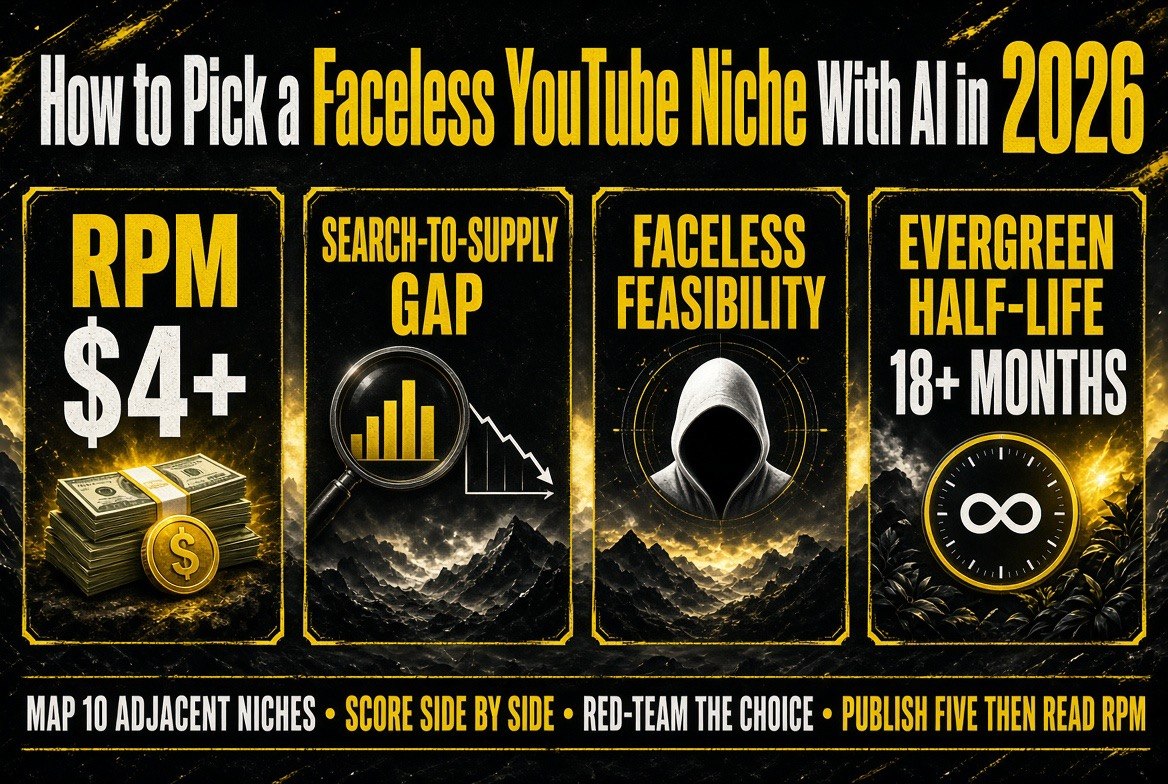
Before you generate a single script, you need three data points. AI makes acquiring all three practical in a single session.
| Metric | What It Tells You | Target Range | Where AI Gets It |
|---|---|---|---|
| RPM (revenue per 1,000 views) | The actual economics of the category | $4+ to be worth it | Creator reporting sites, compiled by AI |
| Search-to-supply gap | Demand minus the quality of existing answers | Visible gap | Transcript analysis of top 20 videos |
| Production feasibility | Whether AI can realistically make this without your face | No filming required | Script-to-video test render |
| Evergreen half-life | How long a video keeps earning after upload | 18+ months | Upload-date spread of top results |
RPM is the number most creators skip, and it is the one that decides whether the channel is a business or a hobby. Published creator RPM data puts finance, software, insurance, and legal content in a completely different bracket from gaming, pranks, and general entertainment. The gap is often five to eight times, not five to eight percent.
The search-to-supply gap is your entry point. A niche is only worth entering if the top results are genuinely weak. This is where faceless AI channels have a structural advantage: you can out-research a hobbyist who films from their bedroom because you can process every transcript in the category in minutes.
Step 1: Map the Adjacent Niches With AI Before You Choose One
Nobody picks a good niche in the abstract. They pick it by comparing five or six candidates that sit near their existing interests, skills, or audience knowledge.
Start by prompting an AI model with your constraints rather than a topic. Give it what you actually have: subjects you already understand, hours per week you can commit, whether you can appear on camera, and a target income. Ask it to return ten adjacent niches, each with the audience, the advertiser category, and the natural video formats.
The value here is not that the AI knows something you do not. It is that it forces breadth. Most creators fixate on the first idea that sounds plausible and never compare it to anything. Ten candidates side by side makes the weak ones obvious.
Then cut the list using a hard filter: does this niche have an advertiser with a real budget? A niche about $8,000 business software has buyers. A niche about celebrity gossip has viewers. Different businesses entirely.

The same 100,000 monthly views pay roughly $150 in a general motivation niche and roughly $2,400 in a commercial insurance niche. Before you commit to a category, check that its RPM clears the $4 floor.
Step 2: Validate Demand and RPM With Real Data, Not Vibes
Once you have three to five candidates, validate each one with numbers. Two queries do most of the work.
First, demand. Search the niche’s core phrases and look at what already ranks. If the top results are from 2019 and have 40,000 views, you have found a neglected niche with proven interest. If the top results are three weeks old with two million views, you are walking into a knife fight.
Second, economics. Pull RPM ranges for the category from creator reporting and industry data. Ask AI to compile and normalize the figures — different sources report RPM, CPM, and playback-based revenue differently, and mixing them produces nonsense. Normalize everything to revenue per 1,000 views on long-form content.
Then apply one more check that most creators miss: what else does this audience buy? If the answer is nothing, the RPM is your entire ceiling. If the answer is software, courses, insurance, or equipment, you have an affiliate and sponsorship layer on top of ads — usually the difference between a channel that pays rent and one that pays a mortgage.
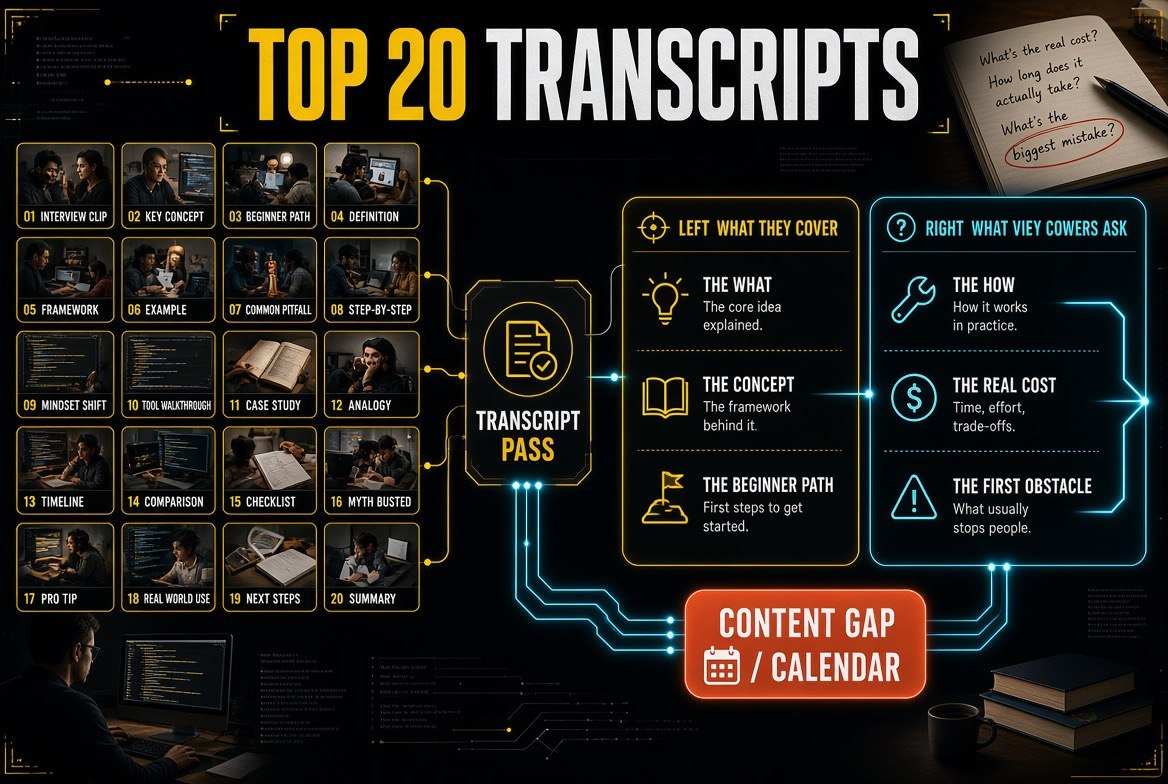
Pull the top 20 videos in a candidate niche, run every transcript through one AI pass, and sort the output into what the videos already cover versus what viewers keep asking for. The right-hand column is your content calendar.
Step 3: Run a Transcript Gap Analysis Against the Top 20 Videos
This is the single highest-value AI task in the entire process, and almost nobody does it.
Pull the top 20 videos in your candidate niche. Feed their transcripts to an AI model and ask one question: what do viewers repeatedly ask for in the comments and in the questions these videos never answer?
The model will surface the same patterns every time. The videos cover the what but never the how. They explain the concept but skip the cost. They cover the beginner path but abandon the viewer at the first real obstacle.
That gap is your content calendar. You now know exactly which videos to make, because you know precisely what the existing answers fail to deliver. A faceless channel that fills documented gaps beats a faceless channel that adds noise to a saturated format every time.
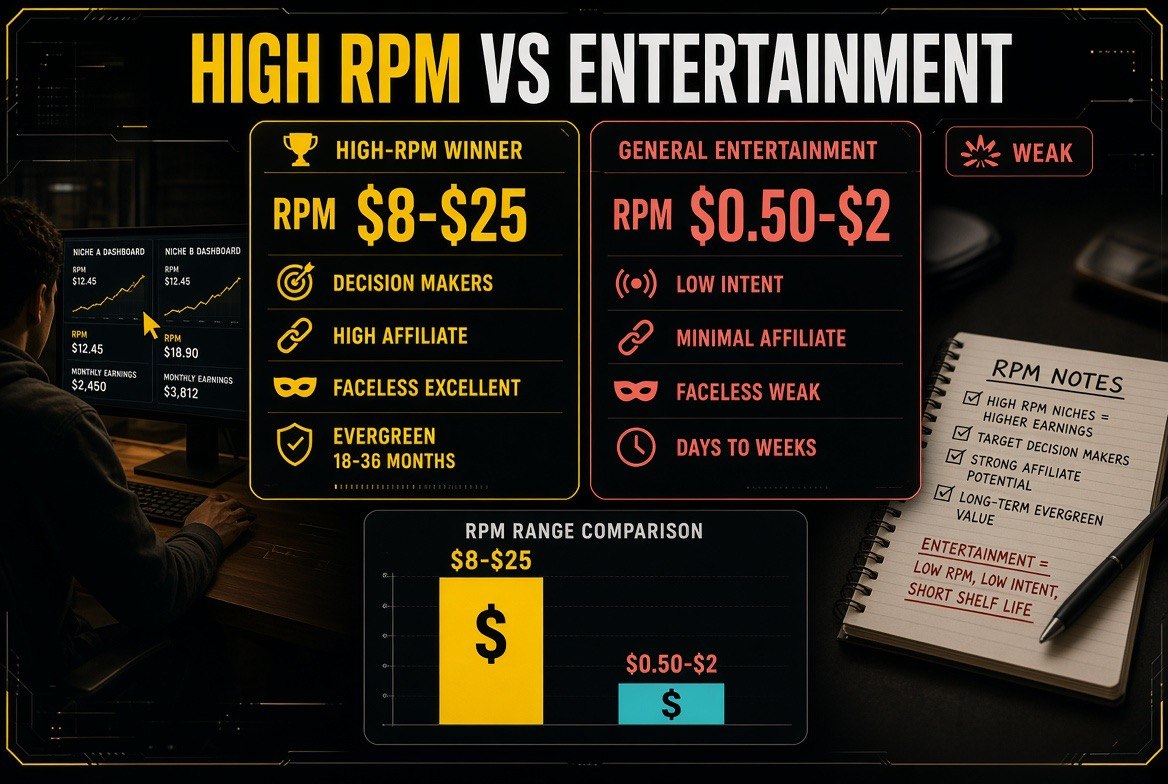
Score your finalists on the six factors that actually decide revenue. The high-RPM niche wins on RPM bracket, buyer intent, affiliate potential, faceless feasibility and evergreen half-life — it is rarely a close call once the numbers sit side by side.
Step 4: Score Your Candidates Side by Side
You will end up with two or three viable niches. Do not pick by feel. Score them.
| Factor | High-RPM Niche (e.g. B2B Software) | General Entertainment Niche |
|---|---|---|
| Typical RPM | $8 – $25 | $0.50 – $2 |
| Audience buying power | Decision-makers with budgets | Broad, low purchase intent |
| Affiliate potential | High — recurring software commissions | Minimal |
| Faceless feasibility | Excellent — screen recordings, charts, text | Weak — needs personality to compete |
| Evergreen half-life | 18–36 months | Days to weeks |
| Competition quality | Often outdated and thin | Saturated, professionally produced |
Notice what happens in that comparison. The high-RPM niche wins on economics, wins on affiliate potential, wins on faceless feasibility, and wins on longevity. It is not a close call. Yet most creators pick the entertainment niche because it is more fun to make.
Fun to make is a real cost. It is just not the cost that decides whether the channel survives.
Step 5: Pressure-Test the Niche With AI Before You Commit
Before you commit 50 videos to a category, run a red-team pass. Ask an AI model to argue against your choice — specifically, to find the reasons this niche fails for faceless channels.
You will get back the failure modes that actually matter. The advertiser base is shrinking. The audience is too small to sustain the upload volume required. The content cannot be made without footage you do not have rights to. The category’s top creators are already using the exact workflow you planned to use as your edge.
Every one of those objections is cheap to test now and expensive to discover in month six. This is the whole argument for AI-assisted niche selection: it moves the failure from the middle of the project to the beginning, when changing course costs nothing.
Step 6: Build the Niche Map and Lock the Format
Once the niche is chosen, do not start uploading. Map it first.
Ask AI to generate the full content architecture: the five or six recurring video formats, the topic clusters under each, the natural internal linking between them, and the upload sequence that builds authority fastest. Treat this as a season plan, not a list of video ideas.
The reason this matters for faceless channels specifically is that you are competing on library depth, not personality. A viewer who finds one video in a well-mapped niche is likely to find six more. A viewer who finds one video in a scattered channel watches it and leaves. The map is what converts a single view into a session, and a session into a subscriber.
Lock the format at the same time. Decide the video length, the structure of the first 30 seconds, the visual style, and the thumbnail convention. Faceless production lives or dies on consistency, because the format is the only thing replacing a familiar face.
Step 7: Run a Small Live Test Before Scaling
Publish five videos. Not fifty. Five.
Then read the data honestly. Look at average view duration, not views. Look at which video earned the most per thousand views, not which got the most clicks. Look at whether the comments are asking questions inside your niche or outside it.
Five videos is enough signal to know whether the niche holds attention and whether the economics are real. If the RPM on video one is a third of what you projected, that is not a slow start — that is the market telling you the category will not pay what you need.
Scaling a broken niche with AI is the most efficient way ever invented to lose money faster. The whole point of using AI in this process is to find out cheaply, before the library exists.
How to Pick a Niche on Each Platform
Niche selection is not platform-neutral, and the same category can behave very differently depending on where you publish and how you monetize.
| Consideration | Long-Form YouTube | Shorts-First Channel |
|---|---|---|
| Revenue per view | High — full ad breaks available | Low — Shorts monetization pays a fraction |
| Best niche type | Research-heavy, evergreen explainers | Hook-driven, high-volume, low-depth |
| Discovery model | Search + suggested, compounds over time | Feed-driven, decays in days |
| AI production fit | Strong — script, voice, b-roll all automatable | Very strong — cheapest possible output |
| Main risk | Slow start, requires patience and volume | Views without income; RPM trap |
If your goal is a channel that pays, pick a long-form evergreen niche and use Shorts as the discovery layer feeding it. If your goal is audience growth for something you monetize off-platform, the Shorts-first math can work — but be honest that YouTube is paying you almost nothing in that model.
The mistake is picking a Shorts-friendly niche and expecting long-form economics from it. Those are two different businesses wearing the same platform.
One more consideration that sits outside niche selection itself: your editing and upscaling stack. A niche built on archival footage, gaming captures, or low-resolution b-roll lives or dies on how those assets look after processing. If your candidate niche depends on older source material, check our AVCLabs vs Topaz Video AI 2026 comparison before you commit — a niche you cannot make look sharp on a phone screen is a niche you cannot win.
Common Niche Selection Mistakes That Kill Faceless Channels
Chasing the trending niche. A niche that trends this month is a niche that is saturated in three. Trends are for established channels to exploit, not for new ones to build on.
Confusing personal interest with audience demand. Your fascination is not evidence. The only evidence is whether people are already searching for this and whether the existing answers are weak.
Ignoring the advertiser entirely. Creators research the audience and never the advertiser. The advertiser pays you. If nobody is bidding to reach this audience with a product, you have a hobby.
Going too broad to feel safe. A channel about “AI” competes with everyone. A channel about AI for dental practices competes with almost nobody and attracts advertisers with real budgets.
Never revisiting the decision. Niche selection is not permanent, but drift is not a strategy either. Review RPM quarterly. If it is falling, find out whether the content or the category changed.
Frequently Asked Questions
Can I run a faceless channel in a low-RPM niche and still make money?
Yes, but the money will come from something other than ads. Low-RPM categories can work with strong affiliate relationships, digital products, or sponsorships where the audience has high intent. Without one of those layers, the ad revenue alone rarely justifies a faceless channel’s production cost.
How many videos before I know if a niche is working?
Five is enough to read the early signal on retention and revenue per view. It is not enough to judge total growth, which takes volume. Treat the first five as a validation test, not a launch.
Do I need to appear on camera for high-RPM niches?
No — this is the strongest argument for high-RPM faceless channels. Software, finance, insurance, and B2B categories are largely screen recordings, charts, and text. The content is information-dense by nature, which suits AI-assisted production.
Is it too late to start a faceless YouTube channel in 2026?
Not in specific niches. It is late in the broad, saturated formats that dominated 2023 and 2024. The opportunity has shifted from “any faceless channel” to “faceless channels in well-chosen niches,” which makes selection the entire game.
What is a good RPM for a faceless channel?
Treat $4 as the floor for a channel you intend to grow as a business. Below that, ad revenue per view rarely covers production time. Above $10, the channel starts to make sense as a standalone asset.
How do I stop my niche from drifting after the algorithm finds an audience?
Lock the format and the topic map before you start, and audit quarterly. When a video outside your core niche outperforms, note it but do not chase it unless it holds for several uploads. One outlier is noise; a pattern is drift.
Can AI actually predict which niche will perform?
No. AI compresses the research — it maps candidates, normalizes RPM data, and finds gaps in existing content. It does not predict outcomes. Use it to eliminate bad options quickly, then test the survivors with real uploads.

About Barak Schurr
Barak Schurr is a serial entrepreneur who built and exited a major ticketing platform before turning his attention to AI and content. He runs three AI-focused research sites and writes about the tools, workflows, and strategies that let solo creators build real channels — without a crew, a studio, or a Hollywood budget.
Email: [email protected]
More AI Resources for Your Business