YouTube’s Conversational Editing: What Made on YouTube 2026 Means for Solo Creators
Get The Faceless YouTube Blueprint — Free
The exact AI tool stack and workflow used to build a faceless YouTube channel from zero.
YouTube’s Conversational Editing: What Made on YouTube 2026 Means for Solo Creators
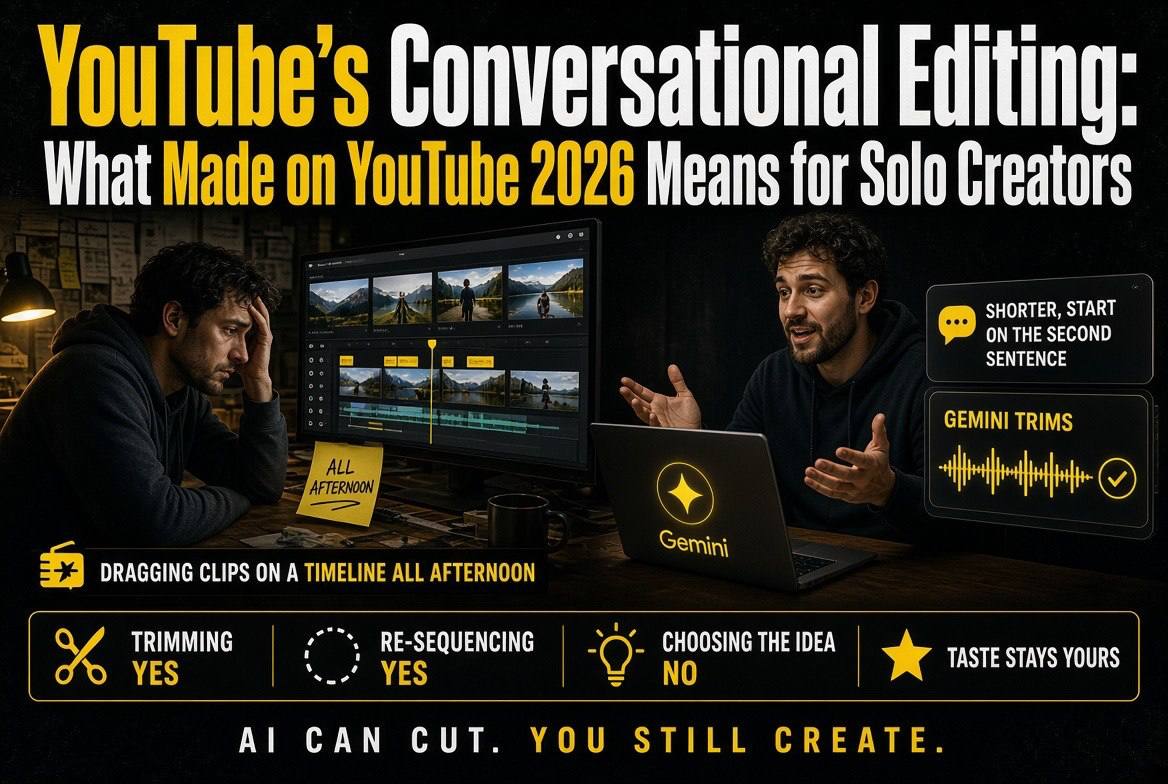
⚡ Expert Summary: YouTube used Made on YouTube 2026 to preview Conversational Editing — a system where creators edit Shorts by talking to Gemini rather than dragging clips on a timeline — alongside new insight tools. It lands in early 2027. The practical meaning for a solo creator is narrower than the headlines suggest and more useful than the sceptics claim. Conversational editing removes the mechanical cost of trimming and re-sequencing, which is where most solo creators lose their afternoons. It does not remove the editorial judgment that decides whether a Short works. The right move in 2026 is not to wait for it and not to rebuild your workflow around it — it is to fix the bottleneck underneath it, which is having too much unstructured footage and no system for the first assembly cut.
Editing is the part of the job solo creators describe most often as the reason they stopped posting. Not ideas — ideas arrive faster than they can execute them. Not filming — a phone and twenty minutes covers that. The bottleneck is sitting in front of a timeline, deciding where each cut goes, for the fourth time on the same three minutes of footage.
That is the specific problem Conversational Editing aims at. YouTube previewed it at Made on YouTube 2026, and the pitch is simple: you talk to Gemini about what you want, and it does the cutting. The rollout is slated for early 2027.
Whether that changes your life depends entirely on which part of your editing time is actually the problem.
What Conversational Editing Actually Is
Strip the marketing and it is one capability: a natural-language interface to the editing timeline. Instead of hunting for the in-point, you describe the intended result — cut this down to the strongest thirty seconds, remove the pauses, reorder so the payoff comes first — and the system produces an edit you can then adjust.
Two things make it genuinely different from the AI editing features creators already have.
It is a conversation, not a one-shot button. The existing generation of AI editing features are mostly single-action: remove silence, generate a thumbnail, suggest a title. Conversational editing means iterating — “shorter,” “start on the second sentence,” “cut the sponsor bit” — as a back-and-forth rather than an export-and-retry loop.
It is platform-native. This is not a third-party tool bolted onto your workflow with a file transfer between them. It lives where the video already does. For a solo creator, removing one upload-download-upload cycle is worth more than most feature lists.
It also arrives alongside new insight tools, which matter more than people expect. Understanding which segments of a Short actually retain viewers is the difference between guessing and knowing what to cut.
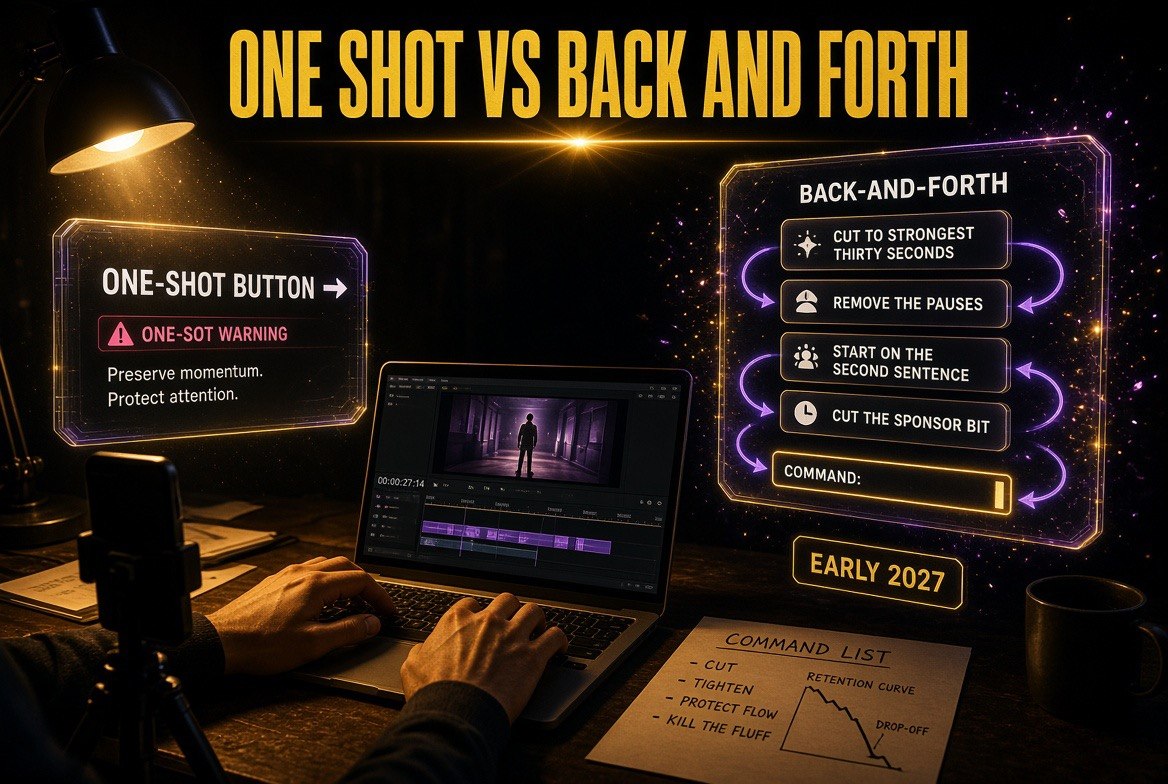
One-shot AI editing versus the back-and-forth conversation: the timeline matters as much as the feature does
The Timeline Matters as Much as the Feature
The part of this announcement that deserves the most attention is the date: early 2027. That is not a rollout schedule, it is a planning constraint, and creators respond to it badly in two predictable ways.
The first mistake is waiting. If you put your channel on hold because a better tool is coming, you have traded a year of compounding audience growth for a feature you have not used yet. The creators who win are the ones with footage, an audience, and a system by the time the tool lands — because a better editing interface multiplies an existing library and does nothing for an empty one.
The second mistake is rebuilding around it now. Writing your workflow around an unreleased feature means guessing at how it will behave in practice, on real footage, at your volume. Preview demos are not the same as a tool you use forty times a week.
The correct posture is boring: keep your current system running, and fix the part of the process that Conversational Editing will not fix.
| Editing Task | What Conversational Editing Fixes | What You Must Still Do |
|---|---|---|
| Trimming and silence removal | Yes — describe it, done | Nothing |
| Re-sequencing for a hook | Yes — iterate by asking | Deciding which moment is strongest |
| Choosing the idea | No | All of it |
| Knowing what to cut next time | Partly — via insight tools | Reading the retention data |
| Having footage to edit | No | Filming, consistently |
What It Replaces, and What It Does Not
The mistake creators make with every new AI editing feature is assuming it removes the editorial work. It does not. It removes the mechanical work, and those are different jobs that happen in the same application.
The mechanical work is finding in-points, removing dead air, reordering clips, matching cuts to beats. It is tedious, it is learnable, and it is exactly what a conversational system can do well once it understands your intent.
The editorial work is deciding that the strongest moment in four minutes of footage is the throwaway line twelve seconds in, and that the whole piece should open there. That judgement is the thing your audience is actually there for, and it remains entirely yours.
So the honest framing is this: conversational editing gives you back hours per week, and it will not make a mediocre idea work. Creators who understand that will get a large return. Creators who hear “AI edits your videos” and stop thinking about structure will produce more videos that nobody watches, faster.
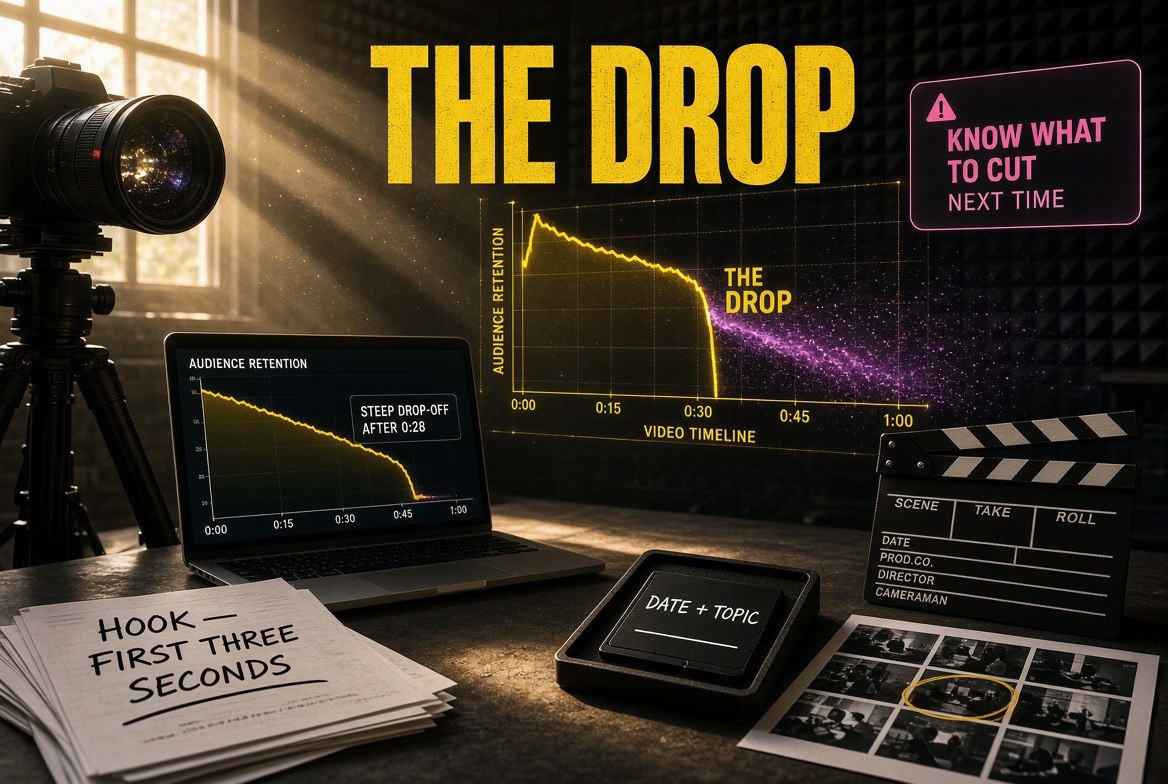
Retention curve with the marked drop-off cliff — the preparation work no editing tool can do for you.
The Real Bottleneck It Does Not Touch
Ask any solo creator where the time actually goes and the answer is usually not the cutting. It is the first assembly — sitting in front of raw footage and deciding what the video is.
Conversational editing starts from an edit you can describe. If you cannot describe the video you want, no amount of conversational interface helps, because the system needs a target. That means the preparation work — knowing your angle, having a rough structure, being able to say what the piece is for — becomes more valuable, not less.
The creators who will benefit most from this are already doing that prep. Everyone else gets a faster path to a video they have not thought through.
What to Do Before Early 2027
Four things, none of which require waiting and all of which survive whatever YouTube ships.
1. Build a footage system. Name files by date and topic. Keep a running note of the strongest thirty seconds from each session, written while you still remember why you filmed it. This single habit is worth more than any editing feature, because it means the first assembly stops being a memory exercise.
2. Write the hook before you film. If you cannot say in one sentence what the first three seconds are doing, you are going to discover the problem in the edit, which is the most expensive place to find it. Fix it before the camera turns on.
3. Read your retention data now. The insight tools coming alongside conversational editing will be more useful to creators who already understand their own numbers. Learn where viewers drop off on your current Shorts. That knowledge is what you will feed into the tool when it arrives.
4. Keep your current editor warm. Do not migrate, do not restructure, do not cancel a subscription on the assumption this replaces it. Treat early 2027 as a possible upgrade, not a scheduled replacement.
| Strategy | Cost Now | Outcome When It Lands |
|---|---|---|
| Wait for the feature | A year of no publishing | A tool, and no library to use it on |
| Rebuild workflow around it | Wasted effort on guesses | Mismatch between plan and reality |
| Keep publishing, fix the prep | Business as usual | A multiplier on an existing channel |
| Learn your retention data | An hour a month | Better inputs to whatever ships next |
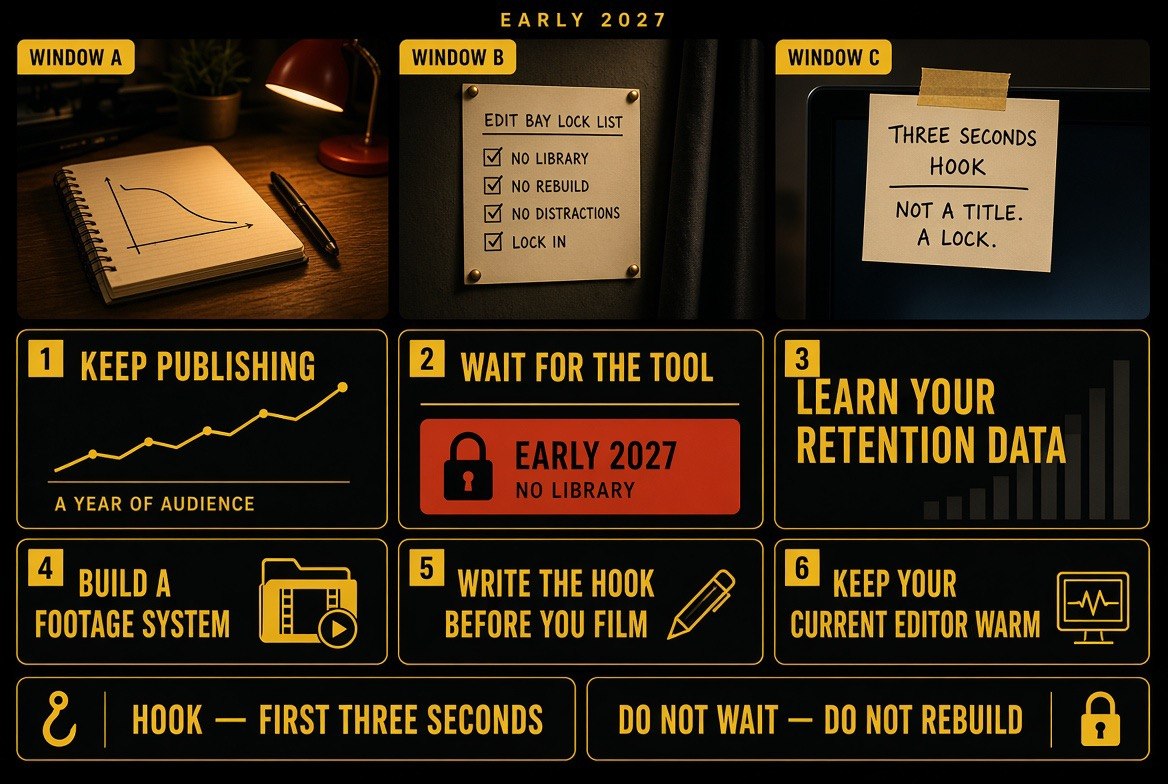
The decision fork before early 2027: keep publishing and build the prep system, or wait for a tool that will not fix the assembly cut.
Why This Matters Beyond the Feature
There is a larger signal in this announcement worth naming. When the platform itself starts building conversational interfaces into the editing process, the value of knowing a specific editing application drops, and the value of knowing what makes a Short work rises.
That is the same shift that has already happened in writing, where the ability to operate a word processor stopped being a differentiator years ago. Editing software is heading the same direction. The durable skills are taste, structure, and knowing your audience — and those have never been automatable, which is precisely why they are worth building.
For a solo creator, that is genuinely good news. You were never going to out-edit a team with three editors. You can absolutely out-think one on a good idea.
Frequently Asked Questions
What is Conversational Editing? A YouTube feature previewed at Made on YouTube 2026 that lets creators edit Shorts by describing the changes they want to Gemini in natural language, rather than manipulating a timeline directly. It is slated for early 2027.
Will it make editors unnecessary? No. It removes mechanical timeline work — trimming, re-sequencing, silence removal — while leaving editorial judgement, structure, and idea selection entirely with the creator. For solo creators it is a time saver, not a replacement.
Should I wait for it before publishing more? No. Waiting gives up a year of audience compounding for an unreleased tool. Keep publishing and fix the preparation bottleneck, because that is the part conversational editing does not address.
Will it work for long-form videos or only Shorts? The preview focused on Shorts. Treat long-form as unannounced until YouTube says otherwise, and do not plan around an assumption.
What should I do in the meantime? Build a footage naming system, write your hook before filming, and learn your own retention numbers. All three make the eventual tool more useful and all three pay off immediately regardless.
The Bottom Line
Conversational editing is a real improvement aimed at a real problem — the mechanical cost of cutting video — and it arrives in early 2027, which is far enough away that planning around it is a mistake in either direction. Do not wait, and do not rebuild.
Spend the intervening months on the part that no editing interface can do for you: deciding what the video is before you start cutting it. When the tool ships, it will multiply whatever system you already have. Make sure there is a system worth multiplying.

About Barak Schurr
Barak Schurr is a serial entrepreneur who built and exited a major ticketing platform before turning his attention to AI and content. He runs three AI-focused research sites and writes about the tools, workflows, and strategies that let solo creators build real channels — without a crew, a studio, or a Hollywood budget.
Email: [email protected]
More AI Video Resources