Seedance 2.5 Launches With 30-Second AI Video Clips and Pixel-Level Editing
Get The Faceless YouTube Blueprint — Free
The exact AI tool stack and workflow used to build a faceless YouTube channel from zero.
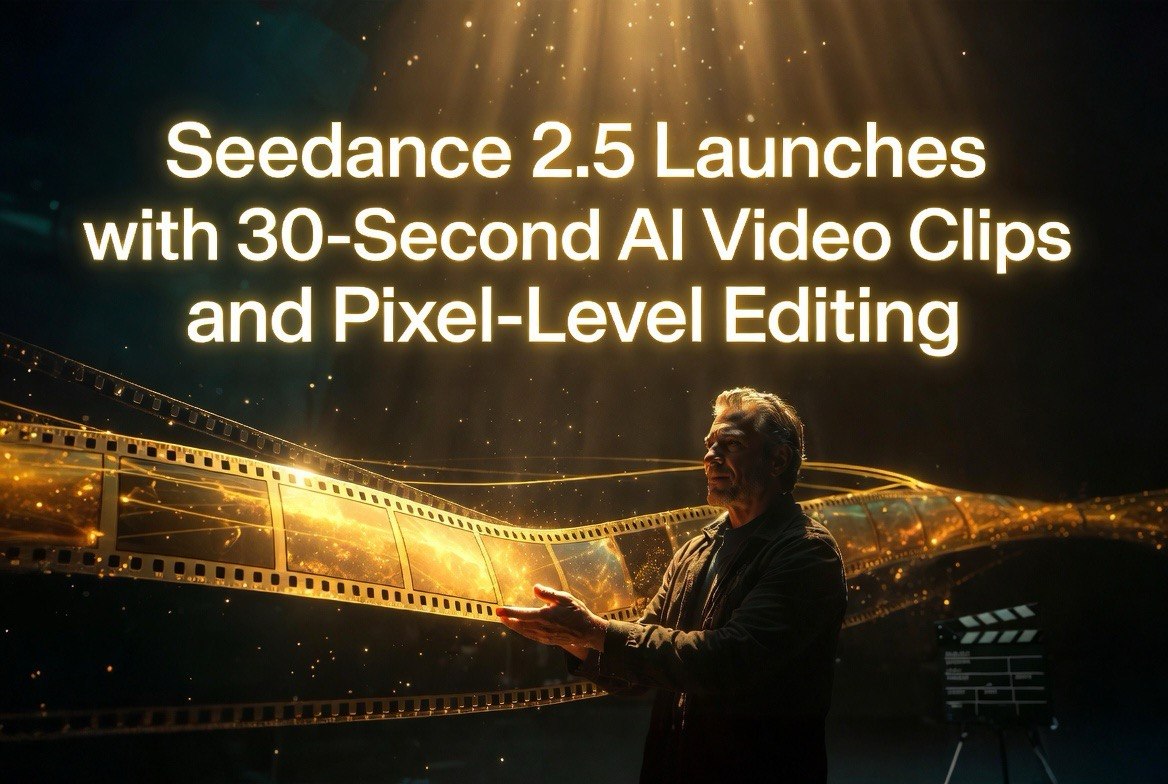
Seedance 2.5 Launches With 30-Second AI Video Clips and Pixel-Level Editing
⚡ Expert Summary: ByteDance’s Seedance 2.5 launched in early July 2026, bringing native 30-second continuous video generation and local pixel-level editing to the AI video space. The model supports up to 50 multimodal reference inputs and allows editors to modify specific parts of a scene — like changing a character’s hair color or fixing a background detail — without regenerating the entire clip. It is available through Dreamina, CapCut (mid-July), and API via Volcano Engine.
ByteDance’s Seedance 2.5 went public this week, and it represents a meaningful leap in what AI video generation can do for creators who need production-quality output without frame-by-frame manual editing.
The model was announced at ByteDance’s Volcano Engine FORCE conference on June 23, with the public rollout starting around July 3. TechTimes, Digital Applied, and multiple outlets confirmed the launch timing and detailed the three features that distinguish 2.5 from its predecessor, Seedance 2.0: native 30-second clips, up to 50 multimodal reference inputs, and local region editing.
Native 30-Second Clips Without Stitching
Most AI video models generate clips in 5-to-15-second segments that creators then stitch together. The stitching process introduces visible seams — lighting shifts, subject inconsistencies, scene jumps — that require manual correction. Seedance 2.5 generates unbroken clips up to 30 seconds in a single pass.
This matters for practical video production. A 30-second clip is long enough for a product demonstration, a social media ad, a short tutorial segment, or a scene in a narrative sequence. Creators who need longer pieces can string two 30-second clips together with a clean transition rather than stitching five or six short clips that fight each other.
The model handles scene changes and tempo shifts within the same generation. A prompt for a “coffee shop interior at sunrise, moving from empty to busy over 20 seconds” would generate the full atmospheric shift in one clip rather than requiring separate morning and busy-hour segments.
Local Pixel-Level Editing Changes the Workflow
The feature that separates Seedance 2.5 from the current field is local region editing. If you generate a scene and the character’s shirt is the wrong color, or a background sign has a typo, or the lighting on a product is off — you can select that specific region in the frame and regenerate only that part.
This is not inpainting applied to a static frame. The local edit propagates through the video timeline, maintaining consistency across frames while only changing the selected area. A creator who needs to fix a product label in a 30-second demonstration does not regenerate the entire video. They select the label area, describe the correction, and the model rewrites that region across the relevant frames.
For commercial use — product videos, ads, branded content — this feature alone justifies the upgrade from Seedance 2.0. It eliminates the “close enough, ship it” tradeoff that creators make when regenerating an entire clip would take another 15 minutes.
50 Multimodal References for Consistent Character and Scene Control
Seedance 2.5 accepts up to 50 reference inputs — images, text descriptions, style references — and uses them to maintain consistency across the generated video. That is a significant jump from Seedance 2.0’s reference handling and puts it ahead of most competitors on input capacity.
For a brand producing a series of social media videos, this means uploading a reference image of the product, a style card for the visual aesthetic, a text description of the scene, and a character reference for any on-screen talent — and having the model respect all of them in the output. The more reference inputs, the tighter the output alignment with the creative brief.
Where and How to Access Seedance 2.5
ByteDance is rolling out Seedance 2.5 through multiple channels. Dreamina, the international consumer platform, has the model available as of early July. CapCut integration is expected by mid-July 2026 — which is significant because CapCut’s existing user base of video editors means Seedance 2.5 will reach creators who are already editing, not just AI tool enthusiasts. Enterprise API access comes through Volcano Engine later in July.
The pricing structure follows ByteDance’s model for Seedance 2.0: a free tier with limited daily generations and paid tiers for higher volume and resolution. Specific Seedance 2.5 pricing had not been finalized at launch, but early access users reported generation credits at roughly 1.5x to 2x the cost of 2.0 generations for the longer clips.
TechTimes noted that ByteDance is offering copyright ownership on all Seedance 2.5 generated content — a detail that matters for commercial users who need clear licensing for their video assets.
Where Seedance 2.5 Fits in the July 2026 AI Video Landscape
Seedance 2.5 launches alongside Grok Imagine Video 1.5 (also released this week) and competes directly with Google Veo 3.1 and Runway Gen-4. Among these, Seedance 2.5 has the strongest claim on practical commercial use — the local editing feature and multimodal reference support address real production pain points that content creators deal with daily.
The 30-second native clip generation also puts pressure on competitors to extend their own clip lengths. Runway Gen-4 currently maxes out at around 18 seconds per clip. If Seedance 2.5’s quality holds up at the 30-second mark, the rest of the field will need to respond.
How Local Editing Changes Production Workflows
Local region editing in Seedance 2.5 is not just a convenience feature. It fundamentally changes the economics of AI video production. Before local editing, generating a video that was almost right meant starting over. If the background had an object that did not fit the brand aesthetic, or the lighting was slightly off, or a product label was blurry — the creator regenerated the entire clip and hoped the next version fixed the issue while introducing no new problems. This regeneration cycle consumed time, credits, and patience.
With local editing, the creator generates once, identifies the specific area that needs to change, describes the correction, and the model updates only that region across the relevant frames. A product label that rendered with the wrong color gets fixed in two minutes instead of creating a new 15-minute generation cycle. A background element that clashes with the brand palette gets replaced without affecting the foreground subject.
For commercial video production — ads, product videos, social media campaigns — this feature alone saves hours per project. A creator generating a 30-second product video for a new clothing line can fix the color of a garment in a specific scene without regenerating the entire video. The time savings compound across multiple iterations, which is the reality of commercial video work.
The editing propagates through the video timeline, maintaining consistency. If you fix a background sign at frame 15, the fix carries through to frame 20 where the sign appears at a different angle. This temporal consistency is difficult to achieve with frame-by-frame editing tools and is one of the most technically impressive aspects of Seedance 2.5.
Seedance 2.5’s Impact on the AI Video Market
Seedance 2.5’s launch alongside Grok Imagine Video 1.5 in the same week creates a competitive dynamic that benefits creators. ByteDance and xAI are now directly competing in the video generation space, and the competition pushes both to improve faster than either would alone.
The key battleground features for the second half of 2026 will be clip length, editing control, and reference consistency. Seedance 2.5 leads on clip length with 30 seconds. Runway Gen-4 leads on editing control. ByteDance’s lead in multimodal reference support — 50 inputs — sets a benchmark that competitors will need to match. Grok Imagine Video 1.5’s lead is accessibility through GlobalGPT’s established platform and existing user base.
For small business owners and content creators, this competition is good. It means each platform is motivated to improve quality, reduce pricing, and add features. The days of paying premium prices for mid-quality AI video generation are ending. By Q1 2027, the expectation will be 30-second clips with local editing capability as standard features across all major platforms.
What Creators Should Know Before Switching to Seedance 2.5
The practical question for creators evaluating Seedance 2.5 is whether the upgrade from Seedance 2.0 or another existing tool is worth the transition cost. For creators who regularly generate videos longer than 15 seconds, the 30-second native clip support is a clear upgrade. The stitching artifacts that plague shorter-clip workflows are eliminated. For creators who do iterative work — generating, reviewing, adjusting — the local editing feature pays for itself in time savings within the first few projects.
Creators who primarily generate short clips for social media — 5-10 second snippets — may not see enough benefit from 2.5 to justify the transition immediately. Seedance 2.0 Mini remains a capable tool for short-form generation at lower cost. But for anyone producing video content for commercial use, the local editing feature alone justifies the upgrade. It removes the biggest friction point in AI video production: the binary choice between accepting a flawed output or regenerating from scratch and hoping for something better.
CapCut integration, expected by mid-July, will be the catalyst that brings Seedance 2.5 to mainstream creator adoption. CapCut’s editing workflow combined with Seedance’s generation capabilities creates a seamless pipeline from prompt to finished video without leaving the editing environment. That integration is where ByteDance’s ecosystem advantage becomes clear.
Pricing and Access for Seedance 2.5
ByteDance’s pricing for Seedance 2.5 follows the model established with 2.0: a free tier with limited daily generations and paid tiers for higher volume and resolution. Early access users reported generation credits at roughly 1.5-2x the cost of Seedance 2.0 generations for the longer 30-second clips. For creators producing commercial video content at scale, this pricing is still competitive against traditional production costs and holds its own against runways and other AI-native tools.
The Dreamina platform provides immediate access through a web interface. CapCut integration arrives in mid-July, bringing Seedance 2.5 directly into the editing workflow. Enterprise users can access the model through Volcano Engine API with volume pricing and dedicated infrastructure. ByteDance’s offer of full copyright ownership on generated content remains a significant advantage for commercial users who need clear licensing terms.
FAQ
What is Seedance 2.5?
Seedance 2.5 is ByteDance’s latest AI video generation model, launched in July 2026. It generates native 30-second continuous clips, supports local pixel-level editing without regenerating the full scene, and accepts up to 50 multimodal reference inputs.
How long are Seedance 2.5 video clips?
Seedance 2.5 generates up to 30 seconds of continuous video in a single pass, with built-in scene changes and tempo shifts. This is a significant upgrade from the 15-second limits of most competing models.
What is local region editing in Seedance 2.5?
Local region editing lets you select a specific area of a generated video — like a character’s hair color, a background object, or a product label — and modify only that region. The change propagates through the video timeline without regenerating the entire clip.
How do I access Seedance 2.5?
Seedance 2.5 is available through Dreamina (international platform) starting July 2026. CapCut integration is expected by mid-July. Enterprise users can access it via Volcano Engine API later in July.
Does Seedance 2.5 offer commercial copyright on generated content?
Yes. ByteDance offers copyright ownership on all Seedance 2.5 generated content, which is important for commercial users who need clear licensing for video assets used in products, ads, and branded content.

About Barak Schurr
Barak Schurr is a serial entrepreneur who built and exited a major ticketing platform before turning his attention to AI and content. He runs three AI-focused research sites and writes about the tools, workflows, and strategies that let solo creators build real channels — without a crew, a studio, or a Hollywood budget.
Email: [email protected]