OpenArt Director Turns AI Video Creation Into a Chat Conversation
Get The Faceless YouTube Blueprint — Free
The exact AI tool stack and workflow used to build a faceless YouTube channel from zero.
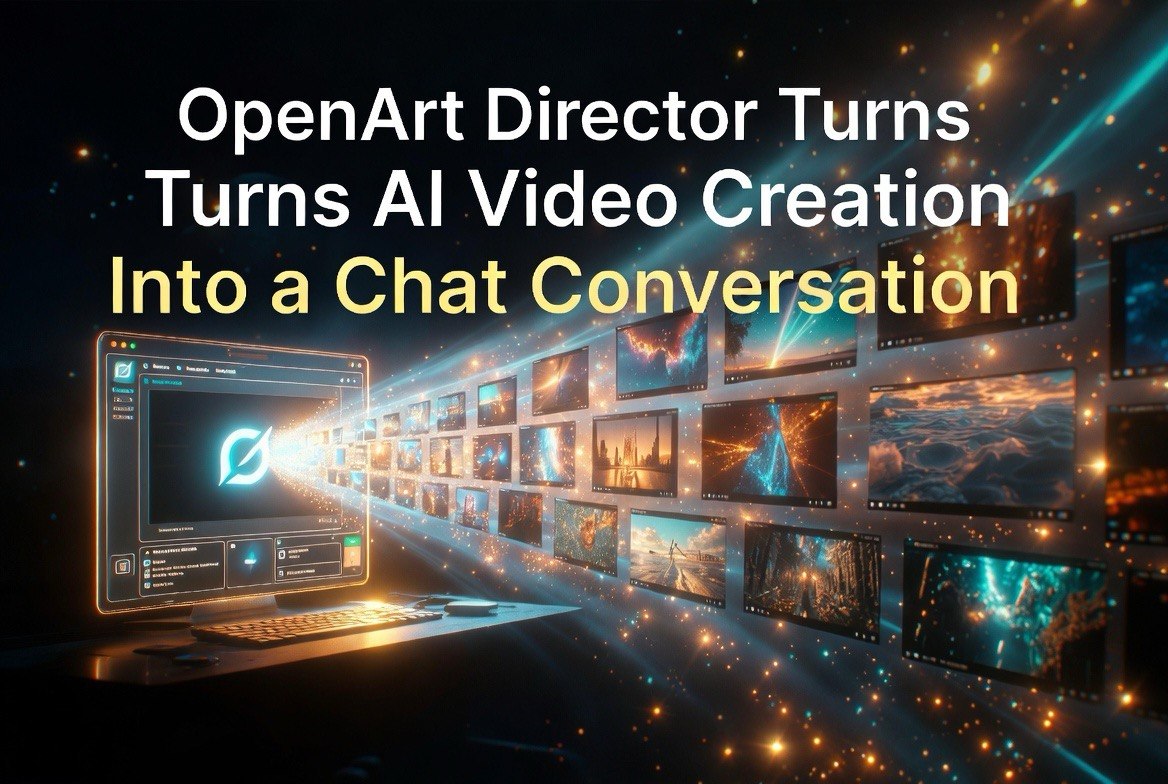
OpenArt Director Turns AI Video Creation Into a Chat Conversation
⚡ Expert Summary: OpenArt just launched Director, a conversational AI video workflow that lets creators describe their ideas in natural language and generate professional-quality video through iterative chat. Called “Vibe Directing,” the system moves AI video creation beyond one-shot generation into a collaborative creative process. For content creators across the United States, this is a meaningful step toward AI video tools that don’t require prompt engineering expertise.
Most AI video generators work the same way. You write a prompt, hit generate, and pray the output matches what you had in your head. When it doesn’t — and it usually doesn’t on the first try — you’re stuck rewriting prompts, tweaking parameters, and generating dozens of versions until something usable appears.
OpenArt Director flips that model. Instead of prompt-and-pray, it offers conversation-and-refine. You describe what you want in natural language. The system interprets your intent, generates draft video, and engages in a back-and-forth creative dialogue until you get what you need.
Think of it as the difference between shouting instructions through a locked door and sitting down with a creative collaborator who can interpret what you actually mean. The locked door approach — traditional AI video prompting — works if you already know exactly which 200 characters of text will produce the result you want. The collaborative approach — Vibe Directing — works if you have a creative vision and are willing to refine it through conversation.
Announced in late June 2026, OpenArt Director represents what happens when AI video tools graduate from tech demos to production workflows. The early wave of AI video was about proving it could be done. This new wave is about making it actually useful for creators who aren’t willing to become prompt engineers.
What Is Vibe Directing?
OpenArt’s “Vibe Directing” is the core innovation in Director. The term sounds like marketing jargon, but the underlying concept is real: instead of treating AI video generation as a single-input, single-output transaction, you treat it as a conversation with a creative assistant.
Here’s how it works in practice. You start by describing the scene you want to create in plain English. “A cinematic drone shot of a mountain lake at golden hour with mist rising from the surface.” Director generates a first draft. You watch it, then refine: “Make the camera movement slower and push the color toward warm amber tones.” Director updates the video. You continue: “Add a bird flying across the upper third of the frame.” Director incorporates the change.
This iterative approach is closer to how actual video production works. A director doesn’t hand a DP a single instruction and walk away. They discuss, adjust, and refine until the shot matches the vision. OpenArt Director brings that creative loop to AI video generation for the first time at scale.
Why This Matters for Content Creators
The fundamental problem with current AI video tools is that they reward prompt engineering skills over creative vision. A creator who knows how to write a perfect prompt gets better results than a creator with a stronger creative vision but weaker technical prompting. That’s backwards.
OpenArt Director inverts this. Strong creative vision becomes the primary skill. You describe what you want, the system does the technical work of translating that into effective generation parameters, and the refinement loop lets you adjust based on results, not based on your ability to guess the right technical parameters.
For creators who produce video content regularly — YouTube channels, social media marketers, short-form content producers — this workflow saves significant time. Instead of generating 30 versions of a scene to find one usable output, you guide the system conversationally and converge on the right result in fewer iterations.
The creators who adopt this workflow early will have a clear advantage. While their competitors are still writing and rewriting prompts in traditional generators, they’ll be having creative conversations that produce better output faster.
How OpenArt Director Compares to Other AI Video Tools
OpenArt Director enters a competitive AI video landscape that includes Runway Aleph, Pika, Kling 3.0, Seedance, and MiniMax. Each has strengths, but Director’s conversational workflow is genuinely different.
Runway Aleph focuses on keyframe-based control — precise, technical, and powerful for creators who know exactly what they want frame by frame. Director is the opposite: it prioritizes creative exploration and iteration over precision. They complement each other. A creator might use Runway for a shot that needs exact frame control and Director for scenes that benefit from guided creative generation.
Pika emphasizes speed and accessibility. Its interface is simple and the generation is fast. Director’s advantage is in the creative depth — the same conversation-based workflow that makes it more complex than Pika also makes it more capable for ambitious projects.
Seedance and Kling compete on resolution and length. Seedance 2.5 just announced native 4K 30-second clips. Kling 3.0 Turbo offers 4K with style reference. Director doesn’t match these on raw specs yet — its strength is in the creative process, not in output metrics.
The right choice depends on what you’re making. If you need a single high-resolution clip with precise specifications, Seedance or Kling might be better. If you’re developing a creative concept through exploration and iteration, Director’s Vibe Directing workflow is the better tool.
Who Should Use OpenArt Director?
Not every AI video creator needs a conversational workflow. Director’s Vibe Directing is purpose-built for specific use cases and creative styles. Understanding who it serves best helps you decide whether it fits your workflow.
Creative directors and concept developers. If your job involves developing visual concepts through iteration — exploring different looks, tones, and compositions before locking in a direction — Director’s conversational model is a natural fit. You can describe, see, refine, and explore variations without interrupting your creative flow to rewrite technical parameters.
Social media content teams. Teams producing multiple short-form video pieces per day benefit from the speed of conversational iteration. Instead of one creator writing prompts while another manages generation parameters, a single person can describe the desired output conversationally and converge on the result quickly. For a US-based marketing team producing 10-15 short videos per week, this represents hours saved in the generation phase alone.
Solo creators with strong visual instincts. If you know what looks good but struggle to translate that into the specific syntax of different AI video tools, Director removes that friction. Your visual judgment becomes the primary input. The system handles the technical translation.
Agency creative teams. When a client says “make it feel more cinematic” or “push the mood darker,” Director can respond to that direction immediately. Traditional AI video tools require the creative team to translate client feedback into technical parameters — a translation layer that often introduces errors and wasted iterations.
Where Director Falls Short
Being honest about limitations helps you choose the right tool for each project. OpenArt Director excels at creative exploration and iteration but has areas where other tools outperform it.
Frame-level precision. If you need exact control over what happens at specific frames — a character enters at frame 24, camera pans left between frames 60-90 — Runway Aleph’s keyframe system is more appropriate. Director is built for guided generation, not frame-by-frame direction.
Maximum resolution and duration. Director prioritizes creative workflow over raw output specs. Seedance 2.5 offers native 4K at 30 seconds. Kling 3.0 Turbo matches those specs. If your project requires the highest possible resolution and the longest possible clips, those tools have the edge.
Batch generation at scale. If you need to generate hundreds of variations for A/B testing or template-based production, traditional prompt-driven tools with batching capabilities are more efficient. Director’s conversational model adds overhead for simple, repetitive generation tasks.
The key is matching the tool to the project. Director for creative exploration and iterative concept development. Other tools for precision, scale, and maximum output quality. The best AI video creators will use both approaches depending on the project.
Technical Details and Availability
OpenArt Director launched as part of the OpenArt platform, which already serves millions of AI-generated images and videos. The Director feature is available to users on OpenArt’s paid plans, though details on pricing tiers have not been fully disclosed.
The system handles a range of video styles, from photorealistic to animated. OpenArt has not specifically disclosed the underlying model architecture, but the platform historically uses a combination of fine-tuned open-source models and proprietary technology. The conversational refinement layer is likely their own development, built on top of existing generation capabilities.
For creators already using OpenArt for image generation, Director extends the platform into video without requiring a separate subscription. For creators coming to OpenArt specifically for Director, the platform’s existing community features — galleries, prompts, and workflow sharing — provide a built-in ecosystem for inspiration and learning that reduces the learning curve for new users significantly.
OpenArt has not announced whether Director will eventually offer an API for integration into existing video production pipelines. If they do, the conversational workflow could become a standard component in automated content production systems — essentially an AI creative director that other tools can consult during the video creation process.
Is This the Future of AI Video Creation?
OpenArt Director’s conversational approach represents a broader trend in AI tools: moving from command-based interaction to collaborative partnership. The same shift is happening across text-based AI (Claude Tag in Slack), image generation (iterative refinement in Midjourney), and now video.
The creators who benefit most from this shift are the ones who have strong creative instincts but limited patience for technical prompt engineering. If your strength is visual storytelling, not syntax optimization, Director is the kind of tool that lets you lean into your strengths.
Runway CEO Cristobal Valenzuela has said that the future of AI video is “the director, not the prompt engineer.” OpenArt Director appears to be the first product that fully embodies that thesis. For creators who have been waiting for AI video tools to understand creative intent rather than demand technical precision, the wait may finally be over.
Frequently Asked Questions
What is OpenArt Director?
OpenArt Director is a conversational AI video creation tool that uses “Vibe Directing” — an iterative chat-based workflow where creators describe their vision in natural language and refine the output through back-and-forth dialogue with the system.
How does Vibe Directing work?
Instead of writing a single prompt and generating multiple versions, you describe your creative vision conversationally. The system generates a draft, you request changes in natural language, and the process continues until the output matches your vision.
How does OpenArt Director compare to Runway or Pika?
Director focuses on creative exploration through conversation, while Runway emphasizes keyframe-level precision and Pika prioritizes speed. They serve different creative workflows. Director is better for iterative concept development; Runway excels at frame-specific control.
Is OpenArt Director available now?
Yes, OpenArt Director launched in late June 2026 as part of the OpenArt platform. It is available to users on paid plans. Existing OpenArt image generation users can access Director without a separate subscription.

About Barak Schurr
Barak Schurr is a serial entrepreneur who built and exited a major ticketing platform before turning his attention to AI and content. He runs three AI-focused research sites and writes about the tools, workflows, and strategies that let solo creators build real channels — without a crew, a studio, or a Hollywood budget.
Email: [email protected]