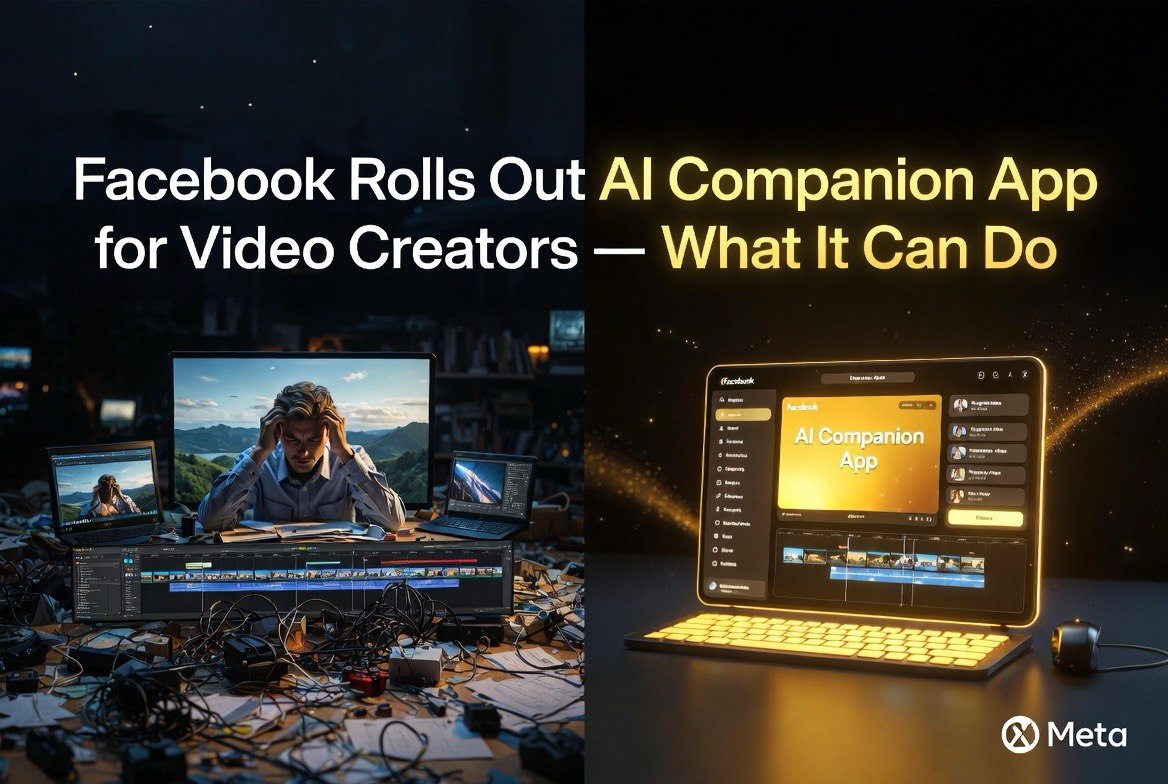
Facebook Rolls Out AI Companion App for Video Creators — What It Can Do
Get The Faceless YouTube Blueprint — Free
The exact AI tool stack and workflow used to build a faceless YouTube channel from zero.
Facebook Rolls Out AI Companion App for Video Creators — What It Can Do
⚡ Expert Summary: Meta just launched an AI companion app for Facebook creators, bringing content ideation, scheduling, and analytics into an AI-powered workflow. For video creators across the United States who produce content for Facebook and Instagram, this could be the most significant platform-native AI tool yet. No third-party integrations required. The AI lives inside the platform and helps with everything from caption writing to content strategy.
Meta has been talking about AI integration for creators for over a year. Now it’s actually here.
On June 24, TechCrunch reported that Facebook rolled out an AI companion app specifically designed for creators. Not a generic AI assistant. A purpose-built tool that understands the Facebook and Instagram content ecosystem, knows how the algorithms work, and can help with the specific tasks that video creators face every day.
The timing makes sense. AI video creation tools are exploding across the market — Runway, Pika, Seedance, Kling, and now OpenArt Director are all competing for the same creator audience. But none of those tools are native to the platforms where creators actually publish their work. Facebook’s AI companion is. That distribution advantage is significant and gives Meta a structural edge that third-party tools cannot easily replicate.
Consider the creator workflow for a typical content week. A video creator might use Runway for generation, Canva for thumbnails, a separate scheduling tool for posting, and the platform analytics for performance data. Each of these tools operates in complete isolation. The Facebook AI companion consolidates the publishing layer — the part of the workflow that happens after the video is created — into a single interface that already knows how the platform works.
What the Facebook AI Companion Actually Does
Based on Meta’s product announcement and TechCrunch’s reporting, the AI companion covers several creator workflows:
Content ideation. The AI suggests video topics based on trending content in your niche, your past performance data, and current platform trends. Instead of scrolling through the Explore page looking for inspiration, you ask the AI for ideas tailored to your audience and get suggestions grounded in real engagement data.
Caption and description writing. For video creators, writing captions that drive engagement is a separate skill from creating the video itself. The AI companion generates captions optimized for reach, hooks, and call-to-action performance. It learns from what has worked for your account specifically.
Scheduling optimization. The AI analyzes when your audience is most active and recommends posting times. For video creators managing multiple platforms, this feature alone saves hours of manual cross-referencing of analytics dashboards.
Performance analytics in plain language. Instead of a dashboard of charts, the AI companion can answer questions like “Why did my last video underperform?” or “What type of content is getting the best engagement this month?” It surfaces actionable insights without requiring the creator to become a data analyst.
Cross-platform content adaptation. The companion can help adapt a video created for Reels into a format optimized for the main Facebook feed, adjusting aspect ratios, caption length, and call-to-action placement based on platform-specific best practices.
Why Native Platform AI Matters for Video Creators
The most important aspect of Facebook’s AI companion isn’t the feature list. It’s that the AI lives inside the platform where creators already work.
Third-party AI tools face a structural disadvantage: they don’t have access to the platform data that powers the most valuable recommendations. A standalone AI writing tool can generate a good caption, but it can’t analyze that caption’s performance against your specific audience demographics. A scheduling tool can recommend posting times, but it can’t cross-reference those times against actual algorithm changes on the platform.
Facebook’s AI companion can do all of this because it sits inside the data. It knows your post history, your engagement patterns, your audience composition, and the real-time platform algorithm signals. That context makes its recommendations more relevant than anything a third-party tool can produce.
For video creators, this is the difference between generic advice (“post at 6 PM”) and specific, data-backed guidance (“your audience engages most at 7:30 PM on weekdays, and your Reels perform 40% better when you use text overlays in the first 3 seconds”).
The platform-native AI advantage is going to compound over time. As the companion learns from more creators and more content, its recommendations will improve. Third-party tools will struggle to keep pace because they don’t have access to the training data.
Who Benefits Most From Facebook AI Companion
The AI companion is not a universal solution, but it covers a broader range of creator workflows than most existing tools. Different types of video creators will extract different value depending on their workflow, team size, and platform strategy.
Solo video creators. For individual creators who produce and publish their own content, the AI companion replaces several tools they likely already use. Caption writing tools, scheduling platforms, analytics dashboards — the companion covers all of these in one interface. For a solo creator spending 2-3 hours per week on publishing logistics, the time savings are substantial. More importantly, the companion brings analytics into a conversation format that removes the friction of switching between tools to understand performance.
Small content teams. Teams of 2-5 creators responsible for a brand or multiple accounts benefit from the companion operational efficiency. Instead of one person managing scheduling while another reviews analytics and a third writes captions, the companion reduces these tasks to a single conversational interface. For US-based content agencies managing 5-10 creator accounts, this is hours per day of recovered production time.
Creators migrating from other platforms. If you are building a Facebook audience from a different primary platform, the companion helps bridge the gap. It can analyze what is working in the Facebook ecosystem specifically, suggest content formats that perform well on the platform, and optimize your publishing strategy for Facebook algorithm preferences. This reduces the learning curve for platform migration significantly.
Creators who struggle with consistent posting. The scheduling and ideation features are designed for creators who know they should post more consistently but get stuck on what to post or when to post it. The AI handles the content calendar front-end, reducing the activation energy required to maintain a regular posting schedule.
The creators who will extract the least value are those who already have established, optimized workflows with specialized third-party tools. If you already use a dedicated analytics platform with custom dashboards and a scheduling tool with specific cross-platform features, the companion replaces functionality without offering significant improvement. For these creators, the companion is a supplementary tool rather than a primary one.
What This Means for the AI Video Tool Landscape
Facebook’s entry into creator AI tools changes the competitive dynamics for every AI video tool on the market. Not because they’re building better video generation technology — they’re not competing with Runway or Pika on that front. But because they control the distribution.
A creator using OpenArt Director to generate videos still needs a workflow tool to manage posting, captions, and analytics across platforms. If Facebook’s AI companion handles that workflow natively, the creator has less reason to adopt a third-party tool that tries to do the same thing with less data access.
This doesn’t mean third-party AI video tools are doomed. It means they need to focus on what they do best — video generation quality, unique creative features, and specialized workflows — and stop trying to be everything. The “all-in-one content creation platform” that includes both generation and publishing was already a tough sell. With Facebook building its own publishing AI, it’s now even harder.
For creators, the net result is better tools on both sides of the equation. Facebook’s companion will improve creator workflow management and reduce publishing overhead. Dedicated AI video tools will focus on generation quality and creative features. The separation of concerns benefits everyone working in the space.
Privacy and Data Considerations
It’s worth noting what an AI that “knows your audience” means for creator data. Facebook’s AI companion processes your content performance data, audience engagement patterns, and posting history. For creators who are already within the Facebook/Instagram ecosystem, this data is already being used for algorithm recommendations and ad targeting. The AI companion adds a direct interface to this data that was previously locked inside analytics dashboards.
Creators concerned about data usage should review how Meta positions the companion’s data handling. The AI uses your account’s content performance data — the same data that powers your existing analytics. It does not, according to Meta’s announcement, use your audience’s personal data or cross-reference creator accounts without permission.
For US-based creators who prioritize data sovereignty, this is essentially what they’ve already opted into by using the platform. The companion surfaces insights from data that already exists — it just makes that data accessible through conversation instead of dashboards.
How to Access the Facebook AI Companion
The AI companion app rolled out to Facebook creators in late June 2026. Access is through the Facebook Creator Studio and the main Facebook app for eligible accounts. Meta has not disclosed the full eligibility criteria, but early access appears to prioritize creators with established audiences and regular posting schedules.
If the companion isn’t available in your account yet, Meta has indicated that broader rollout will continue through the remainder of 2026. The standard strategy for platform-native features: test with power users first, gather data on usage patterns, then expand to the broader creator base.
For creators who want early access, increasing posting frequency and engagement on Facebook and Instagram is the most reliable path. Platform features like this are typically rolled out to the most active creators first — not because of favoritism, but because they generate the most useful data for improving the feature before release to the broader creator community. The data advantage of platform-native AI is something that third-party scheduling and analytics tools will struggle to overcome, and creators should factor that into their tool stack decisions for 2027 and beyond.
FAQ
What is the Facebook AI Companion for creators?
An AI-powered tool within Facebook and Instagram that helps creators with content ideation, caption writing, scheduling optimization, and performance analytics. It uses platform-native data to provide personalized recommendations.
Is the Facebook AI Companion free?
Meta has not announced pricing for the AI companion. Initial access appears to be included with standard creator tools through Creator Studio. Pricing details may change as the feature rolls out more broadly.
How is the Facebook AI Companion different from third-party AI tools?
Because it sits inside the platform, the companion has access to your actual content performance data, audience engagement patterns, and real-time algorithm signals. Third-party tools cannot match this data access, which makes the companion’s recommendations more specific and actionable.
When will the Facebook AI Companion be available to all creators?
Meta is rolling it out in phases, starting with established creators and active accounts in late June 2026. Broader availability is expected through the remainder of 2026.

About Barak Schurr
Barak Schurr is a serial entrepreneur who built and exited a major ticketing platform before turning his attention to AI and content. He runs three AI-focused research sites and writes about the tools, workflows, and strategies that let solo creators build real channels — without a crew, a studio, or a Hollywood budget.
Email: [email protected]