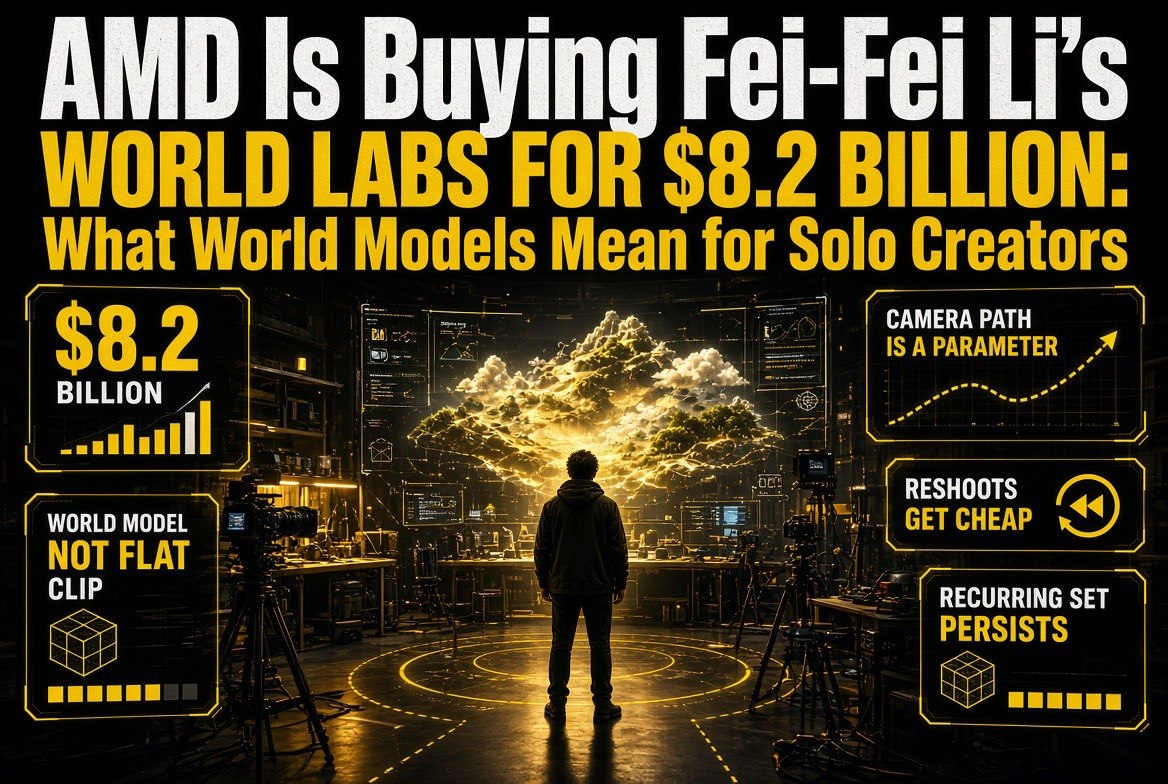
AMD Is Buying Fei-Fei Li’s World Labs for $8.2 Billion: What World Models Mean for Solo Creators
Get The Faceless YouTube Blueprint — Free
The exact AI tool stack and workflow used to build a faceless YouTube channel from zero.
AMD Is Buying Fei-Fei Li’s World Labs for $8.2 Billion: What World Models Mean for Solo Creators
⚡ Expert Summary: AMD is acquiring World Labs, Fei-Fei Li’s spatial intelligence company, for $8.2 billion, and Li joins AMD as executive vice president and chief scientist. World models build navigable 3D environments instead of flat frames. For a solo creator the practical read is narrow and real: the artificial intelligence models that let one person build a camera move through a scene are now funded by a chip company with a competitive reason to make them cheap and fast. That is the same pattern that put video editing on a laptop in 2015.
Two solo creators read the same headline on the same morning. The first sees a nine-figure acquisition in a category they cannot name and moves on to the video they were editing. The second notices who is doing the buying. Not a studio. Not an editing software company. A chipmaker — the company that sells the compute underneath every render.
That distinction is the whole story. When a hardware vendor buys the model layer, the model is about to get cheaper to run. Every previous version of that pattern ended with the tool moving from a studio budget to a creator’s desk.
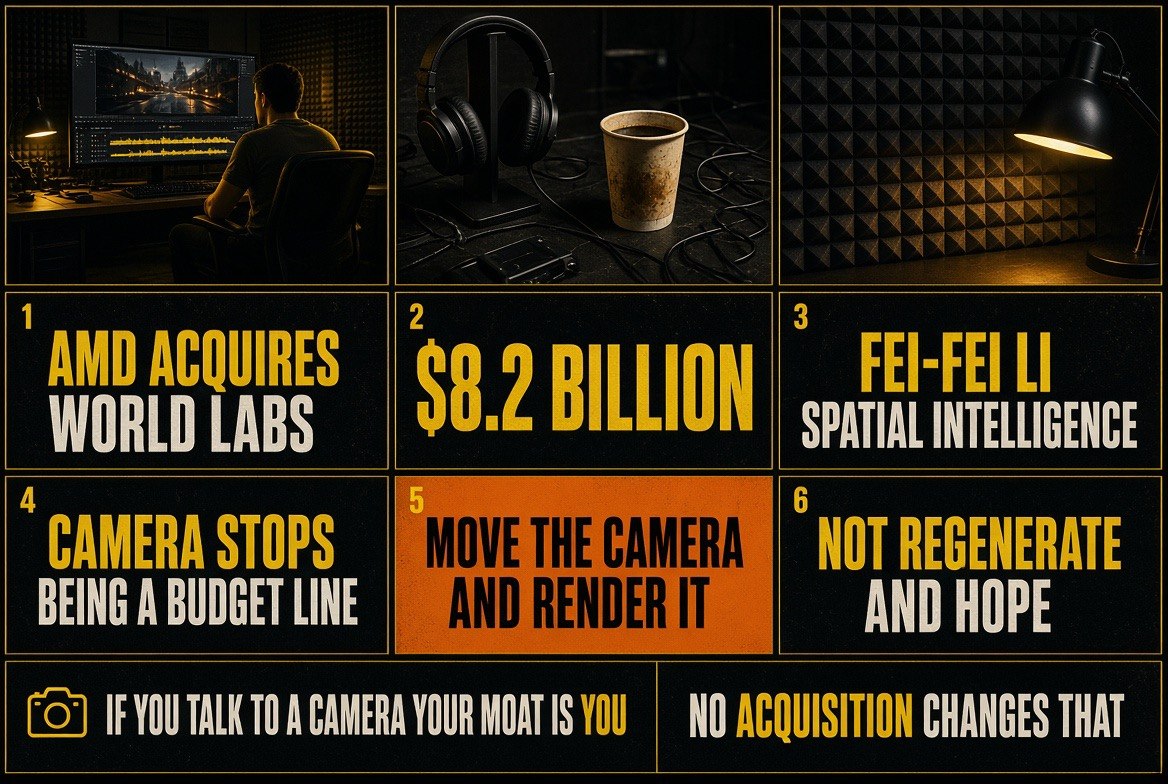
The render stops being a gamble once the scene is spatial: the deal puts an $8.2 billion price on the tooling behind that shift, and the edit bay is where a solo creator meets it.
What AMD Actually Bought
AMD will acquire World Labs for $8.2 billion. World Labs is the spatial intelligence company founded by Fei-Fei Li, whose work on ImageNet in the 2000s is one of the reasons computer vision works at all today. Under the deal, Li joins AMD as executive vice president and chief scientist.
World Labs builds world models — systems that generate and reason about three-dimensional environments rather than flat images. A generation model produces a picture. A world model produces a place: a scene with depth, a consistent geometry, and a camera that can move through it without the scene falling apart.
That difference is the reason the price is what it is. Generating a convincing frame is a solved, commoditised problem in 2026. Generating a consistent space you can walk through, turn inside, and re-approach from another angle is not, because the model has to hold a coherent understanding of a place across every view.
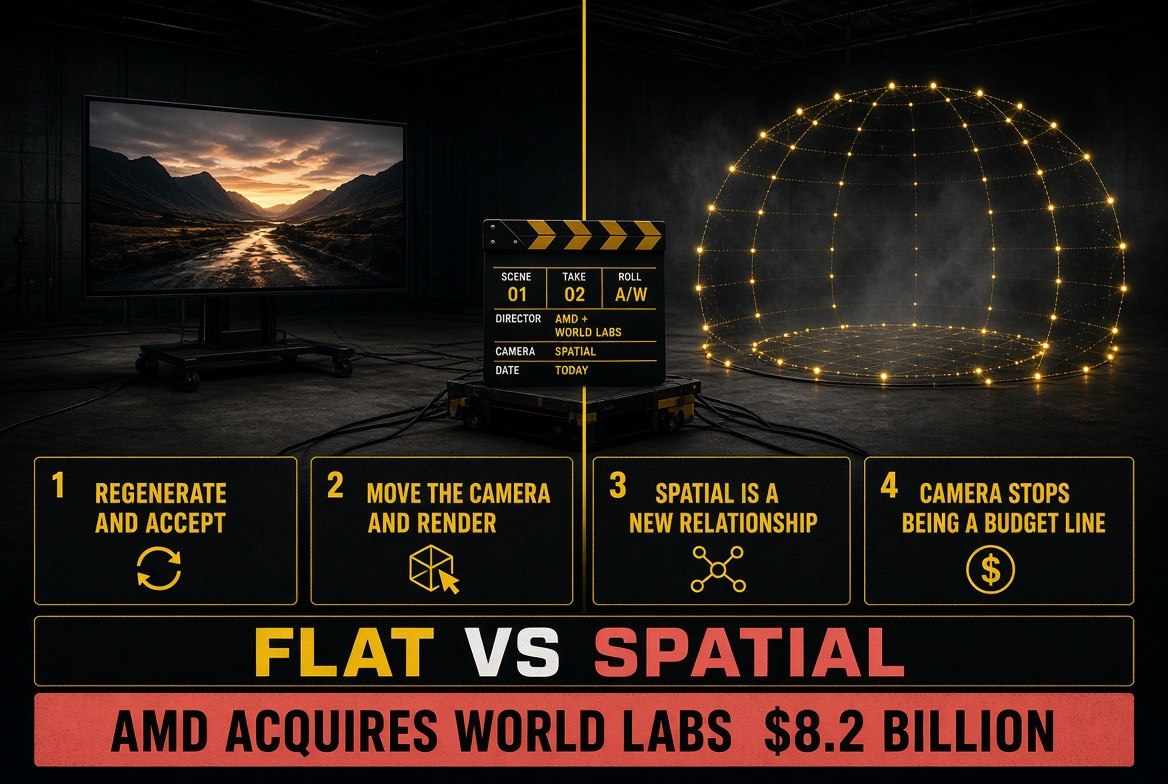
Flat video asks you to regenerate until the shot works. A spatial scene lets you move the camera and render the same room again — the difference the $8.2 billion deal is underwriting.
Why a Chip Company Buys This
AMD competes with Nvidia for the accelerators that train and run every large model. Nobody buys chips for their own sake. Chip demand is derived demand — it exists because someone needs to run a model, and the vendor whose hardware runs the models that matter captures the volume.
Buying World Labs gives AMD a stake in an application class rather than a component. It also gives them Li, who is one of the few people in the field whose name carries weight with both researchers and investors.
| Model Type | What It Produces | What It Costs You Today | What It Cannot Do |
|---|---|---|---|
| Image / video generation | A flat clip or still, seconds long | Subscription, roughly $10 to $60 a month | Change the camera path afterwards without regenerating |
| World model | A navigable 3D scene you can move inside | Limited access, research and enterprise pricing | Photoreal human faces and fine texture still lag |
For a creator, the row that matters is the third column. A generated clip is a fixed outcome — you get the camera move you got. A world model is an environment you can re-shoot. That changes editing from “generate again and hope” to “move the camera and render it.”
Three Things This Changes for a One-Person Channel
First, the camera stops being a budget line. A creator who cannot afford a dolly, a gimbal operator, or a second shooter has been limited to whatever motion they can produce alone. A world model turns camera movement into a parameter. That is not a small convenience for a solo channel; it is the difference between a locked-off shot and a shot that moves.
Second, reshoots get cheap. The expensive part of video is not the first take, it is the twentieth — the one after a client changes their mind or the script changes. In a modelled space, a reshoot is a new camera path through geography that already exists. The scene does not have to be rebuilt because the director wants to approach from the left instead of the right.
Third, and this is the part most creators miss, consistency becomes an asset. A recurring location — the same workshop, the same café, the same storefront — can be built once and reused across an entire series. Regular viewers build familiarity from a set, and a set is precisely what a world model gives a creator who has no studio.
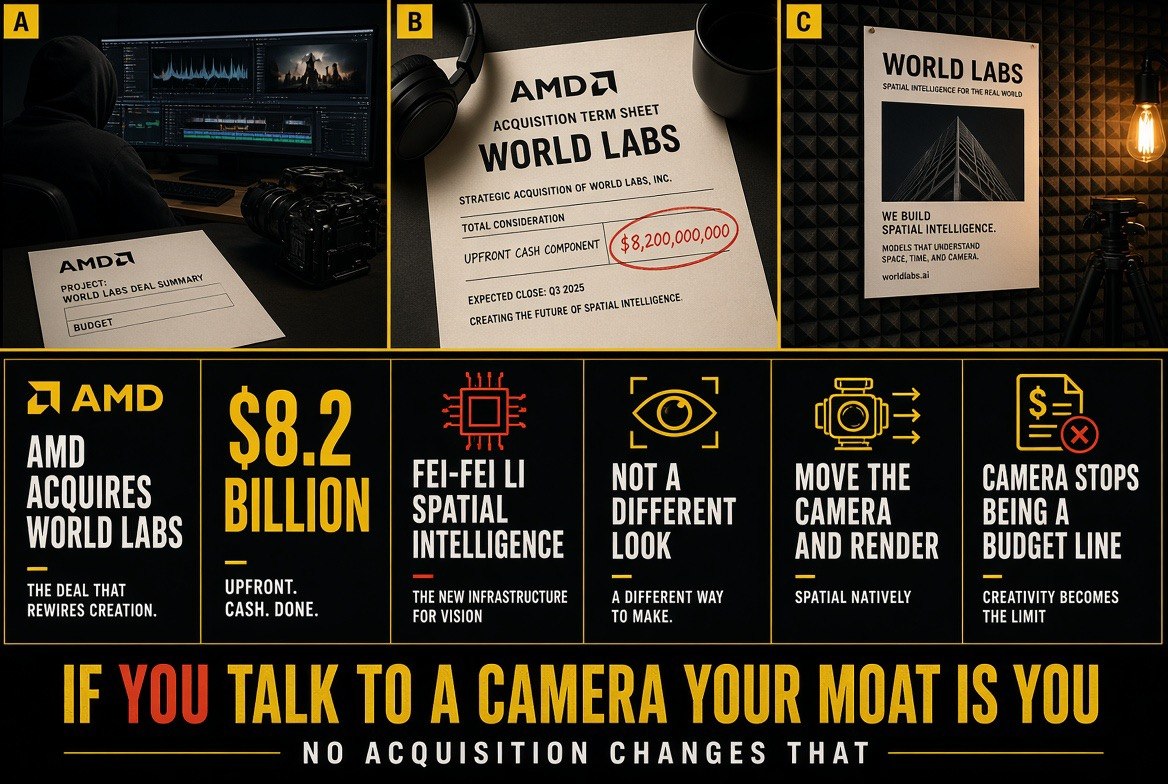
The deal buys the infrastructure behind spatial models, not a new look: the world model holds a room in space, and that is the part a one-person channel can actually rent.
What This Does Not Change
Be precise about the limits, because the hype cycle will not be. World models are not a replacement for filming a person. Faces, hands, and the specific micro-expressions that make a talking-head video feel human remain the hardest problem in the field, and nothing in this acquisition changes that overnight. If your channel is built on you, on camera, your job is unchanged.
Access is also not immediate. Acquisitions take months to close, and the first commercial products out of a deal like this tend to be enterprise-priced, aimed at game studios, simulation, and robotics customers — not at a solo creator paying for a subscription. Treat this as a signal about where the tools are going, not as a tool you can use next week.
There is also a real risk in the other direction. When one company owns both the chips and a leading world model, pricing and access decisions concentrate. Creators have already lived through a version of this with platform-level changes to APIs and licensing. The honest position is that this deal makes the category more credible and less competitive at the same time.
Flat Video and Spatial Video Side by Side
| Factor | Generated Flat Video | Spatial / World Model |
|---|---|---|
| Changing the camera move | Regenerate and accept whatever you get | Move the camera, render the same scene again |
| Location reuse across episodes | Re-prompt and hope it looks the same | The place persists; you return to it |
| Cost driver | Per generation, per retry | Per scene built, amortised over uses |
| Best current use | Talking-head b-roll, quick social cuts | Environments, product spaces, recurring sets |
| Where it breaks | Continuity between shots, repeated locations | Human faces, fine detail, licensing and access |
What a Solo Creator Should Do With This News
Nothing urgent, and that is the correct answer rather than a disappointing one. Your production stack is not being replaced this quarter. What the acquisition changes is the direction of travel, and direction is worth tracking because it tells you which skills compound.
If you are building a channel with a recurring visual identity — a workshop, a kitchen, a studio, a fictional storefront — you are already doing the thing world models make cheaper. Think of your locations as assets, and document them properly: consistent lighting, consistent layout, plenty of reference angles. When the tools arrive, creators who have a well-defined set to feed them will get useful output immediately; creators starting from scratch will spend the first month just defining where they are.
If your channel is a person talking to a camera, your moat is you, and no acquisition changes it. The creators who lose in every tooling shift are the ones whose only differentiator was access to equipment.
Treat this the same way you would treat picking a niche for a faceless channel: the tool is downstream of the decision. Decide what your channel is about and what it should look like, then adopt whichever model class serves that. The World Labs deal does not answer that question for you. It only makes one class of answer cheaper.
For a wider view of who is funding what, the same money pattern showed up in General Intuition’s raise for spatial world models. Two data points are not a trend, but when the second one is a chipmaker paying $8.2 billion, the category has stopped being speculative.
The Question Every Creator Should Ask About Any Model Deal
When a large sum of money moves around a model category, the useful question is not whether the technology is impressive. It is who ends up paying less, and who ends up paying more.
In this case the chipmaker wants the models to run on its hardware, which means the models need to be cheap enough that creators and studios actually use them at volume. That is a good position for a solo creator to be standing in. The counterweight is concentration: one company holding both the silicon and a leading spatial model has less reason to compete on price with itself than three separate companies would.
Watch the two signals that will tell you which way it goes. The first is whether the model becomes available through an ordinary subscription rather than an enterprise contract. The second is whether independent world-model companies keep getting funded, because a category with one well-funded winner and no competitors tends to stall on price.
Until both answers are visible, the correct posture for a creator is preparation rather than purchase: define your visual world, capture your reference material, and keep your workflow portable enough that a change of model is a settings change and not a rebuild.
The Longer Arc
Video production has been consolidating around one person for twenty years. A cutting room became an application, an application became a laptop, and a laptop became subscription software that fits in a browser tab. Each step removed a role from the process and handed the capability to whoever was willing to learn it.
World models are the next step in that line. Not because they replace filming, but because they remove the last category of production cost that required a crew: moving a camera through a space that does not physically exist yet. A creator who has spent years working around that constraint is about to have it lifted, and the ones who benefit fastest will be the ones who already know what their world looks like.
The acquisition is a headline. The constraint it removes is the actual news.
Frequently Asked Questions

About Barak Schurr
Barak Schurr is a serial entrepreneur who built and exited a major ticketing platform before turning his attention to AI and content. He runs three AI-focused research sites and writes about the tools, workflows, and strategies that let solo creators build real channels — without a crew, a studio, or a Hollywood budget.
Email: [email protected]
More AI Video Resources