Hedra Review 2026: AI Character Video Built for Solo Creators
Get The Faceless YouTube Blueprint — Free
The exact AI tool stack and workflow used to build a faceless YouTube channel from zero.
Hedra Review 2026: AI Character Video Built for Solo Creators
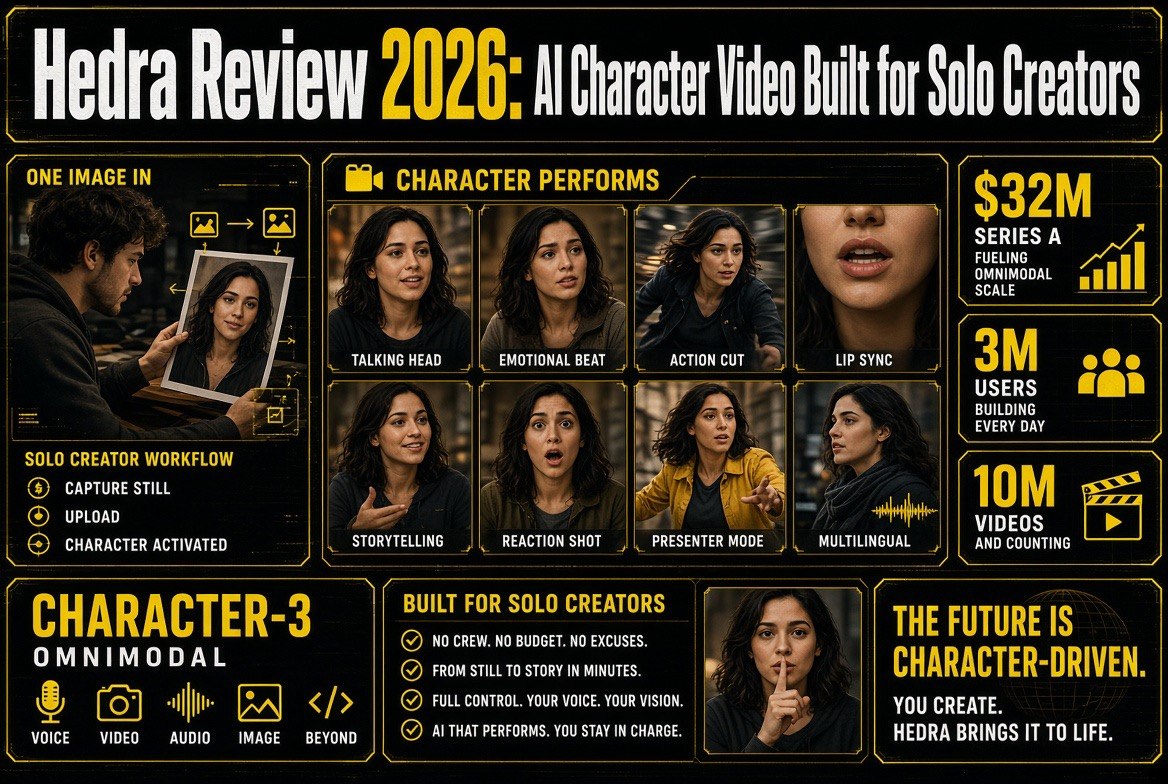
⚡ Expert Summary: Hedra raised $32 million led by a16z on the bet that AI video is not about generating clips, it is about generating characters that perform. The platform turned nearly three million users and ten million videos into a focused product built around one promise: bring a character to life from a single image and keep control of the performance. For a solo creator, that is the difference between a novelty and a production workflow. Here is what Hedra actually does, where Character-3 changes the game, and the honest limits before you commit a channel to it.
Most AI video tools sell the same fantasy: type a sentence, receive a cinematic clip. It looks impressive in a launch video and falls apart the moment you need a consistent face across ten uploads. Your audience notices a character that shifts features between videos long before you do.
Hedra went after a narrower, harder problem. Not “make any video” but “make this character perform.” That focus is why it has ten million videos and a $44 million war chest, and it is why it deserves a serious look from anyone whose channel depends on a recognisable face.
What Hedra Actually Is
Hedra launched publicly in June 2024 with Character-1, a video foundation model built specifically for expressive, lifelike AI characters. The core capability is direct: start with a single image and animate it with performance — speech, facial expression, head movement — without needing a studio, a camera or a person on set.
The platform, Hedra Studio, is web-based and deliberately aimed at people with minimal technical knowledge. It is not a node-based pipeline or a command-line tool. It is designed for creators who have an idea and a still image and want a performance out of it.
That positioning is the whole strategy. Most competitors are trying to win the general text-to-video race. Hedra chose character performance as its lane and has stayed in it.
| Factor | General Text-to-Video Tool | Hedra Character Platform |
|---|---|---|
| Starting point | A text prompt | A single character image |
| What you control | The prompt and the seed | The performance — voice, face, motion |
| Character consistency | The core failure point | The entire design goal |
| Typical output | A scene | A talking, reacting character |
| Skill required | Prompt craft | An image and a script |
Character-3 and Why “Omnimodal” Matters to a Creator
The technical headline is that Hedra describes Character-3 as the first omnimodal foundation model available in production for AI character video. Omnimodal means it handles voice, facial expression and motion as one unified system rather than three separate passes stitched together.
The reason that matters practically: when those elements are generated separately, the seams show. Voice timing drifts from lip movement. A facial expression does not match the emotional beat of the line. The result reads as animated rather than performed, and audiences detect it instantly even when they cannot name what is wrong.
A unified model removes that class of error. The performance is generated as a performance, which is the difference between a character that delivers a line and a character that looks like it is being puppeteered.
For a solo creator producing content alone, that gap is the whole product. You are not competing on effects. You are competing on whether your audience believes the character for thirty seconds.
The Business Case: $32M, a16z, and Nearly 3 Million Users
The funding tells you something concrete about whether this is a durable platform or a weekend project.
| Metric | Figure | Why It Matters |
|---|---|---|
| Series A | $32 million | Serious institutional backing |
| Lead investor | Andreessen Horowitz (Infrastructure) | Infrastructure focus signals the model, not the app |
| Total funding | $44 million | Runway to keep improving the models |
| Users in year one | Nearly 3 million | Real adoption, not a waitlist |
| Videos created | Over 10 million | Platform is being used for volume output |
Other participants in the round included a16z Speedrun, Abstract and Index Ventures. Matt Bornstein from a16z Infrastructure joined the board.
The infrastructure fund leading the round is the detail worth dwelling on. An infrastructure investor is backing the foundation models — the thing that gets better and stays defensible — rather than betting purely on the consumer app on top. For a creator deciding whether to build a channel on a platform, that is a meaningfully better signal than a pure marketing-led round.
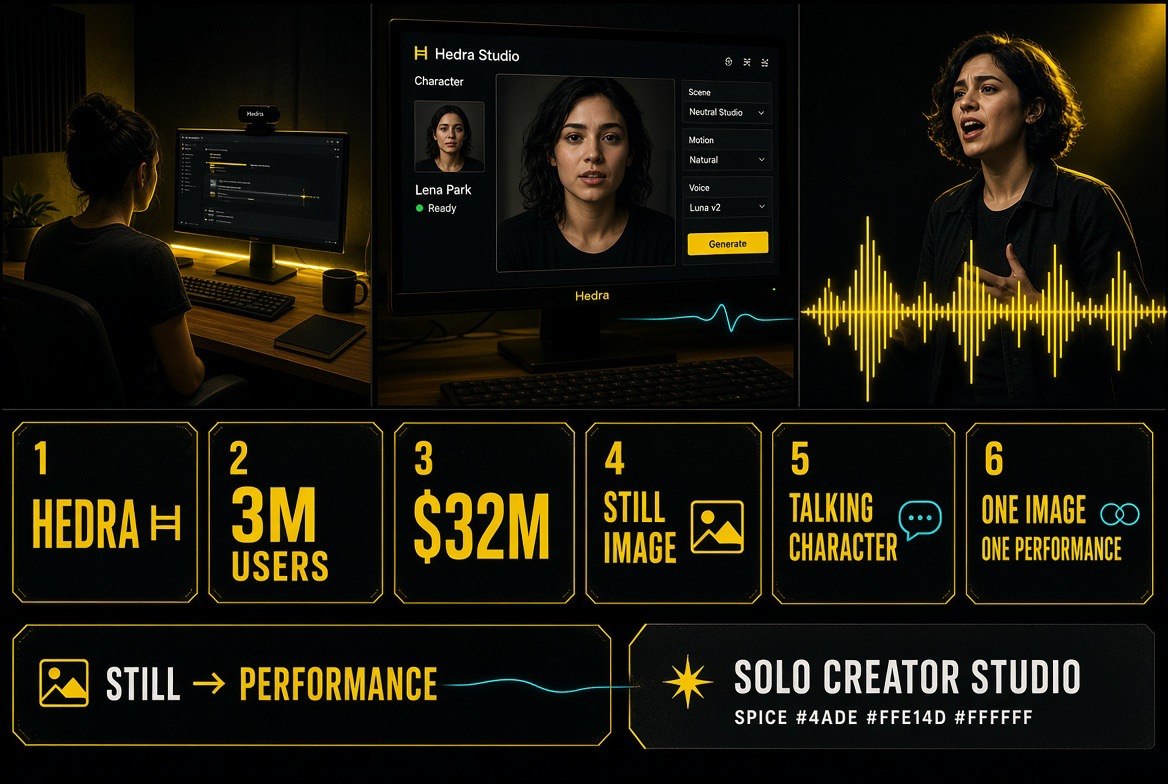
Hedra’s workflow in one frame: a solo creator at the desk, a still photo going in, a performing character coming out. Three vignettes, six cards, one pipeline.
Where Hedra Fits for Different Creators
The platform serves both individuals and large organisations, but the value is not identical across those groups.
| Creator Type | Strongest Use Case | Verdict |
|---|---|---|
| Faceless channel operator | Consistent host character across uploads | Excellent fit |
| Solo educator or explainer | Talking-head content without filming | Excellent fit |
| Short-form social creator | Fast iteration on hooks and formats | Strong fit |
| Ad creative for small brands | Multiple spokesperson variants at low cost | Strong fit |
| Cinematic narrative filmmaker | Complex scenes and camera work | Wrong tool |
If your channel is built on a face — even a synthetic one — this is squarely the right category. If your channel depends on elaborate scene construction, camera movement and world-building, you are looking at the wrong platform. Hedra does characters. It does not do cinematography.
The Honest Limits Before You Commit
Three things deserve a clear-eyed look before you move a channel onto any character platform.
The first is disclosure. Audiences increasingly expect to know when a face is synthetic, and platforms increasingly require it. Deciding your policy before you publish is far easier than retrofitting it after an audience finds out. Creators who are upfront about using AI characters rarely suffer for it. Creators who are caught hiding it usually do.
The second is authenticity ceiling. A generated character can deliver information, hold attention and read a script convincingly. It cannot yet build the parasocial trust that comes from a real person’s unscripted moments. If your channel’s value is your personality, a character platform replaces the production problem, not the trust problem.
The third is workflow dependency. Once your upload schedule depends on a specific model’s output, you inherit its release cadence, its pricing changes and its availability. Keep your source images, scripts and project files organised outside the platform so a change in terms or pricing is an inconvenience rather than a catastrophe.
The Verdict for a Solo Creator in 2026
Hedra solved the problem that kills most AI video projects: character consistency. Nearly three million users and ten million videos in roughly a year is not marketing noise, it is evidence that the product works for real production. The $32 million Series A led by a16z’s infrastructure fund says the people best placed to judge foundation models believe this one has a future.
The strategic advice is the same as with any platform bet. Test it on your actual format before you build a schedule around it. Produce five videos with the same character and watch whether your audience notices anything wrong. Then decide.
What Hedra changes is not whether AI can generate a face. It is whether a solo creator can sustain a recognisable one. For anyone running a faceless channel or producing alone, that shift is worth taking seriously. The barrier that stopped most solo creators was never ideas — it was appearing on camera. Hedra attacks that specific wall, and it attacks it well.
Character Consistency: The Problem Nobody Else Solved
It is worth being precise about why character consistency is the hard problem, because it explains why Hedra exists as a separate company at all.
When a general video model generates a person, it makes independent decisions about facial structure, skin tone, hair and lighting every single time. Ask for “a woman in her thirties in a kitchen” twice and you receive two different people. That is fine for a stock-style clip. It is fatal for a channel, because your audience builds recognition from repetition. Change the face between uploads and you are starting from zero with every video.
Solving it requires the model to hold an identity stable across generations while still varying performance, lighting and angle. That is a fundamentally different objective from generating a convincing single shot. It is why general video tools bolt on reference-image features as an afterthought and why a platform built around identity from day one performs differently.
For a creator, the practical consequence is scheduling. Consistency is what allows you to batch. When you can produce ten videos featuring the same character, you can build a backlog, plan a content calendar, and stop treating every upload as a fresh production.
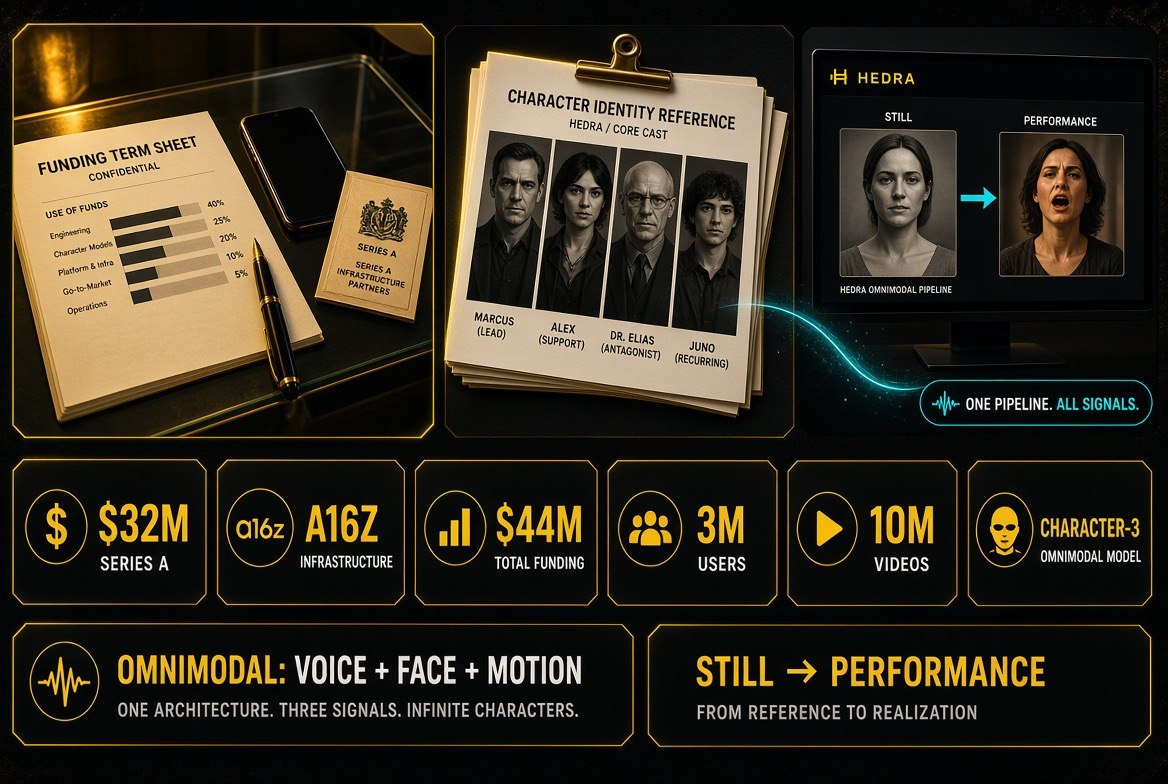
The business case in one frame: $32M Series A led by a16z Infrastructure, $44M total funding, 3M users and 10M videos in year one – all built on Character-3.
What It Replaces in Your Workflow
The clearest way to value a character platform is to price the alternative honestly.
Producing talking-head content the traditional way means a camera, lighting, a quiet room, retakes, editing, and a person willing to sit in front of a lens repeatedly. That last part is the real barrier. Many capable creators never start because they do not want to be on camera, and many that do start burn out on the production loop rather than the ideas.
A character pipeline removes the filming step and most of the retake problem. You write the script, pick the performance, and iterate on the output directly. The time that used to go into setup and shooting goes into scripting and testing hooks instead.
What it does not remove is the editorial work. You still need something worth saying. A generated face reading a weak script is still a weak video, and it is arguably more obvious when there is no human charisma to carry it. The tool moves your bottleneck from production to writing — which, for most solo creators, is exactly where it should be.
Who Should Not Use This
The honest limits are worth stating plainly, because the category attracts more hype than it deserves.
If your audience follows you specifically — your opinions, your reactions, your unscripted moments — a generated character is not a substitute, it is a different product. The trust that makes that channel work is not transferable to an avatar, and audiences are unusually good at detecting the substitution.
If your content depends on real-world footage, locations, products in hand, or anything that must be documented rather than generated, this adds nothing. A character platform is for content where the person is the interface to information, not where the world is.
And if you are not prepared to disclose, do not start. The disclosure question gets harder every month, and building a channel on an undisclosed synthetic presenter is building on ground that is actively moving.
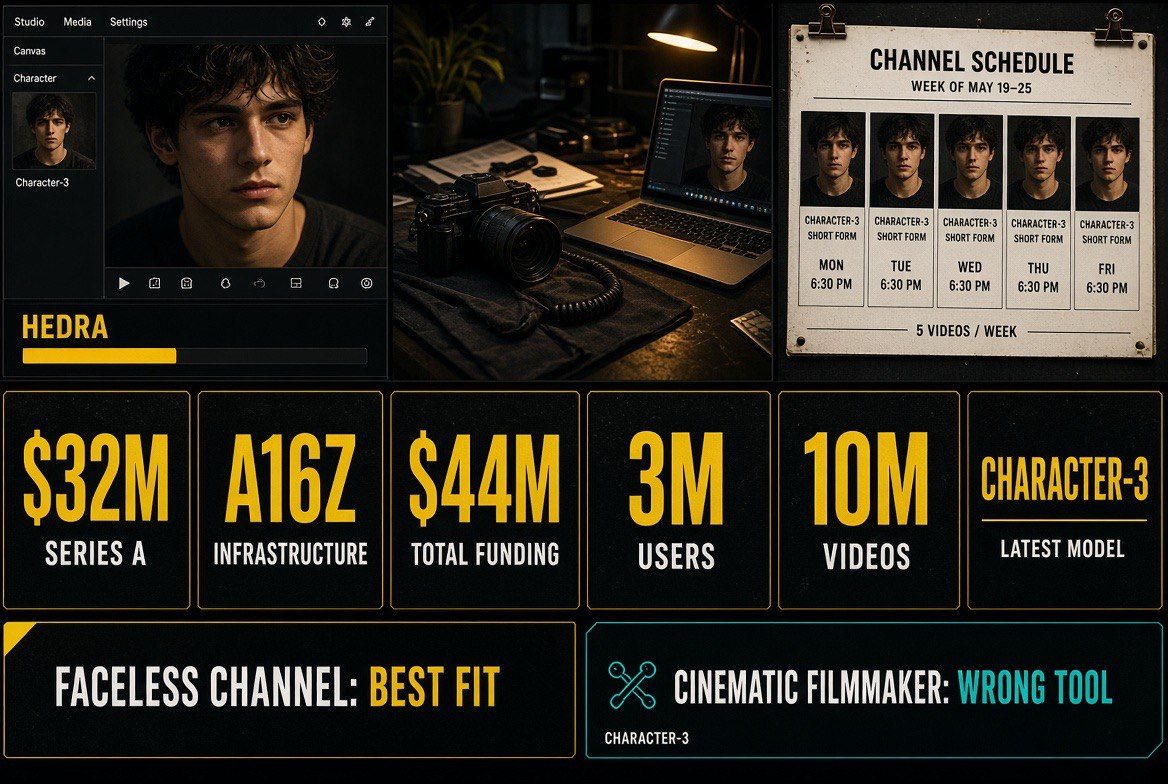
The verdict in one frame: the same six figures, scored against what a solo creator actually needs – a best fit for faceless channels, the wrong tool for cinematic world-building.
How to Test It Properly in a Weekend
The right way to evaluate any platform in this category is a small, real test rather than a demo.
Pick one character and one repeatable format you already produce. Generate five videos with that same character and publish them on your normal schedule. Then watch for the things that actually matter: whether the face holds up, whether viewers comment on the character at all, and whether your retention looks like your usual content or worse.
If retention holds and nobody flags the character as synthetic, you have a workflow. If the output feels uncanny to your audience, no amount of model improvement in the abstract will fix the format decision — you will have learned that cheaply, in a weekend, instead of after committing a quarter of output.
Frequently Asked Questions
What is Hedra?
Hedra is an AI video platform focused on character-driven generation. It launched publicly in June 2024 with Character-1, allowing creators to animate a character from a single image with controlled performance. Its latest model, Character-3, is described as the first omnimodal foundation model in production for AI character video.
How much did Hedra raise?
It raised $32 million in a Series A led by Andreessen Horowitz’s Infrastructure fund, with participation from a16z Speedrun, Abstract and Index Ventures. That brings total funding to $44 million. Matt Bornstein of a16z joined the board.
What does “omnimodal” mean?
It means voice, facial expression and motion are generated as one unified system rather than separate passes combined afterward. In practice it reduces the timing and expression mismatches that make AI characters look animated rather than performed.
Is Hedra good for a faceless YouTube channel?
It is one of the strongest fits in the category. The platform is built specifically for character consistency, which is the main failure point when producing talking-head content across many uploads without appearing on camera.
What is the main limitation?
Scope. Hedra does characters, not cinematography. If your content depends on complex scenes, camera movement and world-building, this is the wrong tool. It also cannot replace the parasocial trust a real presenter builds through unscripted moments.

About Barak Schurr
Barak Schurr is a serial entrepreneur who built and exited a major ticketing platform before turning his attention to AI and content. He runs three AI-focused research sites and writes about the tools, workflows, and strategies that let solo creators build real channels – without a crew, a studio, or a Hollywood budget.
Email: [email protected]
More AI Video Resources