
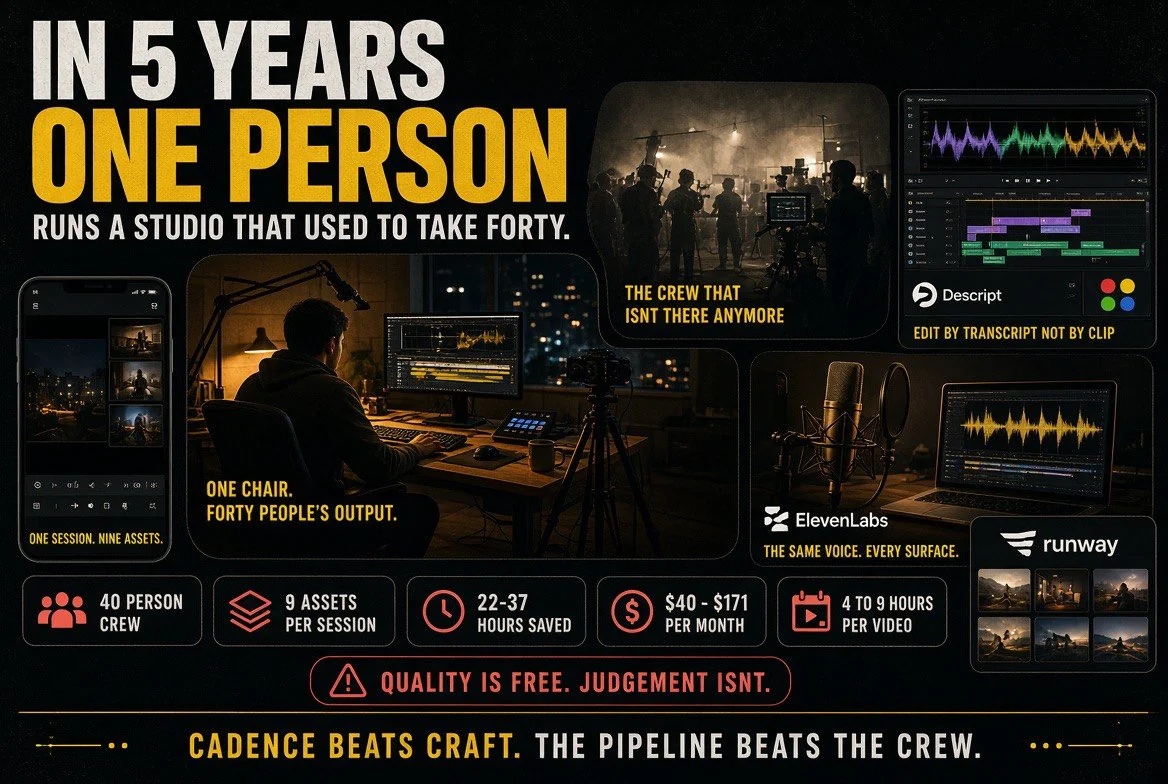
In 5 Years One Person Will Run a Studio That Used to Take Forty
In 5 Years One Person Will Run a Studio That Used to Take Forty
⚡ Expert Summary: The production crew is not being replaced by a robot. It is being replaced by a workflow. By 2031 a single creator will deliver what took a forty-person production company in 2020: scripted, shot, cut, voiced, subtitled, re-versioned into six formats and published across four platforms, on a weekly cadence. The tools already exist for every step of that chain. What is still missing, and what separates the creators who get there from the ones who buy subscriptions and stay stuck, is the assembly. This is a breakdown of the exact stack, what each piece costs, and where the human still has to be the one making the call.
Ask a production company what a 12-minute branded video costs in 2026 and the number lands somewhere between $8,000 and $25,000 depending on how much of it is shot versus animated. Ask how long it takes and the answer is six to ten weeks, most of which is spent waiting on a shoot day, an edit round, a colour pass, a sound pass, and a client who wants to change the opening line after seeing it cut together.
Now ask a solo creator with a working AI stack what a 12-minute video costs. The answer is under a hundred dollars in tooling and somewhere between four and nine hours of their own time — spread across a week, not a quarter.
That gap is not a novelty. It is the single largest change in the economics of video since the DSLR. And the creators who understand it are not the ones buying the most tools. They are the ones who built the pipeline.
The Crew, Job by Job
The mistake most creators make is treating AI video tools as a single category and buying whatever has the best demo. A production company is not one job. It is eight, and each one has a different tool that wins it.
Writer. Still the highest-leverage seat in the building, and the one AI helps least and hurts most. Claude and ChatGPT are strong structuring partners for an outline, a hook, a script spine. They will also produce something that sounds like every other video on the platform if you let them write the first draft unedited. Use them to pressure-test structure, not to author.
Cinematographer. Runway, Luma and Synthesia now generate b-roll and full shots that would have needed a location, a permit, a crew of nine and a rental package. The constraint is no longer capability — it is shot continuity across a sequence, which is where a real cinematographer still earns their rate.
Editor. Descript edits by transcript. DaVinci Resolve keeps professional colour in a free tier. The cut is no longer the bottleneck; deciding what the cut is for, still is.
Voice. ElevenLabs handles narration in a voice that does not sound synthetic if the script is written for speech rather than for reading. Pick one voice and keep it — a channel with four narration voices reads as four channels.
Subtitler, colourist, sound mixer. All three are now one pass inside the editor. Burned captions, a grade, and a limiter on the audio are minutes of work, not days of billing.
That is the trick nobody tells you: the forty-person crew is not forty separate AI subscriptions. It is eight jobs, four of which now share one tool.
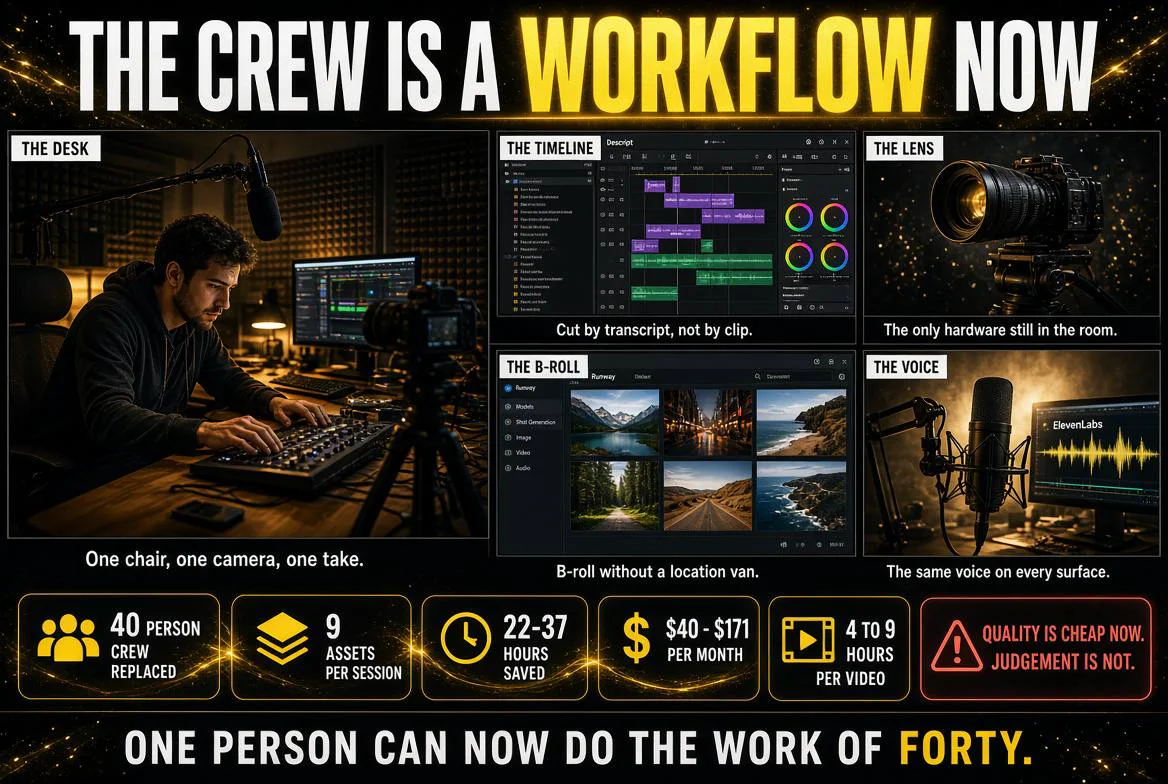
What the Stack Actually Costs
Prices below are the tiers a solo creator actually lands on, not the enterprise quote.
| Job | 2020 crew version | 2026 solo stack | Monthly cost | Time saved per video |
|---|---|---|---|---|
| Writing | Scriptwriter, two rounds | Claude or ChatGPT for structure | $20-$30 | 3-5 hours |
| Shooting | Camera op, crew of nine, location | Runway or Luma for b-roll and shots | $15-$95 | A full shoot day |
| Editing | Editor, three revision rounds | Descript transcript cut + Resolve | $0-$24 | 12-20 hours |
| Voice | VO talent plus studio time | ElevenLabs, one locked voice | $5-$22 | 2-4 hours |
| Captions, colour, mix | Three separate freelancers | One pass in the editor | Included | 5-8 hours |
| Total | $8,000-$25,000 per video | Full solo pipeline | $40-$171 | 22-37 hours per video |
Read the total line twice, because it contains the trap. The stack is cheap. The stack is not the product. A creator who spends $171 a month and produces one video is running an expensive hobby. The same $171 spread across eight videos is a studio.
The Part Nobody Assembles: One Session Into Nine Assets
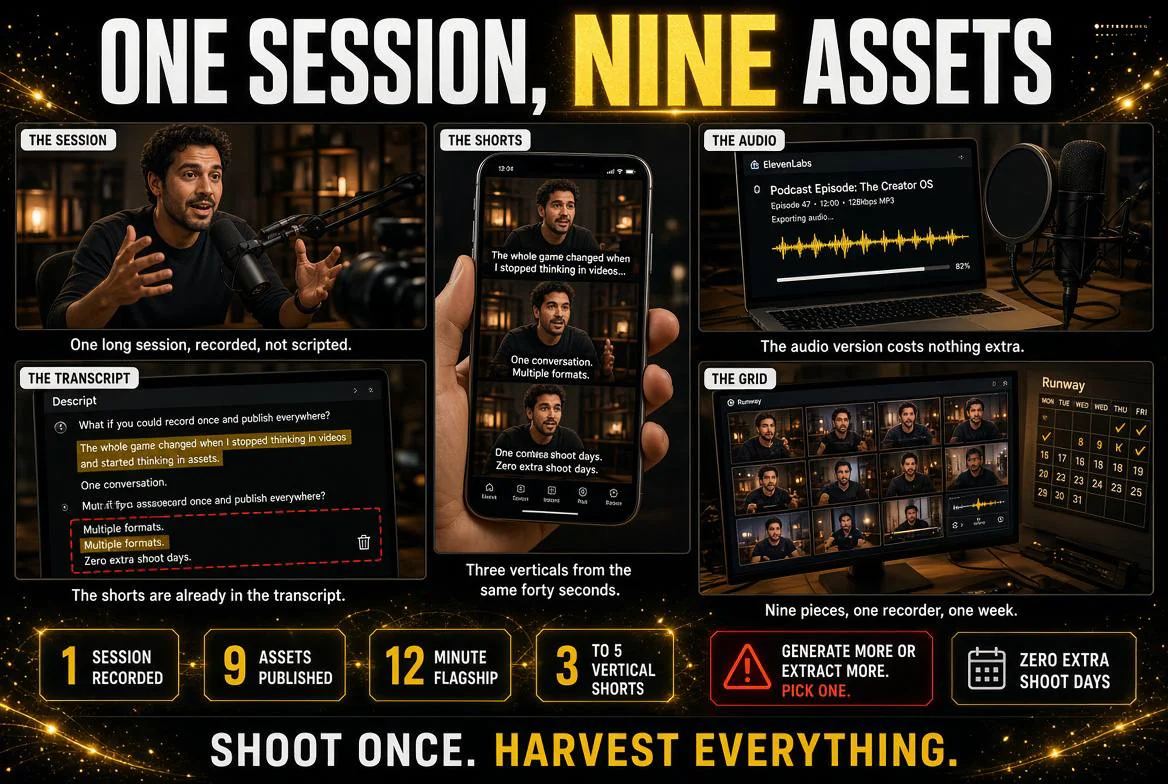
Here is the workflow that actually delivers the 2030 number. It is not about generating more. It is about extraction — shooting once and harvesting everything downstream from the same source material.
Step one: record one long session, 45 to 60 minutes, unscripted but structured. Talking to camera about the subject, with a written outline on the desk in front of you, not a script. Long-form unbroken footage is the raw material for everything else, and it is the one asset AI cannot manufacture for you because it carries your actual opinions.
Step two: cut the 12-minute flagship from the transcript. You are selecting, not writing. This is the highest-judgment hour in the week and it should be the only hour you protect.
Step three: pull three to five short vertical clips from the strongest 40 seconds inside the session. The moments that made you lean forward when you recorded them are the moments that will make someone stop scrolling.
Step four: generate b-roll for the cuts that need visual cover. Twenty seconds of generated footage under a talking-head section kills the jump-cut problem that makes solo videos feel amateur.
Step five: narrate the same script as an audio-only version. The transcript already exists. The voice is already locked. This is a podcast feed produced from a video session with no extra recording.
Step six: pull the argument into a written post, then into a newsletter, then into five social captions. Same words, four surfaces.
One session. Nine pieces of published material. That is the forty-person output. No production company on earth beats that on volume, because their marginal cost per asset is a day rate and yours is zero.
Where the Human Still Has to Be There
Every “AI replaces the studio” piece skips the failures, so here are the four places this stack breaks — and what they cost you when they do.
Continuity. Generated shots do not hold a consistent character, wardrobe or set across a sequence. A generated sequence of six shots will read as six different films. Fix: keep generated footage to b-roll and single shots, never to a scene that requires the audience to track who is in it.
Voice drift. Prompted narration changes tone between sessions. A channel with shifting delivery loses the parasocial effect that makes a solo creator worth subscribing to. Fix: one locked voice, one locked speed, and write for speech — short sentences, no subordinate clauses.
The uncanny cut. AI editors are excellent at removing silence and mediocre at knowing when silence is doing the work. A pause before a punchline is content. Automated tightening deletes it. Fix: review every cut for rhythm before publishing, not just for content.
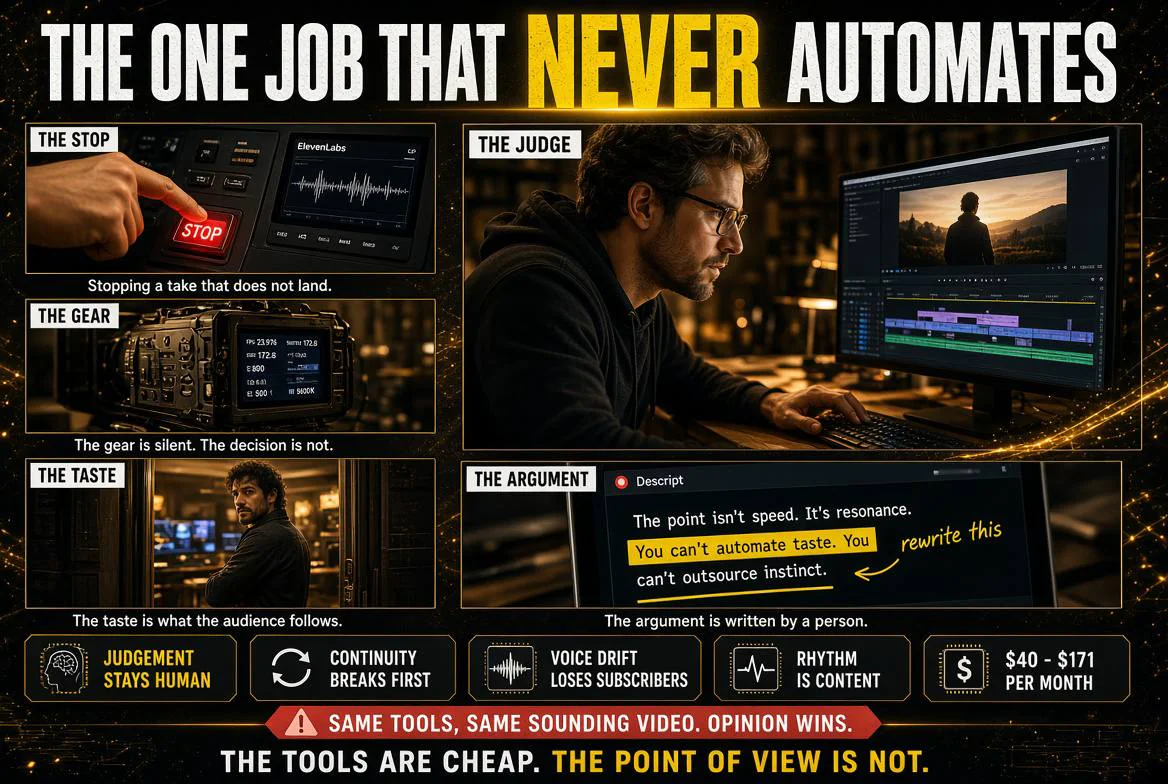
Same-sounding everything. This is the real risk and it is not technical. When a million creators all write hooks with the same model, the hooks converge. The differentiator has stopped being production quality and started being whether you have an actual opinion. A well-produced video with nothing to say is now cheap to make, which means it is now worthless.
What It Takes to Get There by 2031
The 40-person output is achievable now. The reason most creators are not there is not tool access — it is that they never built the chain.
| Capability | Today | 2031 | Bottleneck it removes |
|---|---|---|---|
| Shot generation | 5-10 seconds, imperfect continuity | Minute-long consistent sequences | The shoot day |
| Editing | Transcript cut, manual rhythm | Beat-aware assembly from a brief | The edit suite |
| Voice | Convincing, drifts between takes | Locked identity across a series | The VO booth |
| Reformatting | Manual crops, one tool per format | One master, every surface | The repurposing grind |
| Judgment | Human only | Human only | The last thing to go |
That final row is the whole argument. Every other row is a cost centre that collapses toward zero. Judgment is the row that never does — and in 2031, when anyone can produce a polished 12-minute video for under a hundred dollars, judgment is the only thing left to compete on.
One person, forty people’s output. Not because the person did forty jobs. Because they stopped doing thirty-nine of them by hand and did the one job that could not be automated.
The Question That Actually Decides It
Every creator who looks at this stack asks the same question first: which tool should I buy? It is the wrong question, and it is why so many people end up with four subscriptions and the same output they had six months ago.
The question that decides the outcome is this: what is the one thing I am going to publish every week without exception? Answer that and the tool list writes itself, because you only need the tools that sit on that path. Fail to answer it and no stack will save you — you will produce a technically excellent video every six weeks and lose to someone with worse equipment and a schedule.
Cadence beats craft in the early years, and AI has made that inequality more brutal, not less. When production quality was expensive, the well-funded creator had a moat. Now the moat is a publishing habit plus a point of view, and neither of those can be bought for $171 a month.
The creators who hit the forty-person output are not working forty times harder. They are working the same hours they always did, on a chain that no longer breaks at the shoot day.
Frequently Asked Questions
Can one person really match a forty-person studio?
On output volume, yes. On craft, only for certain formats — talking-head, b-roll-led explainer, podcast, and social cutdowns. Anything needing consistent characters in a scene still needs a real crew.
What is the single most important tool in the stack?
Whichever one you already know how to use. A creator fluent in one editor out-produces a creator with six subscriptions and no pipeline.
How much should a solo creator budget for AI video tools?
$40 to $171 a month covers the entire chain. Anything past that is only worth it if it removes a specific, recurring task you are currently doing by hand.
Will AI video make production quality irrelevant?
It already has. Quality is no longer a differentiator because it is now cheap. The differentiator is whether you have something to say.
What is the biggest mistake solo creators make with AI video?
Generating instead of extracting. Producing one polished asset from a prompt instead of harvesting nine assets from one recording session.
Do I still need to shoot anything myself?
Yes. Your face, your voice and your actual opinions are the only parts of the pipeline that cannot be generated from a prompt — and they are what the audience is subscribing to.

About Barak Schurr
Barak Schurr is a serial entrepreneur who built and exited a major ticketing platform before turning his attention to AI and content. He runs three AI-focused research sites and writes about the tools, workflows, and strategies that let solo creators build real channels — without a crew, a studio, or a Hollywood budget.
Email: [email protected]
More Resources for Creators

