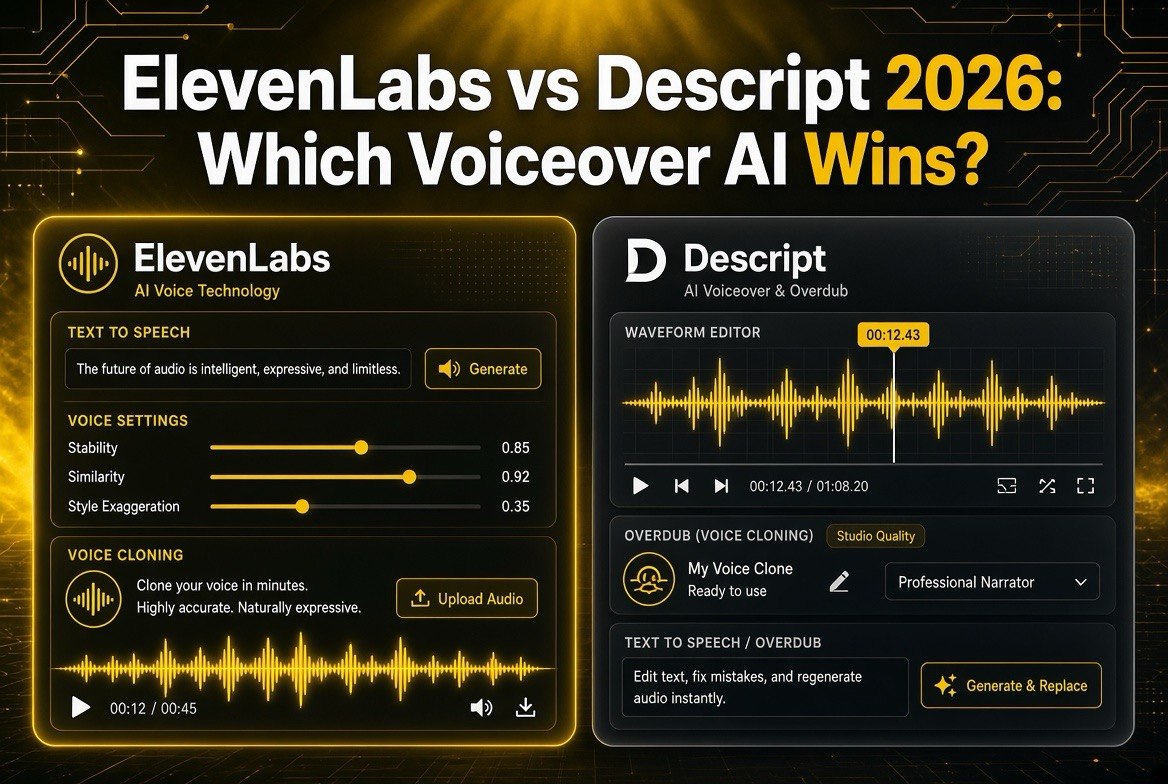
ElevenLabs vs Descript 2026: Which Voiceover AI Wins?
Get The Faceless YouTube Blueprint — Free
The exact AI tool stack and workflow used to build a faceless YouTube channel from zero.
ElevenLabs vs Descript 2026: Which Voiceover AI Wins?
⚡ Expert Summary: ElevenLabs wins for dedicated, high-volume, or API-driven voiceover work with the most natural-sounding voices in 2026. Descript wins when voiceover is one part of a full video-editing and podcast workflow. If you generate bulk narration and want the best-sounding AI voice per dollar, pick ElevenLabs. If you edit video and podcasts every week and want voice, captions, and cleanup in one place, pick Descript.
Why This Comparison Matters for Creators in 2026
Voiceover is the backbone of faceless YouTube channels, short-form clips, explainer videos, and ads. In 2026, the two tools US video creators reach for more than any other are ElevenLabs and Descript. They look similar on paper — both turn text into realistic AI speech, both let you clone a voice, both are used by serious creators. But they solve different problems.
ElevenLabs is a dedicated text-to-speech and voice platform. Descript is a full audio and video editor that happens to include high-quality AI voice. Pick the wrong one and you either pay for editing features you never use, or you fight a video editor to generate one clean voiceover clip. This guide compares them head-to-head so you can pick the right one on the first try.
The stakes are real. A creator producing five narrated clips a week will generate thousands of words of audio every month, and the difference between a $22 tool and a $35 tool becomes hundreds of dollars a year on even a modest workload. Voice quality also drives watch time — a robotic narrator gets skipped, while a natural voice keeps viewers engaged through the first 30 seconds, which is where YouTube decides whether to push your video. That is why choosing the right voice tool is a business decision, not a convenience one.
For a related deep dive on another core creative decision, see our AVCLabs vs Topaz Video AI comparison for upscaling, and browse more tools in the AI video tools category.
Quick Verdict
ElevenLabs is the winner for pure voiceover quality and volume; Descript wins for integrated editing. Creators who need the most realistic narration at scale should choose ElevenLabs. Creators who edit podcasts or long-form video and want AI voice as part of that workflow should choose Descript.
ElevenLabs vs Descript: Side-by-Side Comparison
| Feature | ElevenLabs | Descript |
|---|---|---|
| Core focus | Dedicated AI voice & TTS | Audio/video editor with AI voice |
| Starting paid plan | $6/mo (Starter) | ~$16-24/mo (Hobbyist) |
| Popular pro tier | $22/mo Creator | ~$24-35/mo Creator |
| Voice cloning | Instant + professional (high tiers) | Overdub (custom voice) |
| Video editing | No (audio creation) | Yes, full editor |
| API access | Yes, scalable | Limited |
| Billing model | Credits (characters) | Media minutes + AI credits |
| Best for | Bulk TTS, API, voice cloning at scale | Podcast/video end-to-end production |
ElevenLabs charges by credits, roughly one credit per character on its main models. A 10,000-credit free plan gives about 10 minutes of audio. Paid plans scale from there: Starter at $6 for about 30 minutes, Creator at $22 for two-plus hours, and Pro at $99 for ten-plus hours with higher audio quality at 192 kbps. Descript charges by media minutes for imported audio and video plus monthly AI credits for its AI features, which is a very different cost structure if you generate voice only.
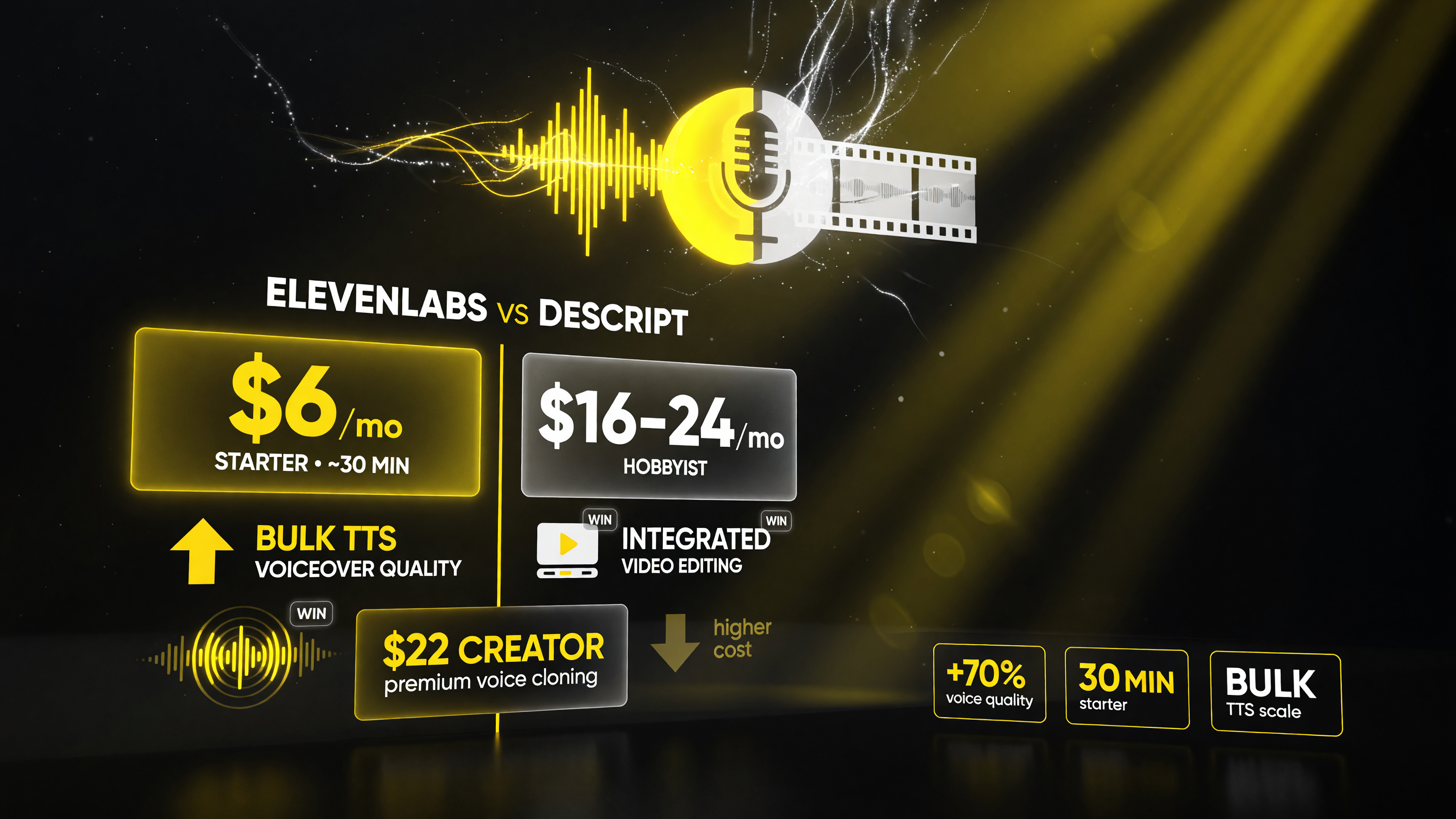
The 2026 price-to-value gap: ElevenLabs Starter at $6/mo gives ~30 minutes of audio, while Descript Hobbyist starts near $16-24/mo — ElevenLabs wins on voiceover quality and bulk TTS at the Creator tier.
ElevenLabs Deep Dive
ElevenLabs is the closest thing to a professional voiceover studio in software form. Its text-to-speech voices are widely considered the most natural in the industry in 2026, with genuine emotional nuance, prosody, and multilingual support across dozens of languages. That realism is the whole point — a faceless YouTube channel can sound like it hired a narrator, and a US business can produce ad reads and product explainers without a recording studio.
Under the hood, ElevenLabs runs a credit system. Each voice generation draws from your monthly credit pool, and on the main models that works out to roughly one credit per character of text. Ten thousand credits, which is the free tier, translates to about ten minutes of audio. That sounds abstract until you map it to real work: a 60-second short-form clip with a fast delivery might consume 1,500 to 2,500 credits, so the free plan is genuinely enough to test voice quality, while a Pro plan at $99 a month covers ten-plus hours of narration for a busy channel.
Its features go beyond TTS. ElevenLabs offers advanced voice cloning (instant cloning on Starter, professional cloning on higher tiers), a Studio mode for multi-voice projects, dubbing in 90-plus languages, sound effects, and even music generation. It has a fully featured API, which makes it the default choice for developers and teams that want to generate voice programmatically at scale.
What it does not do: edit video. You will generate your voiceover in ElevenLabs, download the audio or copy it, and drop it into your video editor. For audio-only workflows and bulk narration, that is an advantage — no editor to fight. For creators who want their whole project in one tool, it is a missing piece.
ElevenLabs Pros and Cons
Pros: Best-in-class voice naturalness; scalable API; strong voice cloning; multilingual dubbing; lower per-minute cost on paid tiers for bulk voice.
Cons: No video editing; credit system takes getting used to; pro features (higher audio quality, professional cloning) sit on more expensive tiers.
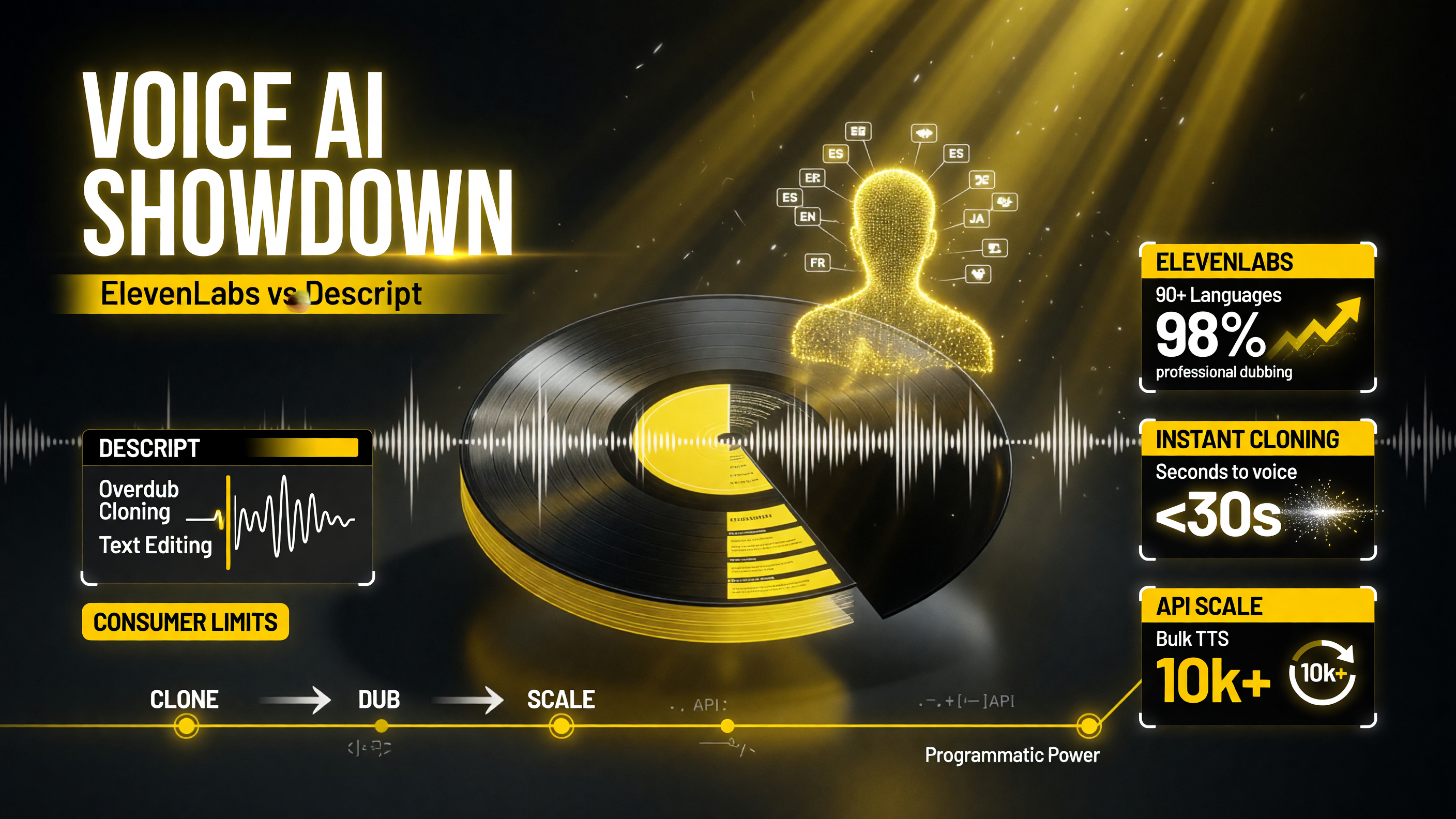
Go deeper than pricing: ElevenLabs brings instant professional voice cloning, dubbing in 90-plus languages, and a programmatic API for bulk TTS — while Descript pairs Overdub cloning with its text-based video editor.
Descript Deep Dive
Descript is a collaborative audio and video editor built around text-based editing. You paste your script, generate speech or import your own, and edit the audio by editing the text — delete a word in the transcript and it deletes the word in the audio. That is the core workflow that has made it popular with US podcasters and video creators who want to move fast.
Descript prices differently. It charges for the media minutes you import and process, plus a separate monthly pool of AI credits that powers features like Overdub, filler removal, and its AI editing assistants. A free plan gives you about 60 media minutes and a handful of credits — enough to feel the workflow. Paid plans bundle more minutes and more credits, which is efficient if you edit a lot of your own recordings, but it means you can consume AI credits on cleanup and captions even before you generate a single line of AI voice.
Its AI voice, Overdub, lets you clone your own voice or use stock AI voices, and you can regenerate or repair a word in a recording seamlessly. Overdub is powerful but generally considered a step below ElevenLabs for pure naturalness. What Descript offers instead is the surrounding production suite: transcription in 25+ languages, multi-track editing, filler-word removal, auto captions, collaboration tools, and direct publishing.
That makes Descript the right pick when voiceover is one step in a larger editing pipeline — for example, a creator who records a video podcast, cleans up the audio, adds AI voice for a segment, generates captions, and publishes to YouTube, all in one session.
Descript Pros and Cons
Pros: Full text-based audio/video editing; transcription and captions; filler removal; collaboration; one tool for the whole pipeline.
Cons: AI voice less natural than ElevenLabs; more expensive per minute for pure voice generation; steeper price floor to get useful AI voice access.
ElevenLabs vs Descript: How They Compare for Your Use Cases
Faceless YouTube and Short-Form Voiceover
This is where ElevenLabs dominates. If you batch-generate narration for 10 clips a week, ElevenLabs produces more natural voice faster and cheaper at volume. Its credit model favors bulk generation. Descript can do this too, but you are paying for a video editor you may not need, and Overdub voice quality trails ElevenLabs for straight narration. Winner: ElevenLabs.
Podcast Editing and Repair
Descript is built for this. Text-based editing, filler removal, and word-repair with Overdub make cleaning a podcast dramatically faster. ElevenLabs offers no editing, so you would need a separate editor. Winner: Descript.
Voice Cloning
Both let you clone a voice, and ElevenLabs gives you instant cloning at a lower entry tier plus professional cloning at higher tiers. Overdub is solid for your own voice, but ElevenLabs is more flexible and higher fidelity for cloning voices you intend to use at scale. Winner: ElevenLabs.
API and Automation
ElevenLabs has a scalable API that is a first-class product feature. Descript is a consumer editor with limited automation surface. If your goal is programmatic voice generation, there is only one choice here. Winner: ElevenLabs.
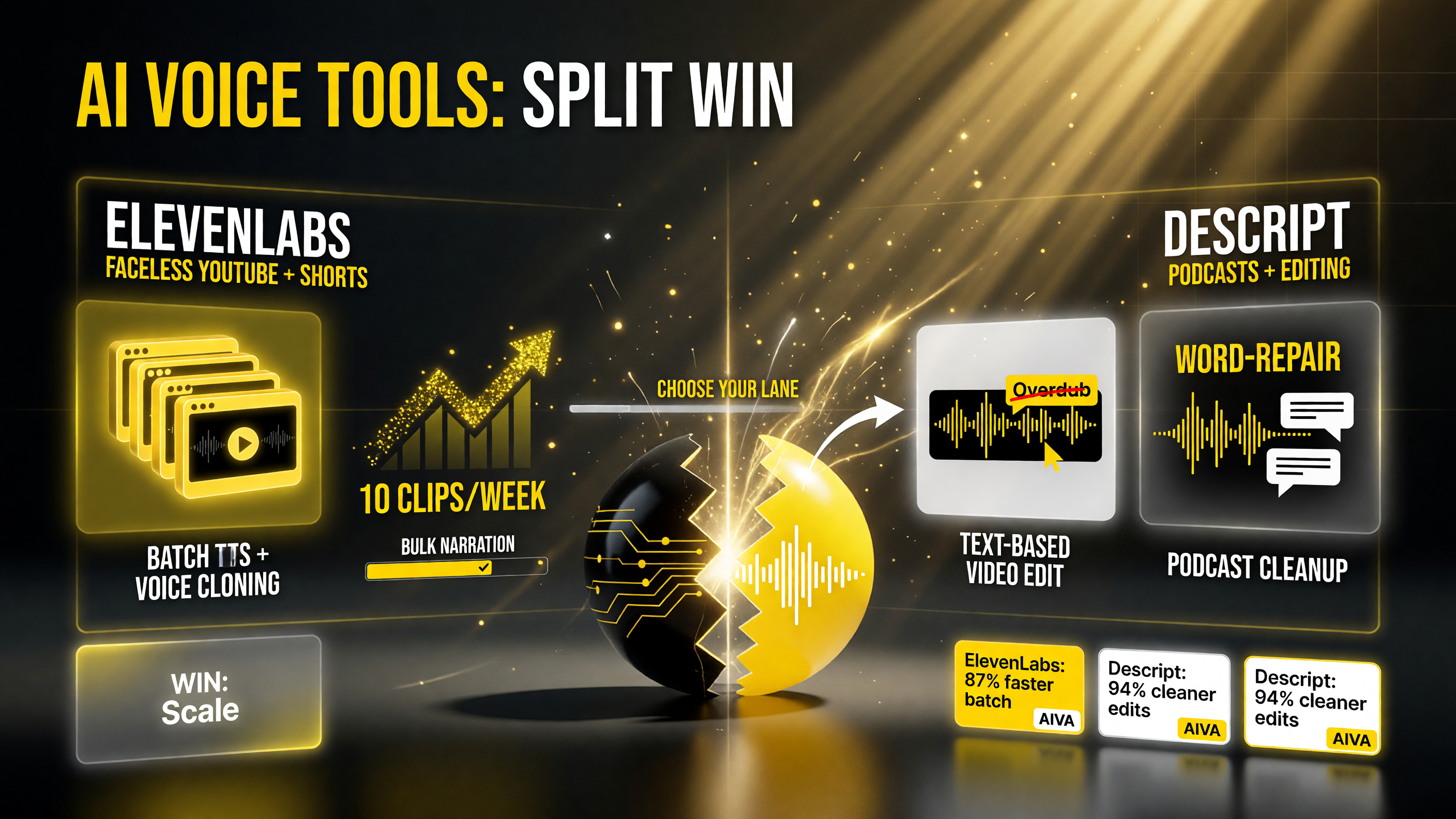
Pick your lane: batch-produce faceless YouTube and Shorts narration with ElevenLabs, or clean up podcasts and edit video by editing text with Descript — each wins in its own workflow.
Pricing Comparison
| Plan | ElevenLabs (monthly) | Descript (monthly) |
|---|---|---|
| Entry | $6/mo (Starter, ~30 min) | ~$16-24/mo (Hobbyist, 10 hrs) |
| Creator | $22/mo (~2+ hrs) | ~$24-35/mo (30 hrs) |
| Pro / Business | $99/mo (10+ hrs, 192kbps) | ~$50-65/mo (Business) |
The key pricing insight: ElevenLabs measures what you actually use for voice — characters generated. Descript bundles voice inside a media-minutes-and-AI-credits model that is efficient if you are editing a lot of video, but wasteful if you only want narration. A creator who generates 20 minutes of voice per week and does no video editing will pay far less on ElevenLabs Creator ($22) than on a Descript tier with enough minutes to cover their project.
Who Should Choose Which
Choose ElevenLabs if: you primarily need high-quality AI narration — faceless YouTube voiceover, short-form clips, ad reads, explainers — and you edit elsewhere or in bulk. It is also the pick if you need an API, voice cloning at scale, or the most realistic voices in 2026.
Choose Descript if: you produce podcasts, record yourself, or edit long-form video regularly, and you want voice, transcription, captions, and cleanup in one collaborative editor. The integration saves more time than the voice-quality gap costs you.
Neither is a mistake — they just serve different production styles. Match the tool to your actual workflow, not to the louder marketing.
One practical note for teams: Descript’s collaboration features mean multiple editors can work on the same project, which matters if you run a small production team. ElevenLabs focuses on single-user generation through Studio, so if your bottleneck is coordination rather than voice quality, Descript’s shared workspace may be worth the trade-off. Spend an hour with the free tier of each, generate the same script with the same cloned voice, and listen back — your ears will settle the argument faster than any spec sheet.
FAQ
Is ElevenLabs better than Descript for AI voiceover?
For pure voiceover quality and volume, yes. ElevenLabs produces more natural-sounding AI voices and costs less per minute of voice at scale. Descript is better when voice is part of a full audio/video editing workflow rather than a standalone output.
Which is cheaper: ElevenLabs or Descript?
For generating voice only, ElevenLabs is cheaper — its credit model bills for characters generated, starting at $6/month. Descript bundles voice into a media-minutes + AI-credits model that only pays off if you are also editing audio or video in the same tool.
Can I clone my voice with both ElevenLabs and Descript?
Yes. ElevenLabs offers instant voice cloning on its Starter plan and professional cloning on higher tiers. Descript offers Overdub, which clones your voice for text-based editing and word repair. ElevenLabs is generally more flexible and higher fidelity for cloning at scale.
Does Descript edit video?
Yes. Descript is a full audio and video editor with text-based editing, transcription, captions, filler removal, and collaboration. ElevenLabs does not edit video — it focuses on voice generation, dubbing, and audio creation.
Which tool is better for a faceless YouTube channel?
ElevenLabs is the stronger choice for faceless YouTube narration because it delivers more natural voices at a lower cost for bulk generation. You generate the voiceover there and drop it into your video editor. Descript works if you want to build the entire video in one tool.
Do ElevenLabs and Descript have free plans?
Both have free plans. ElevenLabs gives about 10 minutes of TTS on a free tier. Descript gives roughly 60 media minutes and a limited amount of AI credits. Free tiers are best for testing voice quality before committing.

About Barak Schurr
Barak Schurr is a serial entrepreneur who built and exited a major ticketing platform before turning his attention to AI and content. He runs three AI-focused research sites and writes about the tools, workflows, and strategies that let solo creators build real channels — without a crew, a studio, or a Hollywood budget. Contact: [email protected]
More AI Video Resources