Snap Spins Off AI Video Team Into Dotmo: Creator’s Guide
Get The Faceless YouTube Blueprint — Free
The exact AI tool stack and workflow used to build a faceless YouTube channel from zero.
Snap Spins Off AI Video Team Into Dotmo: Creator’s Guide
⚡ Expert Summary: Snap is spinning off its generative AI video team into a new company called Dotmo, citing the high costs of developing AI models internally. The new company will focus on AI-powered interactive gaming experiences. Dotmo will be led by current Snap staff, with CTO Bobby Murphy acting as lead investor. This is Snap’s second major spinoff this year, following Specs AR glasses. For video creators, this signals that the cost of building cutting-edge AI video models is pushing even well-funded companies to restructure, and that specialized AI video tools may emerge from these focused spinoffs.
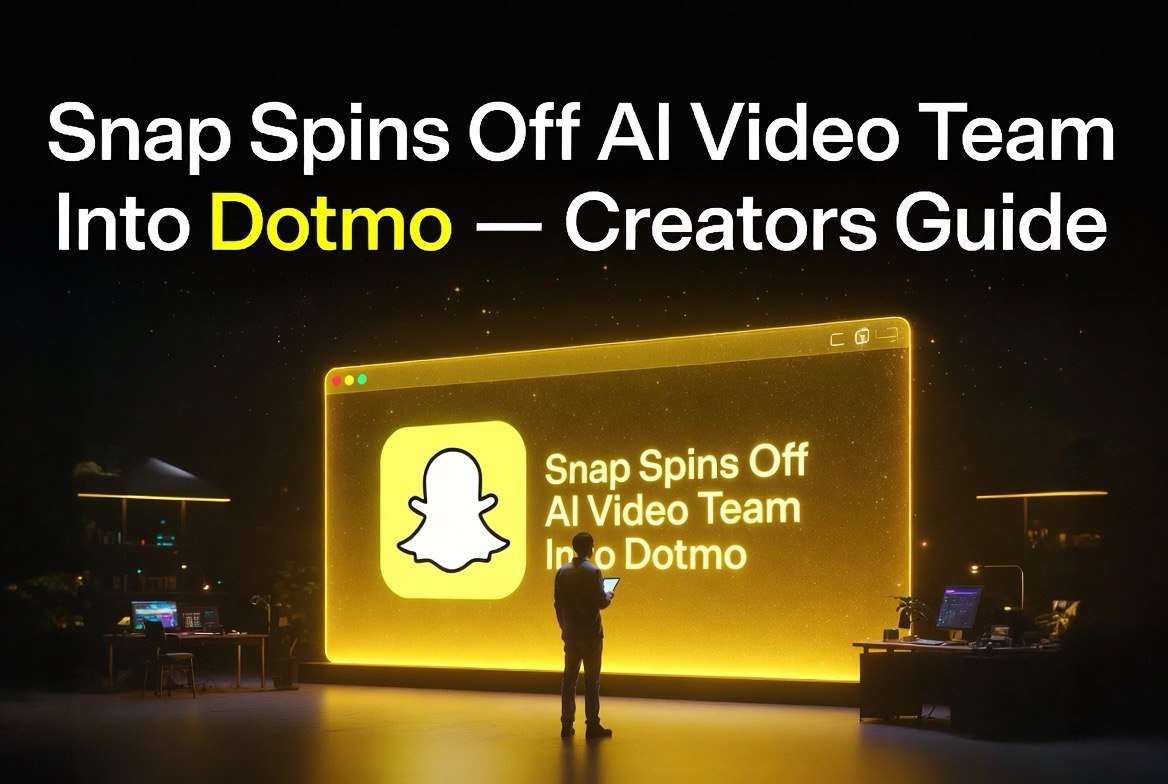
Snap is spinning off another internal team into an independent company. On June 18, 2026, TechCrunch reported that Snap’s generative AI video team will become a standalone company called Dotmo, focused on developing AI models for interactive gaming experiences. The reason according to Snap: the costs of conducting this work internally had become too high. According to TechCrunch’s coverage, the move represents a significant shift in how Snap approaches AI video investment.
This is Snap’s second major spinoff in 2026. Earlier this year, the company spun off its Spectacles AR glasses into a separate entity. Together, these moves tell a clear story about the economics of AI video development: even for a company with Snap’s resources and revenue, building state-of-the-art AI video models is expensive enough to justify spinning off the entire team into a separate entity. For more on how AI is changing video creation, check out our AI video tools coverage.
How the Dotmo Spinoff Works
While Dotmo is technically a separate company, it retains close ties to Snap. Snap will provide Dotmo with a license to adapt its technology for gaming and interactive entertainment platforms. The initial Dotmo team will consist of current Snap staff who are leaving the social media company to launch the new venture.
Financially, the deal is structured to preserve Snap’s upside while limiting its costs. Dotmo will not be funded by Snap directly. Instead, Snap CTO Bobby Murphy will act as lead investor with a significant personal stake in the new firm. Murphy will continue to work for Snap full-time while also backing Dotmo. In exchange for the talent and technology license, Snap gets a large equity stake in Dotmo, with the possibility that Dotmo may eventually seek outside funding from venture capital firms.
The structure is notable. Snap gets the upside of Dotmo’s potential success without carrying the cost of the AI video team on its own books. This is becoming a common pattern for AI development, where the cost of running experiments and training models can exceed the value that a single company can capture internally. By creating a separate entity, Snap can participate in the upside while insulating its core business from the financial volatility of AI research.
What This Means for AI Video Development Costs
The fact that Snap is spinning off AI video work due to cost is a signal to the entire video creation ecosystem. If Snap — a company with $5.4 billion in 2025 revenue and tens of millions of daily active users — finds AI video model development too expensive to keep in-house, it tells you something fundamental about the cost structure of this technology.
Training state-of-the-art video generation models requires enormous compute resources. According to industry estimates, a single training run for a competitive video generation model can cost $10 million to $50 million in GPU compute alone, and those costs are rising as models get more sophisticated. The inference costs — running those models to generate videos — are even higher per unit compared to text-based models. A text generation query might cost fractions of a cent, while generating a ten-second video clip can cost dollars in compute.
For video creators and businesses that rely on AI video tools, this has a direct implication: AI video generation is not going to get dramatically cheaper in the short term. The compute costs are real, and the companies that succeed in this space will need significant capital or creative business structures — like Snap’s spinoff model — to manage those costs effectively.
However, there is a longer-term opportunity worth watching. As more AI video teams spin off into independent companies, they become more focused, more capital-efficient, and more driven to find revenue-generating applications. A focused independent company building AI video for interactive gaming may develop capabilities — real-time rendering, interactive video generation, user-driven content creation — that eventually make their way into broader video creation tools accessible to all creators.
Why This Spinoff Pattern Is Accelerating
Snap is not the first company to spin off an AI unit. In the last 12 months, several large tech companies have restructured their AI operations to create more focused entities. The pattern is driven by three converging factors.
Cost structure mismatch. AI model development has a fundamentally different cost structure than consumer software. Training runs are expensive, unpredictable, and require specialized hardware that consumer software teams do not need. Folding these costs into a parent company’s profit and loss statement makes the entire business look less profitable to investors.
Talent retention. AI researchers and engineers often prefer working in focused startups rather than large corporate divisions, where they can participate more directly in the upside. Spinoffs with equity compensation structures are more attractive to top AI talent. The people building Dotmo are choosing equity in a focused AI video company over being engineers in a larger social media organization.
Capital access. Independent AI companies can raise money from outside investors without diluting the parent company’s stock. Snap’s structure — where Murphy personally invests rather than Snap corporate — keeps the financial risk off Snap’s balance sheet while still allowing the company to benefit if Dotmo succeeds.
According to Gartner’s 2026 technology investment report, 28% of large tech companies plan to spin off or restructure AI divisions within the next 18 months, up from 11% in 2024. The Snap Dotmo spinoff is part of a broader industry shift that will reshape how AI video tools are built and funded.
How Dotmo Changes the Competitive Landscape for AI Video
The creation of Dotmo also reshapes the competitive dynamics of the AI video market. Snap, through its equity stake in Dotmo, keeps a foot in the AI video space while offloading the operational cost and risk. This is a hedge: if AI video models become a commodity where margins compress, Snap is not left holding expensive R&D infrastructure. If AI video becomes a massive market, Snap shares in the upside through its equity position.
For other AI video companies — both startups and established platforms — this creates a new dynamic. Dotmo enters the market as an independent company with Snap’s technology, Snap’s talent, and a clear focus on interactive gaming. It is not starting from scratch. It is starting with a head start, a clear mandate, and the ability to raise outside capital without the constraints of operating as a division inside a public company.
Video creators in the United States and globally should watch Dotmo’s product development closely. If the company succeeds in building compelling AI models for interactive gaming, those capabilities will likely expand into adjacent areas — interactive advertising, personalized video content, real-time video generation — that overlap with broader video creation workflows. The technology that starts in gaming often ends up in everything else.
What Video Creators Should Watch For
For video creators in the United States and around the world, the Dotmo spinoff matters for three specific reasons worth tracking.
Expect AI video prices to stay high. The Dotmo spinoff confirms that AI video model development is expensive and likely to remain so for the foreseeable future. Do not expect AI video generation prices to drop as fast as text-based AI prices have. The compute costs are an order of magnitude higher, and the spinoff trend is a symptom of that reality, not a solution to it. Budget for AI video at roughly 10-20x the cost of text-based AI generation for the near term.
Specialization will increase. Dotmo is focused on interactive gaming experiences, not general video generation. This specialization is good for creators because focused tools tend to be more capable for their specific use cases. A tool built for interactive gaming will be better at real-time video generation than a general-purpose video model. As more AI video startups spin off and specialize, creators will have access to tools that are more capable for specific jobs.
Independent companies may outperform platforms. The spinoff pattern suggests that the AI video market will consolidate around a few well-capitalized independent companies rather than being dominated by the big tech platforms. This could mean more competition, more innovation, and more options for creators who rely on AI video tools. Independent companies are more responsive to customer needs than divisions of larger companies, which means better products for video creators over time.
The bottom line for video creators: AI video is here to stay, but the companies building it are restructuring to manage costs. Watch where the talent goes, because the people leaving Snap to build Dotmo are the ones who will shape the next generation of AI video tools and capabilities.
Frequently Asked Questions
What is Dotmo?
Dotmo is a new company spun out of Snap’s generative AI video team. It will focus on developing AI models for interactive gaming experiences. Snap CTO Bobby Murphy is the lead investor, and the initial team consists of current Snap employees.
Why did Snap spin off its AI video team?
Snap cited the high costs of developing AI video models internally. The spinoff allows the team to continue its work as an independent company while Snap retains a large equity stake and limits its financial exposure to the costs of AI research and development.
Is this related to Snap’s AR glasses spinoff earlier in 2026?
Both spinoffs follow the same pattern: Snap creates independent companies from internal teams while retaining equity stakes. However, they are separate entities focusing on different technologies — Specs for AR hardware and Dotmo for AI video models and interactive experiences.
What does this mean for AI video generation costs?
Snap’s move confirms that AI video model development is extremely expensive, with single training runs costing $10 million to $50 million in GPU compute. Video creators should not expect AI video generation prices to drop as fast as text-based AI prices.
Will more tech companies spin off their AI divisions?
Yes. Gartner reports that 28% of large tech companies plan to spin off or restructure AI divisions within 18 months, up from 11% in 2024. The cost structure of AI development is driving this trend across the industry.

About Barak Schurr
Barak Schurr is a serial entrepreneur who built and exited a major ticketing platform before turning his attention to AI and content. He runs three AI-focused research sites and writes about the tools, workflows, and strategies that let solo creators build real channels — without a crew, a studio, or a Hollywood budget.
Email: [email protected]