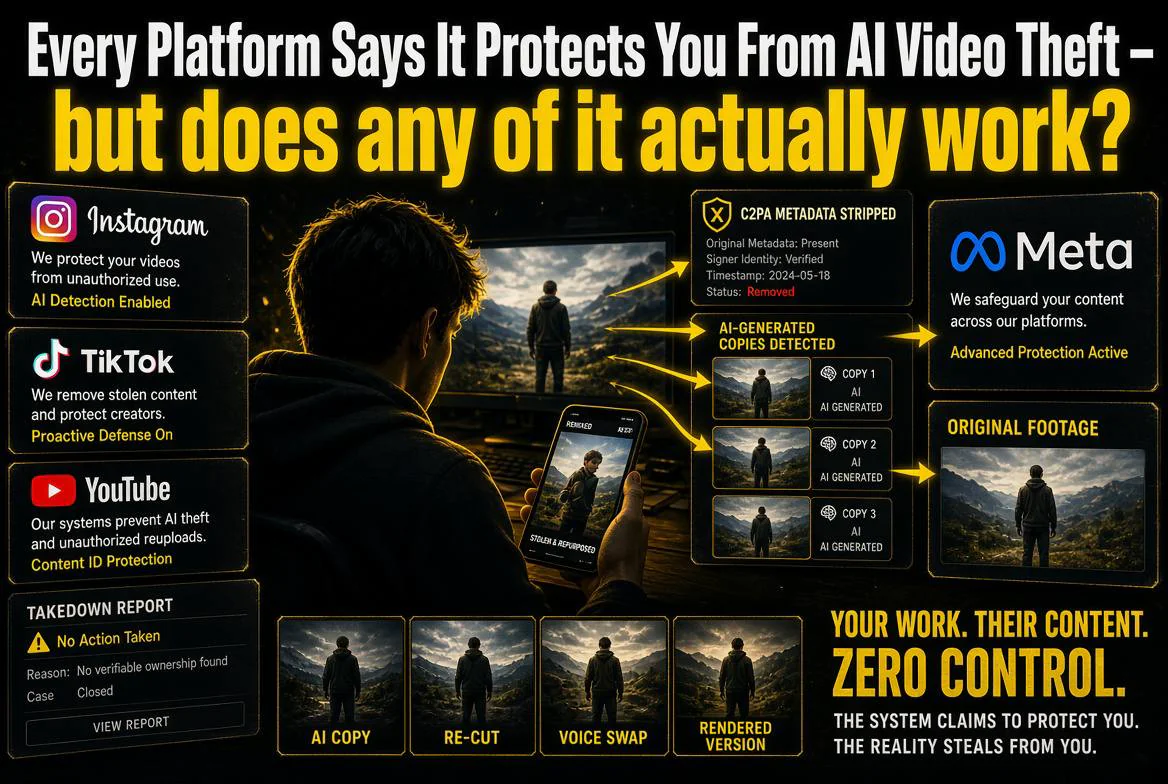
Every Platform Says It Protects You From AI Video theft – but does any of it actually work?
Every Platform Says It Protects You From AI Video theft – but does any of it actually work?
⚡ Expert Summary: Instagram, TikTok, YouTube, Facebook, Meta’s rights tooling, and every major AI video generator now claim to protect creators from stolen AI video. Not one of them publishes detection accuracy, takedown latency, false-positive rate, or appeal outcomes. A C2PA content credential is a metadata tag, and metadata does not survive a re-encode. The protection exists. The proof does not. That gap is the story.
You spent three days on a video. Somebody fed a frame of it into an AI generator, remixed it, posted it, and it did numbers. You filed the report. The platform sent back an automated confirmation, then nothing.
That experience is not a bug in the system. It is the system working as designed, because the platform’s obligation ends when the report form is submitted, not when your video comes down.
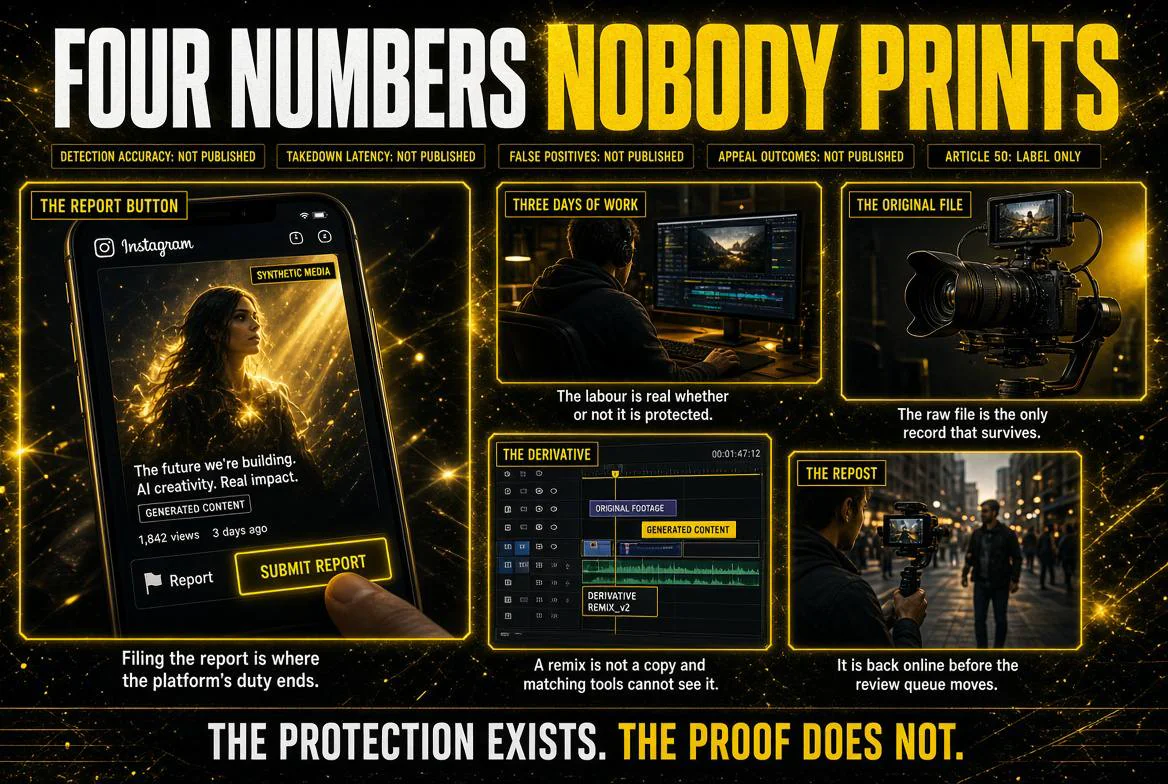
Here is the honest state of AI video theft protection in November 2026. Six surfaces claim to defend you. Four numbers would prove whether they actually do. None of them are published.
The four numbers that would settle this, and who refuses to print them
Any real protection system can be measured on four axes. Every platform publishes the feature. Nobody publishes the measurement.
| The number that matters | What it would tell you | What is published |
|---|---|---|
| Detection accuracy | How often the system recognises YOUR work inside a derivative | Nothing confirmed |
| Takedown latency | Hours between your report and the post disappearing | Nothing confirmed |
| False-positive rate | How often innocent creators get hit, and how they clear it | Nothing confirmed |
| Appeal outcomes | Whether reporting does anything at all, at scale | Nothing confirmed |
Four axes. Four silences. A platform that truly protected creators would publish all four, because publishing them would be the single most effective piece of marketing available in the creator economy.
None of them do. Ask yourself why a company that spends millions advertising its creator tools would refuse to publish the one number that proves the tool works.
What is actually being offered, surface by surface
Strip the branding and each platform’s protection reduces to a different mechanism with a different weakness.
Instagram offers a reporting flow for AI-generated content that impersonates you, reinforced by its AI content labelling — which now extends to third-party tools feeding the platform. Meta has also expanded detection of AI-generated imagery on its surfaces. What it does not publish is what happens after you file, or how often the label is applied correctly to work that mimics you.
TikTok applies automatic AI-generated content labels and requires creators to disclose synthetic media. The label is the protection. A label tells the viewer something might be synthetic. It does not restore your revenue, your attribution, or your reputation.
YouTube requires disclosure of realistic synthetic content and provides its own detection and labelling, plus a copyright system built for a different kind of theft — matching a full copy, not a remix. A video generated from your footage is not a match. It is a derivation, and the matching system was never built to see it.
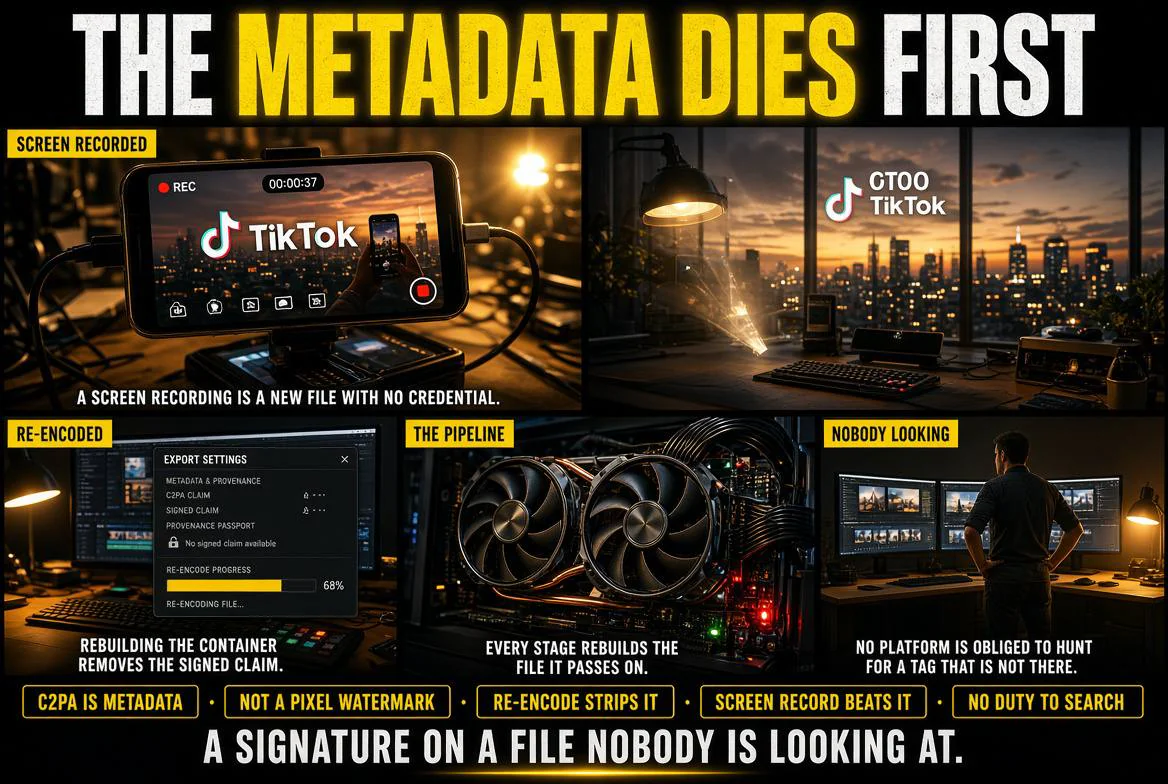
The C2PA content credential is the industry’s technical answer, and it is the most oversold piece of the entire stack. C2PA is a metadata standard that attaches provenance information to a file. It is a signed claim about where a file came from, and it works exactly until someone re-encodes, screen-records, or re-uploads the file without it. Metadata does not survive a phone screen recording. It is not a watermark embedded in pixels, and it does not detect theft — it asserts origin to a platform willing to read it.
Meta’s Rights Manager is a genuine matching tool for video. It requires you to register reference files and it matches copies. AI-generated derivatives that transform the footage — a new style, a new subject, a new length — sit outside what a copy-matching system can see.
AI video generators themselves now claim to block infringing prompts and to honour likeness restrictions. A prompt filter is a text filter. It has no way to know that the face described in a prompt belongs to a person who never consented, unless that person is already in a blocklist the generator maintains.
Every one of those is a real mechanism. Every one of them protects against a narrower threat than the one creators actually face.
Why metadata protection fails the moment someone re-encodes your video
This is the technical heart of the problem, and it is duller and more damning than the marketing suggests.
A C2PA credential lives in the file’s metadata container. When you upload, the platform may preserve it. When someone screen-records your video on a phone, the recording is a new file created by the operating system, with its own metadata and no credential. When someone re-encodes an MP4 to change the bitrate, the container is rebuilt. When a video passes through a generator as input frames, the output is a new file with the generator’s own provenance.
In every one of those cases, the AI-generated derivative carries no credential pointing back to you, and no platform has an obligation to look for one that is not there.
This is not a flaw somebody forgot to fix. It is the structural limit of provenance-on-a-file in an ecosystem where the file is constantly reborn. A robust defence would need to be perceptual — a fingerprint of the content itself that survives transformation — and perceptual matching degrades exactly where AI transformation is strongest.
So the creator is left with a credential that proves authorship of a file nobody is looking at, and a derivative that carries no trace of the original at all.
The comparison that matters: what each layer actually catches
| Protection layer | What it catches | What walks straight through |
|---|---|---|
| C2PA credential | An intact file with metadata preserved | Screen recordings, re-encodes, generator output |
| Platform AI label | Disclosed synthetic content | Anything a creator chooses not to disclose |
| Copy-matching tools | Re-uploads of the same file | Remixes, restyles, frame-level derivations |
| Prompt filters | Known blocklisted names and likenesses | Anyone not yet on the list |
| Manual report | Whatever a human reviewer happens to see | Volume, and anything after the first reply |
Read the right-hand column again. That column is where the actual problem lives, and it is the column nobody is funding.
The incentive is obvious once you look at it plainly. A detection system that works perfectly would take down a meaningful share of the platform’s own AI-generated inventory. Every party in the chain — generator, platform, advertiser — benefits from synthetic content existing and staying up. Nobody in that chain is paid on accuracy.
What the law actually requires — and what it does not
Two European instruments touch this, and both are narrower than creators assume.
The EU AI Act’s Article 50 transparency obligations require that synthetically generated content be marked in a machine-readable format and that deepfakes be disclosed. That is a marking obligation. It creates a duty to label, not a duty to detect theft or to remove derivatives on request. Marking helps a viewer who notices. It does not restore a creator.
The revised product liability directive, EU 2024/2853, brings software into the product liability regime. That expands the surface where a defective system can create liability without proof of negligence — but a creator trying to establish that a platform’s detection system is defective faces the same wall as before: no published accuracy data to prove it against.
So the legal position is this. You have a right to have your work marked as yours if it goes through a compliant pipeline. You have no enforceable published standard for how well anybody must detect a derivative of it.
That is the gap the platforms are standing in. They comply with the marking rule, advertise the feature, and publish nothing about whether it catches anything.
What actually works, ranked by how much it costs you
Since the platforms will not prove their systems work, the practical answer is to build protection that does not depend on their cooperation.
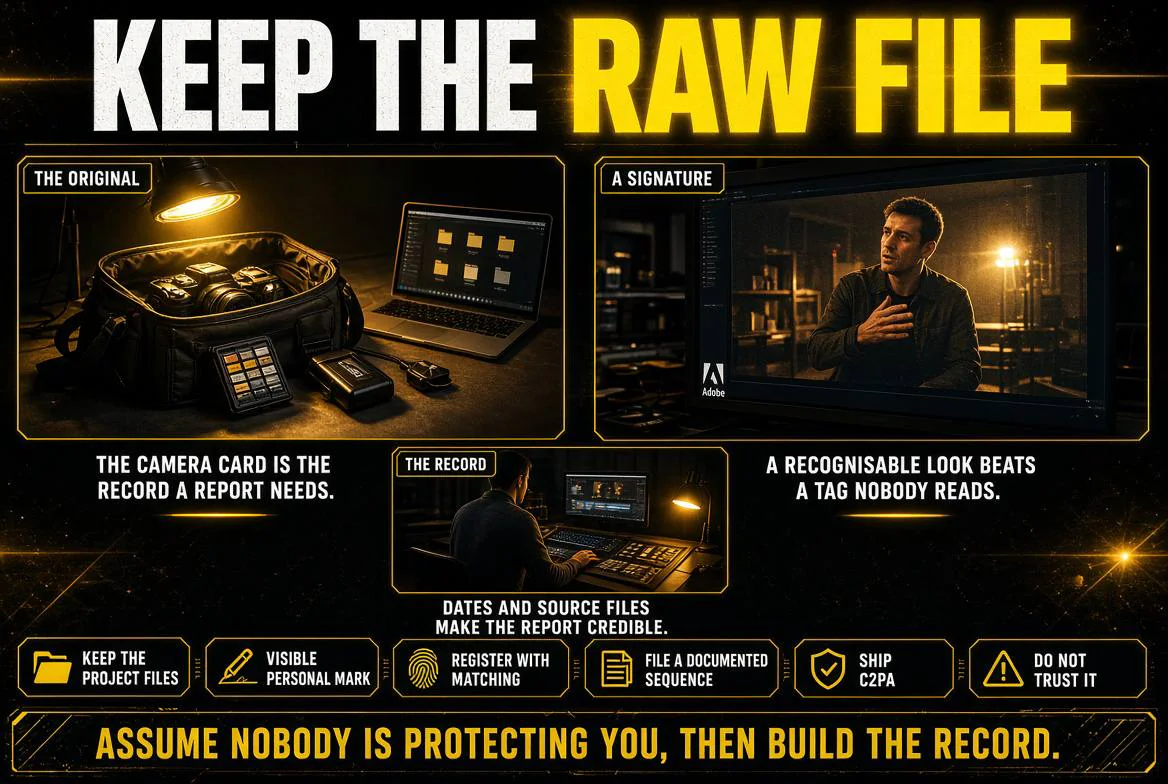
First, keep your raw project files and a dated record. Not for a lawsuit you will probably never file — for the report you will actually submit. A platform review queue moves faster when the report contains the raw footage, the project file timestamps, and the original upload URL. That is the single highest-return thing a creator can do, and almost nobody does it because it is boring.
Second, embed a visible, personal identifier. Something in the frame that is yours — a recurring element, a set, a graphic, a mannerism. Perceptual matching tools and human reviewers both rely on recallable signature. A watermark that survives re-encoding is good. A signature a viewer recognises is better, because it survives the humans too.
Third, register with copy-matching programmes where they exist. Rights Manager and the equivalent systems do catch straight re-uploads, and a straight re-upload is still the most common form of theft. It is a narrow net, but it is free to cast.
Fourth, file reports in a way that creates a record. Not a single automated report — a documented sequence with reference numbers and dates. Platforms respond differently to a pattern than to an incident, and a pattern is what you have.
Fifth, stop expecting the credential to do the work. Ship C2PA if your tooling supports it, because it costs nothing and helps in the one case where a platform honours it. Do not treat it as protection. It is a signature on a file, and the file gets reborn every time somebody touches it.
The honest verdict
Six surfaces claim to protect creators from AI video theft. Not one publishes detection accuracy, takedown latency, false-positive rate or appeal outcomes. The strongest technical mechanism in the stack is a metadata tag that dies on a re-encode. The legal framework requires labelling, not detection. And the parties who would have to fund real detection are the same parties profiting from the synthetic content it would remove.
That is not a conspiracy. It is an incentive structure, and the incentive points away from proof.
So the practical position for a creator in November 2026 is this: assume nobody is protecting you, keep the records that make a report credible, build a visual signature that survives transformation, and use the free matching tools for the narrow case they cover.
The button exists. It is just not the protection. It is the receipt for a system that has never published whether it works.
Frequently asked questions
Do platforms actually remove stolen AI video?
Platforms operate reporting flows and copy-matching systems that can remove content, but none publishes takedown latency, success rate or appeal outcomes. Without published data, removal is an anecdote rather than a measurable protection.
What is a C2PA content credential and does it stop theft?
C2PA is a metadata standard that attaches signed provenance information to a file. It asserts origin to a platform willing to read it. It does not survive re-encoding or screen recording, so it does not prevent derivatives made from your footage.
Does AI content labelling protect creators?
Labelling tells a viewer that content may be synthetic. It does not remove the content, restore attribution, or recover revenue. Several platforms require disclosure, but enforcement depends on creator honesty and on detection that is not published.
Can copy-matching tools detect AI-generated derivatives?
Copy-matching systems like Meta’s Rights Manager are built to find re-uploads of the same file. AI-generated derivatives that change style, subject or length are not copies, and typically fall outside what these systems can match.
What does EU law require platforms to do about AI video?
Article 50 of the EU AI Act requires that synthetic content be marked in a machine-readable format and that deepfakes be disclosed. That is a labelling obligation. It does not create a duty to detect theft or to remove derivatives on request.
What should a creator do first to protect their video?
Keep raw project files, original upload URLs and dated records. A report backed by source files and timestamps moves through a review queue faster than an automated complaint, and it is the highest-return step available.
Is there any protection that survives an AI re-encode?
No published system reliably survives transformation. Perceptual fingerprinting degrades as the derivative moves further from the source, and visible personal identifiers in the frame are the only signal that survives both automated and human review.
About Barak Schurr
Barak Schurr is a serial entrepreneur who built and exited a major ticketing platform before turning his attention to AI and content. He runs three AI-focused research sites and writes about the tools, workflows, and strategies that let solo creators build real channels — without a crew, a studio, or a Hollywood budget.
Email: [email protected]
More AI Resources