Half the Games on Steam Now Say They Used AI: Is AI Effectively Taking Over Game Design?
Half the Games on Steam Now Say They Used AI: Is AI Effectively Taking Over Game Design?
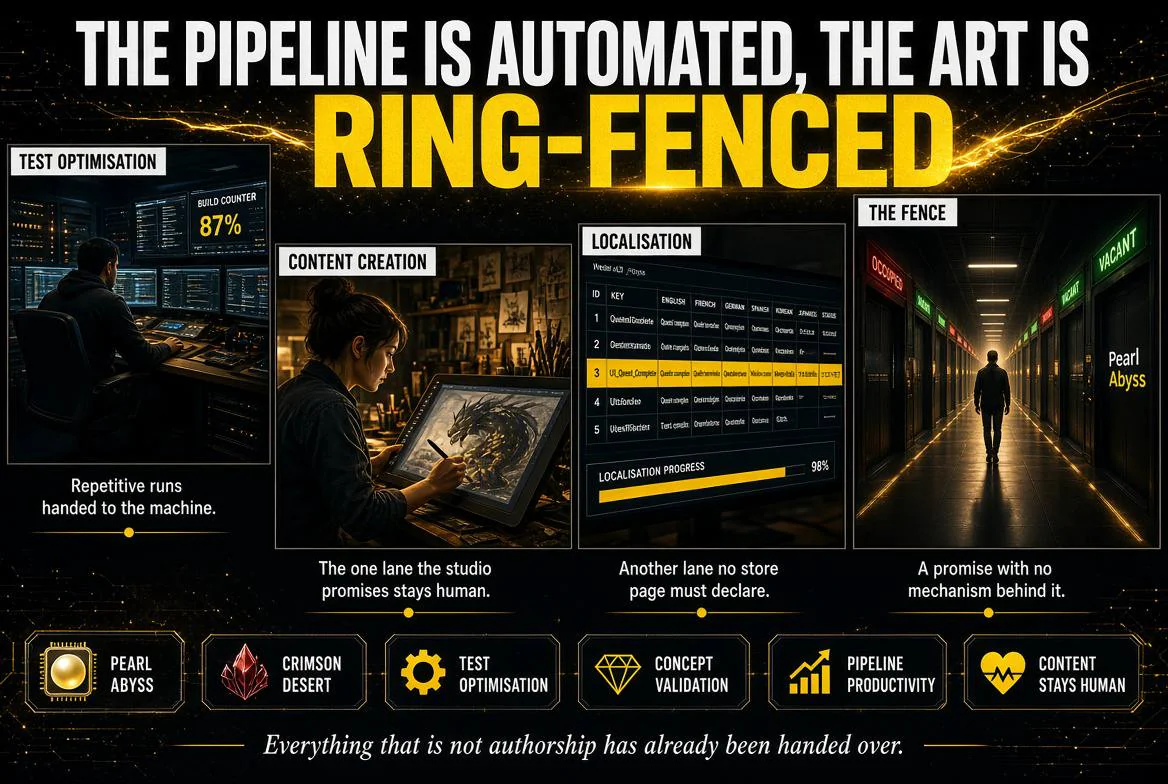
⚡ Expert Summary: Yes, but not in the way the panic suggests — and the caveats matter more than the headline. One person read Valve’s AI content flag on every game released on Steam between January 2024 and October 2026: 63,596 releases. The share disclosing AI rose from 1.7% to 49.9%. That is a disclosure number, not a usage number, because developers fill in the flag themselves — so 49.9% is a floor, not a ceiling. The real answer to “is AI taking over game design” is in the split: Pearl Abyss says AI now runs through its entire development pipeline, automating testing, iteration and concept validation, while “actual content creation” stays fully human. That is the industry’s arrangement, said out loud. Design decisions, iteration and QA are being automated. The authorship is being ring-fenced — for now.
On roughly 14 November 2026, Pearl Abyss — the studio behind Crimson Desert — told investors that AI is “being utilized across various stages of development, including the automation of repetitive tasks, content creation support, and test optimization,” and that it is “expanding its implementation throughout our entire development pipeline.” Then, in the same breath: “AI serves strictly as a tool to support concept validation and pipeline productivity, while the core gameplay experience and actual content creation remain fully driven by our development team.”
Read that twice, because it is the most honest sentence any studio has published this year, and it cuts two ways.
Half of it is a promise: your art is safe, humans make the game. The other half is a confession: everything that is not “content creation” has already been handed to a machine. Not some of it. The pipeline.
The Receipt: 1.7% to 49.9% in Under Three Years
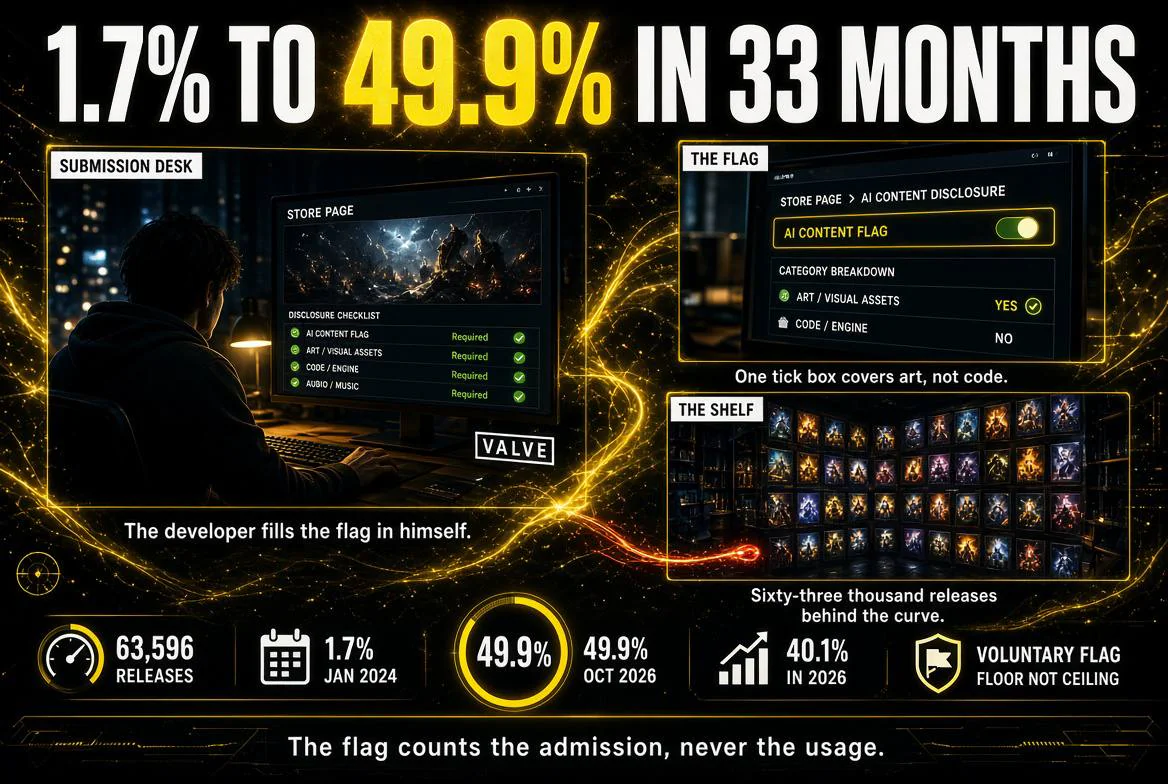
The number everyone is quoting comes from a single person doing brute-force work. On 2 November 2026, a Reddit user posting as u/mateorabi published an analysis in r/dataisbeautiful: they went through every game released on Steam between January 2024 and October 2026 — 63,596 games — and read the AI content disclosure flag that Valve keeps in each game’s app data.
The result: the share of new Steam games disclosing AI-generated content rose from 1.7% in January 2024 to 49.9% in October 2026. Yearly, it went 13.2% in 2024, 24.0% in 2025, and 40.1% across the 25,667 games released so far in 2026. CNET covered the finding on 11 November under the headline “Half of New Games on Steam Are Now Made With AI.”
Now the honest part, and it is the part that changes how you read every other number in this piece: that flag is filled in by developers, voluntarily, at submission. The count measures disclosure, not use. A studio can use AI across its pipeline and never tick the box. Which means 49.9% is not a ceiling. It is a floor that more than half the industry has bothered to admit to.
| Period | Share of Steam releases disclosing AI | What it says |
|---|---|---|
| January 2024 | 1.7% | The flag existed; almost nobody used it |
| Full year 2024 | 13.2% | First wave: asset packs, background art, placeholder audio |
| Full year 2025 | 24.0% | Doubled — generative tooling reached small teams |
| 2026 so far (25,667 games) | 40.1% | Majority of new releases within reach |
| October 2026 | 49.9% | Half of one month’s releases admitted to it |
| Base | 63,596 releases | Self-declared flag — a floor, not a ceiling |
What Valve Actually Makes Developers Admit
At submission, developers complete a content disclosure questionnaire covering AI-generated player-facing content — art, assets, audio and localisation — whether it ships in the build or appears in marketing. The store page gives two categories: pre-generated, meaning static content made with AI during development, and live-generated, meaning content produced dynamically while the game is running. Fail to disclose and Valve’s stated enforcement runs to withheld distribution or removal from the store.
Then the line that should be printed on a wall somewhere: backend-only code assistance requires no disclosure at all.
So the store page tells the player whether the art was generated. It tells them nothing about whether the code, the systems, the testing or the iteration was. And per Pearl Abyss, the code, the testing and the iteration are exactly what is being automated — at scale, across the whole pipeline. The only stage of game development that must be disclosed is the one stage the industry keeps promising humans are doing.
Every Lane They Automate Is Iteration. Every Lane They Protect Is Authorship.
Go back to Pearl Abyss’s language and sort the verbs.
“Automation of repetitive tasks.” “Test optimization.” “We now utilize AI to rapidly validate diverse design concepts prior to actual implementation.” “Concept validation and pipeline productivity.”
Those are iteration jobs. The work of building a thing, playing it badly, finding out why and doing it again — the loop that eats the middle third of every production schedule. A designer who once needed a week of greyboxing to answer “is this traversal loop fun” can now get a proxy answer in a day. That is genuinely a change in how games get designed, not merely in how they get built.
“The core gameplay experience and actual content creation remain fully driven by our development team.”
That is authorship. The premise, the art, the thing the player actually experiences. And it is ring-fenced — by a promise, not a mechanism.
The studio also has some history here: earlier in 2026, community backlash hit when AI-generated 2D props shipped by accident. That is the gap between a promise and a pipeline in one incident. The company’s position on AI has not softened since; PC Gamer’s coverage on 14 November ran under a headline making exactly that point.
So Is AI Taking Over Game Design? The Honest Answer
Half of new Steam releases now disclose AI content. That is not the same as AI designing games, and the industry knows it. Here is the actual picture:
- Design iteration — significantly automated. Concept validation, test-cycle speed, the play-test loop. This is the part of “game design” that is closest to engineering, and it is going first.
- QA, localisation and repetitive production work — heavily automated. Pearl Abyss names test optimisation explicitly. Valve does not require anyone to disclose it.
- Code assistance — automated and undisclosed by design. Backend-only assistance sits outside the disclosure regime entirely.
- Creative authorship — ring-fenced by promise, not by rule. No mechanism enforces “content creation stays human.” Only reputation, contracts and backlash.
- Player-facing art — the most visible, and the most commercially policed. Review-bombing punishes sloppy AI art, which keeps real artists on staff at studios that can afford them.
Which is why the answer is not “yes, AI is taking over game design.” It is narrower and more uncomfortable: AI is taking over the iteration of game design, and the parts of production nobody outside the studio ever sees. The part with a signature on it is being defended — by studios that would rather not be caught, and by an audience that is watching.
The Case Against the Panic
Fairness now, because the counter-argument is real and the number is being over-read.
The 49.9% is front-loaded by solo and micro-indie developers shipping low-review releases. Those are people for whom generative tooling is not a cost cut but a door: a two-person team can ship a game that would otherwise never exist, with background art, placeholder audio removed, and store copy in four languages. If you asked those developers whether AI is “taking over” their design, most would say it let them have a design at all.
The adoption figure is materially lower among commercially serious games — those with 100 or more reviews. I am not going to print a precise number for that because I do not have a study I can name and date, and a made-up percentage is worse than none. Treat it as direction, not data: the bigger the budget, the more human the pipeline remains.
There is also a functioning market floor. Players punish visibly sloppy AI output loudly enough to move sales. Studios have removed assets over it, walked back announcements, and in one case reversed a signed partnership inside a week — more on that below.
So the market is not asleep. That is the strongest version of the argument, and it still does not reach the person this story is actually about.
The Floor Protects the Top of the Market, Not the Work
Here is what the backlash economy does and does not do.
It protects the visible layer: the splash art someone will screenshot, the voice performance someone will recognise, the hero asset in the trailer. Studios that can afford a human artist keep one at that layer, because getting caught is expensive.
It does not protect the invisible layer: the props, the variant textures, the filler dialogue, the 40 hours of localisation, the QA pass, the greybox, the iteration that design used to be. Those are precisely the jobs the disclosure rules do not require anyone to admit to automating, and they are the jobs the count in this article is not measuring.
| Stage of production | Must be disclosed to players? | Can the audience punish it? |
|---|---|---|
| Player-facing art and assets (pre-generated) | Yes — store-page flag | Yes, loudly, and often does |
| Live-generated runtime content | Yes — second flag category | Yes, in principle |
| Audio, localisation, marketing assets | Yes — questionnaire covers them | Partly — visibility varies |
| Backend code assistance | No — outside the regime | No — nobody knows |
| Test optimisation and QA | No requirement | No — invisible by default |
| Design concept validation and iteration | No requirement | No — the player never sees it |
SAG-AFTRA Is the Only Party That Wrote It Down
There is one group in this industry that did not rely on a promise, and you can guess which. SAG-AFTRA‘s interactive media agreements cover performance capture, voice cloning and synthetic voice replication. They set out informed consent, compensation frameworks for digital replicas, the right to refuse synthetic replication, and post-mortem estate controls over a performer’s digital voice and likeness. The newer game agreement also lets indie developers hire union actors for pitch demos and vertical slices without a minimum pitch fee — a practical bridge for small studios that could not otherwise afford union talent.
Whatever you think of unions, that is the counter-model to “artists are safe, trust us.” A written term, with a counterparty, an enforcement mechanism, and a rate. Not a sentence in an earnings call.
The model works at the layer where the consent is done properly: Michael Caine’s The Odyssey audiobook, published on 23 June 2026, was a 13-hour production done in-house using a licensed AI replica of his voice, with his consent. That is not the scandal case; that is the case where the paperwork existed first. And it is instructive precisely because it sits next to the studio statements that say “we use AI as a tool” without naming who agreed to what.
The Audience That Killed an AI Deal in a Week
Which brings us to the cleanest piece of evidence about who actually holds the veto.
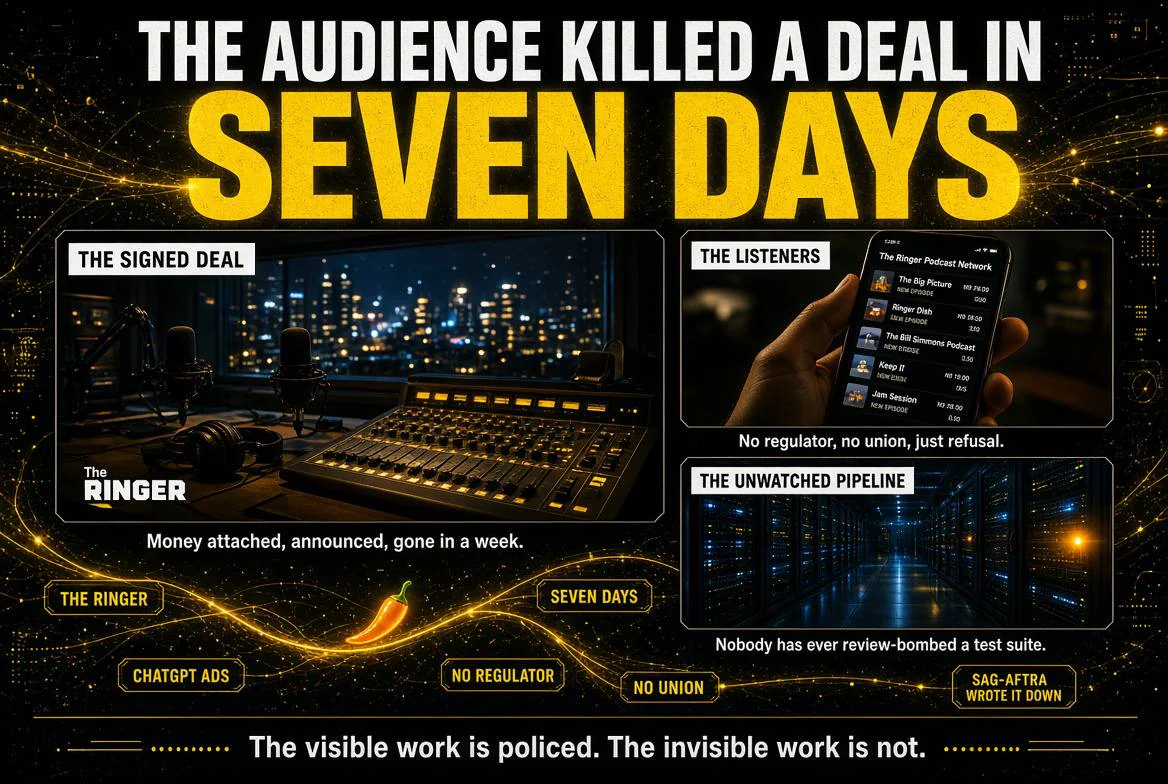
Bill Simmons’ The Ringer ended its ChatGPT podcast-advertising partnership after listeners reacted to AI-generated review segments. His words, in A.V. Club’s 13 November 2026 report by Matt Schimkowitz: “we learned almost immediately that those segments weren’t a fit for us.” Bloomberg’s Ashley Carman reported it first; Awful Announcing and NetInfluencer followed the same week.
Note what happened. A signed commercial partnership, with real money attached, was killed by an audience in roughly seven days. No regulator acted. No union intervened. No law changed. The listeners simply refused, loudly, and the deal went away.
That is the market floor in its purest form, and it should give anyone predicting a total AI takeover pause. But it only worked because the AI was audible. The segment was in the episode. You could hear it.
Nobody has ever review-bombed a test suite.
What This Means If You Make Things
The lesson here is not about games. It is about the specific way automation enters a craft, and it will apply to video production, marketing and every other creative discipline reading this site.
Automation goes first for the work that is iterative, invisible and measurable — the loop between idea and validated idea. It goes last for the work with a signature on it, because that work is what the audience is actually buying and what the buyer can actually see. Studios are not being noble about art. They are being rational about a market that punishes visible AI and a cost sheet that rewards invisible AI, and both of those pressures point the same direction.
If you are a creator, that gives you two things worth doing this month. First, find out which of your processes are the invisible loop — the editing passes, the variant renders, the ten drafts nobody sees — and automate those without apology, because your audience will never know and your competitors already are. Second, understand that the part of your work people pay for is the part with your name on it. That is not a sentimental point. It is the only defensible moat left when iteration costs nothing.
And if you are the one being told your job is safe — get it in writing. Pearl Abyss’s statement is a promise in an earnings call. SAG-AFTRA’s contracts are a promise with a lawyer attached. Only one of those is enforceable, and the difference between them is the entire history of labour.
The Gap That Closes the Case
Bring the two halves together. 49.9% of new Steam releases now say they used AI, up from 1.7% in twenty-one months, counted across 63,596 games by one person with a scraper and some patience. Meanwhile the most automated part of game development — the code, the testing, the iteration, the part Pearl Abyss is expanding “throughout our entire development pipeline” — is the part that requires no label at all.
Is AI effectively taking over game design? It is taking over the design process: the iteration, the validation, the loop. The authorship is still human, protected by an unenforceable promise and a very alive audience.
Whether that holds for another two years is not a technology question. It is a question about whether the people who make games get a term sheet like the actors have, or a sentence in an earnings call like the artists have. Right now they have the sentence.
For the rest of the AI-in-production picture, see our coverage of Epic Games going all in on AI, and browse the full AI video tools category for the rest of the toolkit.
Frequently Asked Questions
What percentage of new Steam games use AI?
Nearly half of new releases disclose AI-generated content: 49.9% in October 2026, up from 1.7% in January 2024, based on Valve’s AI content flag across 63,596 releases. The flag is self-declared by developers, so the figure measures disclosure rather than actual use and should be read as a floor.
Does Valve require developers to disclose AI use?
Yes, for player-facing content. Developers complete a questionnaire at submission covering AI-generated art, assets, audio, localisation and marketing material, split into pre-generated and live-generated categories. Backend-only code assistance does not require disclosure, and enforcement can run to withheld distribution or removal from the store.
What did Pearl Abyss say about AI in Crimson Desert?
In its Q3 2026 earnings materials, Pearl Abyss said AI is used for automating repetitive tasks, content creation support and test optimisation, and that it is expanding AI throughout its entire development pipeline. It also stated that the core gameplay experience and actual content creation remain fully driven by its development team.
Is AI taking over game design?
It is taking over the design process rather than authorship. Concept validation, testing, QA and iterative production work are being automated at scale, while studios publicly commit to keeping creative authorship human. That commitment is enforced by audience backlash and contracts, not by any disclosure rule or regulation.
Which game development jobs are most exposed to AI?
The iterative, invisible and measurable ones: QA and test optimisation, localisation, prop and asset production, and the concept-validation loop. These are also the stages Valve’s disclosure regime does not require anyone to admit to automating, which makes the exposure hardest to measure from outside a studio.
Do players actually punish games for using AI?
Sometimes, and visibly. Review-bombing has targeted sloppy AI art, and The Ringer ended its ChatGPT podcast-advertising partnership within a week after listener backlash in November 2026. That pressure protects the visible layer of a game — art and voice — more reliably than the invisible production work behind it.

About Barak Schurr
Barak Schurr is a serial entrepreneur who built and exited a major ticketing platform before turning his attention to AI and content. He runs three AI-focused research sites and writes about the tools, workflows, and strategies that let solo creators build real channels — without a crew, a studio, or a Hollywood budget.
Email: [email protected]
More AI Video Resources