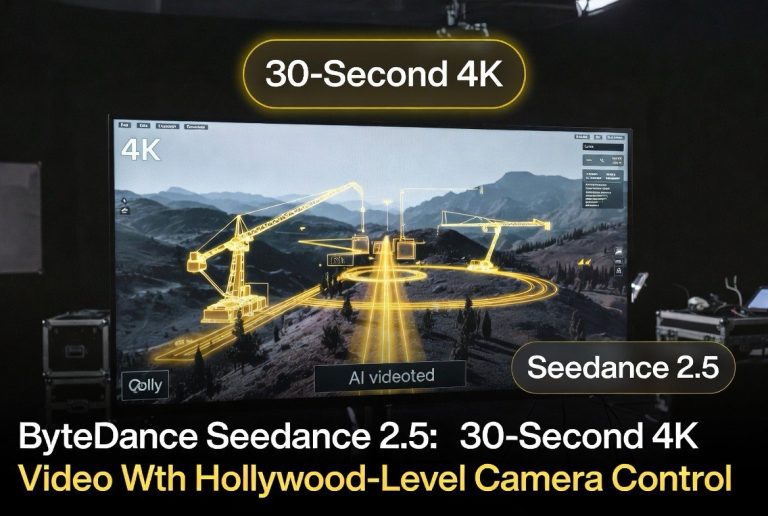
ByteDance Seedance 2.1 Teased — A 20% Quality Leap Over an Already Strong Competitor
Get The Faceless YouTube Blueprint — Free
The exact AI tool stack and workflow used to build a faceless YouTube channel from zero.
ByteDance Seedance 2.1 Teased — A 20% Quality Leap Over an Already Strong Competitor
⚡ Expert Summary: ByteDance’\”s Seedance 2.1 is reportedly preparing to launch with approximately 20% generation-quality improvement over Seedance 2.0, along with a cheaper “Mini” variant. Expected improvements include better physical realism, motion stability, human anatomy, and scene coherence. Here’\”s what creators should know about the upcoming update.
If you’\”ve been watching the AI video space closely this year, you already know the name Seedance. ByteDance’\”s video generation model family burst onto the scene in a big way with Seedance 1.0 in mid-2025 and absolutely dominated with Seedance 2.0 in February 2026 — hitting top marks on Artificial Analysis, earning #1 spots in both text-to-video and image-to-video Elo ratings, and forcing every competitor to play catch-up.
Now, according to multiple reports emerging throughout May 2026, ByteDance is teasing the next iteration: Seedance 2.1. The headline figure being floated is roughly a 20% overall quality improvement over an already impressive 2.0 — and that’\”s before you factor in the reported “Mini” tier that could make Seedance’\”s quality accessible at a meaningfully lower price point.
Let’\”s dig into what this means, what’\”s actually changing under the hood, and how it stacks up against the current AI video landscape — including Google’\”s Gemini Omni, Veo 3.1, Sora 2, and Kling 3.0.
Setting the Stage: Seedance 2.0’\”s Baseline
Before we talk about what’\”s improving, we need to establish just how strong the starting point is. Seedance 2.0 wasn’\”t just another entry in the AI video race — it was, for many benchmarks, the model to beat.
On Artificial Analysis, Seedance 2.0 scored an Arena Elo of approximately 1,450 for text-to-video and 1,449 for image-to-video in early 2026 — ranking #1 in both categories. It also held the top spot for image-to-video with audio (Elo 1,174) and was #2 in text-to-video with audio. Those aren’\”t incremental gains over the competition; those are dominant, category-leading scores. Only Alibaba’\”s HappyHorse model consistently edged it out in a few sub-categories.
But specs and Elo scores only tell part of the story. What made Seedance 2.0 so compelling for creators was the full package:
- True multimodal input: Text prompts, up to 9 reference images, up to 3 reference videos (total combined input ≤15 seconds), and up to 3 audio files for native sound generation. That’\”s an absurd amount of creative control.
- Native audio generation: Synchronized dialogue, spatial sound effects, and music aligned to visuals — no post-production syncing required.
- 1080p output at 60 FPS: Professional-grade resolution and frame rates that actually looked good on a monitor, not just a phone screen.
- Multi-shot sequences: Character and scene continuity across multiple generations, enabling actual storytelling, not just isolated clips.
- Strong motion stability: One of the few models in its weight class that could handle complex multi-subject interactions without devolving into visual noise.
And access wasn’\”t locked behind a $200/month paywall. Seedance 2.0 was available through Dreamina (ByteDance’\”s international platform), CapCut, TikTok Symphony, and third-party API providers — with subscription pricing starting around $14-$18/month for basic tiers and scaling up to roughly $50-$100/month for professional usage. There was a free tier too, albeit with watermarks and queue times.
That’\”s the bar Seedance 2.1 is trying to clear. A model that was already topping leaderboards and winning blind user preference tests.
What Seedance 2.1 Is Reportedly Bringing
The reports circulating in May 2026 — originating from Pandaily and picked up by various AI-focused outlets — point to a ~20% generation quality improvement for Seedance 2.1 over 2.0. Let’\”s break down exactly what that percentage actually means in practice, because “20% better” is a squishy claim without specifics.
Physical Realism & Physics Simulation
This is probably the single biggest area of improvement. Seedance 2.0 was already strong here — it handled things like object collisions, fluid dynamics, and fabric movement better than most competitors. But the 2.1 reports suggest ByteDance has been specifically targeting the remaining pain points: objects that behave slightly “underwater,” gravity that feels a touch forgiving, and interactions that look plausible but not quite physically accurate.
A 20% improvement in this domain could mean the difference between “that looks AI-generated” and “wait, is that real footage?” For product demos, architectural visualization, and cinematic VFX, that’\”s the gap that makes a tool go from “interesting prototype” to “production worthy.”
Motion Stability
If you’\”ve spent any serious time with AI video generation, you know the enemy: frame-to-frame jitter, sudden morphing, objects that flicker or vanish between frames. Seedance 2.0 handled this better than most, but it wasn’\”t bulletproof. Complex scenes with multiple moving subjects, rapid camera motion, or fine details like hair and foliage could still degrade.
Seedance 2.1 reportedly tightens temporal consistency significantly. Better frame coherence means smoother camera pans, steadier character motion, and fewer of those disorienting “morph moments” where a face rearranges itself between frames. For commercial use — think ad spots, music videos, branded content — this kind of reliability is non-negotiable.
Human Anatomy & Hand Articulation
Hands. We keep coming back to hands. It’\”s practically a meme in the AI generation community, but there’\”s a real reason it keeps being a benchmark: hands are hard. They’\”re small, highly articulated, combinatorially complex in their positioning, and our brains are extremely good at detecting when a hand looks wrong.
Seedance 2.0 was better than earlier models, but not flawless. Characters holding objects, gesturing, or making contact with surfaces could still produce hands with extra fingers, merged digits, or anatomically improbable positions. The 2.1 update reportedly makes meaningful headway on hand articulation — cleaner finger separation, natural grip postures, and hands that actually interact convincingly with props and surfaces.
Same goes for general human movement: walking gaits, facial expressions, and full-body motion that doesn’\”t trigger the uncanny valley alarm. If Seedance 2.1 delivers on these improvements, it closes one of the last major visual tells that a video is AI-generated.
Scene Coherence & Multi-Shot Consistency
One of Seedance 2.0’\”s standout features was multi-shot sequence generation — the ability to maintain character appearance, setting, and lighting across multiple clips so you can actually tell a coherent visual story. The 2.1 reports suggest this gets a meaningful upgrade, with better object permanence (that coffee cup stays on the table between shots), consistent lighting direction, and stable character rendering even after scene transitions.
This is particularly important for narrative work — short films, commercial sequences, anything that requires visual continuity. A model that can keep a character looking like the same person across three different angles and lighting setups is vastly more useful than one that generates beautiful but disconnected single clips.
Prompt Adherence & Director Control
Seedance 2.0 already offered “director-level control” — the ability to influence camera movement, lighting, composition, and mood through natural language prompts. The 2.1 rumors suggest tighter alignment to detailed prompts, meaning less time re-rolling generations and more time getting exactly the shot you visualized.
For creators, this is quality-of-life improvement that compounds. Every generation that nails your intent on the first try is time saved, credits not burned, and frustration avoided. If the 20% quality improvement figure is distributed across all these areas, prompt adherence might see a disproportionate increase in practical workflow value.
The Mini Variant: Cheaper, Faster, Still Good
Alongside Seedance 2.1 reports, there’\”s been chatter about a Seedance 2.0 Mini tier — a lighter, cheaper variant that would sit below the existing Standard and Fast pricing tiers. The positioning is interesting: reportedly, Mini outperforms the current Seedance 2.0 Fast tier in quality while costing less.
If confirmed, that’\”s a significant development. Here’\”s the pricing context:
- Seedance 2.0 Fast (current speed-focused tier): approximately $0.022 per second via some providers, making it the budget production option.
- Seedance 2.0 Standard/Pro: roughly $0.10-$0.25 per second on official channels, varying by resolution and provider.
- Seedance 2.0 Mini (reported): approximately $0.073 per second — higher than Fast on a pure per-second basis, but positioned as cheaper than Standard while delivering better quality than Fast.
Now, the numbers get a bit tangled depending on which report you’\”re reading and which provider’\”s pricing scheme is being referenced. Third-party resellers and API aggregators have their own markup, credit systems, and billing structures. But the consistent thread across all the coverage is this: ByteDance is creating a wider pricing spectrum, making Seedance accessible at more budget points.
This matters because one of the biggest barriers to AI video adoption for independent creators and small studios has been cost. Jumping from Sora’\”s $200/month ChatGPT Pro requirement to Seedance’\”s $18-$50/month tiers was already a step in the right direction. A genuine budget tier — even at the reported $0.073/sec — opens the door for high-volume testing, rapid iteration, and draft-level work that doesn’\”t eat into premium credits.
Timeline: When Is This Actually Coming?
The bulk of the reports surfaced in mid-to-late May 2026, suggesting ByteDance has been teasing Seedance 2.1 through international media channels. The expectation from most coverage pegs the launch window around late May through June 2026, with some accounts suggesting a broader “second half of 2026” timeframe.
However — and this is the asterisk everyone needs to pay attention to — ByteDance has pushed back against claims of an imminent release. At least one report from mid-May 2026 quotes the company clarifying or negating specific rumors about an immediate launch, describing some market speculation as inaccurate.
This doesn’\”t mean Seedance 2.1 isn’\”t real or isn’\”t coming. ByteDance’\”s model iteration pace — roughly 8 months between 1.0 and 2.0 — lines up with a mid-2026 reveal for 2.1. The denial could simply be the company managing expectations against overhyped speculation, or it could be a strategic move to give competitors less concrete timeline intel. But as a creator evaluating your toolset, treat the 2.1 reports as credible leaks from an unconfirmed product. Expect it to arrive, but don’\”t reshuffle your production pipeline based on rumors alone.
When it does launch, it will likely roll out through the same channels as Seedance 2.0: Dreamina for international users, Jimeng for the Chinese market, and API access through Volcengine/BytePlus and third-party providers like fal.ai and Replicate.
How Seedance 2.1 Stacks Against the 2026 Competition
Seedance 2.1 isn’\”t launching into a vacuum. The AI video space in mid-2026 is the most competitive it’\”s ever been. Let’\”s line up the contenders.
Google Gemini Omni (Just Announced at I/O 2026)
Google’\”s Gemini Omni (specifically the Omni Flash variant) was arguably the biggest announcement at Google I/O 2026, and it’\”s a direct competitor to Seedance’\”s multimodal approach. Omni is a fully unified model — text, image, audio, and video all go in through the same architecture, and video comes out. It excels at conversational multi-turn editing (“change the camera angle,” “make it sunset,” “swap the coffee cup for a glass of wine”), something Seedance doesn’\”t emphasize.
Key differences: Omni currently maxes out at around 10-second clips at 1080p, while Seedance 2.0 (and presumably 2.1) offers longer generations. Seedance’\”s multi-shot sequence capability also gives it an edge for narrative work. Omni’\”s strength is in rapid iteration and state-preserving edits — it’\”s better for storyboarding and mood exploration. Seedance 2.1’\”s reported physics and quality improvements could make it the better choice for final renders.
Google Veo 3.1
While Omni got the headlines at I/O, Veo 3.1 remains Google’\”s dedicated video specialist. It offers 4K native output, clips up to 60 seconds (via extensions), and stronger dialogue/lip-sync specialization. Seedance 2.0 already matched or exceeded Veo 3.0 in blind preference tests on Artificial Analysis. Seedance 2.1 should extend that lead if the reported improvements materialize. But Veo 3.1’\”s higher resolution ceiling and longer clip support keep it in the conversation for projects that need those specific capabilities.
OpenAI Sora 2
Sora 2 remains a benchmark for cinematic short-form quality — its physics simulation and photorealistic output are still top-tier. However, OpenAI’\”s decision to discontinue the standalone Sora app in April 2026 (API access through September) has shifted the practical landscape. Sora is now harder to access and more expensive (locked behind the $200/month ChatGPT Pro tier). Seedance 2.1, by contrast, is expected to remain broadly available through multiple access points at competitive pricing.
Kuaishou Kling 3.0
Kling 3.0 has been having a moment in 2026. It offers native 4K output, strong character consistency, long clip support, and multi-lingual lip-sync — all at a very competitive price point (plans starting around $10/month). In blind user preference tests, Kling frequently scores well against Seedance 2.0, particularly for image-to-video quality and practical daily-use scenarios.
Seedance 2.1’\”s rumored improvements in physics, anatomy, and motion stability would be targeted directly at the areas where Kling 3.0 currently gives it the stiffest competition. An improved Seedance combined with the Mini pricing tier could create a compelling value proposition that undercuts Kling in certain workflows.
Alibaba HappyHorse
HappyHorse is quietly leading several sub-categories on Artificial Analysis, beating even Seedance 2.0 in some audio-video arenas. It’\”s the dark horse in this comparison (no pun intended) and a reminder that the AI video race is global and broad. Seedance 2.1 will need to reclaim those top spots if reports of a 20% quality bump hold up.
What This Means for Creators
Let’\”s get practical. You’\”re a content creator, video editor, marketer, or small business owner. How does Seedance 2.1 affect your actual workflow?
Better Quality at Potentially Lower Cost
The two-variable equation of AI video has always been quality vs. cost. You pay more for better output — that was the Kling vs. Sora trade-off, the Veo vs. Fast mode trade-off, the Standard vs. Mini trade-off in literally every model’\”s pricing. Seedance 2.1 with a Mini tier flips this: you may get better quality at a lower price point than the current Standard tier. That’\”s not typical in this space, and it’\”s worth planning for.
If you’\”re currently generating on Seedance 2.0 Standard or Pro, the 2.1 upgrade should directly improve your deliverables without changing your pricing tier. If you’\”re on Fast or a competing budget model, the Mini tier could be an upgrade path that improves both quality and cost efficiency.
Fewer “Do-Overs”
This is the hidden ROI of improvements in prompt adherence, anatomy, and motion stability. Every generation that comes out wrong costs you credits and time. If Seedance 2.1 reduces your re-roll rate by just 20%, that’\”s a 20% increase in effective throughput — more output per hour, per dollar, per session. For high-volume creators (social media content, product demos, ad variations), this compounds rapidly.
Credible Cinematic Output
The specific improvements in hand articulation, human movement, and scene coherence target the remaining tells that make AI video look AI-generated. If Seedance 2.1 can produce clips where hands look correct, motion feels natural, and characters stay consistent across shots, the output crosses a threshold: it becomes usable in professional contexts without asterisks or disclaimers. That’\”s the difference between “AI experiment” and “client deliverable.”
Wider Pricing Spectrum Means More Options
With the Mini tier, ByteDance is effectively creating three price bands: budget (Mini), speed (Fast), and quality (Standard/Pro). This gives creators more granularity in matching cost to use case. Drafts and iterations can use Mini. Client proofs and internal reviews can use Fast. Final renders can use Standard or Pro. You optimize your spending instead of taking a one-size-fits-all approach.
Hosting Your AI Video Creator Site? Here’\”s a Practical Note
If you’\”re building a presence in the AI video space — running a portfolio, a comparison site, a tutorial channel, or a service page — you need reliable hosting that can handle video-heavy content. I’\”ve been recommending Hostinger to AI video creators because their infrastructure handles media assets cleanly: included CDN, solid uptime (99.9% SLA on higher tiers), and WordPress-optimized stacks that make embedding seedance clips and comparison demos straightforward.
Their Business plan (around $3.99/month on the longer terms) supports up to 100 websites, 100 GB storage, and daily backups — more than enough for a content creator’\”s landing page or a tools directory. If you’\”re serious about building an audience around AI video content, having reliable hosting is as important as having the right generation tools.
The Caveats: What We Still Don’\”t Know
I’\”ve been using and covering AI video tools since 2023, and I’\”ve learned to read between the lines of press coverage and rumor reports. Let me flag what we should be cautious about:
1. The 20% figure is anecdotal. No one outside ByteDance has benchmarked 2.1. The 20% number appears in coverage citing unnamed sources, company representatives, or internal demos. It could be conservative, aspirational, or marketing spin. Independent benchmarks from Artificial Analysis and community blind tests will be the real verdict.
2. ByteDance denied imminent release rumors. This is significant. It doesn’\”t mean 2.1 isn’\”t coming, but it suggests the timeline may be longer than the most optimistic reports suggest. Plan for a Q3 or Q4 2026 release, not a surprise drop next week.
3. “Quality improvement” covers a lot of ground. A 20% improvement in an aggregate quality score doesn’\”t mean every individual clip is 20% better. Improvements may be concentrated in specific areas — physics simulation and human anatomy seem to be the focus — while other capabilities might hold steady. For creators whose work doesn’\”t heavily feature the improved areas, the practical benefit may be less dramatic.
4. Pricing for 2.1 itself isn’\”t confirmed. The Mini tier pricing ($0.073/sec) is for a variant of Seedance 2.0, not necessarily for Seedance 2.1. The 2.1 update may carry its own pricing structure, potentially higher than 2.0 Standard given the quality improvements. Assume existing tiers may shift.
5. Third-party provider pricing varies wildly. The per-second rates you’\”ll see advertised on fal.ai, Replicate, MagicHour, or AtlasCloud are reseller markups over ByteDance’\”s wholesale API pricing. They include their own margin, latency, queue handling, and support. Official pricing from Volcengine/BytePlus will likely be lower, but may require volume commitments or Chinese payment methods.
The Bigger Picture: Why This Matters
The AI video generation space is moving faster than almost any other creative AI category. In 2024, we were impressed by 5-second clips that vaguely resembled what we described. In early 2025, real-time generation and native audio arrived. By late 2025, models like Veo 3.0 and Seedance 1.0 were producing genuinely useful output. And now, in mid-2026, we’\”re talking about a model that’\”s reportedly 20% better than one that was already #1 on the leaderboard.
What Seedance 2.1 represents — if the reports hold up — is the commoditization of quality. The gap between “AI video” and “professional video” is closing, and ByteDance is positioning itself to be the platform that bridges it first, at scale, at accessible price points. That doesn’\”t mean everyone stops using Kling, Veo, or Gemini Omni. Each tool has strengths for specific workflows. But Seedance’\”s combination of multimodal flexibility, benchmark-leading quality, native audio, and multi-shot continuity makes it one of the most complete packages in the space. A 20% improvement on top of that, with a cheaper tier to expand access, is a genuinely exciting prospect.
For now, keep creating with the tools you have. Demo Seedance 2.0 if you haven’\”t — it’\”s still one of the best options available and will give you a baseline to evaluate the 2.1 improvements when they arrive. Follow the official Seedance blog and Dreamina changelog for concrete details. And when Seedance 2.1 drops, you’\”ll know exactly what to look for: better physics, cleaner hands, steadier motion, and a Mini tier that might just change the economics of your workflow.
Frequently Asked Questions
Is Seedance 2.1 officially announced?
No. As of late May 2026, ByteDance has not made an official announcement about Seedance 2.1. The information comes from media reports, leaks, and industry speculation. ByteDance has also denied some rumors of an imminent release, so treat the details as unconfirmed until official word arrives.
What is the “Mini” variant of Seedance?
The Seedance Mini tier is reported to be a budget-friendly variant positioned below the Standard and Fast pricing tiers. Reports suggest it offers better generation quality than the current Fast tier while being priced lower than Standard — approximately $0.073 per second based on available leaks.
When is Seedance 2.1 expected to launch?
Most reports point to a late May through June 2026 timeframe, though some sources suggest “second half of 2026.” ByteDance”’s clarification disputing imminent release rumors suggests the timeline may be longer. Monitor the official Seedance blog at seed.bytedance.com for concrete dates.
How much better is Seedance 2.1 than 2.0?
The widely cited figure is roughly 20% overall quality improvement, based on anecdotal reports and unnamed sources. Expected improvements include better physical realism, motion stability, human anatomy and hand articulation, scene coherence, multi-shot consistency, and prompt adherence. Independent benchmarks will be needed to verify the actual improvement.
How does Seedance 2.1 compare to Kling 3.0?
Kling 3.0 is one of Seedance”’s strongest competitors, offering native 4K output, strong character consistency, and multi-lingual lip-sync at competitive prices (~$10/month plans). Seedance 2.1”’s rumored improvements in physics, anatomy, and motion stability would target areas where Kling currently gives it the toughest competition. The Mini tier could also help Seedance compete more effectively on price.
How does Seedance 2.1 compare to Google Gemini Omni?
Gemini Omni (announced at Google I/O 2026) excels at conversational multi-turn editing and unified multimodal input/output but maxes out at ~10-second 1080p clips. Seedance 2.1 is expected to offer longer generations and superior multi-shot sequence capabilities, making it better for narrative and production workflows rather than rapid ideation.
How does Seedance 2.1 compare to Veo 3.1?
Veo 3.1 offers 4K native output and up to 60-second clips, making it strong for high-resolution, longer-form content. Seedance 2.0 already matched or exceeded Veo 3.0 in blind preference tests, and 2.1 should extend that lead. Veo retains advantages in resolution ceiling and clip length; Seedance leads in multimodal control and benchmark preference scores.
Will Seedance 2.1 be available on Dreamina and CapCut?
Almost certainly. Seedance 2.0 is available through Dreamina (international platform), Jimeng (China), CapCut, TikTok Symphony, and third-party APIs via Volcengine/BytePlus. Seedance 2.1 is expected to launch through the same channels, though exact availability timelines and pricing per platform remain unconfirmed.
How much will Seedance 2.1 cost?
Pricing for Seedance 2.1 itself hasn”’t been confirmed. The existing Seedance 2.0 pricing ranges from ~$14-$18/month for basic tiers to ~$50-$100/month for professional use, with API per-second rates from roughly $0.022/sec (Fast) to $0.25+/sec (Pro). The reported Mini tier at approximately $0.073/sec would be a new budget option. Seedance 2.1 may carry its own pricing — possibly higher for improvements, or stable with the Mini tier as a complement.
Should I wait for Seedance 2.1 before starting AI video projects?
No. Seedance 2.0 is currently one of the best AI video models available and is available right now. Start creating with it to build your workflow, understand your prompt strategies, and develop a baseline. When 2.1 launches, you”’ll be able to evaluate the improvements against a real reference point and upgrade when it makes sense for your specific use case.
Did ByteDance deny the Seedance 2.1 rumors?
ByteDance has pushed back against reports of an imminent release, describing some market speculation as inaccurate. This doesn”’t confirm or deny that Seedance 2.1 exists — it primarily suggests the timeline may be longer than early reports indicated. The company”’s clarification should be read as an expectation-management signal, not a denial of the update”’s existence.

About Barak Schurr
Barak Schurr is a serial entrepreneur who built and exited a major ticketing platform before turning his attention to AI and content. He runs three AI-focused research sites and writes about the tools, workflows, and strategies that let solo creators build real channels — without a crew, a studio, or a Hollywood budget.
Email: [email protected]
More AI Resources for Your Business