Grok Imagine Video 1.5 Just Topped the Image-to-Video Arena — xAI Dethrones Seedance 2.0
Grok Imagine Video 1.5 Just Topped the Image-to-Video Arena — xAI Dethrones Seedance 2.0
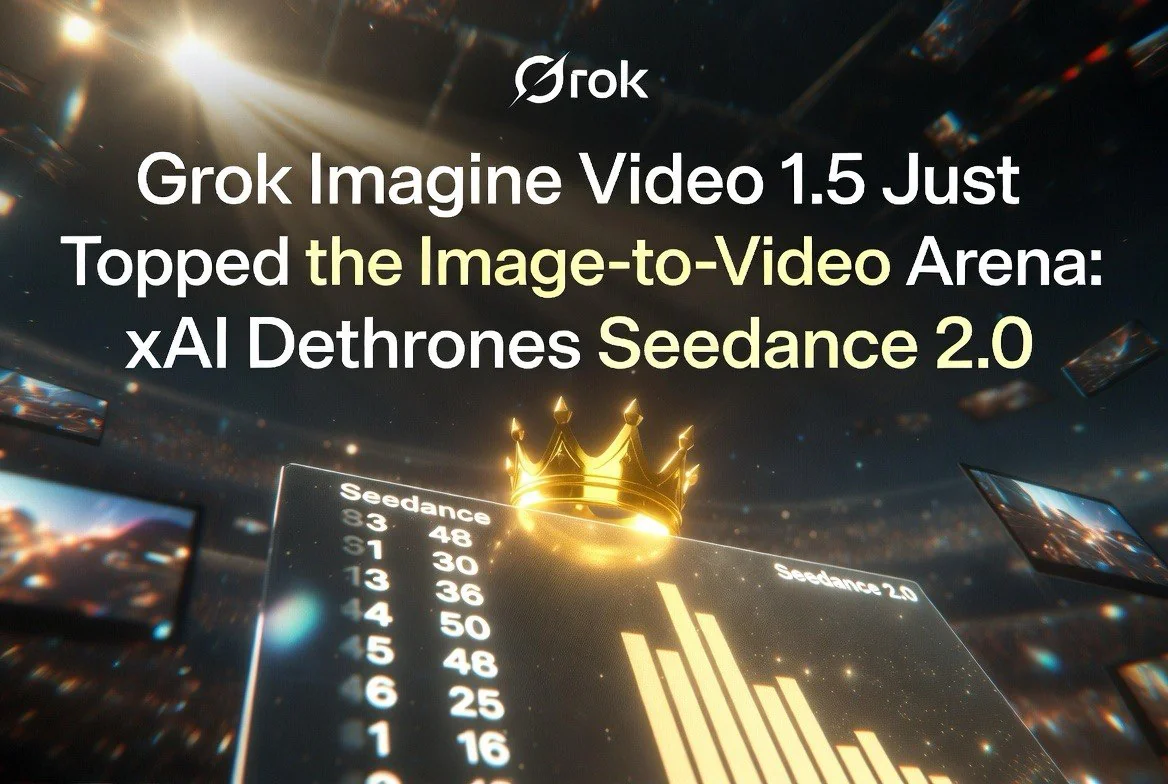
⚡ Expert Summary: xAI’\”s Grok Imagine Video 1.5 Preview has claimed the #1 spot on the Image-to-Video Arena leaderboard with an Elo score of 1,473, edging out ByteDance’\”s Seedance 2.0 at 1,467. This marks the first time Seedance has lost the top position since its debut, signaling xAI as a legitimate contender in the AI video generation space.
The leaderboard at arena.ai just experienced its most significant shakeup in months. xAI’\”s Grok Imagine Video 1.5 Preview has officially taken the #1 spot on the Image-to-Video Arena, posting an Elo score of 1,473 ±9 across 5,564 blind human votes. That puts it six Elo points ahead of ByteDance’\”s Dreamina Seedance 2.0 (720p), which sits at 1,467 ±11 with 56,710 total votes.
This is not a marginal fluctuation within the margin of error. Six Elo points on a well-calibrated leaderboard with hundreds of thousands of cumulative votes represents a genuine, measurable improvement in perceived output quality. For creators and industry watchers alike, this is the story of the month in AI video generation.
What Is the Image-to-Video Arena?
If you’\”re not familiar with the Image-to-Video Arena, here’\”s the tl;dr: it’\”s a crowdsourced, Elo-based leaderboard hosted at arena.ai (the same team behind the LMSYS Chatbot Arena). The concept is simple but powerful. Users submit a static image and a text prompt. The system generates two videos — one from Model A and one from Model B — without telling the user which is which. The user votes for the better result. Over thousands of blind comparisons, the Elo algorithm calculates which models consistently produce preferred outputs.
As of late May 2026, the Image-to-Video Arena has logged over 1.15 million total votes across 40 models. That’\”s a statistically meaningful dataset. Unlike vendor-supplied cherry-picked demos or subjective review roundups, the Arena reflects genuine human preference at scale. When a model jumps to #1, it earned that position through consistent performance against every competitor in the pool.
The leaderboard tracks multiple variants — 480p vs 720p vs 1080p, audio-enabled vs silent, fast inference vs quality-optimized. The current #1 is specifically grok-imagine-video-1.5-preview-720p, which means the model generates 720p output and is currently in preview status. The “preview” label matters, and I’\”ll come back to that.
The Numbers: How Grok Imagine Video 1.5 Stacks Up
Let’\”s look at the top of the leaderboard with precise numbers as of May 31, 2026:
- #1 — Grok Imagine Video 1.5 Preview (720p): Elo 1,473 ±9 | 5,564 votes
- #2 — Dreamina Seedance 2.0 (720p): Elo 1,467 ±11 | 56,710 votes
- #3 — HappyHorse 1.0: Elo 1,443 ±12 | 33,267 votes
- #4 — Grok Imagine Video 1.0 (720p): Elo 1,421 ±6 | 380,580 votes
- #5 — Veo 3.1 Audio: Elo 1,397 ±11 | 25,113 votes
- #6 — Veo 3.1 Audio (1080p): Elo 1,393 ±10 | 24,381 votes
- #7 — Veo 3.1 Fast Audio: Elo 1,384 ±9 | 99,851 votes
- #8 — Grok Imagine Video (480p): Elo 1,383 ±9 | 19,415 votes
- #9 — Veo 3.1 Fast Audio (1080p): Elo 1,374 ±11 | 24,874 votes
- #10 — Vidu Q3 Pro: Elo 1,360 ±8 | 36,674 votes
Here’\”s what jumps out immediately. Grok Imagine Video 1.5 Preview improved by +52 Elo points over its predecessor (Grok Imagine Video 1.0 at 1,421). That is a massive single-generation leap. For context, going from the #4 spot to #1 in one model update is rare. Most models improve by 10–20 Elo points per iteration. Fifty-two points is the kind of jump that signals genuine architectural improvement, not just incremental tuning.
Second, the gap between #1 and #2 is narrow — just 6 Elo points — but the confidence intervals (+9 and ±11 respectively) suggest the gap is real. Even at the lower bound of Grok’\”s confidence interval (1,464) and the upper bound of Seedance’\”s (1,478), there’\”s meaningful overlap. But as more votes come in — Grok’\”s 5,564 votes is still a small sample compared to Seedance’\”s 56,710 — the Elo will stabilize. If the trend holds, this could widen.
Why Seedance Losing #1 Matters
Dreamina Seedance 2.0 launched on February 12, 2026, and it dominated the Image-to-Video Arena from day one. ByteDance’\”s Seed team delivered a model that was, by most accounts, the best image-to-video generator available — period. Its ability to take up to 9 reference images, 3 video clips, and 3 audio clips simultaneously, combined with hyper-realistic physics, micro-expressions, and native audio synchronization, set a new standard for the industry.
Seedance 2.0 went viral globally. Reuters, BBC, Forbes — everyone covered it. Some clips featuring realistic depictions of actors and public figures sparked both awe and ethical debate. The model was so good that it became the benchmark every other entrant was measured against. Competitors didn’\”t just try to match Seedance 2.0; they tried to be “the Seedance killer.”
For three and a half months, no one dislodged it from #1. Not Google’\”s Veo 3.1, not OpenAI’\”s Sora 2, not Kuaishou’\”s Kling 3.0. Seedance 2.0 sat at the top with the confidence of an incumbent that had solved problems others hadn’\”t even articulated yet.
Until now.
Grok Imagine Video 1.5 Preview didn’\”t just tie Seedance 2.0 — it beat it. In blind head-to-head comparisons, human voters preferred xAI’\”s output more often. That is significant, not just for xAI’\”s positioning but for what it tells us about the pace of progress in AI video generation.
The fact that an upstart model from a company that only started shipping video generation in late 2025 can overtake ByteDance’\”s flagship in less than six months suggests that the AI video market is still very much in its land-grab phase. No one has built an unassailable moat. The technology is improving so rapidly that a six-month-old model, no matter how dominant, can be leapfrogged.
What Grok Imagine Video 1.5 Can Actually Do
Let’\”s get into the specifics of what makes this model tick.
Architecture. Grok Imagine Video is powered by xAI’\”s Aurora model, an autoregressive mixture-of-experts architecture. Version 1.5 represents a significant upgrade to both the training pipeline and the inference engine. The model operates at 24 fps and supports multiple aspect ratios including 16:9, 9:16, 1:1, 4:3, and 3:4.
Image-to-Video Quality. This is where the model truly shines. Given a starting image — a photograph, a digital illustration, a frame from another video — Grok Imagine Video 1.5 can animate it with realistic motion physics, consistent lighting, and proper temporal coherence. The source image becomes the first frame, and the model generates what happens next. In blind tests, voters consistently rated these animations higher than Seedance 2.0’\”s in terms of natural motion, object permanence, and visual fidelity.
Multimodal Input. Like its competitors, Grok Imagine Video 1.5 accepts text prompts, reference images (up to 7 in some workflows), and generates synchronized audio natively. You can describe a scene in text, supply a character reference photo, and the model will produce a video with dialogue, ambient sound, and music — all in a single generation pass. No post-production audio editing required.
Native Audio. Version 1.5 improved significantly on lip-sync accuracy, voice emotion rendering, and background audio quality. Dialogue sounds natural. Sound effects align with on-screen action. Background music matches the mood of the prompt. This matters more than most people realize — audio quality is often the differentiator between a video that feels produced and one that feels like a tech demo.
Motion Realism. This is the headline improvement. Version 1.0 was strong on static visual quality but sometimes produced unnatural motion — that telltale AI wobble, objects that phase through each other, physics-defying transitions. Version 1.5 substantially improved physics modeling. Objects interact correctly. Characters walk and gesture naturally. Camera movements feel deliberate rather than algorithmic.
Character Consistency. Another weak point of early video generation models was losing character identity between frames. A person’\”s face would subtly change, or clothing would morph. Version 1.5 maintains much better temporal consistency, keeping characters recognizable throughout the clip.
Generation Speed. xAI has invested heavily in inference infrastructure. Clips typically generate in 5 to 30 seconds, depending on resolution and duration. That’\”s fast enough for iterative creative workflows — generate, review, tweak the prompt, regenerate — without breaking creative flow.
Pricing. The API runs approximately $0.05 to $0.08 per second of video, varying by resolution. App access is available through X Premium+ and SuperGrok subscriptions. There’\”s also a credits-based system on some third-party platforms.
Limitations. It’\”s important to stay grounded. This is a preview model. Maximum clip duration is short — most implementations support 4 to 15 seconds. Resolution tops out at 720p on the Arena leaderboard (though some sources suggest 1080p support may be rolling out). The 5,564 votes it has received are a fraction of Seedance’\”s 56,710, so the Elo will shift as more comparisons come in. Full text-to-video capabilities are still being deployed and may not match the image-to-video quality yet.
How It Compares to the Competition
The AI video landscape in mid-2026 is fiercely competitive. Here’\”s how the major players stack up.
Google Veo 3.1
Veo 3.1 from Google DeepMind remains a powerhouse for photorealistic output and native audio. It supports up to 4K resolution, text-to-video, image-to-video, and video-to-video workflows. Its audio synchronization — particularly lip-synced dialogue — is industry-leading. On the Arena, Veo 3.1 Audio sits at #5 with an Elo of 1,397. That’\”s 76 points behind Grok 1.5 Preview. Why so far back? Veo 3.1 excels at realism and detail, but voters in blind tests apparently prefer Grok’\”s motion quality and overall scene coherence. Veo remains an excellent option for high-fidelity commercial work, especially when 1080p or 4K output is required.
OpenAI Sora 2
Sora 2 — released around September 2025 — was once the most hyped video model on the planet. Its ability to simulate physics and maintain narrative coherence over longer sequences set it apart. But OpenAI’\”s strategic challenges caught up with it. The original Sora app operations largely ceased by April 2026, and OpenAI has been phasing out direct access. The model still exists through some API integrations, but its momentum has stalled. On the Arena, Sora variants don’\”t crack the top 10 — a far cry from where many expected it to be by now. That said, for physics-heavy or imaginative narrative clips where you can still access it, Sora 2 remains uniquely capable.
Kling 3.0 (Kuaishou)
Kling 3.0 has carved out a specific niche: long-form, cinematic, multi-shot storytelling. It can produce clips up to 15 seconds with native audio, strong character consistency, and director-like controls. Its “Elements” system maintains character identity across multiple shots, making it a strong choice for narrative content like short films and brand videos. Kling doesn’\”t crack the Arena top 10 either, but that reflects the leaderboard’\”s image-to-video focus. Kling’\”s strengths in multi-shot narratives and longer duration may not be fully captured by single-shot image-to-video comparisons.
Google Gemini Omni
Announced at Google I/O on May 19, 2026 — just twelve days before Grok 1.5 Preview’\”s Arena takeover — Gemini Omni is Google’\”s most ambitious video play yet. It’\”s an any-to-any multimodal world model that can take text, images, audio, and video as inputs and generate any combination as output. It’\”s designed for complex editing workflows, reference-based generation, and coherent world modeling with proper object permanence and lighting. Early clips run about 10 seconds. Gemini Omni is so new it hasn’\”t yet accumulated enough Arena votes for a stable ranking. But it’\”s the strongest signal yet that Google sees video generation as a core capability, not an add-on.
HappyHorse 1.0 (Alibaba)
HappyHorse 1.0 from Alibaba sits at #3 on the Arena with an Elo of 1,443 — just 24 points behind Seedance 2.0 and 30 behind Grok 1.5 Preview. It has 33,267 votes, giving it strong statistical weight. It’\”s a serious competitor that tends to fly under the radar in Western coverage but consistently delivers high-quality image-to-video output.
Other Contenders
Vidu Q3 Pro (Shengshu) holds #10 at 1,360. Luma Ray, Runway Gen-3, Pika 2.0, and MiniMax Hailuo all trail below that. The open-source community is represented by models like LTX from Lightricks, though none have yet cracked the top tier on quality metrics.
What This Means for Creators
If you’\”re a content creator, marketer, or video producer, the Grok 1.5 Preview’\”s rise to #1 matters for three concrete reasons.
1. Better quality across the board. When a new model leapfrogs the leader, every other competitor scrambles to catch up. Google will push Veo harder. ByteDance is almost certainly training Seedance 2.5 or 3.0 as we speak. Kuaishou, Alibaba, and Shengshu all have incentive to improve. This competitive pressure creates a rising tide that lifts every model’\”s quality. The video output you can generate today from any top-5 model is dramatically better than what was available six months ago.
2. Lower prices. Competition drives price compression. When one company has the best model, it can charge a premium. When three companies are fighting for #1, pricing becomes a weapon. xAI’\”s API pricing at $0.05–$0.08/second is competitive, and you can expect downward pressure across the board. For creators producing high volumes of content, these savings add up quickly.
3. More choice, less lock-in. The rapid pace of change means no single platform can claim permanent dominance. If you built your workflow around Seedance 2.0, you can now get comparable or better results from xAI, Google, or Alibaba. The smart play is to stay model-agnostic — use the best tool for each specific job, and be ready to switch as the leaderboard shifts.
For creators specifically considering Grok Imagine Video 1.5, here’\”s where it wins and where it doesn’\”t:
Best for: Short-form social content (TikTok, Reels, Shorts), product demos from still images, character animations with consistent faces, ad creative where motion realism matters, and iterative creative workflows where fast generation speed is an advantage.
Not ideal for: Long-form narrative content, projects requiring 4K output, workflows that depend on precise camera control across multiple shots, and use cases requiring consistent output from text-only prompts (where the image-to-video pipeline is stronger).
xAI’\”s Broader Ambitions in Video
This Arena win isn’\”t just a technical achievement — it’\”s a strategic signal from xAI. The company was founded in July 2023 with a stated mission to “understand the true nature of the universe.” Chat was the beachhead. Video is the next front.
Elon Musk has been unusually explicit about xAI’\”s video ambitions. After OpenAI discontinued Sora’\”s standalone app in March 2026, Musk posted that the next Grok Imagine release would be “epic” and that xAI was “doubling down” on video. He set a specific goal: produce a “watchable AI movie” by the end of 2026, alongside an AI-generated game.
These are aggressive targets. But the progress from Grok Imagine Video 1.0 (September 2025) to 1.5 Preview (May 2026) — a +52 Elo jump and the #1 slot on the most respected leaderboard — suggests xAI has the technical velocity to back up the ambition.
Behind the scenes, xAI is building massive infrastructure for this push. The Colossus supercluster in Memphis, Tennessee, gives xAI compute capacity that rivals the largest AI training clusters on the planet. Training generative video models at scale requires exactly this kind of hardware advantage. It’\”s not a coincidence that xAI went from shipping its first video generation model to claiming the Arena #1 spot in roughly eight months.
xAI’\”s broader product strategy also supports the video push. The company offers a unified API that handles text, code, voice, images, and video through a single endpoint. This multimodal-first architecture means video generation isn’\”t a separate product — it’\”s a native capability of the same system that powers Grok’\”s chat, reasoning, and image generation features. That’\”s architecturally different from competitors who bolt video onto existing text models.
The Caveats You Need to Know
I’\”ve been specific about the numbers and capabilities, but responsible coverage requires acknowledging the limitations.
Preview label. This is not a final release. “Preview” in the model name means xAI is still iterating. The model could get better — or worse — as training continues. The Elo score of 1,473 is preliminary and based on a relatively small vote count (5,564) compared to Seedance’\”s 56,710. Confidence intervals will narrow as more comparisons accumulate.
Single benchmark. The Image-to-Video Arena measures one thing: blind human preference for image-to-video generation. It doesn’\”t measure text-to-video quality, multi-shot consistency, editing capabilities, generation speed, cost efficiency, or production readiness. A model can be Arena #1 and still not be the best tool for your specific use case.
Narrow lead. Six Elo points is a real but narrow margin. On many days, with different vote distributions, the ranking could invert. The real story isn’\”t “Grok destroyed Seedance” — it’\”s “Grok pulled ahead of Seedance for the first time.” That’\”s a meaningful milestone, but it’\”s not a knockout.
Resolution ceiling. The #1 entry is specifically the 720p variant. If you need 1080p or 4K output for broadcast-quality work, Veo 3.1 and Seedance 2.0 remain stronger options on resolution alone.
Access limitations. The best video generation model in the world doesn’\”t help you if you can’\”t use it. xAI access requires a paid subscription (X Premium+ or SuperGrok) or API credits. The Grok app’\”s video generation features are rolling out gradually. Not every user in every region has equal access.
None of these caveats invalidate the achievement. But they should keep your expectations calibrated. The leaderboard will shift. The model will improve. The competitive landscape will look different in three months. That’\”s the nature of a market this dynamic.
Hostinger: Build Your AI Video Presence
If you’\”re building a website to showcase AI-generated video content — whether it’\”s a portfolio, a comparison blog, or a service offering — you need reliable hosting. I recommend Hostinger for its combination of speed, uptime, and affordability. Their VPS and shared hosting plans handle media-rich sites well, and their control panel makes deployment straightforward even if you’\”re not a developer. It’\”s the platform I use for AI video publishing workflows, and it’\”s held up well under traffic.
The Bottom Line
Grok Imagine Video 1.5 Preview topping the Image-to-Video Arena is a genuine milestone. It’\”s the first time ByteDance’\”s Seedance 2.0 has lost the #1 position since its February 2026 launch. It’\”s a +52 Elo improvement over the previous Grok generation. And it firmly establishes xAI as a serious competitor in AI video generation — not just a text-chat company that dabbles in video.
For creators, the takeaway is straightforward: the AI video market is more competitive than ever, and the quality floor keeps rising. Whether you use Grok, Seedance, Veo, Kling, or Gemini Omni, you have access to tools that would have seemed like science fiction eighteen months ago. The smart money is on staying flexible, testing multiple models, and letting the leaderboard — and your own eyes — guide your choices.
The race isn’\”t over. It’\”s barely begun. But xAI just served notice that they’\”re in it to win it.
Frequently Asked Questions
What is the Image-to-Video Arena?
The Image-to-Video Arena is a crowdsourced, Elo-based leaderboard at arena.ai where users submit blind comparisons between AI video generation models. Models are ranked by how often their output is preferred by human voters in head-to-head matchups. As of late May 2026, over 1.15 million votes have been cast across 40 models.
How does Grok Imagine Video 1.5 compare to Seedance 2.0?
Grok Imagine Video 1.5 Preview currently leads Seedance 2.0 with an Elo of 1,473 vs 1,467 — a gap of 6 points. Grok performs particularly well on motion realism, physics, and temporal consistency. Seedance 2.0 remains stronger in multimodal control (up to 9 images, 3 videos, and 3 audio clips simultaneously) and has over 10x more votes logged for statistical confidence.
Is Grok Imagine Video 1.5 available to everyone?
Access requires an X Premium+ or SuperGrok subscription, or API credits through xAI”’s developer platform. The model is rolling out gradually across the Grok app and third-party integrations. Availability varies by region and platform tier.
What resolution does Grok Imagine Video 1.5 support?
On the Arena leaderboard, the #1 entry is the 720p variant. Some sources indicate 1080p support may be available in certain interfaces or rolling out. The model generates at 24 fps with multiple aspect ratio support.
What are the main limitations of Grok Imagine Video 1.5?
It”’s a preview model, so performance may shift. Maximum clip duration is short (4–15 seconds depending on implementation). Text-to-video capabilities lag behind image-to-video quality. Resolution is currently capped at 720p on the leaderboard variant. The model”’s vote count (5,564) is small compared to competitors, so Elo confidence intervals will narrow over time.
How much does Grok Imagine Video cost?
API pricing runs approximately $0.05 to $0.08 per second of generated video, varying by resolution. App access is included with X Premium+ and SuperGrok subscriptions. Third-party platforms may charge credits per generation.
What other models are in the top 10 of the Image-to-Video Arena?
As of May 31, 2026: #1 Grok Imagine Video 1.5 Preview (1,473), #2 Seedance 2.0 (1,467), #3 HappyHorse 1.0 (1,443), #4 Grok Imagine Video 1.0 (1,421), #5 Veo 3.1 Audio (1,397), #6 Veo 3.1 Audio 1080p (1,393), #7 Veo 3.1 Fast Audio (1,384), #8 Grok Imagine Video 480p (1,383), #9 Veo 3.1 Fast Audio 1080p (1,374), #10 Vidu Q3 Pro (1,360).
Is the Arena leaderboard the definitive benchmark for AI video quality?
No single benchmark is definitive. The Image-to-Video Arena measures blind human preference for image-to-video outputs, which is an important signal but doesn”’t capture text-to-video quality, generation speed, editing capabilities, cost, production readiness, or use-case-specific performance. Pair Arena rankings with hands-on testing for your specific workflow.
What is xAI”’s broader video strategy?
xAI has publicly committed to “doubling down” on video generation, with CEO Elon Musk setting a goal of producing a “watchable AI movie” by end of 2026. The company is investing heavily in video infrastructure including the Colossus supercluster and has built video generation as a native capability of its unified multimodal API rather than a separate product.
Will Grok Imagine Video 1.5 stay at #1 on the Arena?
That depends on upcoming releases from competitors. ByteDance is likely training Seedance 2.5 or 3.0. Google just announced Gemini Omni. Kuaishou continues to improve Kling. Given the rapid pace of improvement in this space, the #1 position is likely to change multiple times over the next year. Stay flexible and test periodically.

About Barak Schurr
Barak Schurr is a serial entrepreneur who built and exited a major ticketing platform before turning his attention to AI and content. He runs three AI-focused research sites and writes about the tools, workflows, and strategies that let solo creators build real channels — without a crew, a studio, or a Hollywood budget.
Email: [email protected]
More AI Resources for Your Business