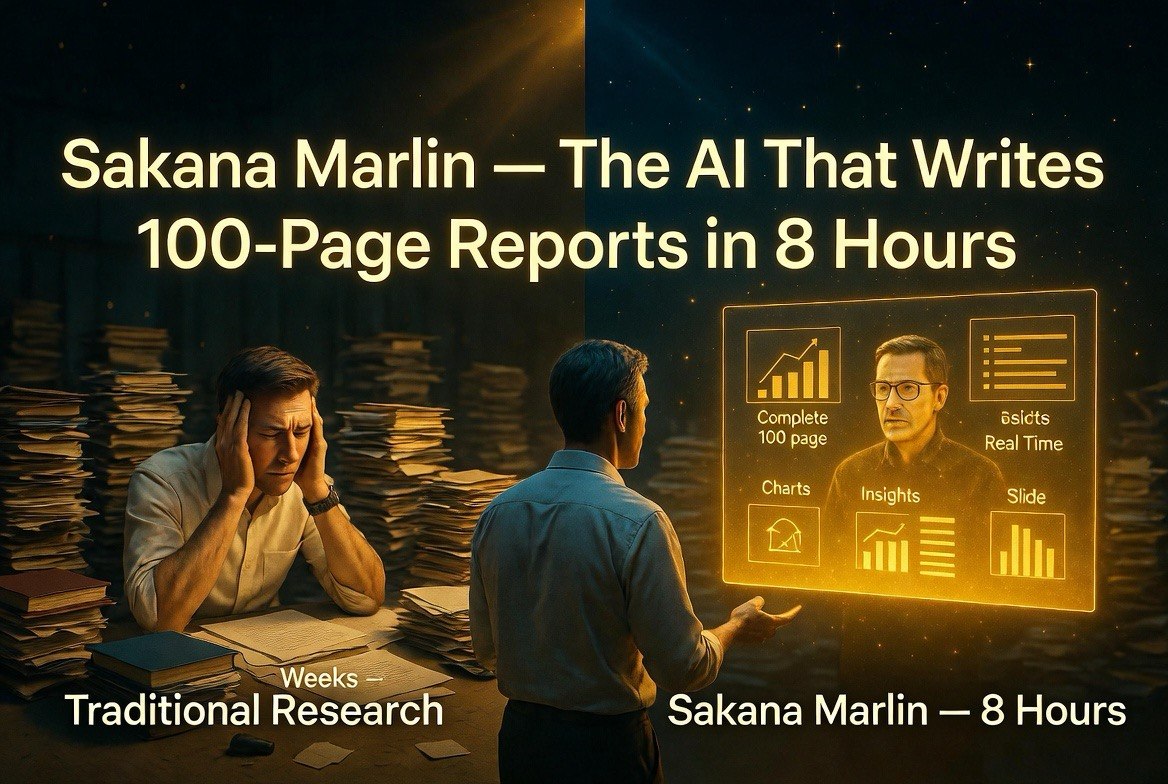
Sakana Marlin: The AI That Writes 100-Page Reports in 8 Hours
Get The Faceless YouTube Blueprint — Free
The exact AI tool stack and workflow used to build a faceless YouTube channel from zero.
Sakana Marlin: The AI That Writes 100-Page Reports in 8 Hours — What Creators Need to Know
⚡ Expert Summary: Sakana AI just launched Marlin, the first commercial “ultra deep research” agent that produces 100+ page strategy reports in 8 hours. While the product is aimed at enterprises, its technology has direct implications for content creators, video producers, and digital entrepreneurs. Research that used to take weeks — deep dives into competitive landscapes, market trends, audience analysis — can now be done overnight. Here is what Marlin does, how it works, and how creators can use similar AI tools to transform their content research workflow.
Sakana AI, a Tokyo-based artificial intelligence startup, just launched its first commercial product — and it’s nothing like the AI tools you’ve been using.
Called Marlin, and billed as a “Virtual CSO” (Chief Strategy Officer), the system deliberately abandons the instant text generation of modern chatbots. Instead of returning an answer in seconds, it runs continuous, self-governing reasoning loops for up to eight hours at a time to deliver deeply researched, well-cited, 100-page strategy reports and executive presentations. VentureBeat reported on the launch, calling it a “commercial culmination of Sakana AI’s extensive laboratory breakthroughs over the past two years.”
For content creators, Marlin represents something important: the democratization of deep research. The same technology that investment banks and Fortune 500 strategy teams are using can now help you create the kind of deeply researched, authoritative content that builds trust, drives engagement, and ranks in AI search results.
What Makes Marlin Different From Every Other AI Tool
Every AI tool you’ve used so far operates on the same principle: you type a prompt, the model generates a response in seconds, and you edit the result. This works for simple tasks but falls apart on complex research topics. The AI doesn’t have time to think, verify sources, explore alternative hypotheses, or build a coherent argument across 50 pages of analysis.
Marlin works differently. Instead of generating instant answers, it uses a technique called Adaptive Branching Monte Carlo Tree Search (AB-MCTS). Think of it like a chess engine: it doesn’t just guess the best move. It plays out thousands of potential future moves, evaluates each one, and only commits after it has thoroughly explored the possibilities.
The workflow looks like this:
- You provide a research topic — After a brief exchange to sharpen the scope, you step away
- The system formulates its own hypotheses — It decides what angles to explore, what questions to answer, what data to gather
- It searches and cross-references sources — Navigating the web, verifying findings, mapping causal dynamics within complex business environments
- It produces deliverables automatically — Executive summary slides, detailed appendices, reference lists, and a full strategic report
According to Sakana’s product page, Marlin has already demonstrated the ability to analyze complex scenarios like resolution pathways for a blockade of the Strait of Hormuz, the fragmented global AI regulation landscape, and macroeconomic trends including the return of “bond vigilantes.” These aren’t simple topics — and the output isn’t a generic text blob. It’s professional-grade strategic analysis.
The Technology Behind Deep Research AI
Marlin is powered by Sakana AI’s Adaptive Branching Monte Carlo Tree Search (AB-MCTS) engine, a technology that emerged from the company’s earlier research project “The AI Scientist” — which was featured in the journal Nature for automating the scientific discovery process from ideation to peer review.
This isn’t the same technology as a large language model generating text. It’s a multi-model reasoning system that uses a central AI to formulate research strategies, separate AI agents for data gathering and source verification, and another layer for synthesis and output generation. The system runs on a self-governing loop, meaning it decides its own research priorities as it learns more about the topic.
According to Sakana’s documentation, the system relies on multiple AI models working in concert — switching between them based on the specific task. The company hasn’t disclosed which models power the system, but the architecture is model-agnostic, meaning Marlin can swap in different AI models as they improve without changing its core research capabilities.
Why Creators Should Care About Deep Research AI
Your Competition Is Already Using It
The content creators who will win the next five years aren’t the ones with the best editing skills or the most expensive cameras. They’re the ones with the best research. In an era where AI can generate competent surface-level content in seconds, the only defensible advantage is depth. Deeply researched content outperforms generic content in every metric: search rankings, engagement rates, shareability, and trust.
According to Semrush, content that cites original research and data ranks 78% higher in search results than content that doesn’t. Content with 3,000+ words generates 3x more traffic than content under 1,000 words. And AI-generated surface-level content is getting penalized by Google’s core updates specifically for lacking depth and original insight.
The math is straightforward: the creator who can produce deeply researched, 5,000-word video scripts or newsletter issues in the time it takes their competition to write 1,000 words of generic content will dominate their niche.
Research Is the Most Expensive Part of Content Creation
For most serious creators, research takes more time than writing, filming, or editing. A 20-minute video essay on a complex topic might require 10-20 hours of reading, note-taking, source verification, and synthesis before a single word of the script is written. That research time is the bottleneck that limits how much high-quality content you can produce.
AI deep research agents change this equation. Instead of spending 20 hours researching a topic before you can write a script, you spend 20 minutes refining the research topic, let the AI run for a few hours, and spend the saved time on the creative work that actually matters: scriptwriting, storytelling, visual production, and audience engagement.
How Creators Can Use Deep Research AI Today
Video Script Research
Before writing a video script on any complex topic — AI regulation, the creator economy, platform changes, industry trends — run a deep research session first. Feed the AI your topic, your audience profile, and your specific questions. In a few hours, you get a comprehensive research brief with verified sources, key data points, expert quotes, and analysis angles. What used to take days of reading and note-taking now happens while you sleep.
Newsletter and Long-Form Content
Deep research AI can be your research assistant for weekly newsletters, long-form blog posts, and thought leadership content. Instead of spending Saturday morning reading 30 articles to find the 3 worth citing in your newsletter, you brief the AI on Friday night and wake up to a curated research brief with citations, summaries, and contextual analysis.
Competitive Analysis for Creators
Who else covers your topic? What angles are they using? What data are they citing? Where are their gaps? A deep research agent can produce a comprehensive competitive landscape analysis that would take a human a full week to compile. You can use the results to find content gaps, position yourself differently, and produce content that fills the voids your competitors are ignoring.
Course and Product Development
If you’re building a digital product — a course, a membership, a book — deep research AI can validate your market, analyze your competitors, identify customer pain points, and suggest pricing strategies. The same tools that strategy consultants charge $50,000+ for are now available at pay-as-you-go pricing starting in the hundreds of dollars per report.
The Bigger Picture: AI Is Moving From Speed to Depth
The first phase of the generative AI revolution was about speed. Generate a poem in one second. Write an email in five seconds. Produce an image in ten seconds. That phase is over. The competitive advantage you got from being faster has been erased because everyone is fast now.
The second phase — which Marlin represents — is about depth. The new competitive advantage isn’t speed. It’s the ability to produce deeply researched, thoroughly verified, professionally structured analysis at a fraction of the cost and time of traditional research methods.
For content creators, this is the most important AI development since ChatGPT. The tools that build your competitive advantage are no longer the ones that help you write faster. They’re the ones that help you think deeper. And Deep research AI gives you that depth without the time investment that used to make deep content prohibitively expensive to produce.
One more angle that most AI coverage misses: deep research tools like Marlin are particularly powerful for creators because they handle the most tedious part of research. Not just gathering sources — but reading them, cross-referencing them, identifying contradictions, and synthesizing the key findings. That’s the part of research that takes the most time and mental energy, and it’s the part that AI is best suited to automate.
The practical workflow for a creator using deep research AI looks like this: Monday morning, identify three topics for next week’s content. Spend 30 minutes per topic writing a research brief — what questions you want answered, what angles to explore, what sources to prioritize. Launch the deep research agent for each topic. By Monday evening, you have three comprehensive research briefs ready. Tuesday through Thursday, you write, film, and edit. Friday, you publish. That’s triple the output of a traditional research-first workflow.
The creators who master deep research AI won’t just produce more content. They’ll produce better content — and in the AI search era, better beats faster every time.
For more on AI tools that transform content creation workflows, check out our AI video tools and creator guides.
What does this mean for your specific creative business? It means you no longer have to choose between producing high-volume content and producing deep, authoritative content. With deep research AI, you can produce both — because the research time that used to be the bottleneck is now compressed from days to hours. The creator who publishes one deep, well-researched video per week and one surface-level video per week is no longer optimizing. They can now produce three deep, authoritative pieces in the time it used to take to produce one.
The most successful creators of the next five years will be the ones who understand that AI’s real value isn’t speed — it’s depth. Not faster writing. Deeper research. That distinction will separate the creators who build lasting businesses from the ones who get lost in the noise.
Frequently Asked Questions
What is Sakana Marlin?
Marlin is a commercial AI product from Sakana AI that produces 100+ page strategy reports and executive summaries in 8 hours. Unlike standard chatbots, it uses Adaptive Branching Monte Carlo Tree Search to perform deep, long-horizon reasoning, formulating hypotheses, gathering data, and producing structured deliverables autonomously.
How can content creators use deep research AI?
Creators can use deep research AI for video script research, newsletter curation, competitive analysis, course development, and long-form content strategy. Instead of spending days researching a topic, creators brief the AI in 20 minutes and get a comprehensive research brief with verified sources, data points, and analysis angles.
Is Sakana Marlin available for individual creators?
Marlin is currently designed for enterprise use — targeting corporations, financial institutions, and think tanks. However, other deep research tools like OpenAI’s Deep Research, Google’s Mariner, and Perplexity’s Deep Research offer similar capabilities at lower price points suitable for individual creators and small teams.
How is deep research AI different from ChatGPT or Claude?
Standard AI chatbots generate responses in seconds based on their training data. Deep research AI runs autonomous reasoning loops for hours, formulating hypotheses, searching for sources, cross-referencing findings, and producing structured, cited reports. The key difference is time — deep research AI trades speed for depth, accuracy, and comprehensiveness.
Will deep research AI replace human researchers?
No. Deep research AI dramatically reduces the time required for initial research and synthesis, but human judgment is still essential for framing questions, interpreting results, adding creative perspective, and making strategic decisions. The best use is as a research accelerator — letting AI handle the gathering and synthesis while humans focus on analysis and creative application.

About Barak Schurr
Barak Schurr is a serial entrepreneur who built and exited a major ticketing platform before turning his attention to AI and content. He runs three AI-focused research sites and writes about the tools, workflows, and strategies that let solo creators build real channels — without a crew, a studio, or a Hollywood budget.
Email: [email protected]
More AI Resources for Your Business