Vyond Turbo: Agentic AI Video Creation That Turns a Prompt Into a Finished Draft
Get The Faceless YouTube Blueprint — Free
The exact AI tool stack and workflow used to build a faceless YouTube channel from zero.
Vyond Turbo: Agentic AI Video Creation That Turns a Prompt Into a Finished Draft
⚡ Expert Summary: Stratbeans launched Vyond Turbo on September 7, 2026 — an agentic AI video creation platform that generates complete video drafts from a detailed prompt, a script, or visual directions, automatically building scenes, visuals, voiceovers, background audio, and text formatting. You refine the output by talking to it in plain language. For solo creators and small teams, the interesting part isn’t the generation speed — it’s that the traditional bottleneck of assembling a video from separate assets is being collapsed into a single conversational workflow.
There’s a specific kind of pain that anyone who has made video content alone knows intimately.
You have the script. You know exactly what the video should look like. Now you spend the next four hours doing work that has nothing to do with your idea: sourcing visuals, cutting them to length, writing the voiceover, generating the audio, matching the timing, formatting the text so it doesn’t collide with the scene, and re-rendering because one clip ran 1.5 seconds long.
The idea took twenty minutes. The assembly ate the afternoon.
That gap — between knowing what you want and having a finished piece — is where most solo creators lose their channel. Not to a lack of ideas, and not to a lack of skill, but to the sheer number of discrete steps between script and screen. Each step is a place where momentum dies.
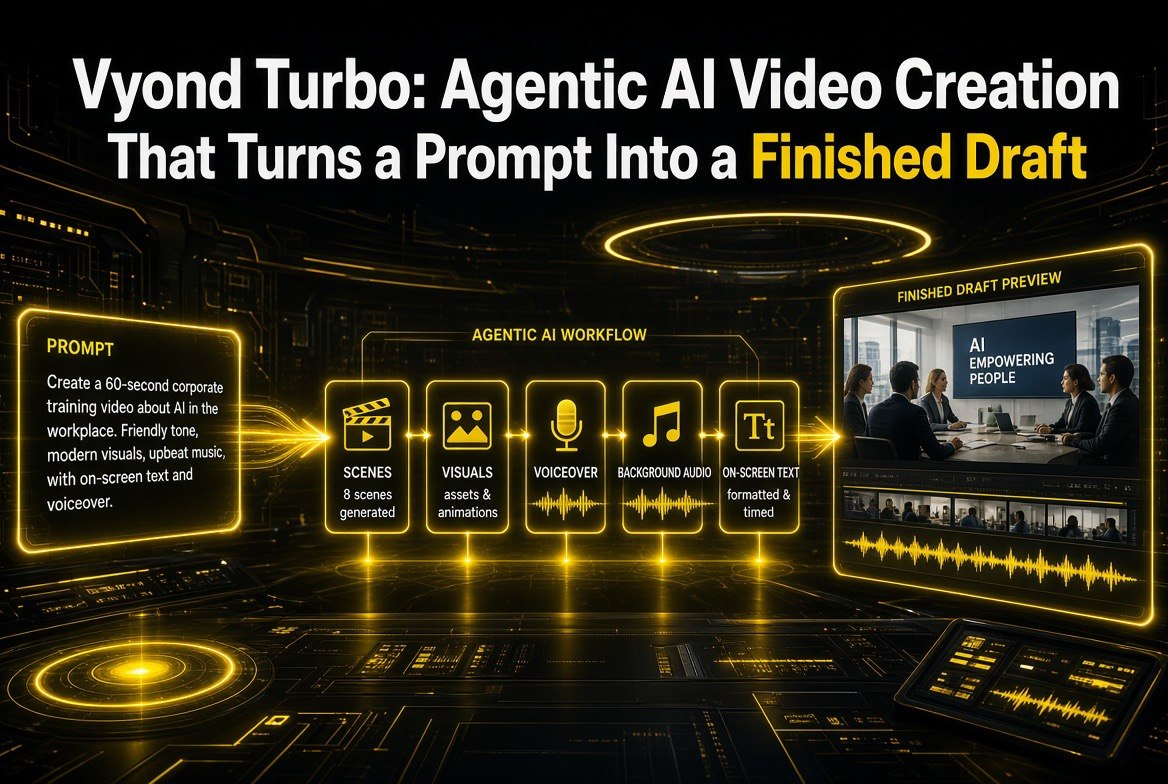
Stratbeans launched Vyond Turbo on September 7, 2026, and it’s aimed directly at that gap. It’s an agentic AI video creation platform, which means it doesn’t just generate a clip when you ask for one. It takes a detailed prompt, a script, or visual directions and builds a complete draft — scenes, visuals, voiceovers, background audio, and text formatting — then lets you refine the result by telling it what to change in normal language.
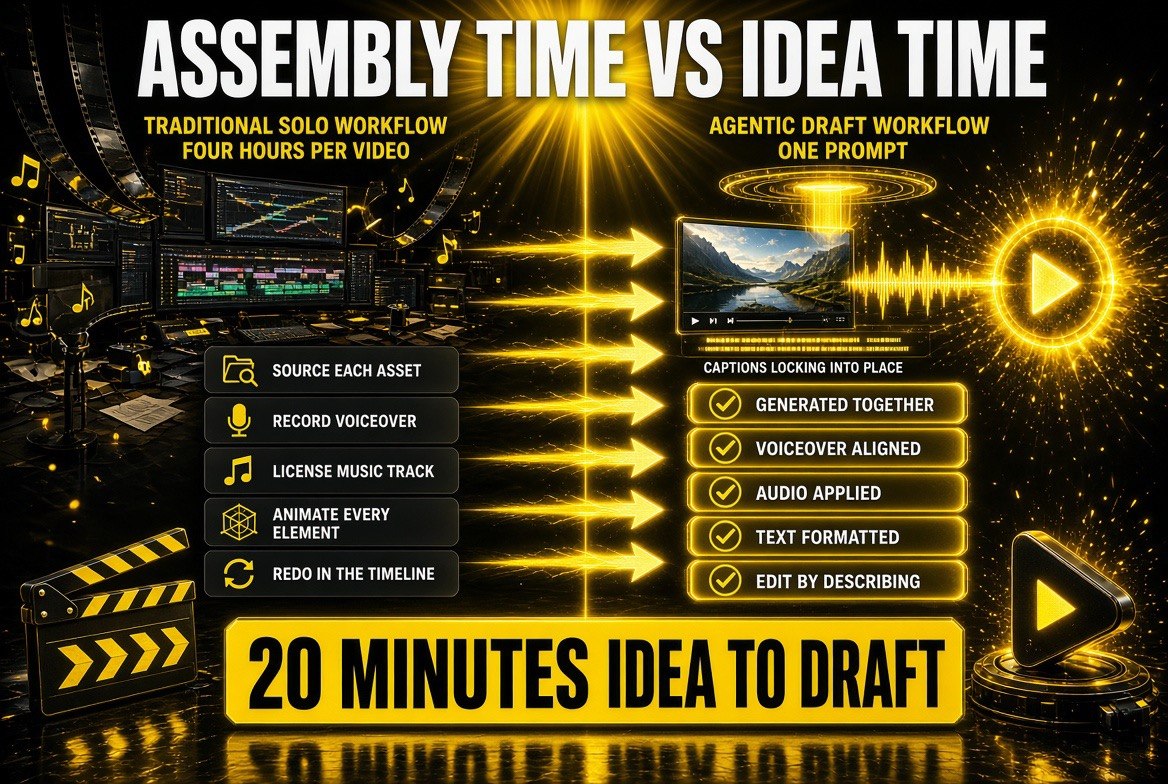
The swap in one frame. Where a solo creator once sourced assets, recorded voiceover, licensed music, animated every element and rebuilt in the timeline, agentic drafting generates the sequence together, aligns the voiceover, applies audio and format the text — then you edit by describing the change.
What “Agentic” Actually Changes About Video Production
The word gets used loosely, so it’s worth being precise about what’s different here.
A standard AI video generator is a single-shot tool. You write a prompt, it returns a clip. If you want twelve clips that form a coherent three-minute video, you write twelve prompts, generate twelve results, then go assemble everything in an editor. The AI handled generation. You handled the entire production pipeline, including making sure the twelve pieces felt like they belonged together.
An agentic system coordinates the steps rather than executing one. Vyond Turbo takes a higher-level instruction — a script, a detailed prompt, a set of visual directions — and produces a draft where the components already fit together. Scenes are built. Visuals are placed. Voiceover is generated. Background audio is applied. Text is formatted so it reads cleanly against the visuals.
Then the refinement loop is conversational. You don’t reopen an editor and drag things around. You say what’s wrong in plain language — this scene is too long, make the narration warmer, change the visual on scene three — and the system adjusts.
That’s a meaningfully different workflow, and the difference matters most for the people who work alone.
Why This Workflow Suits Solo Creators Specifically
Video production is a team sport that has been quietly outsourced to individuals.
In a traditional production workflow, the tasks are divided: a writer, a designer for visuals, a voice talent, an editor for assembly, and a motion designer for text and transitions. Ten years ago, a solo creator doing all five jobs either hired out or accepted a lower production quality. Five years ago, template tools cut the design work down but left assembly and narration manual.
Now the value proposition is that one person plus a conversational workflow can produce a complete draft. Not a finished broadcast-quality piece — but a complete draft, which is the part that was genuinely blocking.
The economics matter here. A freelance editor charged hourly turns a two-minute explainer into a four-figure invoice. Voiceover talent adds more. For a creator building a channel on a lean budget, the question has always been whether the extra production polish returns more than it costs. For most people under a certain subscriber count, the answer is no — which is why so many channels plateau at “decent content, rough production.”
An agentic draft doesn’t solve taste or strategy. It does remove the production cost floor that forced that trade-off in the first place.
| Production Step | Traditional Solo Workflow | Agentic Draft Workflow (Vyond Turbo) |
|---|---|---|
| Starting input | Script plus a storyboard you build yourself | A detailed prompt, script, or visual direction |
| Scene and visual creation | Source each asset separately, then place manually | Generated together as a coherent sequence |
| Voiceover | Record it, or hire talent and direct them | Generated and aligned to the scenes |
| Audio and music | License a track, then mix and duck it | Background audio applied in the draft |
| Text and formatting | Animate each element in an editor | Formatted as part of generation |
| How revisions happen | Reopen the timeline and redo the work | Describe the change in plain language |
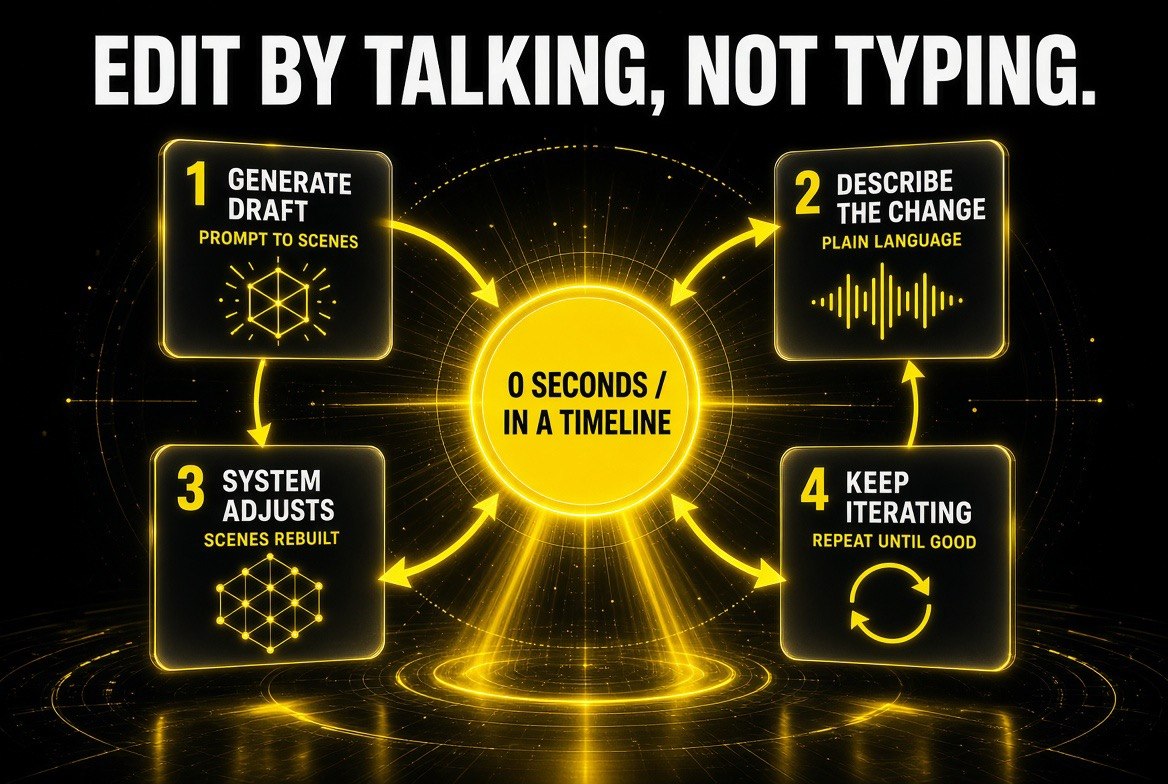
The refinement loop is the feature that matters. You generate a draft, describe what is wrong in plain language, the system adjusts the scenes, and you repeat — without ever reopening a timeline.
The Conversational Refinement Loop Is the Real Feature
Most coverage of AI video tools fixates on generation quality. That’s the wrong thing to evaluate, because generation quality is converging fast across every serious platform — and because it’s not where projects actually stall.
Projects stall in revision. Anybody who has made more than a handful of videos knows the pattern: the first cut gets made, you watch it, you have eight notes, and then you spend longer implementing those eight notes than you did making the first cut. Every revision cycle is a tax on finishing.
Natural-language refinement is the feature that attacks that tax directly. If you can watch a draft and say “scene two is dragging, cut four seconds and make the narration more energetic,” and the system applies it, the revision loop shrinks from an editing session to a sentence.
That changes creator behavior in a way that’s easy to underestimate. When revisions are cheap, you iterate more. When you iterate more, the finished piece gets better — not because the tool is smarter, but because you’re willing to make a fifth pass when the fourth one costs thirty seconds instead of thirty minutes.
There’s a real limitation worth stating plainly, though. Conversational editing is powerful for structural and tonal changes and clumsy for pixel-precise work. If you need a logo to sit at exactly 42 pixels from the left edge because your brand guidelines say so, plain-language instructions will frustrate you. The workflow shines when you want broad, meaningful changes fast — not when you need frame-level surgical control.
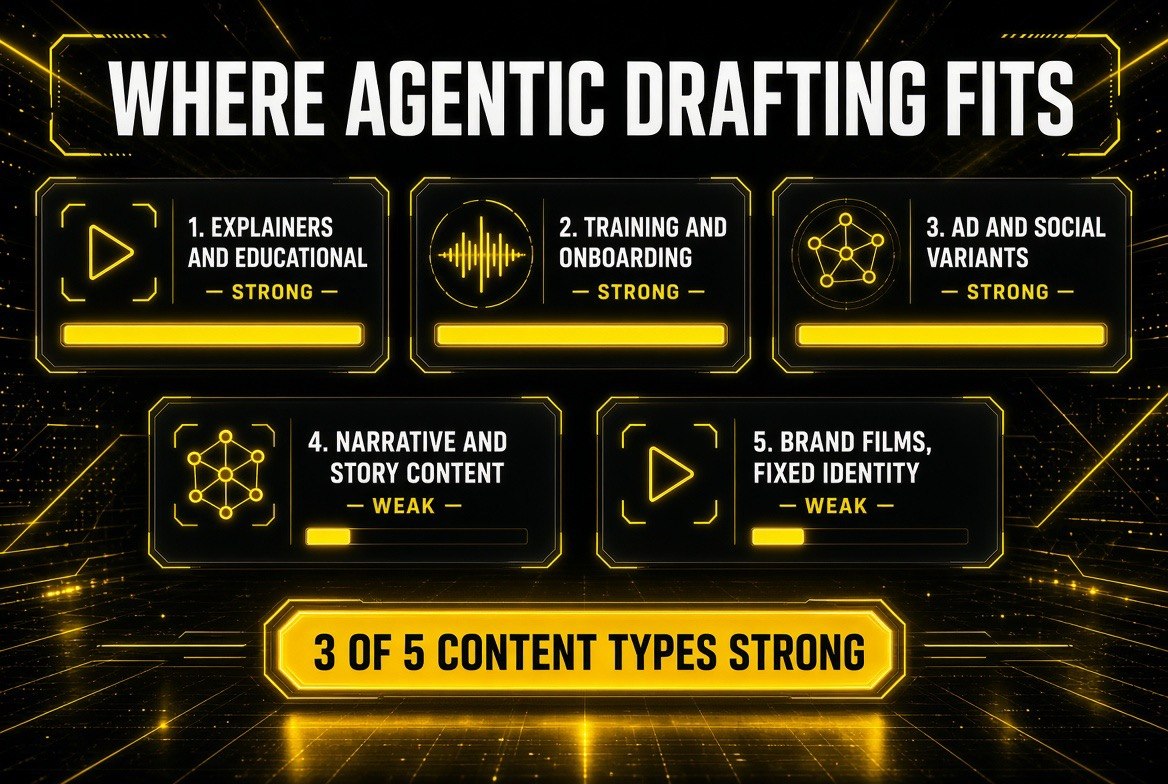
Three of five content types are a strong fit for agentic drafting — explainers, training and onboarding modules, and ad or social variants. Narrative storytelling and brand films with strict visual identity are not, because both depend on human performance or frame-precise control.
Where This Fits for Creators Building Real Channels
Strip the marketing away and the practical use cases are narrow but sharp.
Explainer and educational content is the strongest fit. This is the use case Vyond’s own product line was built around, and it holds up independently of that: explainer videos are structured, scripted, and rarely need cinematic visuals. They need clear scenes, clean narration, and readable text — precisely the components that can be generated together.
Training and onboarding material for small businesses is the second strong fit. A small business that needs a product walkthrough or a customer-facing how-to video is not going to hire a production crew. Agentic drafting turns that from a project into an afternoon.
Fast iteration on ad creative and social variants is the third. If you’re testing five hooks for the same offer, the ability to spin up five structurally complete drafts and refine the weak ones conversationally is worth more than any single polished video.
Where it fits less well: narrative storytelling, anything that depends on a specific human face or performance, and brand work where visual identity is the entire point. Those still need a human director’s judgment, and no amount of generation speed substitutes for a point of view.
| Content Type | Fit for Agentic Drafting | Why |
|---|---|---|
| Explainers and educational videos | Strong | Scripted structure with narration and clean text, no performance needed |
| Training and onboarding modules | Strong | High volume, low cinematic ambition, fast revision beats polish |
| Ad and social creative variants | Strong | Volume and iteration speed matter more than any single draft |
| Narrative and story-driven content | Weak | Depends on human performance and directorial judgment |
| Brand films with strict visual identity | Weak | Needs frame-precise brand control, not conversational edits |
The Strategic Read for Content Creators
Two years ago, the differentiator for an AI video tool was whether it could generate something convincing. That contest is over — quality is broadly good enough across the major platforms, and the differences are becoming marginal.
The current contest is about workflow. Which tool collapses the most steps between idea and finished piece? Whose revision loop is cheapest? Who handles the unglamorous parts — audio, timing, text — without making you think about them?
That reframing should change how you evaluate tools. Generation samples look impressive in a launch demo and tell you almost nothing about whether the tool will still be useful on your fortieth video, when the novelty has worn off and you’re just trying to ship on schedule.
Ask a different set of questions. How many separate steps does this remove from my current process? How does revision work when I hate scene three? Where does the output go when I’m done — and can I take it into a real editor if I need to? Does it handle voiceover in a way that doesn’t sound like a robot reading a phone book?
Those questions separate tools that change your output from tools that merely look good in a demo.
What to Watch From Here
Vyond Turbo’s launch was positioned around enterprise learning and development, which is Vyond’s existing market and where the paid demand already sits. That’s a sensible launch strategy and it’s also a signal: enterprise L&D buyers have the budget and the volume to justify the tool immediately.
But the capability itself doesn’t care who buys it first. The same prompt-to-draft workflow that lets a corporate L&D team produce onboarding videos at scale lets a solo creator build a channel without a crew, an editor, or a voiceover budget.
That’s the pattern worth tracking across the category in 2026. Enterprise tools keep arriving with enterprise framing and enterprise pricing, and the underlying capability quietly becomes available to individuals at a price that makes sense for them within a year or two. Creators who understand the workflow shift early get to exploit it while everyone else is still comparing generation samples.
The bottleneck in solo video production has never been the idea. It’s been the assembly. When the assembly becomes a conversation, the constraint moves — and the people who move with it are the ones who publish a fifth video while everyone else is still polishing the first.
Frequently Asked Questions
What is Vyond Turbo?
Vyond Turbo is an agentic AI video creation platform launched by Stratbeans on September 7, 2026. It generates complete video drafts from a detailed prompt, a script, or visual directions, automatically building scenes, visuals, voiceovers, background audio, and text formatting. Users refine the output through natural-language prompts rather than manual timeline editing.
What does agentic mean for AI video creation?
A standard AI video generator is a single-shot tool: you write a prompt and get one clip back, then assemble everything yourself in an editor. An agentic system coordinates the whole pipeline — scenes, visuals, voiceover, audio, and text — from a higher-level instruction, producing a coherent draft instead of isolated assets. That shifts the creator’s job from assembling pieces to directing and refining.
Why does conversational editing matter more than generation quality?
Because projects do not usually stall at generation, they stall at revision. Implementing eight notes on a first cut often takes longer than making the cut. When revision happens through plain-language instructions instead of a full editing session, iterations get cheap, so creators iterate more and the finished video improves. Generation quality is converging across platforms, so the workflow advantage is what separates tools.
What types of video is agentic AI drafting best suited for?
It works best for explainer and educational videos, training and onboarding modules, and rapid ad or social creative variants. These are structured, scripted, and narration-heavy with no need for human performance. It is a weaker fit for narrative storytelling, content that depends on a specific person on camera, and brand films that require frame-precise visual identity control.
Can a solo creator use an enterprise-focused AI video tool?
The underlying capability is not limited by who the vendor sells to first. Vyond Turbo launched with enterprise learning and development framing because that market has immediate budget and volume, but the same prompt-to-draft workflow removes the production cost floor for individual creators. Historically these capabilities reach individual creators at accessible pricing within a year or two of an enterprise launch.
What should creators ask before choosing an AI video tool in 2026?
Focus on workflow rather than demo footage. Ask how many separate steps the tool removes from your current process, how revision works when you want to change a specific scene, what export options exist and whether you can finish in a real editor, and how natural the generated voiceover sounds. Those questions reveal whether a tool changes your output or merely looks impressive in a launch video.

About Barak Schurr
Barak Schurr is a serial entrepreneur who built and exited a major ticketing platform before turning his attention to AI and content. He runs three AI-focused research sites and writes about the tools, workflows, and strategies that let solo creators build real channels — without a crew, a studio, or a Hollywood budget.
Email: [email protected]
More AI Video Resources