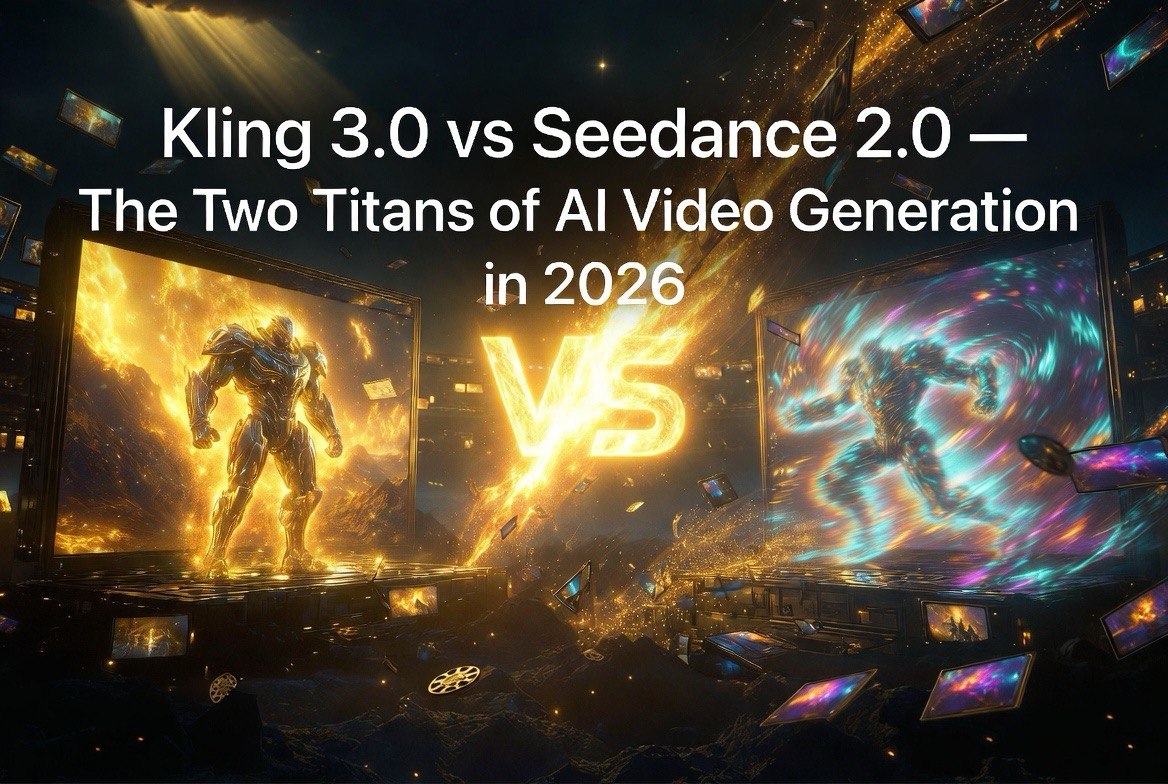
Kling 3.0 vs Seedance 2.0: The Two Titans of AI Video Generation in 2026
Get The Faceless YouTube Blueprint — Free
The exact AI tool stack and workflow used to build a faceless YouTube channel from zero.
Kling 3.0 vs Seedance 2.0: The Two Titans of AI Video Generation in 2026
⚡ Expert Summary: February 2026 saw two landmark releases in AI video — Kuaishou’s Kling 3.0 and ByteDance’s Seedance 2.0. Both launched within days of each other, both introduced native audio generation, extended durations, and 4K output. But they diverge sharply in approach: Kling 3.0 prioritizes motion capture precision and professional control, while Seedance 2.0 goes all-in on multi-modal input (text, images, video, audio) and cinematic narrative coherence. This comparison breaks down where each tool excels and which one fits different creative workflows.
If you blinked in February 2026, you missed the most important week in AI video history.
On February 5, Kuaishou released Kling 3.0 — a major overhaul that introduced professional motion capture, native audio, 4K photorealistic output, and extended durations up to 15 seconds. The AI video community called it a leap forward.
On February 8 — three days later — ByteDance dropped Seedance 2.0. Multimodal inputs supporting text, images, video, and audio. Consistent characters across shots. Director-level control features.
Two platforms. Two philosophies. Both released within the same week.
Here’s how they compare and which one you should use based on what you’re trying to build.
The Quick Comparison
Kling 3.0’s DNA: Motion capture precision. Professional control. If you need a specific character performing a specific action with specific camera movement, Kling 3.0 is your tool. It excels at the technical execution of a well-defined vision.
Seedance 2.0’s DNA: Multimodal flexibility. Narrative coherence. If you need to generate a multi-shot sequence with consistent characters, seamless audio-video sync, and director-level editing control, Seedance 2.0 is your platform.
The difference is visible in the outputs. Kling 3.0 produces technically polished clips that look like professional footage. Seedance 2.0 produces cinematic sequences that feel like scenes from a film. One prioritizes execution quality. The other prioritizes storytelling capability.
Kling 3.0 Deep Dive: Precision First
Kling 3.0 introduced professional motion capture and control — the standout feature that sets it apart from every other AI video tool in 2026. Users can define specific motion paths, camera angles, and character movements with a level of precision that previously required motion capture equipment.
The practical implication: if you need a product shot with a specific camera orbit, a character walking a defined path, or a scene with complex blocking, Kling 3.0 delivers it consistently. The motion control features mean you’re not relying on the model to guess what movement you want — you tell it explicitly.
Other key features:
– Photorealistic 4K output — the highest resolution available in consumer AI video tools
– Native multi-language audio — generated audio that matches the visual content, supporting multiple languages
– Extended duration — clips up to 15 seconds (30 seconds in some configurations)
– High facial and character consistency — the same character maintains appearance across frames
– Multi-shot storytelling — multiple shots generated with narrative coherence
The weakness: Kling 3.0 requires more specific input to produce great results. It rewards precision in prompting. Vague inputs produce mediocre outputs. This is a tool for creators who know exactly what they want.
Seedance 2.0 Deep Dive: Multimodal First
Seedance 2.0’s headline feature is its multimodal input system. The platform accepts text prompts, still images (up to 9), reference videos, and audio inputs — all simultaneously. You can feed it a set of reference images and an audio track, and it generates video that incorporates visual references and syncs to the audio.
For content creators, this is transformative. Instead of describing a scene, you can show the model reference images and say “combine these.” Instead of writing “a dramatic orchestral score,” you can upload the actual audio and the video will match the pacing and mood.
The platform’s other standout capability is multi-shot cinematic output with consistent characters. Seedance 2.0 can generate sequences where the same character appears across multiple shots with consistent appearance, clothing, and positioning — something most AI video tools struggle with.
Additional capabilities:
– Audio-video synchronization — generated visuals that match reference audio timing and mood
– Reference-based editing — make changes to specific frames or elements without regenerating the full video
– Director-level control — define camera position, movement, and framing across the sequence
– Motion stability — significantly improved over Seedance 1.0, with fewer artifacts and smoother transitions
– Free and unlimited tier — ByteDance offers a generous free tier with no daily generation limits
The weakness: Seedance 2.0’s output quality varies more than Kling 3.0 depending on the input. When the multimodal inputs are well-chosen, the results are spectacular. When they’re not, the output can feel disconnected. It also has a steeper learning curve to master the multimodal input system.
Head to Head: Key Categories
Motion quality and physics: Kling 3.0 wins. The professional motion capture features deliver smoother, more physically accurate movement. Seedance 2.0 is strong but occasionally shows the artifacts and uncanny movement that plague AI video models.
Character consistency across shots: Seedance 2.0 wins. Its multi-shot consistency engine maintains character appearance across sequences — clothing, facial features, positioning. Kling 3.0 is good within a single clip but less reliable across multiple shots.
Audio integration: Tie. Both generate native audio. Seedance 2.0’s audio-video synchronization from a reference track gives it an edge for music-driven content. Kling 3.0’s multi-language capabilities make it better for dialogue-heavy work.
Resolution and visual quality: Kling 3.0 edges ahead at 4K output. Seedance 2.0 outputs at high resolution but Kling 3.0’s 4K is noticeably sharper for professional use.
Ease of use for beginners: Kling 3.0 is easier to get started with. Seedance 2.0’s multimodal system requires more setup and experimentation to master.
Best for storytelling: Seedance 2.0, decisively. The multi-shot consistency and reference-based editing make it the choice for narrative work.
Best for product and commercial work: Kling 3.0, decisively. The motion control and 4K output meet commercial production standards.
Where Google’s Veo 3.1 Fits Into This Picture
A fair comparison must acknowledge the third player: Google DeepMind’s Veo 3.1, which consistently tops “best overall” lists for reliability and cinematic quality. Veo 3.1 doesn’t compete on the same dimensions — it prioritizes consistent, physics-aware, reliable output over the advanced control features that Kling and Seedance offer.
Where Veo 3.1 excels is trustworthiness. You give it a prompt, it produces a high-quality result, and it does so reliably. There’s less configuration, less experimentation, less variability in output quality. For creators who want great results without spending hours refining inputs, Veo 3.1 remains the safest choice.
Kling 3.0 and Seedance 2.0, by contrast, are for creators who want control over the output. Veo 3.1 delivers consistency. Kling and Seedance deliver capability.
Real-World Testing: When the Choice Matters
Let me give you a concrete scenario that illustrates the difference.
Scenario: Producing a 30-second product advertisement for social media.
With Kling 3.0, you define the product shot precisely. Camera orbits the product at a defined speed and angle. The lighting responds to the motion naturally. The output is 4K, ready for commercial use. You generate 4-5 takes in different motion configurations and pick the best one. Total time: 30 minutes.
With Seedance 2.0, you upload 3 reference images of the product, an audio track of the background music, and a text prompt describing the scene. The system generates a multi-shot sequence — establishing shot, product close-up, lifestyle context — all with consistent visual style. Total time: 15 minutes, but the output requires more curation.
The Kling output looks like professional commercial footage. The Seedance output tells a mini-story. Which one is better depends entirely on whether you need a product shot or a product story.
Scenario: Creating a 60-second brand story for YouTube.
Seedance 2.0 is the clear choice. You feed it reference images of the brand’s visual identity, upload a voiceover track, and generate a multi-shot sequence that maintains character and style consistency across 10+ shots. The director-level editing features let you refine individual frames without regenerating the full sequence.
Kling 3.0 would require you to generate each shot individually and stitch them together externally — possible, but many more manual steps.
This is the practical framework: Kling for single-shot precision. Seedance for multi-shot storytelling. Use both, and your AI video workflow covers the full range.
Pricing and Access: What It Costs
Kling 3.0 pricing: Free tier with limited daily generations. Paid plans start at approximately $10-20/month for higher resolution and longer durations. Enterprise plans available for commercial licensing.
Seedance 2.0 pricing: Notably generous — ByteDance offers a free tier with unlimited daily generations. Paid plans ($15-30/month) unlock higher resolution, longer clips, and priority generation. The free tier alone is competitive with most paid AI video tools.
Both platforms are accessible via their native web interfaces. Seedance 2.0 is also available through aggregator platforms like Higgsfield, which may offer additional workflow features.
Which One Should You Use?
Choose Kling 3.0 if:
– You’re producing commercial or product content that requires precise motion
– You need 4K output for professional distribution
– You know exactly what you want and need a tool that executes it faithfully
– Your work relies on specific camera movements and character actions
– You’re creating short-form content (5-15 second clips) for ads, social media, or presentations
Choose Seedance 2.0 if:
– You’re creating narrative content — story-driven videos with multiple shots
– You have reference material (images, video, audio) that should inform the output
– You need character consistency across a sequence of shots
– You’re willing to invest time in mastering the multimodal input system
– You want to generate longer, more complex video projects
Use both if:
– Your workflow demands both precision and narrative capability
– Use Kling for individual shots that need specific motion, use Seedance for sequence-level storytelling
– The cost is manageable (both offer free tiers), and the combination covers the full spectrum of AI video creation
The Bottom Line
February 2026 was a watershed month for AI video. Kling 3.0 and Seedance 2.0, launched within three days of each other, represent two different philosophies of how AI video should work — and both are excellent at what they do.
Kling 3.0 is the precision tool for creators who need technical execution. Seedance 2.0 is the creative tool for storytellers who need narrative flexibility. The best AI video creators aren’t choosing one — they’re learning both and deploying each where it excels.
The gap between them isn’t quality. It’s philosophy. Understanding which philosophy matches your workflow is the decision that matters.
Frequently Asked Questions
Which is better — Kling 3.0 or Seedance 2.0?
Neither is universally better. Kling 3.0 excels at motion precision and 4K output for commercial work. Seedance 2.0 excels at narrative coherence, multi-shot consistency, and multimodal input for storytelling. The right choice depends on your project type.
Does Seedance 2.0 have a free tier?
Yes — ByteDance offers Seedance 2.0 with a free tier that includes unlimited daily generations. Paid tiers unlock higher resolution, longer durations, and priority processing.
Does Kling 3.0 support audio generation?
Yes — Kling 3.0 introduced native audio generation with multi-language support. The generated audio syncs to the visual content, supporting both dialogue and ambient sound.
Can I use both Kling 3.0 and Seedance 2.0 together?
Yes, and many professional creators do. Use Kling 3.0 for individual shots requiring precise motion control. Use Seedance 2.0 for sequences that need narrative coherence and character consistency. Both offer free tiers for testing.

About Barak Schurr
Barak Schurr is a serial entrepreneur who built and exited a major ticketing platform before turning his attention to AI and content. He runs three AI-focused research sites and writes about the tools, workflows, and strategies that let solo creators build real channels — without a crew, a studio, or a Hollywood budget.
Email: [email protected]
More AI Resources for Your Business