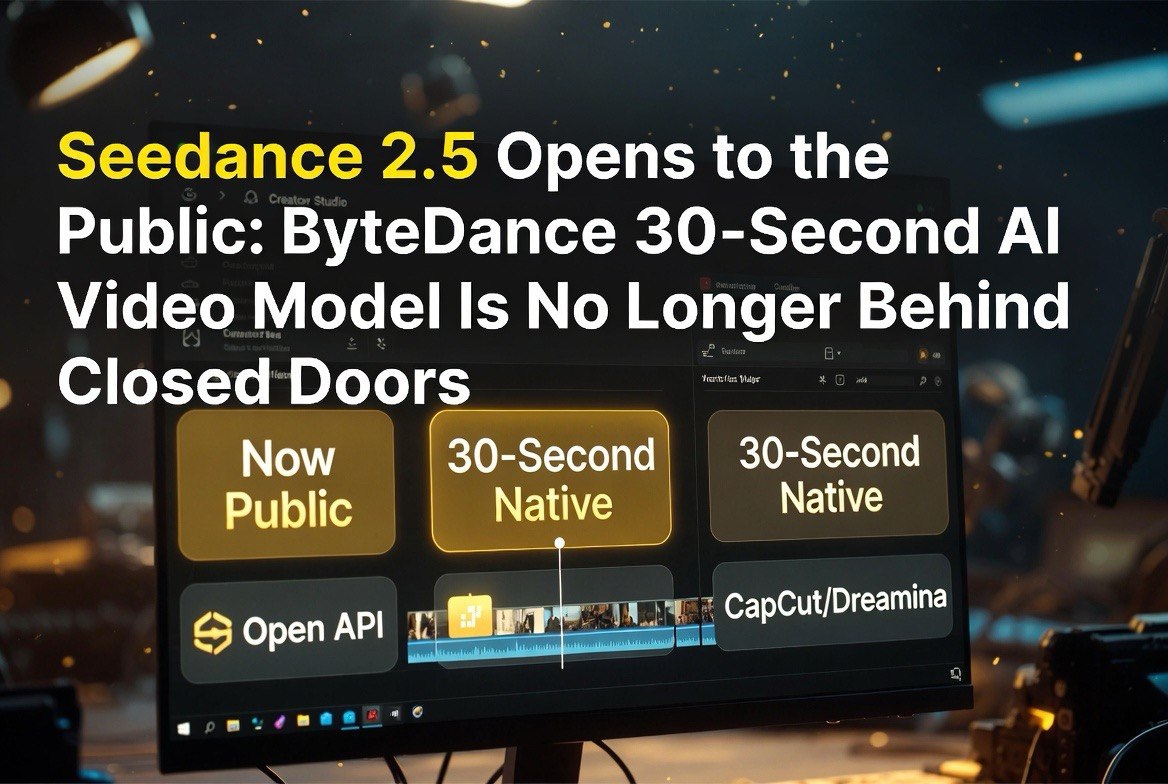
Seedance 2.5 Opens to the Public: ByteDance 30-Second AI Video Model Is No Longer Behind Closed Doors
Get The Faceless YouTube Blueprint — Free
The exact AI tool stack and workflow used to build a faceless YouTube channel from zero.
Seedance 2.5 Opens to the Public: ByteDance’s 30-Second AI Video Model Is No Longer Behind Closed Doors — Here’s How Creators Get Access
Expert Summary: ByteDance has opened general public API access to Seedance 2.5, its 30-second AI video model, through BytePlus ModelArk and Volcano Engine. The model supports native 30-second single-pass clips up to 4K, multimodal references, R2V reference control, and unified audio-video generation. For creators and developers, this removes the closed-beta restriction that kept Seedance 2.5 out of reach — now anyone with an account can generate, and the consumer rollout through Dreamina and CapCut is expanding. Access is usage-based rather than free, but the door that was sealed shut in early July is now open.
For most of July, Seedance 2.5 existed in a frustrating middle state. ByteDance had shown off the model’s capabilities — native 30-second clips in a single pass, up to 4K, strong character consistency — and reviewers across the industry had confirmed the results were real. But actually getting your hands on it was another matter. The API was closed to all but approved partners, and consumer access had not yet rolled out broadly. You could read about Seedance 2.5, watch demos of it, and even compare it against competitors, but you could not run your own prompts.
That has now changed. In mid-July, ByteDance opened public API access to Seedance 2.5 through BytePlus ModelArk for international developers and Volcano Engine for the enterprise and China markets. The model is no longer limited to a closed beta. Any developer with an account on these platforms can access it, and the consumer front is moving too, with Seedance 2.5 generation rolling out through Dreamina in the CapCut ecosystem. For a creator who has spent the last three weeks watching Seedance 2.5 clips circulate wondering when they could make their own, the answer is: now.
This is the moment the model stops being a headline and becomes a tool. And for independent creators and small teams in the United States, the practical question is not whether Seedance 2.5 is impressive — it is — but how you actually get in, what it costs, and whether it earns a spot in your workflow next to Kling, Runway, and the rest of the field.
What Public Access Actually Means
Public access for Seedance 2.5 has two distinct channels, and knowing the difference matters.
For developers and advanced users, the path is the BytePlus ModelArk API. This is where Seedance 2.5 is available to anyone who signs up, with usage-based pricing. It is also available through Volcano Engine for enterprise workloads. This is the route for anyone who wants to build Seedance 2.5 into their own tools, automate generation, or run prompts at scale through code. It is not a free tier — it is a paid, per-use API — but it is open, and that is the change worth noting.
For consumer-facing creators, the path runs through the CapCut ecosystem, specifically Dreamina. Seedance 2.0 already has free daily credits and trials on Dreamina, and Seedance 2.5 generation is being added to the same flow. This is how a non-technical creator who does not want to touch an API gets to use the model: through the same interface they already use for editing.
Both channels matter because they cover the two halves of the creator economy — the builders who want programmatic control and the artists who want a polished interface.
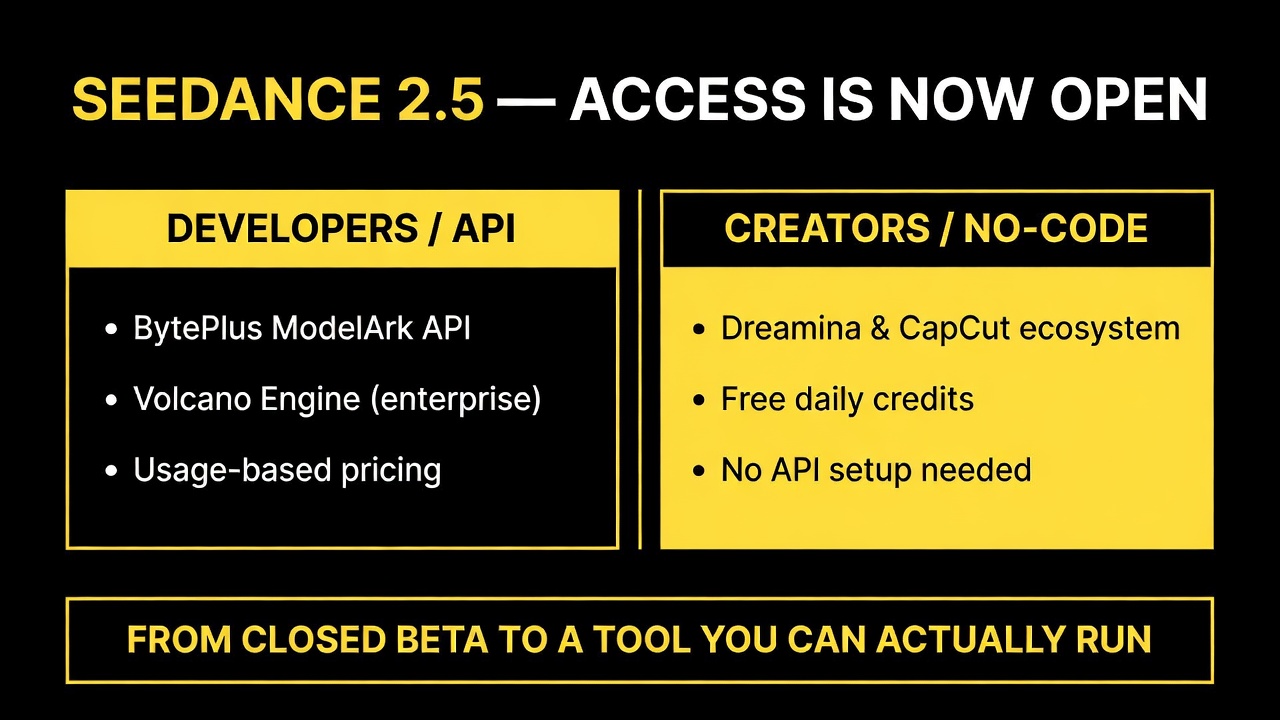
Two ways into Seedance 2.5 now: the BytePlus ModelArk API for developers and the Dreamina and CapCut consumer flow for no-code creators.
Why the Closed Door Mattered
To understand why public access is news, you have to understand what was locked away. Seedance 2.5 was not just another incremental update. It represented one of the first models to deliver genuinely usable 30-second single-pass AI video — a clip that holds together across motion, lighting, and subject consistency without visible stitching or seams.
That capability was demonstrated repeatedly in July. But demonstration is not access. A creator could not translate those impressive demo clips into their own work because the model was behind ByteDance’s closed distribution. The gap between “this model is good” and “this model is useful to me” was the access gap, and for several weeks it was the entire story.
Public API access closes that gap. The model’s capability did not change in mid-July. What changed is that creators and developers were finally let through the gate. That is the story — not a new feature, but the removal of the restriction that was keeping a capable model out of reach.
What Seedance 2.5 Actually Delivers
For anyone new to Seedance 2.5, here is what the model brings to the table now that it is publicly accessible.
Native 30-second clips are the headline. In a single generation pass, Seedance 2.5 produces up to 30 seconds of coherent video, eliminating the stitching and scene-cut artifacts that plagued earlier models. Combined with up to 4K output, this makes it viable for production-adjacent work where earlier AI video felt like a demo rather than a deliverable.
Multimodal references are the other major feature. Seedance 2.5 can take up to 50 reference assets — images, video, audio, text prompts — and use them to guide generation. That includes R2V reference control, which locks consistency across shots. For a creator producing a multi-shot piece, this is the difference between scenes that feel disconnected and scenes that feel like one cohesive production.
None of this had changed by the time the API opened. But the access made it real. A feature you cannot run produces nothing; a feature you can run produces deliverables.
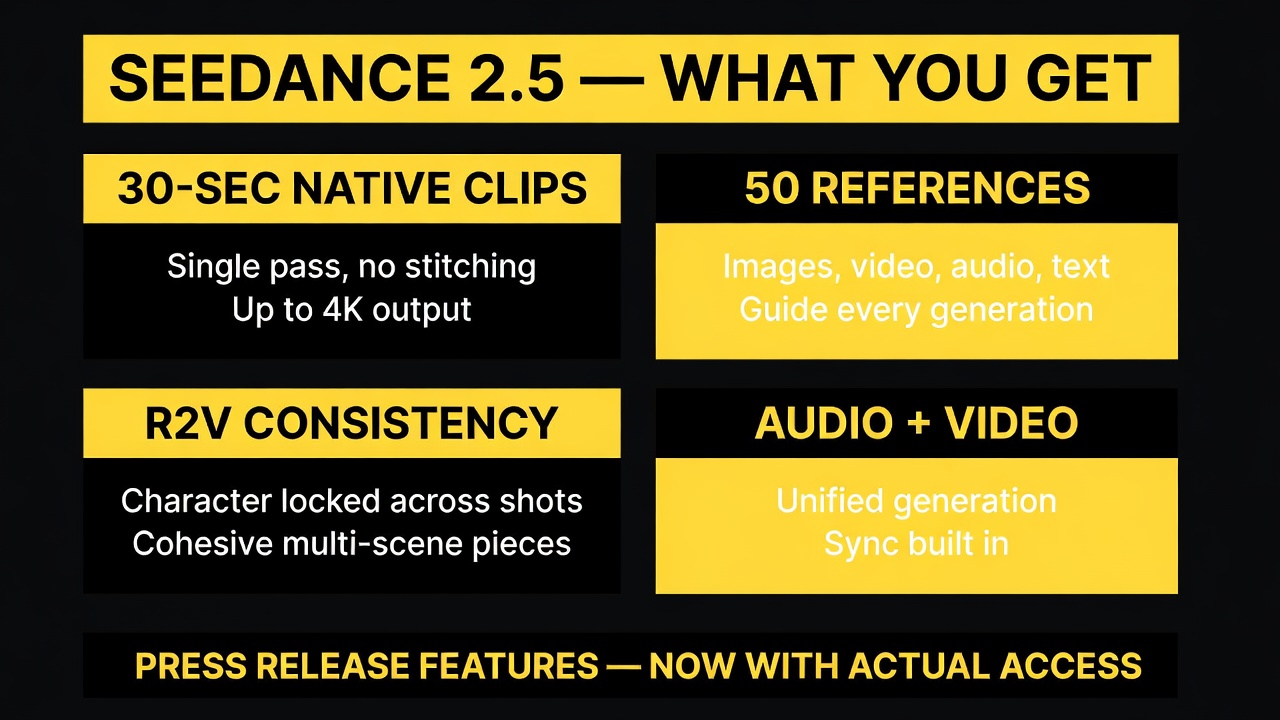
What Seedance 2.5 delivers once you are in: 30-second native clips up to 4K, up to 50 references, R2V consistency across shots, and unified audio-video generation.
What It Costs to Access
Seedance 2.5 is not free. Pricing is usage-based, with rates that depend on resolution and settings. Realistic estimates put a 30-second clip in the range of $1 to $2 or more depending on output quality and length, though ByteDance has not published a single clean per-second rate sheet. As with most AI video, the effective cost will vary by how you configure each generation.
The consumer path via Dreamina and CapCut is different. There, the existing free-daily-credit model applies to Seedance 2.0, and Seedance 2.5 is joining that ecosystem. That gives non-API creators a way to test the model without immediately committing production budget — the same pattern Kling and other platforms use to get creators comfortable before they scale up spend.
The practical takeaway for US creators is to start small. Run test generations at the lower resolution settings, compare the 720p and 1080p output against what your deliverable actually requires, and only scale to 4K when a specific project justifies the cost. The per-clip economics of Seedance 2.5 are competitive with the rest of the field, but the discipline of testing before scaling applies just as it does with any AI video model.
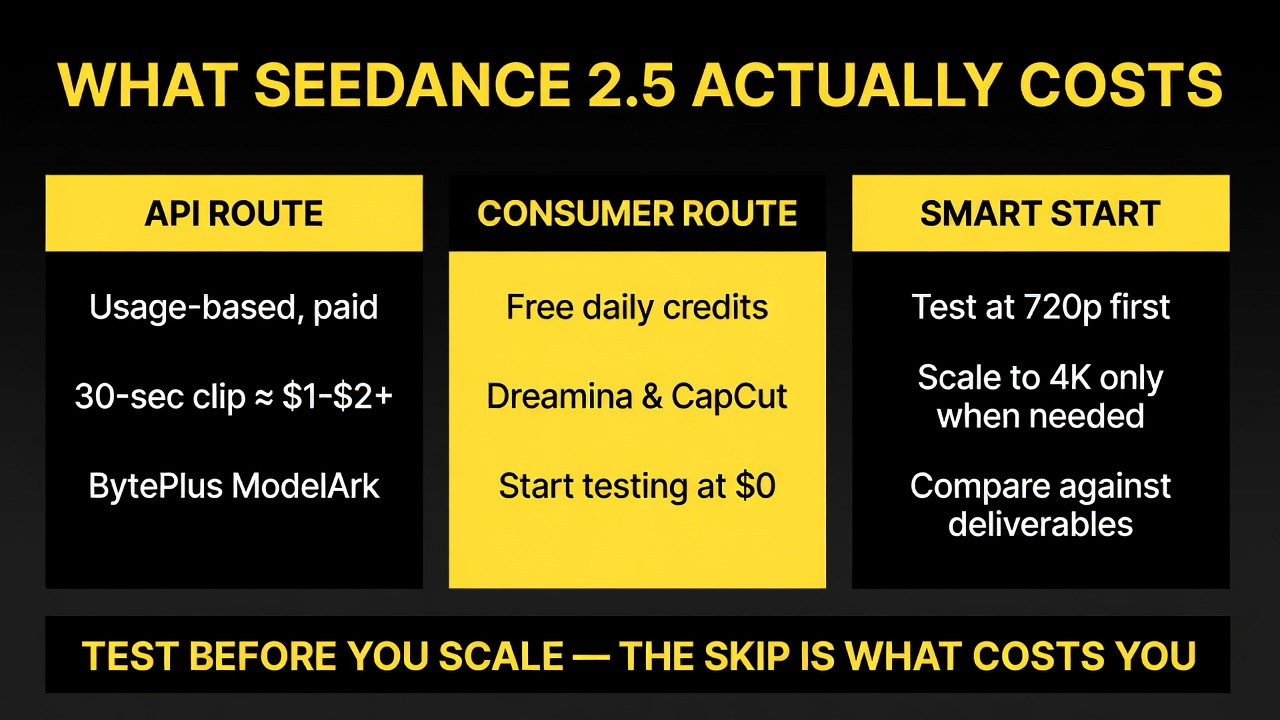
The cost picture: usage-based API pricing around $1 to $2 per 30-second clip, free daily credits on the consumer route, and a test-at-720p-first approach before scaling to 4K.
Copyright Risk: The Cloud You Cannot Ignore
There is a caveat that has followed Seedance 2.5 since its launch, and public access does not erase it. ByteDance’s AI video training has been under scrutiny for potential use of copyrighted material, and an unresolved copyright cloud hangs over the model. This has real consequences for commercial work in the United States.
For creators generating content for clients, brands, or other commercial deliverables, that risk matters. If a model’s training data is later found to infringe, output derived from it can carry legal exposure. Developers building products on top of the Seedance 2.5 API inherit that exposure into their own commercial offerings.
None of this means you cannot use Seedance 2.5. It means you should think before you do. For internal experimentation, concept work, and content that is not tied to commercial obligations, the risk is manageable. For client-facing commercial deliverables, especially from a US agency or studio, the copyright question deserves a deliberate answer before you commit. It is the reason some creators will happily use Seedance 2.5 and others will pass until the issue is settled.
How to Get In Today
Getting access to Seedance 2.5 now is a straightforward, if not frictionless, process.
For the API route, sign up for BytePlus ModelArk. Create an account, generate API credentials, and you can begin calling the Seedance 2.5 endpoints. The setup mirrors what you would do for most modern AI APIs, and the model is available through the same console used for ByteDance’s other AI offerings. Enterprise access through Volcano Engine follows a similar path with more provisioning around workloads and compliance.
For the consumer route, head to Dreamina in the CapCut ecosystem. Seedance 2.0 is already usable there with free daily credits, and Seedance 2.5 is being added to the same interface. If you already edit in CapCut, this is the lowest-friction way to test the model with zero API setup.
Whichever route you take, the principle is the same: verify the model’s output against your use case before you scale. Run a few test generations, evaluate motion and consistency at your target resolution, and only then decide whether Seedance 2.5 joins your production stack.
Where Seedance 2.5 Fits in the 2026 Field
Seedance 2.5 now sits alongside the other publicly accessible models of 2026, and the field is genuinely crowded. Kling 3.0 Turbo competes on cost per second. Runway competes on creative control and polish. Veo 3.1 competes on cinematic quality. Seedance 2.5’s differentiator is the combination of native long-form clips and powerful reference control — the ability to hold a production together across multiple shots.
For a US creator already using Kling or Runway, that makes Seedance 2.5 a complementary tool rather than a strict replacement. It earns its place for pieces where you need sustained coherence — a product story, a multi-scene commercial, a branded narrative — rather than single hero shots. The pricing structure is competitive, so the decision comes down to output character and workflow fit more than cost.
The honest assessment is that Seedance 2.5 is now one of several strong options, distinguished by its 30-second native clips and reference control, shadowed by a copyright question that will not resolve itself quickly. Whether it becomes your primary model depends on how you weigh its strengths against that risk.
Bottom Line: Access Was the Whole Story
Seedance 2.5 was always a strong model. What public access changes is that it is now a strong model you can actually use.
ByteDance’s decision to open the API and expand the consumer rollout transforms Seedance 2.5 from a demonstrated capability into a working tool in the hands of creators. The capability did not change in mid-July. Access did. And for independent creators, small businesses, and developers in the United States, that is the difference between admiring the model from a distance and putting it to work.
Start with test generations on Dreamina or the BytePlus API, judge the output against your deliverable, and weigh the copyright question deliberately if you work commercially. The door that was closed is open now — that is the news, and it is also the opportunity.
Frequently Asked Questions
How do I get access to Seedance 2.5?
Seedance 2.5 is publicly available through the BytePlus ModelArk API for developers and through the consumer rollout in Dreamina and the CapCut ecosystem. Anyone can sign up for BytePlus ModelArk with an API account, or use Dreamina for a no-code interface with free daily credits.
Is Seedance 2.5 free to use?
No. The Seedance 2.5 API is usage-based and paid, with a 30-second clip typically estimated at $1 to $2 or more depending on resolution and settings. The consumer route through Dreamina and CapCut offers free daily credits, primarily for Seedance 2.0, with 2.5 joining that ecosystem for testing.
What does Seedance 2.5 do differently from other AI video models?
Seedance 2.5 generates native 30-second single-pass video clips, up to 4K, and supports up to 50 multimodal references with R2V reference control for consistency across shots. That long-form coherence and strong reference control are its main differentiators versus Kling, Runway, and Veo 3.1.
Is Seedance 2.5 safe to use for commercial work?
There is an unresolved copyright question over ByteDance’s training data. For internal experimentation and non-commercial content the risk is manageable, but creators should weigh the exposure deliberately before using Seedance 2.5 output in client-facing or other commercial deliverables, especially from a US agency or studio.

About Barak Schurr
Barak Schurr is a serial entrepreneur who built and exited a major ticketing platform before turning his attention to AI and content. He runs three AI-focused research sites and writes about the tools, workflows, and strategies that let solo creators build real channels — without a crew, a studio, or a Hollywood budget. Contact: [email protected]
More AI Video Resources