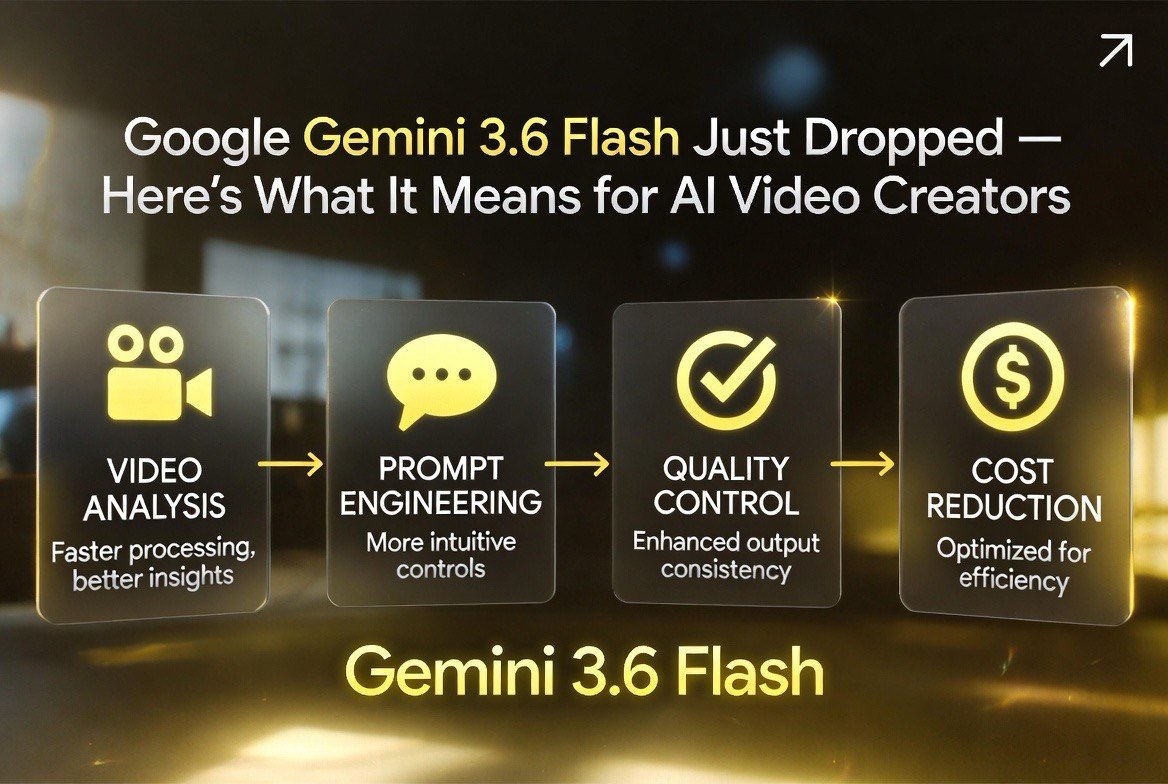
Google Gemini 3.6 Flash Just Dropped — Here’s What It Means for AI Video Creators
Get The Faceless YouTube Blueprint — Free
The exact AI tool stack and workflow used to build a faceless YouTube channel from zero.
Google Gemini 3.6 Flash: What AI Video Creators Need to Know
⚡ Expert Summary: Google released Gemini 3.6 Flash on July 21, 2026 — its fastest multimodal understanding model yet. It does not generate video, but it processes video as input for transcription, scene analysis, shot matching, and workflow automation at 43% lower cost than 3.5 Flash. For AI video creators, this is the model that connects the pipeline between raw footage and finished output.
Google’s July 21 release of Gemini 3.6 Flash marks a significant evolution in how AI video creators can work with large language models. While the model does not generate video natively — that capability lives in the separate Gemini Omni Flash — it processes video, audio, images, and text simultaneously with the lowest latency and highest token efficiency of any Flash-class model to date.
For US-based AI video creators, the question is not “can this generate videos?” — it is “what parts of my production pipeline can this model run faster, cheaper, and more accurately?” The answer involves video transcription at scale, semantic scene analysis, agent-driven editing workflows, and cost optimization that cuts API bills by nearly half compared to the previous generation.
| Specification | Gemini 3.6 Flash | Gemini 3.5 Flash |
|---|---|---|
| Release Date | July 21, 2026 | April 2026 |
| Context Window | 1 million tokens | 1 million tokens |
| Input Pricing | $1.50 per million tokens | $3.00 per million tokens |
| Output Tokens | ~17% fewer than 3.5 Flash | Baseline |
| Video Understanding | Top performer on VantageBench/VideoNet | Strong but lower accuracy |
| Output Type | Text only | Text only |
| Video Generation | No (separate Omni Flash) | No |
Why Video Creators Should Care About a Model That Does Not Generate Video
It sounds counterintuitive — a video creator’s blog analyzing a model that cannot generate video. But the most expensive, time-consuming parts of AI video production are not the generation step. They are the pipeline stages before and after generation: analyzing source footage, writing precise prompts, structuring multi-shot sequences, and post-processing output.
Gemini 3.6 Flash excels at exactly these tasks. The model processes video input natively — you can feed it hours of footage and it returns structured scene descriptions, shot classifications, spoken dialogue transcripts, and spatial analysis of what appears on screen. This makes it a natural fit for creators who work with AI video tools like Runway Gen-4, Pika, Seedance 2.5, or Luma Dream Machine.
A creator working with 60 minutes of raw interview footage can ask Gemini 3.6 Flash to identify every shot where a specific product appears, transcribe all dialogue mentioning “AI editing,” and generate a scene-by-scene timeline — all in a single API call. The same task on 3.5 Flash would cost twice as much in input tokens, produce 17% more output tokens, and return lower accuracy on the video analysis benchmarks.
Token Efficiency: The Math That Cuts Your API Bill
Google’s published benchmarks for Gemini 3.6 Flash show a 17% reduction in output tokens compared to 3.5 Flash on equivalent tasks. For a creator who processes 50 million input tokens and 10 million output tokens per month through the API, the savings break down as follows:
At the previous 3.5 Flash pricing of $3.00 per million input tokens and $9.00 per million output tokens, that creator would spend $150 on input and $90 on output per month — $240 total. At 3.6 Flash pricing of $1.50 per million input and $7.50 per million output, the input cost drops to $75 and output cost to approximately $62 — $137 total. That is a 43% reduction in API costs for the same analytical work.
For creators who build higher-volume automated pipelines — analyzing hundreds of short clips daily for social media content — these savings add up quickly. Independent creators and small studios operating on US$500-2,000 monthly AI budgets see meaningful runway extension from this pricing shift alone.
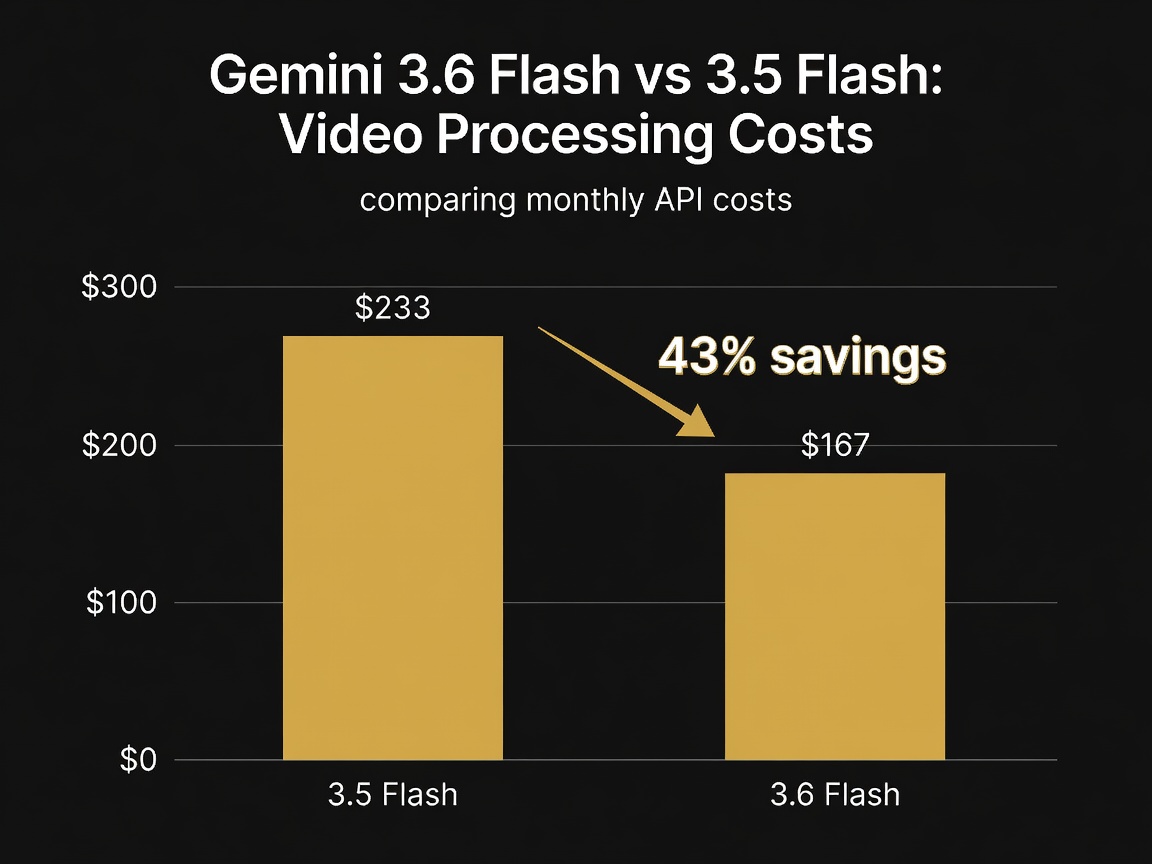
Gemini 3.6 Flash delivers a 43% cost reduction for video processing workloads through lower per-token pricing and 17% fewer output tokens. For creators processing 50 million+ tokens monthly, this saves over $100 per month.
Video Understanding Benchmarks: Where Gemini 3.6 Flash Leads
According to benchmark data from Roboflow and independent evaluations, Gemini 3.6 Flash achieves top-tier performance on video understanding tasks including spatial tracking across frames, temporal event detection, multimodal context reasoning, and audio-visual synchronization analysis.
Spatial tracking across frames. The model can follow an object through a video sequence and identify its position, movement trajectory, and interactions. This is critical for creators who need AI to catalog assets from existing footage libraries — identifying every clip where a specific person, object, or action appears across hundreds of hours of raw material.
Temporal event detection. Given a long-form video, Gemini 3.6 Flash identifies scene changes, key moments, and temporal boundaries with higher precision than 3.5 Flash. This enables automated rough-cut assembly — the model watches the raw footage, identifies the best takes, and outputs a timeline structure that feeds directly into editing tools.
Multimodal context reasoning. The model correlates what it sees, hears, and reads simultaneously. A creator can upload a video with its script file and ask the model to flag discrepancies between spoken content and visual content — catching errors that would otherwise require manual playback and verification.
Audio-visual synchronization analysis. For creators working with AI-generated lip-sync or dubbing, Gemini 3.6 Flash can analyze video input to evaluate whether the audio track matches the visual timing — a capability that previously required separate audio analysis and video analysis pipelines run through different models.
Agentic Workflows: Flash Replaces Manual Pipeline Steps
Gemini 3.6 Flash arrives with improved tool use and agentic capabilities, meaning it can execute multi-step workflows without human intervention between steps. For AI video creators, this unlocks automated pipelines that previously required custom scripting across multiple APIs.
A practical example: A YouTube creator who publishes weekly AI-generated short films can build a Gemini 3.6 Flash-driven agent that reads the script, generates scene-by-scene descriptions, calls the Runway API with those descriptions as prompts, reviews the generated clips for quality and consistency, and outputs a sequence log for final assembly in the editing software. The agent handles the full pipeline, with the creator only intervening at the final review stage.
This agentic loop is possible because Gemini 3.6 Flash can evaluate its own outputs — the video analysis capability lets it “watch” the generated clips and judge whether they match the intended prompt. If a clip fails the quality check, the model re-generates the prompt with corrections and retries, all within a single agentic trace.
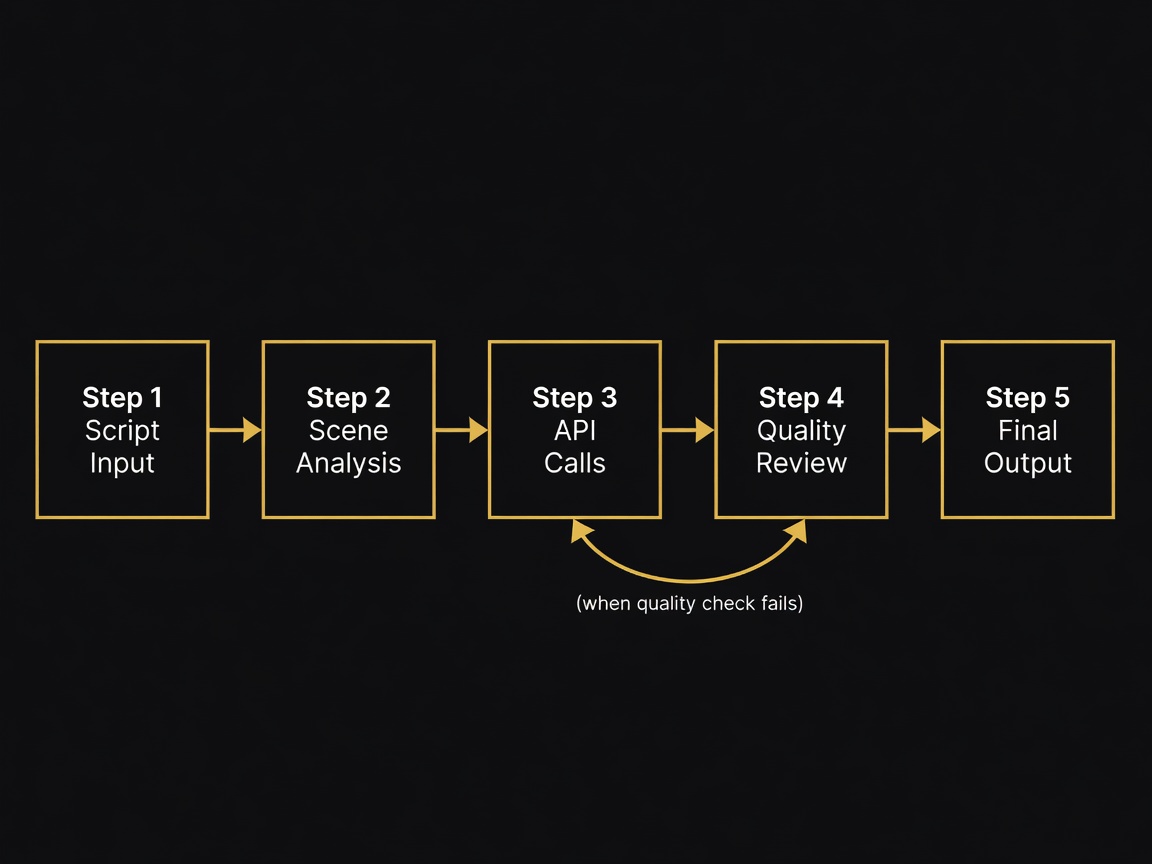
Gemini 3.6 Flash enables automated video production pipelines where a single agent handles script analysis, prompt generation, API orchestration, and quality review — reducing manual steps from six to two.
Where Gemini Omni Flash Takes Over for Generation
It is important to understand the separation between the Flash and Omni model families within Google’s ecosystem. Gemini 3.6 Flash is the fast, cost-efficient analysis model. Gemini Omni Flash, released in May-July 2026, is the video generation model. They are designed to work together.
In practice, a creator building a complete AI video production pipeline uses both: Gemini 3.6 Flash analyzes reference footage and scripts, generates optimized prompts, and checks output quality. Gemini Omni Flash generates the actual video frames based on those prompts. The two models share a common interface through the Gemini API, so routing between them is transparent to the developer.
Google has integrated Omni Flash generation into the Gemini app, Google Flow, and YouTube Shorts/Create platform. For API users, Omni Flash handles generation while 3.6 Flash handles everything else — analysis, planning, tool orchestration, and post-generation verification.
This separation matters for creators deciding which Google model to integrate into their pipeline. If your primary need is video analysis, prompt engineering, and workflow automation, Gemini 3.6 Flash is the correct choice at the correct price point. If you need native video generation, Omni Flash or third-party tools like Runway Gen-4 Turbo are your options.
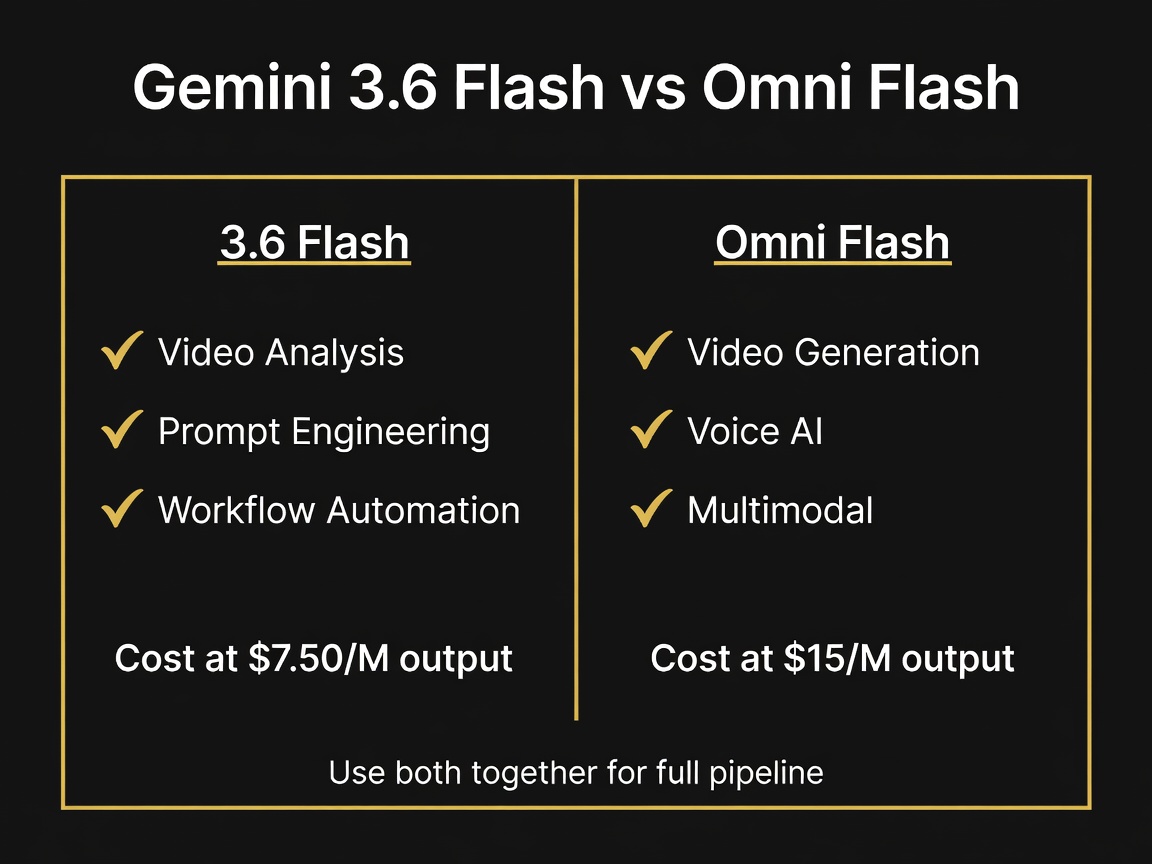
Gemini 3.6 Flash handles analysis and orchestration while Omni Flash handles generation. Most AI video production pipelines benefit from using both together.
Who Should Adopt Gemini 3.6 Flash Right Now
For US-based AI video creators, the decision to integrate Gemini 3.6 Flash depends on your current workflow:
Creators using API-driven pipelines — if your production system already calls Gemini, OpenAI, or Anthropic APIs for video analysis, prompt generation, or quality checking, the 43% cost reduction alone justifies the switch. The improved video understanding benchmarks are a bonus. Migration from 3.5 Flash requires updating the model identifier in your API calls and testing for output consistency changes.
Manual creators who write their own prompts — if you use Gemini through AI Studio or the Gemini app rather than the API, 3.6 Flash provides better video analysis in your prompt engineering workflow. Feed a sample clip into the model, ask for a frame-by-frame breakdown, and use the structured output as your generation prompt template.
Creators building automated social media pipelines — agents built on 3.6 Flash can ingest raw footage, produce platform-optimized clips, schedule posts, and monitor engagement all within a single system. The cost structure makes this viable at small scales that were previously uneconomical.
The Bottom Line
Google Gemini 3.6 Flash is not the model that generates your next viral AI video. It is the model that makes everything around that video cheaper, faster, and more accurate — the analysis pipeline, the prompt engineering, the quality control, and the workflow orchestration. For AI video creators who treat their production stack as a system rather than a collection of standalone tools, 3.6 Flash is the infrastructure upgrade worth making today.
The 43% cost reduction over 3.5 Flash at equivalent throughput, combined with superior video understanding and agentic capabilities, makes it the default choice for any video creator using Google’s API ecosystem. Pair it with Gemini Omni Flash for generation, Runway Gen-4 Turbo for high-quality output, or Seedance 2.5 for 4K resolution, and you have a complete AI video production stack that costs less than a single SaaS subscription.
Frequently Asked Questions
Can Gemini 3.6 Flash generate video?
No. Gemini 3.6 Flash is a text-output model designed for multimodal understanding and reasoning, not generation. It processes video, audio, images, and text as input and returns text-based analysis, transcriptions, descriptions, and code. Video generation is handled by the separate Gemini Omni Flash model.
How much does Gemini 3.6 Flash cost for API usage?
Gemini 3.6 Flash costs $1.50 per million input tokens and $7.50 per million output tokens. This is a 50% reduction in input pricing and a 17% reduction in output pricing compared to Gemini 3.5 Flash, making it significantly more cost-effective for high-volume video analysis workloads.
What is the context window of Gemini 3.6 Flash?
Gemini 3.6 Flash supports a 1 million token context window, matching the previous 3.5 Flash. This is sufficient to process hours of video footage, hundreds of pages of transcripts, or an entire video production script alongside reference materials in a single API call.
How does Gemini 3.6 Flash compare to Gemini Omni Flash for video work?
Gemini 3.6 Flash is optimized for fast, cost-effective video analysis, transcription, and reasoning. Gemini Omni Flash is the video generation model. They are complementary — creators typically use 3.6 Flash for pre-production analysis and prompt engineering, then Omni Flash for actual video generation in the same workflow.
Is Gemini 3.6 Flash better than 3.5 Flash for video analysis?
Yes. Gemini 3.6 Flash achieves top-tier scores on video understanding benchmarks including VantageBench and VideoNet, with significant improvements in spatial tracking across frames, temporal event detection, and audio-visual synchronization analysis compared to 3.5 Flash.
Can I use Gemini 3.6 Flash with my existing video generation tools?
Yes. Gemini 3.6 Flash can be integrated as an analysis and orchestration layer above any video generation API — Runway Gen-4, Pika, Seedance 2.5, Luma Dream Machine, or Gemini Omni Flash. The model’s agentic capabilities allow it to call external APIs, evaluate results, and iterate on prompts automatically.

About Barak Schurr
Barak Schurr is a serial entrepreneur who built and exited a major ticketing platform before turning his attention to AI and content. He runs three AI-focused research sites and writes about the tools, workflows, and strategies that let solo creators build real channels — without a crew, a studio, or a Hollywood budget. Contact: [email protected]
More AI Video Resources