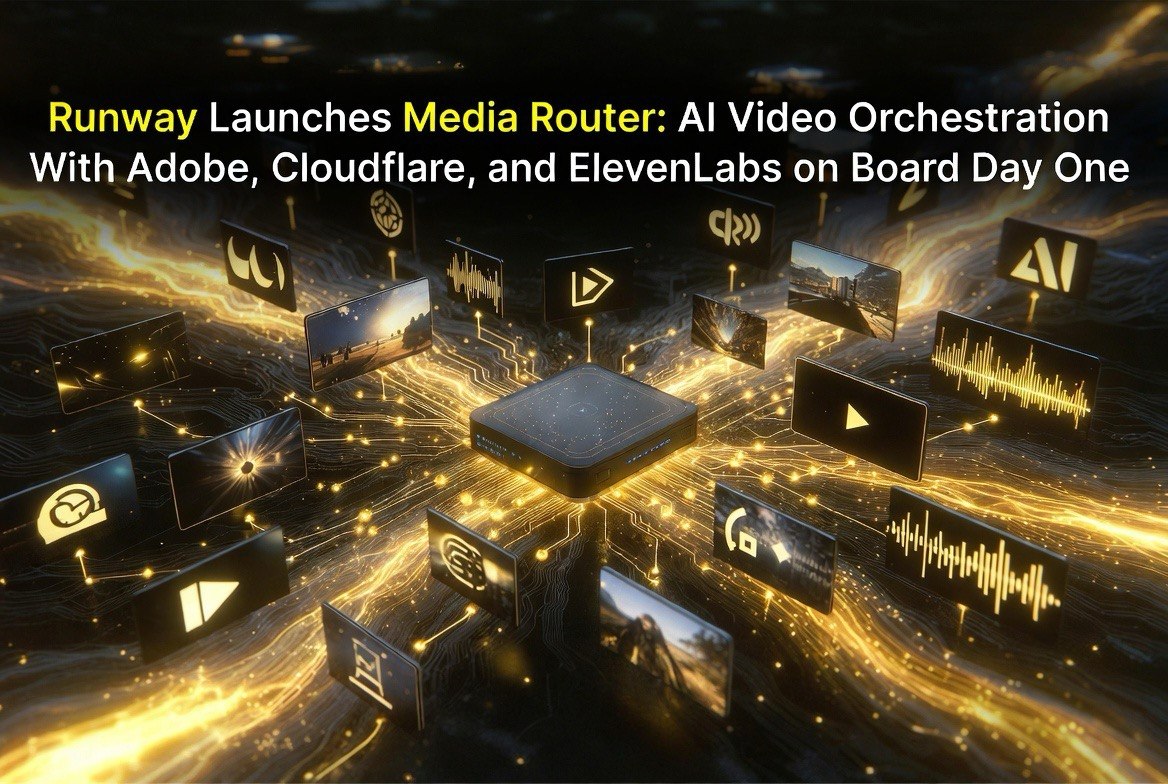
Runway Launches Media Router: AI Video Orchestration With Adobe, Cloudflare, and ElevenLabs on Board Day One
Get The Faceless YouTube Blueprint — Free
The exact AI tool stack and workflow used to build a faceless YouTube channel from zero.
Runway Launches Media Router: AI Video Orchestration With Adobe, Cloudflare, and ElevenLabs on Board Day One
⚡ Expert Summary: Runway launched Media Router on July 23, 2026 — an intelligent AI routing layer that automatically selects the best model for each generative task based on quality, speed, or cost. Instead of manually switching between AI video tools, developers connect to one API and Media Router handles model selection behind the scenes. Adobe, Cloudflare, ElevenLabs, Expedia, Shutterstock, and Quora are already using the platform. This is Runway’s bet that the future of generative media is orchestration, not just better models.
What Is Runway Media Router and Why Does It Matter?
Runway Media Router is a unified API layer launched as part of the Runway Dev platform on July 23, 2026. It functions as an intelligent routing system for generative media — when a developer sends a request, Media Router automatically selects the optimal model based on user-defined preferences for quality, speed, latency, or cost.[1]
This matters because the generative media landscape has fragmented rapidly. In 2025, a video creator needed access to Runway for video generation, ElevenLabs for audio, and Flux or Midjourney for images — each with separate APIs, billing, rate limits, and integration code. Media Router collapses that into a single API call that handles routing across Runway’s own models (Gen-4.5, Aleph 2.0, Act-Two) and third-party partners.
Think of it as the middleware layer that decides which model runs each task. If a creator prioritizes speed for a quick social media clip, Media Router picks the fastest model. If a filmmaker needs maximum quality for a commercial project, it routes to the highest-quality model. If budget is the constraint, it optimizes for cost per generation.[1]
Who Is Already Using It
The list of launch partners gives Media Router immediate credibility. These are not small startups testing a new API — they are infrastructure and platform companies that process massive volumes of media daily:
| Partner | Role | What This Means |
|---|---|---|
| Adobe | Creative suite leader | AI video generation natively available in Adobe tools through Media Router |
| Cloudflare | Edge computing / CDN | Media processing at the edge with AI routing |
| ElevenLabs | AI audio provider | Audio models available through the same routing layer |
| Expedia | Travel platform | Generative video for travel content at scale |
| Shutterstock | Stock media library | AI-generated licensed content via Media Router |
| Quora | Q&A platform | AI video generation for content creators on Poe |
The presence of both Adobe and Cloudflare signals that Media Router is being treated as infrastructure rather than consumer software. Adobe integrating Media Router means Premiere Pro and After Effects users will get AI video generation without leaving their editing environment. Cloudflare’s involvement means media routing can happen at the edge, reducing latency for end users.[1]
How Media Router Changes the Workflow for Creators
Before Media Router, a creator building an AI-generated video had to make a series of manual decisions: which model for the base video, which model for upscaling, which model for audio generation, and how to stitch everything together. Each decision meant either learning a new tool or building custom integration code.
Media Router replaces this with a preference-based system. The creator defines priorities — quality first, or speed first, or lowest cost — and Media Router picks the appropriate model for each step. If a better model becomes available next month, Media Router can route to it automatically without the creator changing anything in their workflow.
This is particularly valuable for creators who produce content regularly and cannot afford to re-evaluate the model landscape every week. The AI video model space moves fast — new models launch, pricing changes, quality improves — and keeping up manually is a full-time job. Media Router acts as a curator that adapts automatically.
What This Means for the AI Video Industry
Runway’s move is a strategic bet that the company’s long-term value is in the orchestration layer rather than any single model. This is the same playbook that Cloudflare and AWS used — build the infrastructure that everyone needs, even if they use it with your competitors.
For video creators and businesses using AI video tools, this is good news. A unified API with intelligent routing means:
- Less tool switching — One API replaces five separate integrations for video, image, and audio generation
- Automatic optimization — The router picks the best model for each task based on your specific priorities
- Future-proof integration — As new models launch, your workflow adapts without code changes
- Single billing — One provider, one bill, one rate limit to manage instead of juggling five dashboards
The position also gives Runway leverage over model providers. If a new video model launches with better quality than Runway’s Gen-4.5 at a similar price, Media Router can route to it and Runway still captures the transaction revenue. This aligns Runway’s incentives with quality and choice rather than vendor lock-in.
How to Get Started With Media Router
Media Router is available through the Runway Dev developer platform. Getting started follows a standard API onboarding flow:
- Sign up for a Runway Dev account and generate an API key
- Define your routing preferences — quality, speed, or cost optimization
- Send API requests to the Media Router endpoint with your generative task parameters
- Media Router selects the optimal model, processes the request, and returns the result
The platform supports exclusion rules as well — developers can block specific providers or model families if needed for compliance or brand safety reasons. This is particularly relevant for enterprise users who may need to avoid models trained on certain data or hosted in specific regions.
For individual creators and small studios, the value proposition is simpler: one API subscription replaces the need to maintain accounts with multiple video, image, and audio generation providers. The billing consolidation alone saves time, and the automatic model optimization ensures you are always using the best available tool for each task without research overhead.[1]
Real Scenarios Where Media Router Changes the Game
To understand why this matters beyond the technical architecture, consider three real use cases:
Use Case 1: The YouTube Creator Producing Daily Content — A creator publishing daily AI-generated shorts needs consistent quality across videos without spending hours configuring each generation. Media Router handles model selection automatically based on the creator’s quality preference. When a new video generation model launches with better lip-sync or motion consistency, Media Router can route to it without the creator changing a single line of their workflow. Over a six-month period, the creator benefits from model improvements without any research or migration effort.
Use Case 2: The Marketing Agency Managing Multiple Client Campaigns — An agency producing video assets for different clients needs different quality and cost profiles for each campaign. A low-budget social media campaign optimizes for speed and cost. A high-end brand commercial optimizes for maximum quality. Media Router applies different routing preferences per API call, so the agency manages one integration for all campaigns and the router handles model selection per task.
Use Case 3: The SaaS Platform Embedding Video Generation — A platform that adds AI video generation as a feature for its users cannot afford to hard-code model selections that become outdated in three months. Media Router provides a stable API layer while the underlying model selection adapts automatically. The platform’s integration code does not need updates when new models launch or pricing changes.
These scenarios highlight Media Router’s core value: it decouples the integration layer from the model layer, so creators and developers build once and benefit from ongoing optimization without ongoing maintenance.
How Media Router Compares to Running Models Directly
For creators who currently run AI video models directly, the comparison is straightforward:
Running models directly gives you maximum control — You choose exactly which model, with which settings, from which provider. No abstraction layer adds latency or makes decisions you disagree with. If you are an expert who knows exactly which model works best for each task and does not mind maintaining multiple accounts, direct access is better.
Media Router gives you efficiency and automation — You trade a small amount of control for significant time savings, automatic optimization, and a single billing relationship. If you produce content regularly and do not want to track the model landscape weekly, the trade-off favors Media Router.
The hybrid approach is what most creators will use — Media Router for routine production where speed and efficiency matter, direct model access for special projects where specific model features are critical. Runway Dev supports this hybrid model by allowing both routed and direct API calls through the same platform.
The launch partners tell the story: Adobe is not using Media Router because it cannot access models directly. It is using Media Router because the routing layer saves engineering resources that are better spent on creative tools than API maintenance.
What the Launch of Media Router Signals About the Industry
Runway’s shift from being primarily a model company to an infrastructure company reflects a broader maturation in the generative AI video market. The industry is moving past the phase where each vendor competes only on model quality and into a phase where distribution, integration quality, and developer experience matter as much as output quality.
Media Router positions Runway to capture value across the entire generative media ecosystem rather than only from users of its specific models. Every third-party model routed through Media Router generates revenue for Runway. Every developer who builds on Runway Dev is more likely to use Runway’s models when quality is competitive.
For creators and businesses building with AI video, this is the kind of infrastructure investment that signals a long-term platform play rather than a model-first approach that could pivot or fade. Runway is betting that its value is in being the layer beneath every generative media tool, not in being the best individual model.
FAQ
What is Runway Media Router?
Media Router is Runway’s unified API layer that automatically selects the optimal AI model for each generative task based on developer-defined preferences for quality, speed, or cost.
When was Runway Media Router launched?
Runway launched Media Router on July 23, 2026 as part of the Runway Dev developer platform.
Which companies are using Runway Media Router at launch?
Adobe, Cloudflare, ElevenLabs, Expedia, Shutterstock, and Quora are launch partners already using the Runway Dev platform with Media Router.
How does Media Router decide which AI model to use?
Developers set preferences for quality, speed, or cost. Media Router evaluates available models against these priorities and selects the best fit for each request automatically.
Does Media Router work with non-Runway models?
Yes. Media Router supports both Runway’s own models (Gen-4.5, Aleph 2.0, Act-Two) and third-party models including ElevenLabs for audio generation.

About Barak Schurr
Barak Schurr is a serial entrepreneur who built and exited a major ticketing platform before turning his attention to AI and content. He runs three AI-focused research sites and writes about the tools, workflows, and strategies that let solo creators build real channels — without a crew, a studio, or a Hollywood budget.
Email: [email protected]
More AI Video Resources